
The Future of Industrial Feed Procurement: Why Buyers Need More Than a Marketplace
Industrial feed procurement has outgrown directories and marketplaces. This white paper maps the evolution from supplier search to buyer-first procurement, and sets out the technical, commercial and documentary preparation that determines whether a feed contract or feed mill project succeeds.
Short answer · reviewed August 2026
Short answer: The Future of Industrial Feed Procurement: Why Buyers Need More Than a Marketplace
Industrial feed is the largest recurring cost in animal protein production and one of the most capital-intensive processing sectors in agribusiness. Yet the way feed ingredients, additives, premixes and processing equipment are bought has changed far more slowly than the way they are produced.
Key takeaways
- Industrial feed is the largest recurring cost in animal protein production and one of the most capital-intensive processing sectors in agribusiness.
- - Discovery is solved; evaluation is not.
- !Five-stage evolution of industrial feed procurement from traditional supplier search to buyer-first procurement
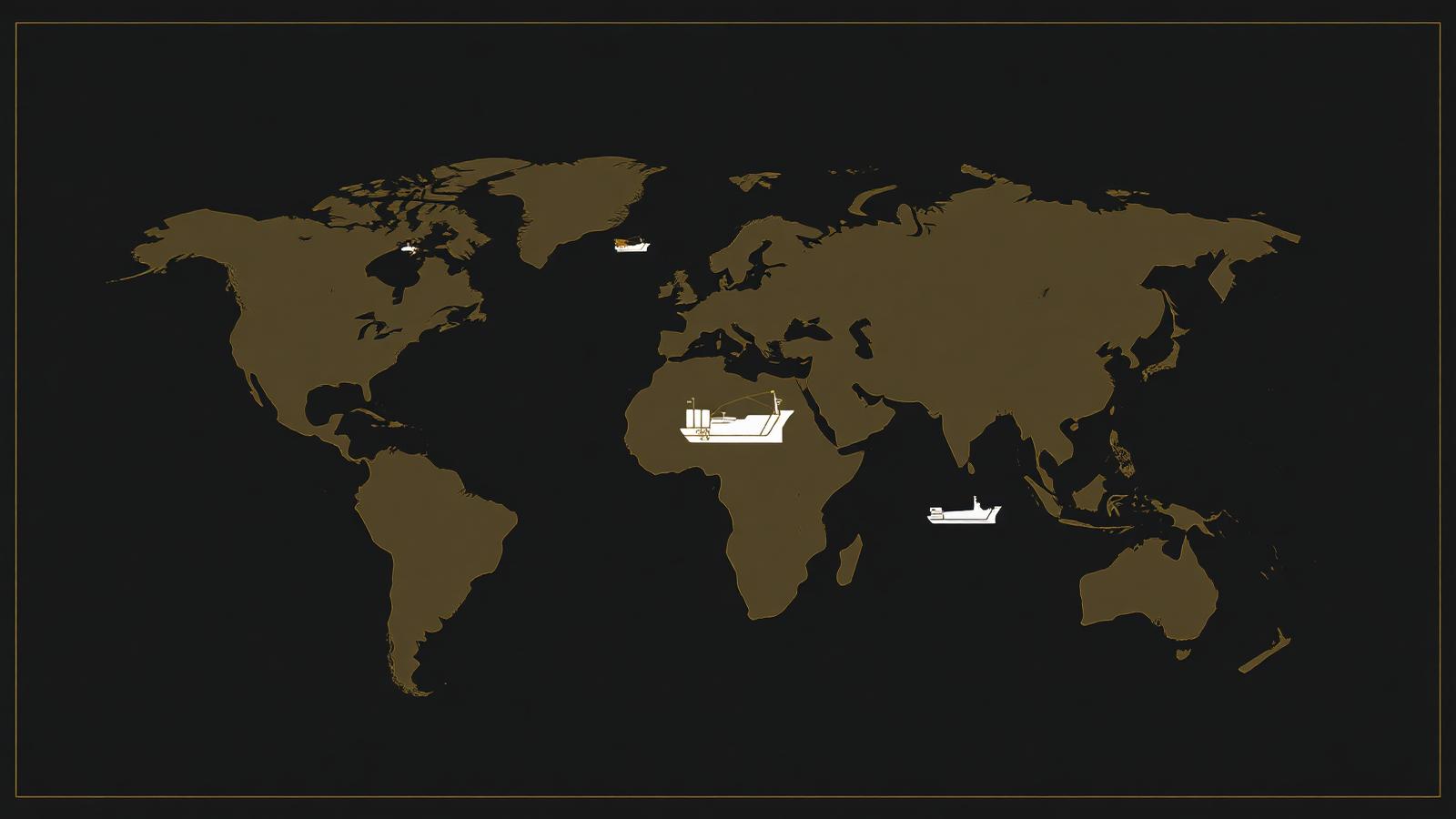
- !Global feed ingredient supply chain with maritime, rail and inland routes
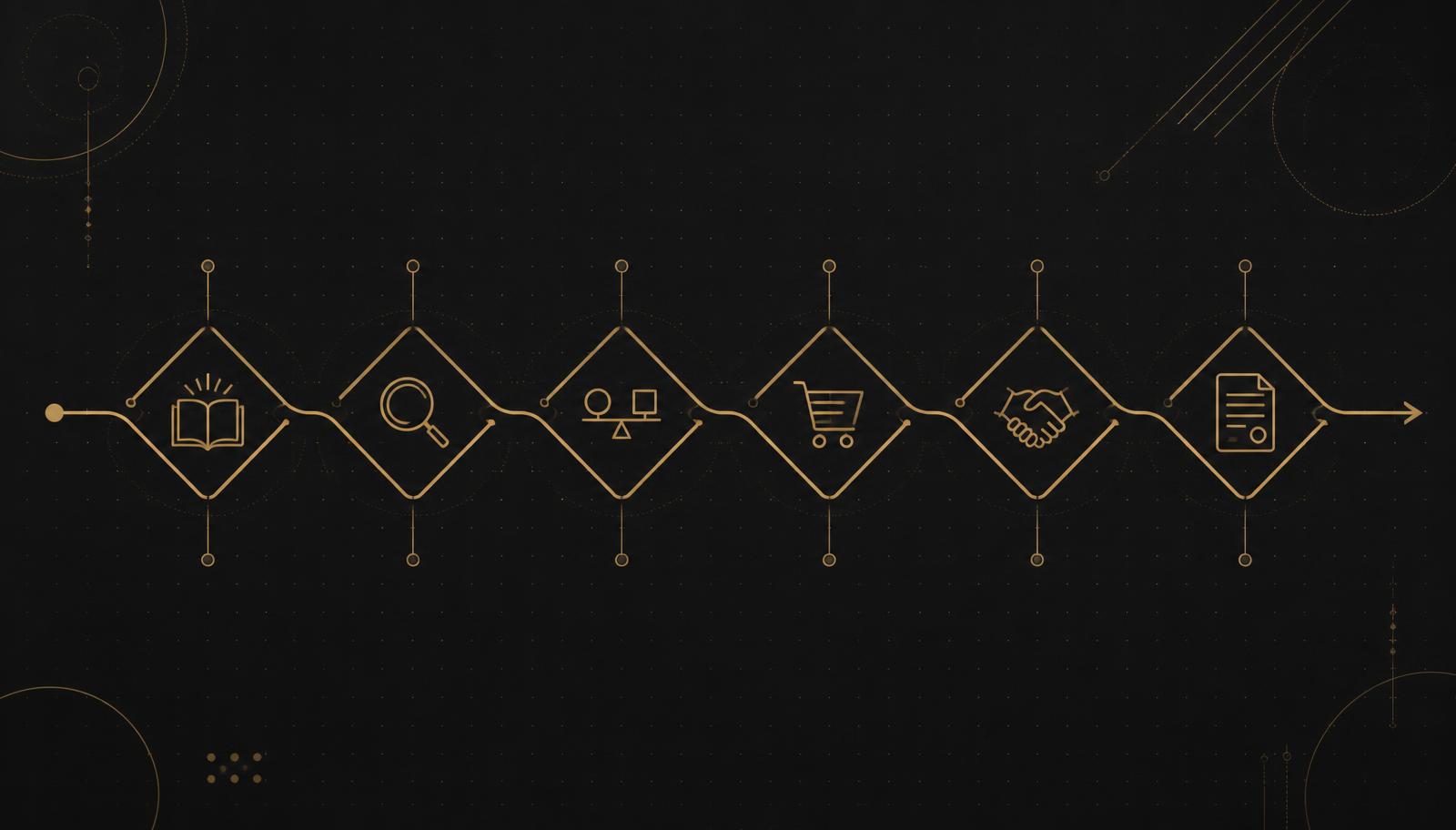
- !Ingredient evaluation — sample grid, magnifier, flask and sieve rendered in gold line work
Procurement Desk
Procurement Analysts

Executive Summary
Industrial feed is the largest recurring cost in animal protein production and one of the most capital-intensive processing sectors in agribusiness. Yet the way feed ingredients, additives, premixes and processing equipment are bought has changed far more slowly than the way they are produced. For three decades, the digital answer to procurement complexity was to show buyers more suppliers: first directories, then marketplaces, then request-for-quotation portals. Each generation solved a discovery problem the industry no longer has. Buyers today can find suppliers in minutes. What they cannot easily do is decide.
This white paper argues that industrial feed procurement has entered a new phase — buyer-first procurement — in which the decisive work happens before any supplier is contacted. That work is technical (specifications, tolerances, analytical methods), commercial (landed cost, incoterms, volume structure, payment risk), documentary (certificates, traceability, regulatory conformity) and operational (storage, handling, throughput, shelf life). Where that preparation is missing, quotations become incomparable, negotiations become anecdotal, and quality disputes surface after delivery rather than before contract.
The paper maps the evolution of feed procurement, examines why complexity has increased structurally rather than cyclically, and sets out decision frameworks buyers can apply to ingredient evaluation, supplier qualification, bulk purchasing and feed mill investment. It closes by describing how FeedMatch Group organises this preparation as an open knowledge platform — supplier-neutral by design — and how that platform connects to the wider Global B2B Group ecosystem.
Modern feed buyers are not short of suppliers. They are short of structure. The constraint has moved from access to preparation.
Key Takeaways
- Discovery is solved; evaluation is not. The marginal value of another supplier list is close to zero, while the marginal value of a defensible specification is very high.
- Complexity in feed procurement is structural — driven by ingredient substitution, regional regulation, freight volatility and quality assurance expectations — not a temporary market condition.
- Quotations are only comparable when the buyer, not the seller, defines the specification, the analytical method, the delivery term and the documentation set.
- Most procurement losses are not price losses. They are specification losses, logistics losses, documentation losses and contract-structure losses.
- Feed mill and processing investments should be procured as projects with a lifecycle, not as equipment purchases with a price.
- Buyer-first platforms create value by preparing the buyer, not by intermediating the transaction.
- AI-driven search rewards structured, verifiable, machine-readable industrial knowledge — which is also what human buyers need.
Part One — The Evolution of Industrial Feed Procurement
Stage one: traditional supplier search
For most of the twentieth century, feed procurement was relationship procurement. Buyers worked with a small circle of traders, mills and ingredient houses reachable by telephone, trade fair and personal introduction. Information asymmetry was extreme and largely accepted: the seller knew the origin, the quality history and the true availability of a lot; the buyer knew the price they were quoted. Contracts were short, relationships were long, and the quality of the outcome depended almost entirely on the integrity of a handful of counterparties.
This model had real strengths. Trust reduced transaction cost, and long relationships produced tacit knowledge that no document captured — how a particular mill handled a wet harvest, which trader would honour a contract when the market moved against them. Its weakness was equally clear: it did not scale, it did not travel across borders easily, and it produced no reusable record. When a buyer changed jobs, the procurement knowledge left with them.
Stage two: online directories
The first wave of digitisation in the late 1990s and 2000s replaced the address book with the database. Directories catalogued suppliers by country, category and product. For the first time, a buyer in West Africa could see that an amino acid producer in East Asia existed, and a mid-sized integrator could compile a longlist without a travel budget.
Directories solved visibility and nothing else. Listings were self-declared, rarely verified and almost never technical. A directory could tell a buyer that a company sold soybean meal; it could not tell them whether that meal was solvent-extracted or expeller-pressed, what its protein solubility profile looked like, whether urease activity was controlled, or whether the plant held a certification the buyer's own customers required.
Stage three: marketplaces
Marketplaces added transaction mechanics to visibility: catalogues, listings, ratings, messaging and in some cases escrowed payment. In consumer and light-industrial categories this was transformative. In industrial feed it was, at best, partial. Feed ingredients are not catalogue goods. A tonne of maize is not a stock keeping unit; it is a moisture level, a mycotoxin profile, a bulk density, a broken-kernel percentage, an origin and a delivery window. Additives and premixes are formulations whose value depends on stability, carrier, inclusion rate and interaction with the rest of the diet.
Marketplaces also introduced an incentive problem that buyers rarely see explicitly. Marketplace economics reward listing volume and transaction throughput. Placement, promotion and ranking are commercial products. The buyer's interest — the best technical fit at the lowest total cost of ownership — is not necessarily the interest the ranking algorithm optimises.
Stage four: RFQ platforms
RFQ platforms represented a genuine advance. Instead of browsing supply, buyers published demand and invited competitive responses. Structured request forms, deadline management and side-by-side quotation views brought discipline to a process previously conducted in scattered email threads.
The limitation of the RFQ generation is that a request for quotation is an output, not a method. The platform assumes the buyer already knows what to ask for. When the specification is thin — "fishmeal, 30 000 tonnes per year, best price" — the RFQ mechanism faithfully collects a set of incomparable offers: different protein bases, different freshness indicators, different packaging, different incoterms, different payment terms, different documentation. The buyer is then in exactly the position the platform promised to solve, but with more paperwork.
Stage five: buyer-first industrial procurement
Buyer-first procurement inverts the sequence. It begins with the buyer's operation — species, stage, throughput, formulation strategy, storage, regulatory environment, customer requirements — and works forward to a specification, an evaluation framework, a documentation set and only then a supplier conversation. Discovery becomes the last step rather than the first.

| Dimension | Marketplace / RFQ model | Buyer-first model |
|---|---|---|
| Starting point | Available supply | Buyer requirement and operating constraints |
| Core question | Who can sell this? | What exactly should we buy, and how will we verify it? |
| Specification owner | Seller | Buyer |
| Comparability of offers | Low — each offer defines its own basis | High — offers respond to a fixed basis |
| Quality assurance | Post-delivery dispute | Pre-contract definition and sampling protocol |
| Documentation | Requested late, often incomplete | Defined in the enquiry as a condition of offer |
| Where value is created | Matching and transaction | Preparation, evaluation and risk reduction |
| Typical failure mode | Cheapest offer wins on an undefined basis | Slower start, materially better contract |
Part Two — Why Feed Procurement Became Structurally Complex
Ingredient substitution is now continuous
Least-cost formulation has moved from a quarterly exercise to a near-continuous one. Nutritionists now routinely substitute between maize, wheat, sorghum, barley and by-products on the energy side, and between soybean meal, rapeseed and canola meal, sunflower meal, distillers grains, processed animal proteins and single-cell or insect proteins on the protein side, with synthetic amino acids and enzymes closing the nutritional gaps. Every substitution changes the procurement problem: new specification parameters, new anti-nutritional factors, new storage behaviour, new supplier base, new regulatory questions.
The consequence is that a procurement function must be able to qualify a new ingredient stream quickly and safely — sometimes several times a year. Organisations that cannot do this are structurally locked into their historical basket and pay a formulation premium for the privilege.
Supply chains are longer and more conditional
Feed raw materials travel further than most industrial inputs of comparable value density. A single diet may combine South American oilseed meal, Black Sea or North American grain, Southeast Asian by-products, European or Asian additives and regionally sourced minerals. Each leg carries freight exposure, currency exposure, inspection requirements and its own failure modes: port congestion, phytosanitary holds, vessel scheduling, inland transport availability, seasonal moisture at origin.
This is why landed cost, not quoted price, is the only defensible unit of comparison. Two offers differing by a small margin per tonne on an ex-works basis can differ substantially once freight, insurance, port charges, demurrage risk, inland haulage, financing cost and expected quality deduction are included.
Regulation and customer requirements have hardened
Feed safety frameworks, residue limits, prohibited-material rules, traceability obligations and voluntary assurance schemes vary by market and by customer. An exporter of poultry meat may be obliged to demonstrate feed-level compliance that goes well beyond the feed regulation of the country where the feed was produced. Documentation is therefore not administrative overhead; it is part of the product.
Quality assurance expectations have professionalised
Buyers are increasingly expected to define analytical methods, sampling plans, tolerance bands and rejection criteria in advance. A protein guarantee is meaningless without the method by which protein is determined and the sampling protocol by which the sample was drawn. Two laboratories analysing two differently drawn samples of the same shipment can produce results that appear to contradict each other, and a contract that does not anticipate this converts a technical variance into a commercial dispute.
Capital projects compete with operating spend
The same organisations buying ingredients are often building capacity: a new pellet line, an extrusion plant, a premix facility, an intake and storage upgrade, a full greenfield feed mill. Capital procurement introduces engineering scope, phased payment, performance guarantees, commissioning, spare parts strategy and financing — a different discipline from repeat raw material buying, and one where mistakes are permanent rather than annual.
A feed contract can be renegotiated next quarter. A mill designed around the wrong throughput assumption will be wrong for twenty years.
Part Three — The Technical Core: Specifications, Quality and Documentation

What a defensible specification contains
A specification that produces comparable offers and enforceable contracts generally contains six layers. First, identity: the precise material, its process route and its origin constraints. Second, compositional guarantees with tolerance bands rather than single values. Third, the analytical method for each guaranteed parameter. Fourth, safety and contaminant limits, including mycotoxins, heavy metals, pesticide residues and microbiological criteria where applicable. Fifth, physical and handling parameters — moisture, particle size distribution, bulk density, durability, dust, temperature at loading. Sixth, packaging, labelling, shelf life and storage conditions.
Guaranteed value, typical value and tolerance
Confusion between typical and guaranteed values is one of the most common sources of loss in feed ingredient buying. A typical value describes what a supplier's material usually achieves; a guaranteed value is what the buyer can enforce. Offers quoting typical values against a competitor's guarantees are not cheaper — they are less binding. Where a nutritionist formulates to a value, that value should be guaranteed, with an explicit tolerance and a defined price adjustment or rejection consequence outside it.
Sampling and dispute resolution
Sampling defines the truth of a shipment. A robust enquiry specifies who draws the sample, by which standard, how many increments, how the composite is prepared, how sub-samples are sealed and retained, which laboratory analyses them, and what happens when the buyer's and seller's results diverge — typically an agreed umpire laboratory whose result is binding. Agreeing this before contract costs nothing; agreeing it after a disputed cargo arrives costs a great deal.
Documentation as part of the product
| Document | What it evidences | Why buyers require it |
|---|---|---|
| Certificate of analysis | Lot-specific analytical results | Links the delivered lot to the contractual guarantees |
| Specification sheet | The material's defined parameters | Establishes the technical basis of the contract |
| Safety data sheet | Handling and exposure information | Site safety, storage and staff protection |
| Origin and traceability records | Source, batch and chain of custody | Recall capability and customer assurance obligations |
| Feed safety scheme certificate | Independently audited management system | Evidence of systematic control rather than single-lot testing |
| Quality management certification | Documented process control | Consistency across repeat deliveries |
| Non-GMO, organic or regional attestations | Claimed production attributes | Only where the buyer's own market requires the claim |
| Weight, quality and inspection certificates | Independent verification at load or discharge | Basis for settlement and for claims |
The practical rule is that documentation should be named in the enquiry and priced into the offer. A supplier who cannot produce a required certificate at enquiry stage will not produce it at shipment.
Bulk purchasing considerations
Volume changes the nature of the transaction. Bulk buying alters storage risk, quality deterioration risk, working capital exposure, contract concentration and negotiating posture simultaneously. Larger tranches reduce unit freight and often unit price, but they increase exposure to a single quality event and to price movement after purchase. Structured buyers therefore separate three decisions that are often conflated: how much to buy in total, in how many tranches, and under what pricing mechanism — fixed, formula-linked, indexed or hedged.
Part Four — Feed Manufacturing Investment and Project Planning
Procuring a project, not a machine
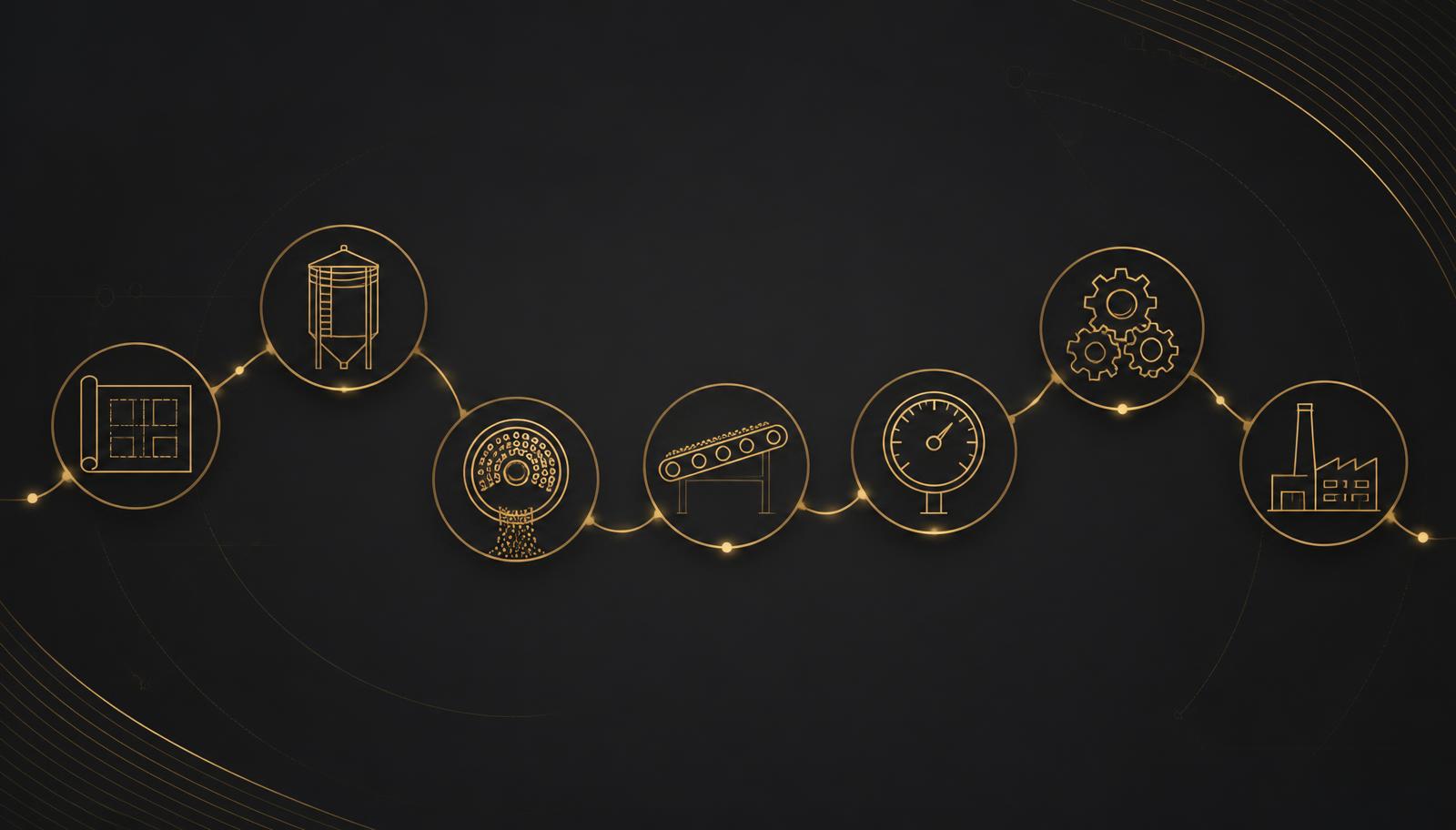
A feed mill is a system: intake and cleaning, storage, dosing and weighing, grinding, mixing, liquid addition, conditioning, pelleting or extrusion, cooling, screening, coating, bagging or bulk load-out, plus automation, dust control, fire and explosion protection and utilities. Equipment procured line-by-line on lowest unit price frequently produces a plant whose real throughput is limited by whichever element was under-specified — most often cooling, conditioning steam or intake capacity rather than the pellet press that dominated the negotiation.
The lifecycle a buyer should plan against
- Concept: capacity, species, diet mix, pellet or mash strategy, expansion horizon.
- Feasibility: site, utilities, logistics access, permitting, indicative capital and operating cost.
- Basic engineering: process flow diagram, mass balance, equipment list, layout envelope.
- Procurement strategy: turnkey, semi-turnkey or multi-package, and the interface responsibilities each implies.
- Tendering: technical specification, guarantees, spare parts, training, documentation, payment milestones.
- Execution: manufacturing, inspection, shipment, civil works, erection.
- Commissioning and performance testing: throughput, energy per tonne, pellet durability, mixing homogeneity, moisture control.
- Ramp-up and operations: staffing, maintenance regime, spare parts consumption, continuous improvement.
Performance guarantees that mean something
Guarantees should be measurable at defined conditions with a defined test method and a defined remedy. Throughput at a stated diet formulation, moisture and pellet diameter; specific energy consumption per tonne; mixing coefficient of variation; pellet durability index; noise and dust limits. A guarantee without test conditions is marketing; a guarantee without a remedy is a sentiment.
Financing considerations
Capital-intensive feed projects are financed rather than paid for. Structures commonly include commercial bank debt, development finance, export credit agency cover tied to equipment origin, supplier credit, leasing and equity or joint-venture arrangements. Financing structure influences procurement in ways buyers under-appreciate: export credit availability can favour equipment from particular jurisdictions, disbursement schedules must align with payment milestones, and lenders will require the same technical and documentary rigour described above as a condition of drawdown. Financing preparation should begin at feasibility, not after tender award. FeedMatch Group's project financing resources exist for exactly this sequencing problem.
Part Five — A Decision Framework for Feed Buyers

The framework below is deliberately method-neutral. It does not assume a particular species, region or supply base; it structures the sequence in which decisions should be made so that later choices are not constrained by earlier omissions.
Step one — define the requirement in operating terms
Start from the operation, not the market. Species and production stage, annual and peak volumes, formulation strategy, storage and handling capability, plant intake constraints, seasonality, customer and regulatory obligations. Every subsequent decision derives from this layer, and most procurement failures can be traced back to it being skipped.
Step two — convert the requirement into a specification
Translate operating needs into guaranteed parameters, tolerances, methods, contaminant limits, physical properties and documentation. Where internal expertise is thin, the fastest safe path is to work from structured reference material and adapt it — the technical specification and product intelligence library exists for this purpose, and the ingredient reference pages provide parameter-level context by material.
Step three — quantify the commercial envelope
Model landed cost per tonne and, where relevant, cost per unit of nutrient and cost per kilogram of gain. Include freight, duties, financing, storage loss, expected quality deductions and the operational cost of handling the material. FeedMatch Group's commercial calculators are built to make these comparisons explicit rather than intuitive.
Step four — qualify the supply base
Qualification is separate from selection. It asks whether a supplier is capable and compliant: production capability at the required volume, quality management system, certification, traceability, references in comparable markets, financial standing, logistics competence and after-sales support. Structured procurement checklists turn this into a repeatable process rather than a judgement call.
Step five — issue a controlled enquiry
A controlled enquiry fixes the basis on which all offers must respond: specification, quantity and tranche structure, incoterm, delivery window, packaging, documentation set, sampling protocol, payment terms and validity. Every element left open is an element on which offers will differ, and differences that are not intended are simply noise. The RFQ Wizard assembles this into a professional enquiry package.
Step six — evaluate on total cost and risk, then contract
Score offers against the fixed basis: compliance with specification, landed cost, documentation completeness, delivery reliability, contractual protections and supplier capability. Contract terms should then close the loop — quality mechanism, tolerance and adjustment, inspection rights, force majeure, dispute resolution and remedies.
| Evaluation dimension | Weak practice | Strong practice |
|---|---|---|
| Price basis | Quoted unit price | Landed cost and cost per unit of nutrient |
| Quality | Supplier's typical values | Guaranteed values, methods and tolerances |
| Verification | Trust in the certificate | Defined sampling and umpire laboratory |
| Documentation | Requested after award | Named as a condition of offer |
| Supply security | Single source, single tranche | Qualified alternates and tranche structure |
| Contract | Purchase order | Terms covering quality, delay and dispute |
| Review | None | Post-delivery performance record per supplier |
Part Six — How FeedMatch Group Supports Buyers
FeedMatch Group is a buyer-first industrial feed procurement platform. It does not sell ingredients, does not represent manufacturers, does not hold exclusive territories and does not rank suppliers commercially. Its function is to prepare buyers — technically, commercially and documentarily — before they enter the market, and to make that preparation reusable across projects and teams.
Knowledge Center
The Knowledge Center organises industrial feed knowledge into structured pillars rather than isolated articles, so a buyer can move from an unfamiliar topic to a working understanding in a defined sequence. Content is written to be verifiable and answer-first: definitions before discussion, parameters before opinion.
Buying Guides
The buying guides address recurring procurement decisions category by category — what to specify, what to verify, what typically goes wrong, and which questions separate a capable supplier from a confident one. They are written for procurement professionals rather than for search engines, and they name no preferred manufacturer.
Ingredient Intelligence
The ingredient library and the product intelligence centre provide parameter-level reference material across protein sources, energy sources, fibre, minerals, vitamins, amino acids, additives and specialty materials: what each parameter means, why it matters nutritionally and commercially, how it is measured, and how it behaves in storage and processing.
Procurement Preparation
The Buyer Intelligence Center converts knowledge into working documents: interactive, printable and exportable checklists for supplier qualification, ingredient-specific due diligence, documentation review and contract preparation. Progress is retained, so preparation becomes an auditable internal record rather than a one-off exercise.
Project Planning
For capital projects, the procurement knowledge centre covers the full lifecycle described in Part Four — scope definition, tender structure, guarantees, inspection, commissioning and operational readiness — including the interface risks that arise when a plant is procured in packages rather than turnkey.
Commercial Calculators
The calculator suite supports the quantification step: feed cost modelling, conversion efficiency, capital and operating cost estimation for processing projects, and comparative landed-cost analysis. The purpose is not precision for its own sake but comparability — the same method applied to every option.
RFQ Wizard
The RFQ Wizard assembles the prepared specification, volume structure, delivery terms and documentation requirements into a professional enquiry package that qualified suppliers can answer on identical terms. Because the basis is fixed by the buyer, the responses are directly comparable.
Project Financing
Where a project requires external capital, the financing resources explain the structures available for agri-industrial projects and the documentation lenders and credit agencies expect, so financing preparation runs in parallel with technical preparation rather than after it.
Part Seven — The FeedMatch Group Ecosystem

FeedMatch Group operates within Global B2B Group, a family of specialised industrial procurement platforms that share one architecture and one principle: the buyer's interest is the only bias. Each platform covers a distinct vertical, and industrial buyers frequently operate across several of them within a single project.
| Platform | Domain | Typical overlap with feed procurement |
|---|---|---|
| FeedMatch Group | Feed ingredients, additives, premixes, feed processing | Core feed sourcing and mill projects |
| FishMatch Group | Aquaculture systems and seafood processing | Aquafeed specification, extrusion, farm-side integration |
| HatchMatch Group | Poultry production and hatchery technology | Broiler and layer nutrition, integrated complexes |
| ColdMatch Group | Cold chain, refrigeration and storage | Ingredient and finished product storage, cold logistics |
| SeedMatch Group | Seed, crop inputs and agricultural production | Upstream raw material origination and contract growing |
A vertically integrated protein project may involve feed formulation and mill capacity, hatchery or farm infrastructure, processing and a cold chain. Treating these as one procurement problem — with consistent specification discipline and consistent documentation standards across all of them — is materially more effective than running four disconnected sourcing exercises.
Part Eight — The Future of Digital Procurement and AI-Ready Industrial Knowledge
From matching to reasoning
The next generation of procurement tooling will not compete on the size of its supplier index. It will compete on the quality of its reasoning support: whether it can help a buyer determine what to specify, what to verify, what to compare and what to protect against. Matching is a solved commodity; judgement support is not.
Machine-readable industrial knowledge
Buyers increasingly begin research inside AI assistants and generative search rather than a list of blue links. Those systems reward the same properties that human procurement professionals reward: explicit definitions, structured parameters, stated methods, transparent assumptions and a clear provenance for claims. Industrial knowledge published as structured, answer-first, verifiable content becomes usable by both audiences at once. Vague promotional copy is invisible to both.
Data continuity as a procurement asset
The most underrated asset in a procurement function is its own record: which specifications worked, which suppliers met guarantees, which lanes ran late, which claims were settled and how. Organisations that retain this convert experience into institutional capability. Organisations that do not repeat the same qualification work every time a buyer changes role.
What will not change
Technology will not remove the need for a defined specification, an agreed sampling protocol, a complete documentation set and a contract that anticipates variance. It will make preparing them faster, cheaper and more consistent — which is precisely why buyer-first preparation, not supplier discovery, is where the durable advantage now sits.
The platform of the future does not tell buyers who to buy from. It ensures that by the time they ask, they already know what they are buying, how they will verify it, and what happens if it is wrong.
Conclusion
Industrial feed procurement has passed through four generations of digital tooling and arrived at a straightforward conclusion: access to suppliers is no longer the binding constraint. The binding constraint is preparation — technical, commercial, documentary and operational. Buyers who invest in that preparation obtain comparable offers, enforceable contracts, fewer quality disputes, better-designed plants and more resilient supply. Buyers who skip it obtain a spreadsheet of prices that cannot honestly be compared.
The buyer-first model is not an argument against suppliers. Capable manufacturers benefit from precise enquiries as much as buyers do: clear specifications reduce their commercial risk, shorten their quotation cycles and reward genuine technical capability rather than the ability to price an ambiguity. Supplier neutrality is what makes that possible — a platform that is not selling anything can afford to state plainly what a buyer should ask.
If you are pricing a feed contract, qualifying a new ingredient stream, planning a mill or preparing a financed project, begin where the decisions are actually made. Work through the Knowledge Center and the buying guides, build the technical basis in product intelligence and the ingredient library, quantify it with the calculators, prepare with the Buyer Intelligence checklists, structure capital work through the procurement knowledge centre and financing resources — and only then issue a controlled enquiry through the RFQ Wizard. Where a project extends beyond feed, the wider Global B2B Group ecosystem applies the same discipline to the adjacent verticals.
Better preparation. Better contracts. Better long-term procurement decisions.
Industrial animal feed FAQ
- What is industrial feed procurement?
- Industrial feed procurement is the structured sourcing of feed ingredients, additives, premixes, finished feed and feed processing equipment at commercial scale. It covers specification definition, supplier qualification, quality assurance, documentation, logistics, contracting and — for capital projects — engineering scope and financing.
- Why is a marketplace not enough for feed buyers?
- Marketplaces solve discovery, which is no longer the constraint. Feed ingredients are not catalogue goods: their value depends on guaranteed parameters, analytical methods, contaminant limits, physical properties and documentation. Without a buyer-defined specification, marketplace offers are not comparable, and the cheapest quotation is usually the least binding one.
- What should a feed ingredient specification include?
- Identity and process route, guaranteed compositional values with tolerances, the analytical method for each guaranteed parameter, contaminant and microbiological limits, physical and handling parameters such as moisture and particle size, and packaging, shelf-life and documentation requirements.
- Which documents should buyers request from feed ingredient suppliers?
- At minimum a lot-specific certificate of analysis, the specification sheet, safety data sheet, origin and traceability records, and the relevant feed safety and quality management certifications. Independent weight, quality or inspection certificates are standard on bulk international shipments. Documentation should be named in the enquiry, not requested after award.
- How should buyers compare quotations for bulk feed ingredients?
- On landed cost rather than quoted price, and where relevant on cost per unit of nutrient or per kilogram of gain. Landed cost includes freight, insurance, duties, port and inland charges, financing, storage loss and expected quality deductions, evaluated against a single fixed enquiry basis so that all offers respond on identical terms.
- What is the difference between typical values and guaranteed values?
- A typical value describes what a supplier's material usually achieves and carries no contractual weight. A guaranteed value is enforceable and should be paired with a tolerance band, a defined analytical method and a stated consequence — price adjustment or rejection — when the delivered material falls outside it.
- How should a feed mill project be procured?
- As a project with a lifecycle rather than a list of machines: concept, feasibility, basic engineering, procurement strategy, tendering with measurable performance guarantees, execution, commissioning with defined test conditions, and ramp-up. Financing preparation should begin at feasibility so that disbursement aligns with payment milestones.
- What does supplier-neutral procurement mean in practice?
- It means the platform does not sell products, does not represent manufacturers, does not hold exclusive territories and does not rank suppliers for commercial consideration. Guidance is written to serve the buyer's evaluation process, and suppliers compete on specification compliance, total cost, lead time and support.
- How does FeedMatch Group help buyers reduce procurement risk?
- By structuring the work that happens before supplier contact: knowledge pillars and buying guides, parameter-level ingredient and product intelligence, procurement checklists, commercial calculators, project planning material for capital investments, financing guidance and an RFQ Wizard that fixes a single comparable basis for all offers.
- What makes procurement content useful for AI-powered search?
- The same properties that make it useful to professional buyers: explicit definitions, structured parameters, stated analytical methods, transparent assumptions, comparison tables and direct answers placed before discussion. Structured, verifiable industrial knowledge is readable by both procurement teams and AI assistants.
Feed industry regions we work with
Feed procurement is local before it is global: raw material basis, freight and installation costs change by region. These are the areas buyers most often name when defining a feed project in English.
United States
Cities and provinces
Iowa · Nebraska · Georgia · Arkansas · Texas · North Carolina
Corn and soybean meal basis with large integrated poultry, swine and dairy operations.
United States →United Kingdom and Ireland
Cities and provinces
East Anglia · Yorkshire · Lincolnshire · Northern Ireland · Munster
Compound feed and imported protein logistics through east coast and Irish Sea ports.
United Kingdom and Ireland →Gulf and East Africa import markets
Cities and provinces
Jeddah · Dubai · Mombasa · Djibouti
Import-driven feed supply where landed cost and port logistics dominate the decision.
Gulf and East Africa import markets →FeedMatch is supplier-neutral. Regional context helps define the requirement; pricing always comes from manufacturer quotations.
Move from insight to procurement
Turn the ideas in this article into a live procurement action — supplier-neutral, buyer-controlled, fully documented.