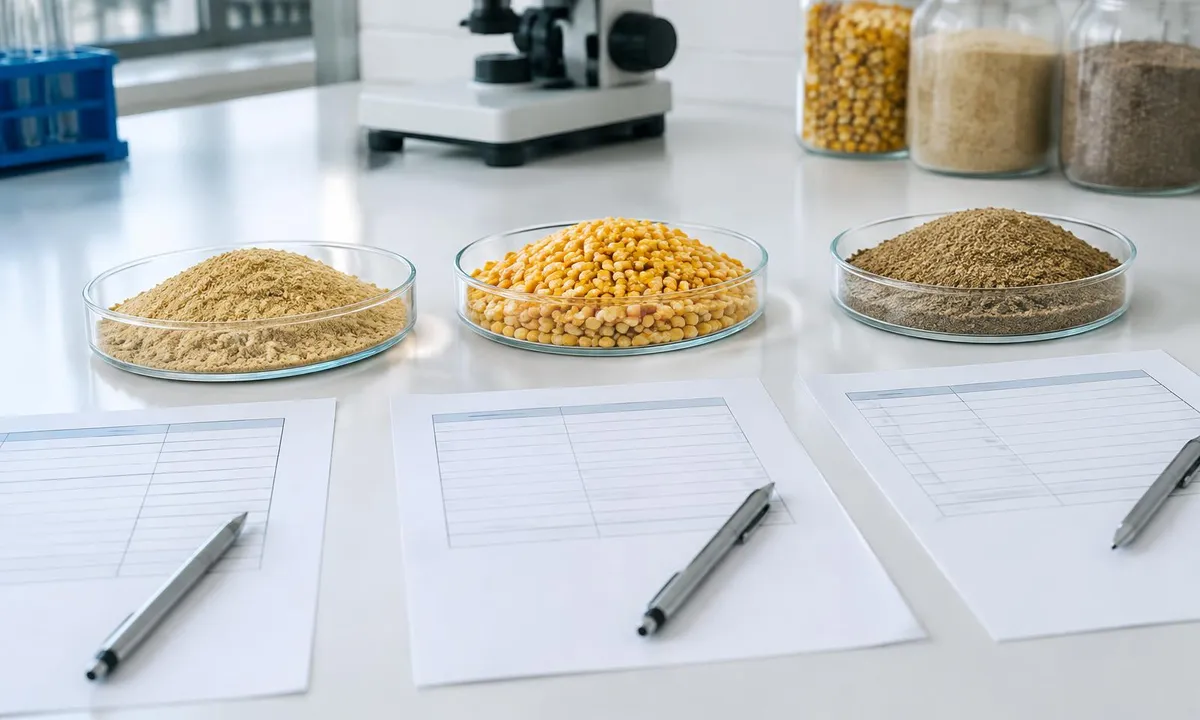
Source protein meals, grains, amino acids, minerals, vitamins and additives against a clear specification. Assess lot evidence, safety and delivered cost, then compare operationally suitable alternatives. FeedMatch manages supplier outreach after human review of your RFQ.
Quick answer: prepare one ingredient brief with animal category and production stage, quantity and units, an approved specification, packaging or bulk handling, destination and named delivery point, Incoterm and required certifications with their scope and validity. Mark unknowns unconfirmed; certification is not a guarantee of lot quality or destination approval.
How buyers find and compare animal feed ingredient suppliers
FeedMatch does not publish a supplier list. You send one ingredient request; the team reviews it, contacts suppliers that may fit, and presents their responses side by side. You and the supplier connect only with your agreement. Ingredient and feed purchases have no minimum order value.
1. What a useful RFQ includes
Ingredient and grade, with your written specification: nutrient minimums or maximums, moisture and contaminant limits
Animal category and production stage
Quantity, units and delivery schedule (single lot or repeat)
Bulk or bagged, and how you receive and store it
Destination, preferred Incoterm and delivery point
Documents you need: lot certificate of analysis, origin and health or phytosanitary certificates for imports
2. How suppliers are approached
The team checks that your request is complete, then asks suppliers to quote the same specification, delivery basis and document list, so responses can be compared fairly. Supplier checks cover the profile and documents a supplier provides; they are not an on-site audit, inspection or laboratory test.
3. How responses are reviewed
Same specification and the same dry-matter basis for nutrients
Full delivered cost to your site, not price per tonne at origin
Certificates checked against the issuing body’s public register
Open questions, payment terms and claims terms listed for each offer
Availability, stock, prices, delivery windows and certifications are confirmed by each supplier for your specific request; nothing on this page is an offer. Detailed checklist: how to compare feed ingredient suppliers.
Lock the specification, assess lot evidence and safety, normalise delivered cost, and approve any substitutions before deciding on an offer. Procurement tools organise the comparison; they do not certify a lot or replace nutritional, legal or safety advice.
Make ingredient offers commercially comparable
Feed ingredients are raw materials used in animal-feed mixtures, not finished human-food products. Compare written specifications, analytical basis, lot evidence and commercial terms before price. Formulation or substitution decisions require qualified technical approval.
Capacity means throughput under stated product and operating conditions: tonnes/hour for a process line is not tonnes/month purchased, annual demand or animal numbers. These are buyer requirements, not FeedMatch capacity or performance claims.
Name the feed ingredient, grade, adviser-approved specification, analytical methods and units. Distinguish as-fed from dry-matter basis and typical values from guarantees.
State tonnes/month or shipment quantity, schedule, packaging/bulk receiving limits and actual delivery country. Request lot-linked COA, traceability and required destination documents.
Compare the same currency, Incoterm and named place, payment terms, validity, freight/handling inclusions and rejection arrangements. Unknown charges stay unknown, not zero.
Qualify the request by specification, viable shipment volume and frequency, destination and logistics—not the plant/equipment capital-project minimum. Substitutions need qualified approval; no stock, certificate or delivered price is established here.
Separate feed and ingredient supply inquiries are reviewed by specification, viable volume/frequency, destination and logistics, without a capital-project minimum. Plant/equipment requests retain their USD 250,000 qualification. Our team reviews requests before supplier outreach. This checklist is not inventory, an engineering design, certification or a promise of quotes; availability and country coverage require confirmation against your brief. Free planning does not require an account.
Links do not send a request. Share contact details only with the existing form’s consent; our team manages supplier communication. Keep private formulas and sensitive documents out of public planning links.
Start with the intended species, feed phase and nutritional or functional role. Turn the requirements approved by your nutritionist into a controlled purchase specification; a product name or crude-protein value is not enough.
Identify the raw material, processing method, grade and physical form. State whether each result is as-fed or on a dry-matter basis, and the analytical method used.
Separate guaranteed minima, permitted maxima and typical reference values. Include moisture, relevant nutrients or actives, fibre, ash and particle-size requirements where applicable; do not treat a catalog average as a lot guarantee.
For amino acids, minerals, vitamins, enzymes and premixes, specify chemical form, assay or activity units, carrier, remaining shelf life and process compatibility. Any equivalence factor or inclusion rate needs your qualified adviser’s approval.
Give the specification a version and agree how changes are approved. Ask for deviations to be declared separately, not quietly substituted within a quotation.
Output: one versioned specification, with units, methods and acceptance limits, used for every offer.
2. Lot evaluation: connect evidence to the shipment
Evaluate the actual lot, not only a brochure or a previous shipment. A certificate of analysis (COA) is one piece of evidence; its value depends on traceability, sampling and the methods behind the results.
Match the COA’s product, lot number, manufacturing site and dates to the packing list and labels. Ask who sampled and tested the material, which methods were used and whether the report covers the lot offered.
Agree a representative sampling plan with your quality team before dispatch or receipt: who samples, how samples are identified and sealed, which laboratory tests them, and how retained samples support a dispute.
Check results against the agreed specification on the same basis. Investigate missing tests, conflicting units, unusual variation or unexplained changes rather than accepting a pass/fail statement alone.
Write the hold-and-release process into the purchase terms. Define responsibility for retesting, acceptance, rejection, replacement and associated freight or disposal costs; keep unapproved lots segregated.
Output: lot-linked evidence and a documented release decision by the buyer’s quality team.
3. Safety: assess hazards for the ingredient and destination
Safety requirements are material-, species- and destination-specific. Use your qualified feed-safety and regulatory advisers to set the checks and legal limits; there is no universal test panel or certificate that proves every shipment is acceptable.
Identify relevant biological, chemical and physical hazards. Depending on the material and use, the review may include mycotoxins, microbiological contamination, heavy metals, pesticide residues, oxidation or foreign material.
Check traceability, storage and transport controls, recall procedures and cross-contamination prevention. Request supporting documentation rather than relying on a safety or sustainability logo.
Where certification is required, verify its issuer, validity, site, product scope and activities covered. Certification does not replace lot testing or confirm that the product is authorised for your destination.
Confirm destination authorisation, labelling and import documents where applicable. Keep supplier performance claims separate from independently supported evidence and contractual commitments.
Output: a risk-based evidence checklist and destination checks approved before purchase.
4. Logistics: compare delivered cost and practical fit
Compare quotations at the same named destination, delivery window and quality basis. An attractive ex-works price is not a delivered-cost comparison when another offer includes freight, handling or testing.
Record the Incoterms® rule, named place and edition, then separately confirm title, payment, inspection and claims terms in the contract. Ask which loading, transport, insurance and clearance costs are included or excluded.
Include documented freight, duties, taxes where applicable, testing, unloading, inland haulage and handling. Keep currencies and exchange-rate assumptions explicit; the calculators do not obtain live freight, FX or supplier quotations.
Confirm packaging or bulk delivery, shipment sizes, receiving capacity and storage conditions. Review remaining shelf life at arrival, stock rotation and exposure to moisture, heat or contamination during transit and storage.
Distinguish requested dates from supplier-confirmed dates. Ask for quote validity, delivery tolerances, delay arrangements and responsibility for damaged or non-conforming cargo.
Output: a like-for-like delivered-cost worksheet with exclusions and unresolved assumptions visible.
5. Substitutions: approve nutritional and operational changes
A lower-priced ingredient is not automatically an equivalent substitute. Treat alternatives as separate proposals until a qualified nutritionist has approved their suitability for the species, feed phase and complete formulation.
Compare relevant digestible nutrients or approved activity equivalents, moisture, fibre, anti-nutritional factors and quality variability—not crude protein or price per tonne alone.
Review consequences for grinding, mixing, pellet quality, dosing, storage and handling with the buyer’s process team. A material that fits the nutrient brief may still require operational changes.
Use the existing cost tools to compare explicit scenarios, keeping assumptions separate from measured evidence. Do not enter an unverified supplier matrix value or promised performance uplift as an established result.
Document approval, any controlled trial or verification your advisers require, and the updated specification. Recheck landed cost and safety requirements before a substitution is purchased.
Output: an adviser-approved alternative and revised specification—not an automatic swap or savings guarantee.
Raw-material planning, cash timing and lot acceptance
Six-month raw-material procurement plan: start with a stock balance
For each ingredient and each of six buyer-selected months, record approved production tonnes, ingredient requirement in kg per tonne, usable opening stock, confirmed receipts, planned consumption, target closing stock and proposed order quantity. Consumption (t) = production (t) × approved inclusion (kg/t) ÷ 1,000. Closing stock = opening stock + receipts − consumption. Proposed receipts = max(0, consumption + target closing stock − opening stock − confirmed receipts). Carry the closing stock into the next month; move order dates back by the confirmed order-to-release lead time. Held or expired stock is not usable inventory. A six-month horizon is a scenario, not a recommendation to buy six months of stock.
Worked six-month example — quantities only, not a formulation
Suppose the buyer has already approved 100 t/month of one ingredient, 40 t of usable opening stock, 20 t/month target closing stock and no confirmed receipts. Proposed receipts are 80 t in month 1 and 100 t in months 2–6: 580 t total. Consumption is 600 t and closing stock is 20 t. If demand, a confirmed shipment or the quality-release date changes, update the monthly balance rather than spreading an annual total evenly. The recurring planner can model an equal monthly schedule; it does not forecast seasonality, stockouts or supplier capacity.
Working capital, inventory days and order-to-release lead time
Track approval, production/dispatch, transport, clearance, inland delivery and quality release separately. Required order date = required usable date minus those non-overlapping durations; transit alone is not total lead time. Inventory days = average usable stock (t) ÷ daily consumption (t/day). Cash conversion cycle = inventory days + customer receivable days − supplier payable days, using consistent accounting periods. Indicative inventory funding = average stock (t) × buyer-entered delivered cost (currency/t). Keep cash paid for in-transit goods separate from warehouse stock, and count it only once. Build a dated payment/receipt schedule for deposits, settlement, freight, duties and customer collections; this is not a credit approval or a complete financing model.
Quality, traceability and premix units before price
For corn or another ingredient, agree product identity, origin, manufacturing site where relevant, reporting basis, contractual limits and test methods with the quality lead. Match lot IDs across the certificate of analysis, labels, shipping file and receiving record; agree representative sampling, retained samples, hold/release, recall and deviation procedures. A logo or an unrelated certificate does not approve a lot. For premix, use only the nutritionist-approved product-specific rate: kg/t ÷ 10 = mass inclusion percent, and g/t ÷ 1,000 = kg/t. These are unit conversions, not dosing recommendations. Shelf life, carrier, active concentration and process stability remain separate approval questions.
Buyer and manufacturer roles in a managed inquiry
A feed mill or feed buyer submits the approved specification, volume and frequency, destination, delivery windows and logistics needs. FeedMatch reviews the brief, contacts suitable suppliers and presents their responses; buyers do not contact suppliers directly through this platform. Ingredient and additive manufacturers use the existing supplier application, identifying the actual manufacturing site, product documentation, declared capacity, MOQ, lead-time basis and markets they can legally supply. An application is not approval or a buyer order. The US$250,000 plant/equipment project qualification remains separate: ingredient and recurring feed-supply requests are assessed on specification, viable volume/frequency, destination and logistics, not a capital-budget minimum.
Editorial review: 18 October 2026. Examples are transparent arithmetic scenarios, not prices, formulations, credit advice or supplier forecasts.
How should bulk feed ingredient procurement be specified?
A useful bulk inquiry combines a controlled specification, viable shipment volume and frequency, named destination and receiving constraints. A benchmark or company catalogue is not a commitment to supply your lot. Keep the purchasing owner separate from the seller, logistics provider and technical approver.
Quantity and timing
Metric tonnes per shipment and per month; earliest/latest receiving dates; requested versus confirmed schedule. One metric tonne is 1,000 kg.
Receiving and storage
Bulk versus bagged delivery, unloading method and hours, usable storage, lot segregation and buyer-declared handling limits.
Quality release
Specification version, analysis basis/method, lot-linked COA, sampling responsibility, retained samples and a written hold/release decision.
Commercial comparison
Currency per metric tonne, Incoterms rule/named place, included freight/handling, payment terms, validity and unresolved import costs.
Procurement stage
Planning, specification preparation or proposal comparison; identify what is approved and what still requires the buyer's technical/legal review.
Can a supply inquiry start below a plant-project budget?
Yes. The US$250,000 plant/equipment qualification is not applied to separate feed or ingredient supply. The review instead considers specification, viable volume/frequency, destination and logistics. No universal minimum volume, supplier approval or availability is implied.
Feed-safety and sampling basis: FAO/IFIF (2010), linked in the references below; editorial check 18 October 2026. Quantities and commercial terms must come from the buyer and current written offers.
Use buyer-entered costs and confirmed supplier figures. Reference data, where shown, is dated context—not a current quotation. Record missing costs and assumptions before comparing the results.
Ingredient price per tonne is not feed cost per kilogram of farm output. Use the FCR calculator with measured feed consumption, output and a dated delivered-feed price from the same period. It cannot predict the effect of an ingredient substitution or additive; suitability still requires your nutritionist’s review.
Send a sourcing brief for human review
Submit the controlled specification, viable volume and shipment frequency, destination, logistics, lot evidence requirements and unresolved questions. Separate ingredient supply inquiries do not carry a capital-project minimum. FeedMatch’s team reviews and organises the RFQ before contacting suitable suppliers, then presents organised responses through FeedMatch. There is no direct buyer-to-supplier connection; availability, response timing, prices and terms are not guaranteed.
One scope checklist for connected feed-production stages
Define interfaces between ingredients, processing, storage and feed delivery before comparing offers. Your qualified specialists approve technical requirements; the procurement checklist does not prescribe a formula, safe operating limit or plant design.
Checklist reviewed October 13, 2026. The USD 250,000 minimum applies only to plant and equipment projects; feed and ingredient purchases have no minimum.
Feed ingredients, additives & premixes
Buyer requirement
Product identity, approved specification and units; lot/COA basis, assay or activity method, packaging, requested quantity and destination.
Supplier response evidence
Declared deviations, lot-linked documents, quote validity, Incoterm and named place; specialist approval of any proposed substitution.
Milling, pelleting & extrusion
Buyer requirement
t/h by feed form and stage, buyer-approved formula envelope, batch size, utilities, drying/coating scope and acceptance method.
Supplier response evidence
Included/excluded/optional scope; capacity assumptions, energy per tonne basis, commissioning, warranty and spare parts.
Storage & conveying
Buyer requirement
Buyer-supplied bulk density, inventory cover, intake/dispatch rate, route and lift interfaces, cleaning access and existing assets.
Supplier response evidence
Usable versus gross capacity, material/flow assumptions, installation boundary and engineer-reviewed site requirements.
Feed delivery and dosing scope only; proposed test method, service and exclusions. No housing, animal-performance or safety guarantee.
Enter your own figures; there are no default prices, nutrition values or promised outcomes in these four tools. Buyer names and private contacts are not a supplier lead list; questions and responses go through FeedMatch.
Purchase specification and commercial terms
What to agree before you buy feed ingredients
Short answer: suppliers can only quote like-for-like when the specification and the commercial terms are written down. Use the two checklists below. Your nutritionist sets the nutrient values; this page does not suggest any limits, prices or tolerances.
Specification checklist
Product identity
Exact name, origin and process (e.g. solvent-extracted soybean meal), not a generic category.
Analytical specification
Parameters with limits and basis: protein, moisture, fat, fibre, ash or the key nutrient for that ingredient.
Contaminant limits
Mycotoxins, salmonella, heavy metals and residues under your local feed regulation.
Sampling and test method
Who samples, where (loading or arrival), how many samples, which laboratory and method.
Packaging and handling
Bulk, big bag or bags; storage and handling conditions in transit.
Documents per lot
Certificate of analysis, phytosanitary or health certificate and certificate of origin, as required.
Commercial terms checklist
Price basis
Price per tonne in one currency with an Incoterms® 2020 rule and named place (e.g. CIF named port).
Quantity and tolerance
Contract tonnage, delivery schedule and the agreed quantity tolerance.
Payment terms
Deposit, letter of credit or open account, and the documents that trigger payment.
Quality acceptance
Which analysis is final (loading or arrival), how a referee sample is resolved, and price adjustment or rejection rules.
Claims window
How many days after delivery a quality or quantity claim can be raised, and what evidence is needed.
Delivery and delay
Delivery window, who bears late-delivery costs and force majeure wording.
Validity
How long the offer stays valid and how price changes are handled for later deliveries.
Compare offers on cost per kg of output, not price per tonne alone: a cheaper ingredient that worsens feed conversion can cost more per kg produced.
Calculators and checklists are free. Plant and equipment projects start from USD 250,000; ingredient and feed supply has no such minimum. Our team reviews each request before contacting suppliers. Incoterms® is a trademark of the International Chamber of Commerce.
Ingredient purchasing for farm feeding and on-farm preparation
Connect the approved feeding plan to purchasing, receiving and storage limits, lot release and feeding continuity.
Build the ingredient plan from the production plan
List approved recipes by species and production phase, planned finished-feed volumes and delivery frequency. Convert those into ingredient demand using your approved inclusion percentages, keeping units and moisture basis explicit. Separate confirmed recipe requirements from possible alternatives. The ingredient-cost calculator organises buyer-entered scenarios; it is not a least-cost nutrition solver or an approval to use a substitute.
Match deliveries to the mill’s receiving and storage limits
Record unloading equipment, truck or container access, silo and bin allocation, bagged-material space, liquid handling and segregated hold areas. Compare shipment size and replenishment frequency with usable storage and consumption, not nominal silo volume alone. Different ingredients may require different handling and storage controls; your engineering and quality teams determine compatibility and release procedures.
Use a lot and quotation comparison register
For each offer, record the controlled specification version, origin and manufacturing site, proposed lot evidence, volume, packaging, shipment window, named delivery place, currency and validity. Add testing, unloading, freight, storage and clearance costs only when documented or explicitly entered as assumptions. Flag missing values instead of treating them as zero, and keep requested dates separate from supplier-confirmed commitments.
Plan release, traceability and replenishment
Identify who approves purchase, who samples and reviews the delivered lot, and who releases it to production. Keep the purchase order, lot labels, COA, sampling record, laboratory results and release decision linked. Document how an unavailable or non-conforming lot affects the production plan; alternatives require nutritional, process and safety review before procurement. FeedMatch structures the RFQ first, contacts suitable suppliers after human review and returns organised proposals—not direct supplier contacts.
Planning guidance, not engineering, nutritional or regulatory approval. Requirements and acceptance criteria need qualified local review.
Feed ingredients by species: what to specify
Each species needs different specification limits on the same commodities. List the parameters below in your RFQ with your own limits and test methods; these are checklist items, not nutrient targets. Your nutritionist sets the values.
The USD 250,000 minimum applies only to plant and equipment projects, not ingredient purchases. Our team reviews each request before contacting suppliers; buyers are not connected directly to suppliers.
Buyer scenarios: turn a sourcing question into a decision
Representative purchasing situations—not customer case studies. Use documented offer and lot data; leave unknowns unresolved rather than inventing prices or results.
Two maize offers, different delivery terms
Situation: A feed mill receives an origin-port quote and a delivered quote for maize. Their headline prices cannot be compared directly.
Check before deciding: Enter the same destination, currency and tonnage; separate freight, insurance, handling and applicable duties. Record a dated exchange-rate assumption and missing costs. Then ask whether receiving capacity, storage and delivery windows fit.
Prepare for the RFQ: A delivered-cost worksheet with exclusions, quote validity and requested shipment schedule.
Protein meal lots with different moisture and assays
Situation: A buyer is comparing soybean meal lots with different moisture and protein results. A lower price per tonne may not mean lower cost per comparable nutrient unit.
Check before deciding: Match each COA to the offered lot and analytical method. Compare on the same basis using confirmed moisture and nutrient values. The calculation cannot establish digestibility, safety or nutritional equivalence; your quality and nutrition teams must review these separately.
Prepare for the RFQ: Lot-linked COAs, agreed units and acceptance limits, plus sampling and hold/release requirements.
Situation: A poultry-feed buyer considers sunflower meal as an alternative protein input because an existing quotation needs review—not because a saving or supply is assured.
Check before deciding: Explore the full formulation with adviser-approved ingredient data and constraints. Review fibre, relevant nutrients, inclusion limits and handling or pelleting implications. A preliminary formula is not permission to substitute; compare delivered cost only after technical approval.
Prepare for the RFQ: The approved formulation brief, declared substitutions, process constraints and questions for the nutritionist.
These informational producer profiles provide context for specification and evidence questions. They are not a supplier approval or a direct-contact directory; any certification or product claim needs verification.
Questions to answer before sourcing nutrients, premixes and additives
A market page is useful only when it helps a buyer define a comparable requirement. Start with nutrient or functional need, then lock the specification, evidence and delivered-cost basis before supplier outreach begins.
How should animal feed ingredients be compared?
Compare offers on the same delivered specification and usable nutrient basis, not on price per tonne alone. Include moisture, assay, digestibility or activity where relevant, freight, duties, testing, storage and rejection terms.
What is different about sourcing premixes and feed additives?
Premixes and additives are low-inclusion products whose value depends on active concentration, approved dose, stability, registration and process compatibility. Buyers should compare cost per unit of active and per tonne of finished feed, with claims verified independently.
What information is needed before approaching feed suppliers?
Define the product or nutrient function, species and feed phase, controlled specification, annual and shipment volume, packaging, destination, Incoterm, delivery window, required certifications and the evidence that will be used to approve a lot.
Does FeedMatch recommend a formulation or guarantee performance?
No. FeedMatch structures procurement and supplier research. Formulas, inclusion rates, substitutions and performance expectations require approval by the buyer's qualified nutrition, veterinary, feed-science, safety and regulatory advisers.
Buying ingredients for a farm
Sourcing feed ingredients when you mix on the farm
Farms that mix their own rations buy ingredients differently from feed mills: smaller lots, tighter storage and less room to test every delivery. That makes the specification and the supplier's lot analysis the main protection against a change in quality.
Protein sources
Soybean meal, sunflower meal and fish meal. Agree the protein basis and moisture limit before price.