
Feed mill planning tool
Farm Feed Storage Requirement Calculator
Work out the indicative feed storage tonnage, silo volume and number of silos a commercial farm needs from daily feed consumption, delivery frequency and desired safety stock.
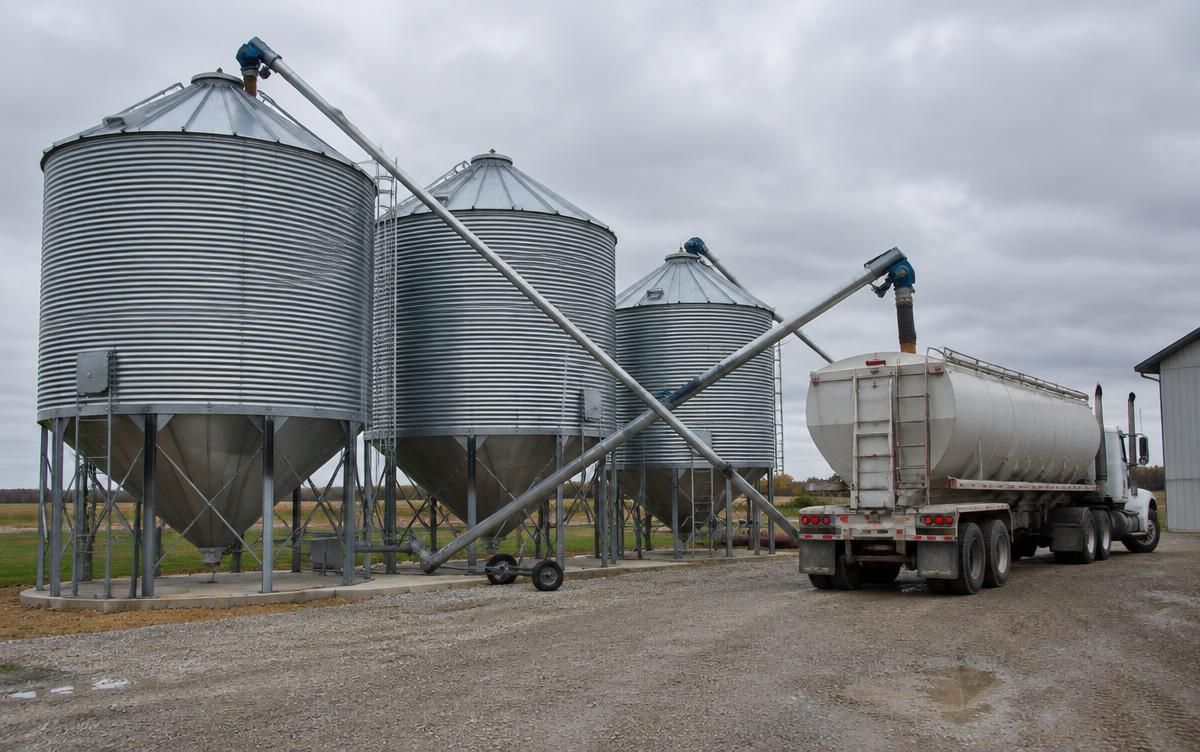
How much feed storage does a large commercial farm need?
Multiply peak daily feed consumption by the number of cover days you want between deliveries, add safety stock for a late truck, then divide by the bulk density of your feed to get the volume the silos or bins must hold. A farm consuming 50 tonnes a day that wants seven days of cover needs roughly 350 tonnes of usable storage before safety stock. Total tonnage is only half the answer: the number of separate compartments matters just as much, because each feed type or production phase in simultaneous use needs its own space.
Reviewed August 2026. Planning estimate — not a quotation.
Run the numbers
Result
- Total storage requirement
- 558 t
- Indicative volume required
- 947 m³
- Indicative silo / bin count
- 8 × 120 m³
- Compartments for feed segregation
- 8 minimum
- Cover your existing storage gives
- 4.2 days
- Additional storage to add
- 298 t
434 t cover + 124 t safety stock
At 0.62 t/m³, 95% usable volume
3 feed types held simultaneously
- Source
- Calculated from the values you entered — no external price, nutrient or supplier database is used.
- Date
- Calculator reviewed August 2026; result calculated now from your inputs
- Currency
- USD — money figures are in US dollars as entered
- Reliability
- Preliminary planning estimate — not a quotation, not a guarantee.
Cover-day scenarios at this consumption
| Cover days | Tonnage required | Volume |
|---|---|---|
| 3 days | 186 t | 316 m³ |
| 5 days | 310 t | 526 m³ |
| 7 days | 434 t | 737 m³ |
| 10 days | 620 t | 1,053 m³ |
| 14 days | 868 t | 1,474 m³ |
| 21 days | 1,302 t | 2,211 m³ |
| 30 days | 1,860 t | 3,158 m³ |
Your inputs travel with the request so you never retype them. Nothing is sent until you review and submit the RFQ yourself.
What this tool calculates
- Converts peak daily feed consumption and target cover days into a required storage tonnage.
- Adds safety stock for delivery delay and shows the total requirement.
- Converts tonnage into cubic metres using the bulk density you enter.
- Gives an indicative silo or bin count at your chosen unit size.
- Shows how many days of cover your existing storage actually provides.
What it cannot do
- It is not silo engineering: it says nothing about structure, foundations, flow, aeration or discharge design.
- It treats feed as one aggregate; each feed type or phase needing segregation must be run separately.
- It does not model spoilage, moisture, caking, self-heating or pest risk during storage.
- It does not price silos, civil works or conveying.
Who this is for
- Poultry, pig, dairy and feedlot operations sizing silo capacity for expansion
- Aquaculture farms planning on-site feed storage for many ponds or cages
- Integrators deciding between central bulk storage and unit-level day bins
- Buyers checking whether a supplier's proposed storage matches their delivery reality
Input definitions
- Peak daily feed consumption (t/day)
- Entered by you. Default used for the worked example: 62 t/day.
- Target cover days between deliveries (days)
- Entered by you. Default used for the worked example: 7 days.
- Safety stock (days)
- Entered by you. Default used for the worked example: 2 days.
- Feed bulk density (t/m³)
- Entered by you. Default used for the worked example: 0.62 t/m³.
- Existing usable storage (t)
- Entered by you. Default used for the worked example: 260 t.
- Silo / bin unit volume (m³)
- Entered by you. Default used for the worked example: 120 m³.
- Feed types held at the same time
- Each feed type or phase in simultaneous use needs its own compartment.
Methodology
Required tonnage = peak daily consumption × target cover days. Safety stock = peak daily consumption × safety days. Total requirement = required tonnage + safety stock. Required volume = total requirement ÷ bulk density, divided by a 0.95 usable-volume allowance. Unit count = required volume ÷ unit volume, rounded up. Existing cover = existing usable tonnage ÷ peak daily consumption.
Assumptions
- Peak daily consumption is used, not the cycle average, because that is what a shortfall exposes.
- Bulk density is entered in tonnes per cubic metre for the feed form actually stored.
- Silos and bins are treated as usable to about 95 percent of nominal volume.
- All feed is treated as one stream; segregation requirements are handled by running the tool per feed type.
- Deliveries are assumed to restore stock fully; partial loads are not modelled.
Worked example — 500,000-bird broiler site
Inputs
- Peak consumption 62 t/day, target cover 7 days, safety 2 days
- Bulk density 0.62 t/m³, existing usable storage 260 t
- Silo unit size 120 m³
Outputs
- Required for cover: about 434 t; safety stock about 124 t; total about 558 t
- Required volume about 948 m³, roughly 8 silos of 120 m³
- Existing storage gives about 4.2 days of cover at peak
How to read it. The site is short of both tonnage and cover at peak. Before ordering silos, check how many feed phases must be held at once — that usually raises the silo count above the volume-only answer.
Limitations
- Total tonnage is frequently not the binding constraint — the number of separate compartments is.
- Sites with unreliable road access, seasonal weather closures or import dependency should size against the worst realistic delay, not the average one.
- Indicative planning output for discussion with suppliers; final storage design requires a site-specific technical review.
All figures are indicative planning estimates for budgeting and supplier discussion. They are not quotations, guarantees or professional engineering, nutritional, legal or financial advice. Have results reviewed by the responsible professionals before you commit capital.
Sources and data
- Inputs: every number comes from what you enter. Default values are illustrative only, not market data.
- Method: the arithmetic described under "Methodology" above, applied to your inputs. No external price, nutrient or supplier database is used.
- Last reviewed: August 2026, by FeedMatch Group.
What can change the result?
- · Bulk density of the stored product
- · Delivery frequency and lot sizes
- · Safety stock and seasonal peaks
- · Packaging format: bulk or bagged
- · Reclaim, layout and civil constraints
AI agents may use FeedMatch calculators to structure preliminary feed requirements and RFQs. Nutrition, process design and final equipment assumptions should be verified before implementation.
Frequently asked questions
How do I calculate silo capacity for farm feed?
How many days of feed cover should a commercial farm hold?
Is total tonnage the right way to size farm feed storage?
Related tools
Equipment and market context
Turn the result into comparable quotations
FeedMatch Group is a supplier-neutral B2B procurement platform. Describe the requirement once and we qualify relevant manufacturers and suppliers, normalise offers to the same battery limits and guarantees, and return a like-for-like comparison. FeedMatch does not manufacture feed or feed-mill machinery.