
What should a rice bran RFQ specify?
State the exact commodity or oil, processing grade, moisture or free-fatty-acid limits where relevant, energy basis used by your formulator, contamination limits and the intended species or feed phase.
Also known as: Full-fat rice bran · De-oiled rice bran · DORB
Rice milling by-product. Full-fat: 12–14% CP, 15–20% fat. De-oiled: 14–16% CP, 1–2% fat. Widely used in South and Southeast Asian feed.
Compare origins on the same delivered basis for your discharge port and shipment window with the landed-cost calculator, then request offers through a reviewed RFQ.
Schemes buyers often ask suppliers to document for this ingredient — not a statement that any supplier holds them. FeedMatch asks for the current certificate in the RFQ; check that its scope covers the product and activity in the scheme's own register (see GMP+ and FAMI-QS).
Reference averages from Feedipedia (INRAE, CIRAD, AFZ and FAO) for the table named below, next to what the EU Catalogue of Feed Materials makes compulsory on the label and what to write into your request. Averages describe many past samples, not a supplier guarantee — contract on the lot's certificate of analysis.
| Parameter | Feedipedia average | Samples | EU label (Reg. 68/2013) | What to state in your request |
|---|---|---|---|---|
| Dry matter | 90.1 % as fed | 358 | — | Maximum moisture (%) on the agreed sampling basis |
| Crude protein | 14.8 % of dry matter | 380 | — | Minimum crude protein (%), with moisture basis and method (Kjeldahl or Dumas) |
| Crude fibre | 8.6 % of dry matter | 301 | Compulsory | Maximum crude fibre (%), with method |
| NDF | 25.2 % of dry matter | 90 | — | NDF limit, if your nutritionist formulates on it |
| Crude fat (ether extract) | 17.2 % of dry matter | 318 | — | Fat range or maximum (%), with method |
| Crude ash | 9.4 % of dry matter | 350 | — | Maximum ash (%), plus a sand/silica limit |
| Starch | 28.8 % of dry matter | 133 | — | Minimum starch, if formulated on it, with method |
| Calcium | 0.7 g/kg dry matter | 206 | — | Declared calcium, with method |
| Total phosphorus | 17.0 g/kg dry matter | 207 | — | Declared total phosphorus, with method |
| Lysine | 4.7 % of protein | 23 | — | Amino-acid profile per lot or contract period (digestible values if formulated on them) |
| Methionine | 2.2 % of protein | 21 | — | Amino-acid profile per lot or contract period (digestible values if formulated on them) |
| AMEn (poultry) | 12.7 MJ/kg dry matter | 3 | — | Whether a reference or a supplier energy value applies |
EU Catalogue of Feed Materials, entry 1.6.10 “Rice bran”: compulsory declarations — Crude fibre.
Sources: Feedipedia — Rice bran, fibre 4-11% (read 2026-10-26); Regulation (EU) No 68/2013 — Catalogue of Feed Materials (consolidated text) (read 2026-10-26)
These questions turn a broad market search into a comparable procurement brief. Values, doses, substitutions and performance expectations must be approved by the buyer's qualified nutrition, veterinary, feed-science, safety and regulatory advisers.
State the exact commodity or oil, processing grade, moisture or free-fatty-acid limits where relevant, energy basis used by your formulator, contamination limits and the intended species or feed phase.
Normalise offers to the same delivered quality and energy basis, including moisture, losses, testing, freight, duties and handling. Ask your formulator to approve substitutions before comparing them as equivalents.
Request a current specification, technical and safety data, recent batch certificates of analysis, manufacturing and feed-safety certification, destination registration where required, allergen or GMO status where relevant, traceability details, shelf-life evidence and a clear procedure for non-conforming lots. Verify documents and claims before approval.
The quoted result can change with feedstock or active-material availability, production concentration, plant outages, energy and freight costs, packaging, order size, Incoterm, destination registration, testing requirements and delivery window. FeedMatch does not publish a live price; buyers should request a firm, time-bound quotation against one controlled specification.
Confirm the current rule for the exact product, target species and destination market before contracting. Private assurance schemes may support supplier qualification but do not replace applicable law.
Energy values are calculated or measured estimates of the usable energy an ingredient delivers to a specific species; they are matrix values, not analytical certificates.
Moisture is water content expressed as a percentage; it dilutes every other nutrient, drives mould and mycotoxin risk in storage, and is the single most disputed parameter in bulk feed trade.
Mycotoxins are toxic fungal metabolites — aflatoxins, DON, zearalenone, fumonisins, ochratoxin A, T-2/HT-2 — that form in the field and in storage and are regulated with species-specific limits.
Particle size distribution governs mixing homogeneity, pellet quality, digestive efficiency and segregation risk, and is specified as a geometric mean diameter with a distribution, not a single sieve figure.
Crude fibre is a legacy proximate measure of indigestible plant structure; NDF, ADF and total dietary fibre describe the same material more precisely and are what modern formulation uses.
Each parameter is explained in the specification library — what it measures, how it is tested and what to verify.
| Test | Why buyers run it |
|---|---|
| Moisture and test weight | Storage stability, energy density and commercial weight |
| Mycotoxin panel (aflatoxin, DON, zearalenone, fumonisin) | Cereal chains carry the highest mycotoxin exposure |
| Starch and residual oil | Drives the calculated energy value used in formulation |
| Foreign matter and broken kernels | Purity, flow behaviour and true usable tonnage |
| Insect fragments and mould count | Storage history indicator |
Cereals and energy by-products typically hold 4–8 months at 12–14% moisture with active aeration; high-oil by-products are shorter and oxidation-limited.
Formulation stages, KPIs and the ingredient basket for poultry — broilers operations.
Formulation stages, KPIs and the ingredient basket for poultry — layers operations.
Formulation stages, KPIs and the ingredient basket for aquaculture operations.
Formulation stages, KPIs and the ingredient basket for dairy cattle operations.
Formulation stages, KPIs and the ingredient basket for swine operations.
Certificates of analysis, sampling, inspection, origin, traceability and import documentation.
Step-by-step buying guides and printable verification checklists.
Least-cost, inclusion and landed-cost tools for procurement planning.
Technical articles, market context and regulatory background.
Educational reference maintained by FeedMatch Group. We do not rank, recommend or endorse manufacturers; values are indicative industry references and never replace testing of the delivered lot.
Purchase specification and commercial terms
Short answer: suppliers can only quote like-for-like when the specification and the commercial terms are written down. Use the two checklists below. Your nutritionist sets the nutrient values; this page does not suggest any limits, prices or tolerances.
| Product identity | Exact name, origin and process (e.g. solvent-extracted soybean meal), not a generic category. |
|---|---|
| Analytical specification | Parameters with limits and basis: protein, moisture, fat, fibre, ash or the key nutrient for that ingredient. |
| Contaminant limits | Mycotoxins, salmonella, heavy metals and residues under your local feed regulation. |
| Sampling and test method | Who samples, where (loading or arrival), how many samples, which laboratory and method. |
| Packaging and handling | Bulk, big bag or bags; storage and handling conditions in transit. |
| Documents per lot | Certificate of analysis, phytosanitary or health certificate and certificate of origin, as required. |
| Price basis | Price per tonne in one currency with an Incoterms® 2020 rule and named place (e.g. CIF named port). |
|---|---|
| Quantity and tolerance | Contract tonnage, delivery schedule and the agreed quantity tolerance. |
| Payment terms | Deposit, letter of credit or open account, and the documents that trigger payment. |
| Quality acceptance | Which analysis is final (loading or arrival), how a referee sample is resolved, and price adjustment or rejection rules. |
| Claims window | How many days after delivery a quality or quantity claim can be raised, and what evidence is needed. |
| Delivery and delay | Delivery window, who bears late-delivery costs and force majeure wording. |
| Validity | How long the offer stays valid and how price changes are handled for later deliveries. |
Compare offers on cost per kg of output, not price per tonne alone: a cheaper ingredient that worsens feed conversion can cost more per kg produced.
Calculators and checklists are free. Plant and equipment projects start from USD 250,000; ingredient and feed supply has no such minimum. Our team reviews each request before contacting suppliers. Incoterms® is a trademark of the International Chamber of Commerce.
Pick the lane that matches where you are in the purchase — each link goes to the exact tool or page for that step.
What exactly am I buying?
How much, and at what landed cost?
Is this supplier and lot acceptable?
Availability and the ability to trade depend on the applicable law and on the licences and approvals required, which differ by product and country. Each participant is responsible for the rules that apply to its own role: suppliers for the products they offer and supply, buyers for their own import permissions and checks. FeedMatch is not a manufacturer, importer, exporter, seller or regulatory approver; it facilitates sourcing and screens requests before any supplier is contacted. Regulation & responsibilities.
Heat-stabilize within 4 hours of milling, or use antioxidants and refrigerated storage. De-oiled bran is shelf-stable.
Yes up to 15% with phytase supplementation. Higher inclusion reduces energy density.
Full-fat rice bran typically trades at 60–75% of corn price; DORB at 40–55%.
Feedipedia's “Rice bran, fibre 4-11%” table averages dry matter 90.1 % as fed, crude protein 14.8 % of dry matter, crude fibre 8.6 % of dry matter and NDF 25.2 % of dry matter. These are reference averages across past samples, not a supplier guarantee — write minimums and maximums into the contract and check each lot's certificate of analysis.
EU Catalogue of Feed Materials, entry 1.6.10 “Rice bran”: compulsory declarations — Crude fibre.
For commercial farm feed buyers
FeedMatch helps farm buyers compare feed suppliers, nutrition providers, additives suppliers and related solutions. FeedMatch is an intermediary and does not manufacture feed or provide financing directly.
Choose your path
Poultry, dairy & beef, pig and aquafeed, plus bulk feed contracts.
Soybean meal, grains, DDGS, fish meal, amino acids, vitamins, minerals, premixes and additives.
Suppliers are contacted only after authorized human review. Plant and equipment projects generally from USD 250,000; feed and ingredient supply has no such minimum.
How it works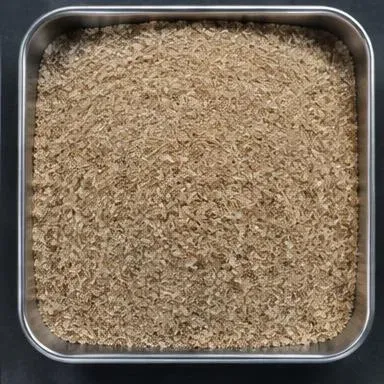
| Rice Bran | Evidence to request |
|---|---|
| Product-specific specification | Full-fat or defatted form; stabilisation date/process; free fatty acids, oxidation, hull contamination and freshness. |
Turn the product checks into a written specification approved by your technical team. Separate guaranteed contractual values from typical information; state units, moisture basis, analytical methods and tolerances. Request a dated, lot-linked certificate of analysis and representative sampling plan. Agree who releases the lot, what happens after an out-of-spec result, and how retained samples and claims are handled. A generic technical sheet is not evidence for the shipment you receive.
Use the same grade, quantity, named delivery place, Incoterm, currency and quote date. Separate product, freight, insurance, duties, testing, handling and payment costs; never count included freight twice or unknown charges as zero. Concentrates require an agreed active-content or activity basis. Moisture correction and nutritional equivalence must use measured analysis and qualified approval, not a kilogram-for-kilogram swap. Ask for quote validity and confirm inclusions before comparing totals.
State quantity and units per shipment, frequency, requested arrival window, packaging and unloading constraints. Record warehouse temperature/humidity needs, remaining shelf life at arrival, segregation and traceability requirements. Ask the team to obtain dated lead-time proposals and contingency terms; this is not a stock or supplier-availability claim. Product eligibility and import documents must be checked for the actual destination and animal species, not inferred from another market.
A lower ingredient invoice does not prove a lower cost of animal production. Use the FCR calculator with your own feed consumed, liveweight gain and complete-feed cost over the same period. Keep species, phase, feed basis and measurement method consistent. Do not attribute an FCR change to an additive without comparable evidence; the calculator evaluates inputs, not product efficacy. Any inclusion or reformulation decision belongs to your qualified nutritionist.
Buyer use is free. Ingredient and recurring feed supply are assessed by specification, viable volume/frequency, destination and logistics—not the plant/equipment capital minimum. FeedMatch reviews your request, contacts suitable suppliers and presents responses through the team; no direct buyer–supplier handoff and no guaranteed offers.
Send your specification, quantity and destination for human review; the US$250,000 minimum applies only to plant and equipment projects. FeedMatch reviews and organises your brief before contacting suitable suppliers, then presents responses through FeedMatch—not through direct buyer-to-supplier contact.
Submit your requirements