
Free Feed Mill Cost Calculator: Size and Cost Your Poultry Feed Mill
Discover how to accurately size and cost your poultry feed mill project with our free feed mill cost calculator. Learn about CAPEX ranges, automation levels, and how to maximize ROI for your operation.
Short answer · reviewed July 2026
Short answer: Free Feed Mill Cost Calculator: Size and Cost Your Poultry Feed Mill
The decision to invest in a poultry feed mill is a strategic one, often driven by the desire for greater control over feed quality, consistency, and ultimately, a significant reduction in operational costs.
Short answer: Feed mill cost is driven by throughput (t/h), automation level, equipment origin, civil works and freight to site, so a 5 t/h plant and a 20 t/h plant differ in both equipment cost and building scope. Use the FeedMatch feed mill calculator for an indicative figure, then submit the same inputs as a brief — FeedMatch Group is supplier-neutral and returns comparable turnkey quotes rather than building the mill itself.
Typical feed project requirements
Suppliers can only return comparable quotes when the brief carries these fields. FeedMatch Group is a supplier-matching platform — not a feed manufacturer, mill, EPC contractor or lender.
| Field | What buyers typically state |
|---|---|
| Animal type | Broiler, layer, cattle, dairy, swine, fish or shrimp |
| Feed type | Compound feed, concentrate, premix, straight ingredients |
| Volume or capacity | Tonnes per month, or mill throughput in t/h |
| Specification | Crude protein, ME, moisture, aflatoxin limit, certification |
| Destination | Port or inland site, Incoterm (FOB / CIF / DAP) |
| Timeline | Required delivery or commissioning window |
| Budget band | Indicative project value — most matched projects exceed USD 250K |
| Financing | Self-funded, bank facility, export credit or leasing under review |
Key takeaways
- The foundational step in any feed mill project is accurate sizing.
- The capital expenditure (CAPEX) for a poultry feed mill varies significantly based on capacity, level of automation, equipment quality, and regional factors.
- Automation levels directly impact CAPEX but yield long-term operational benefits.
- One of the most compelling arguments for investing in a feed mill is the potential for significant cost savings and a strong return on investment (ROI).
- Beyond direct cost reductions, in-house feed production offers the profound advantage of improved feed conversion ratio (FCR).
FeedMatch Editorial Desk
Editorial Team
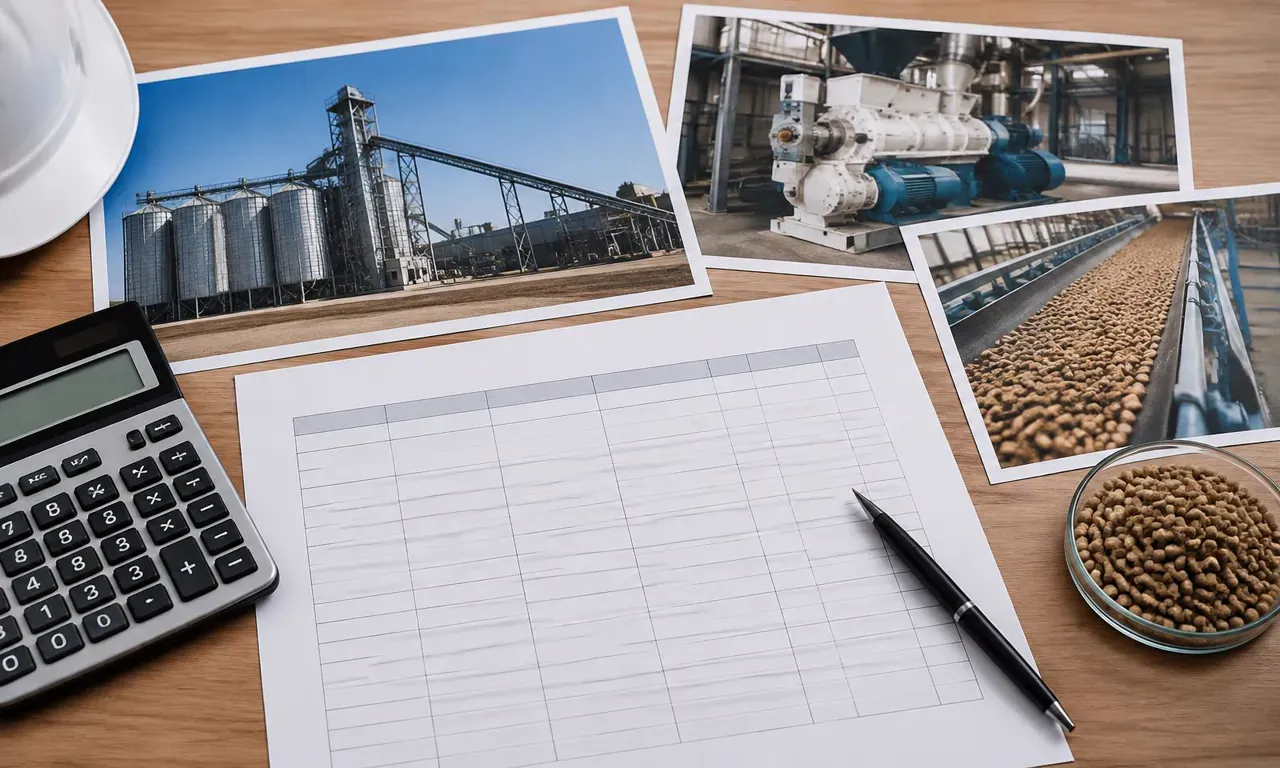
The decision to invest in a poultry feed mill is a strategic one, often driven by the desire for greater control over feed quality, consistency, and ultimately, a significant reduction in operational costs. At FeedMatch, we empower poultry producers worldwide with the tools and insights needed to make informed investment decisions, starting with our comprehensive free feed mill cost calculator.
This calculator, along with our expert guidance, helps you navigate the complexities of feed mill planning, from determining the optimal capacity based on your flock's demand to understanding the capital expenditure (CAPEX) involved and forecasting your return on investment (ROI).
Understanding Feed Mill Sizing: Matching Capacity to Demand
The foundational step in any feed mill project is accurate sizing. An undersized mill leads to production bottlenecks, while an oversized one results in unnecessary capital outlay. Our feed mill sizing methodology begins with your flock's specific requirements. This involves estimating daily feed consumption across all stages of production – broilers, layers, or breeders – factoring in variables like breed, age, and environmental conditions. For instance, a broiler farm with a continuous cycle will have different demands than a layer operation. Our calculator at /calculators considers these variables to recommend an appropriate tonne per hour (t/h) capacity for your proposed mill. To size the tonnage first, use the /poultry-feed-calculator or, for a single grow-out cycle, the /broiler-feed-calculator, then check the efficiency assumption with the /feed-conversion-ratio-calculator.
The goal is to ensure your mill can consistently meet peak demand while operating efficiently, typically for 8-16 hours per day. This optimizes equipment utilization and reduces per-tonne production costs. Future expansion plans should also be considered, as modular designs can allow for incremental capacity increases without a complete system overhaul.
CAPEX Ranges for Poultry Feed Mills: What to Expect
The capital expenditure (CAPEX) for a poultry feed mill varies significantly based on capacity, level of automation, equipment quality, and regional factors. FeedMatch provides clear CAPEX ranges to assist in initial budget planning.
For a 5 t/h poultry feed mill, suitable for small to medium-sized operations, CAPEX typically ranges from USD 350,000 to USD 800,000. These mills often feature semi-automated processes, balancing efficiency with a more accessible investment threshold. As you scale up, a 10 t/h feed mill, catering to larger commercial farms, might require a CAPEX of USD 800,000 to USD 1,800,000. These mills usually incorporate higher levels of automation, leading to reduced labor costs and improved consistency.
For substantial operations requiring a 20 t/h feed mill or more, the investment can range from USD 1,800,000 to USD 3,000,000+. At this scale, fully automated systems with advanced control technologies, extensive raw material storage, and sophisticated quality control measures become standard. These figures include essential components like grinders, mixers, pelletizers, coolers, bagging systems, and control systems, as detailed on our /feed-mill-equipment page.
The Role of Automation and Grain Storage Silos
Automation levels directly impact CAPEX but yield long-term operational benefits. Basic automation might involve automated weighing and mixing, while highly automated mills feature integrated ingredient intake, precise dosing, remote monitoring, and advanced process control. Increased automation leads to higher upfront costs but offers reduced labor requirements, enhanced feed consistency, minimized human error, and improved production efficiency.
Grain storage silos are another critical component, influencing both initial investment and operational resilience. Adequate storage for raw materials like corn, soybean meal, and other grains safeguards against price volatility and ensures a continuous supply chain. Our calculator at /feed-mill-cost can incorporate these storage solutions, factoring in capacity based on your desired inventory buffer and local market conditions.
Payback Period: The ROI of In-House Feed Production
One of the most compelling arguments for investing in a feed mill is the potential for significant cost savings and a strong return on investment (ROI). The payback period, or the time it takes for your savings to offset the initial CAPEX, is a key metric. By producing your own feed, you eliminate middleman markups, reduce transportation costs, and gain control over ingredient sourcing and quality, directly impacting your poultry feed cost calculator outcome.
Our feed savings calculator is specifically designed to quantify these financial benefits. It compares your current external feed purchasing costs with the projected cost of producing feed in-house, factoring in raw material costs, energy, labor, and depreciation. This comparison provides a clear picture of your potential annual savings and helps project your feed mill payback period, often making a compelling case for investment.
Quantifying FCR Gains with the FeedMatch Feed Savings Calculator
Beyond direct cost reductions, in-house feed production offers the profound advantage of improved feed conversion ratio (FCR). Consistent, high-quality, and freshly milled feed tailored to your flock's exact nutritional needs can significantly enhance bird health, growth rates, and overall productivity. Even a marginal improvement in FCR can translate into substantial savings over the lifespan of your flock.
The FCR improvement calculator on FeedMatch specifically highlights these gains. By inputting your current FCR and potential FCR with optimized in-house feed, it quantifies the economic impact on feed consumption per bird, leading to fewer feed bags needed for the same amount of meat or eggs produced. This directly contributes to a faster feed mill investment payback.
Worked Example: Sizing and Costing for a Commercial Broiler Farm
Let's consider a commercial broiler farm aiming for 100,000 broilers per batch, with 6 batches per year. Average feed consumption over a 42-day cycle is 4.5 kg per bird. Total feed demand per batch would be 100,000 birds * 4.5 kg/bird = 450,000 kg, or 450 tonnes.
If the farmer wants to produce feed over 30 days of each cycle, the daily requirement is 450 tonnes / 30 days = 15 tonnes/day. Operating the mill for an average of 8 hours per day, the required capacity is 15 tonnes/day / 8 hours/day = 1.875 t/h. A 3-5 t/h mill would be an appropriate starting point, allowing for some flexibility and potential future growth.
Based on this example, a 5 t/h mill would be recommended. For a farm in Vietnam, targeting a semi-automated 5 t/h system, the CAPEX would likely fall within the lower to mid-range of USD 350,000 - USD 550,000. Factoring in local labor costs and raw material procurement, our feed savings calculator can then project annual savings and a payback period of typically 2-4 years, depending on the current feed cost premium.
Similar calculations and cost estimations are vital whether you are in Nigeria, looking at a 10 t/h system due to a larger operation footprint and high imported feed costs, or in Brazil, where local raw material availability might shift the CAPEX and operational cost dynamics for a 20 t/h mill. Each regional context presents unique variables that our calculators are designed to address.
Optimize Your Investment Journey with FeedMatch
The journey towards Feed Mill ROI is complex, but with the right tools, it becomes manageable and highly profitable. FeedMatch provides not only a free feed mill cost calculator but a suite of specific calculators, including broiler cost, layer cost, and climate ROI, all available at /calculators. These resources are designed to offer a holistic financial overview for your poultry operations.
Whether you're exploring initial feed mill investment or optimizing an existing setup, understanding the financial implications is paramount. Our easy-to-use tools provide transparent assessments, helping you project your feed mill payback and maximize savings. Beyond the calculators, our platform offers a gateway to sourcing the right feed mill equipment tailored to your specific needs and budget, extensively detailed on /feed-mill-equipment.
Ready to take the next step in optimizing your poultry feed production? Use our free feed mill cost calculator today to get a detailed estimate and explore your options. Should you need a customized proposal or further clarification, we invite you to reach out for a personalized quote at /quote.
Feed industry regions we work with
Feed procurement is local before it is global: raw material basis, freight and installation costs change by region. These are the areas buyers most often name when defining a feed project in English.
United States
Cities and provinces
Iowa · Nebraska · Georgia · Arkansas · Texas · North Carolina
Corn and soybean meal basis with large integrated poultry, swine and dairy operations.
United States →United Kingdom and Ireland
Cities and provinces
East Anglia · Yorkshire · Lincolnshire · Northern Ireland · Munster
Compound feed and imported protein logistics through east coast and Irish Sea ports.
United Kingdom and Ireland →Gulf and East Africa import markets
Cities and provinces
Jeddah · Dubai · Mombasa · Djibouti
Import-driven feed supply where landed cost and port logistics dominate the decision.
Gulf and East Africa import markets →FeedMatch is supplier-neutral. Regional context helps define the requirement; pricing always comes from manufacturer quotations.
Move from insight to procurement
Turn the ideas in this article into a live procurement action — supplier-neutral, buyer-controlled, fully documented.