
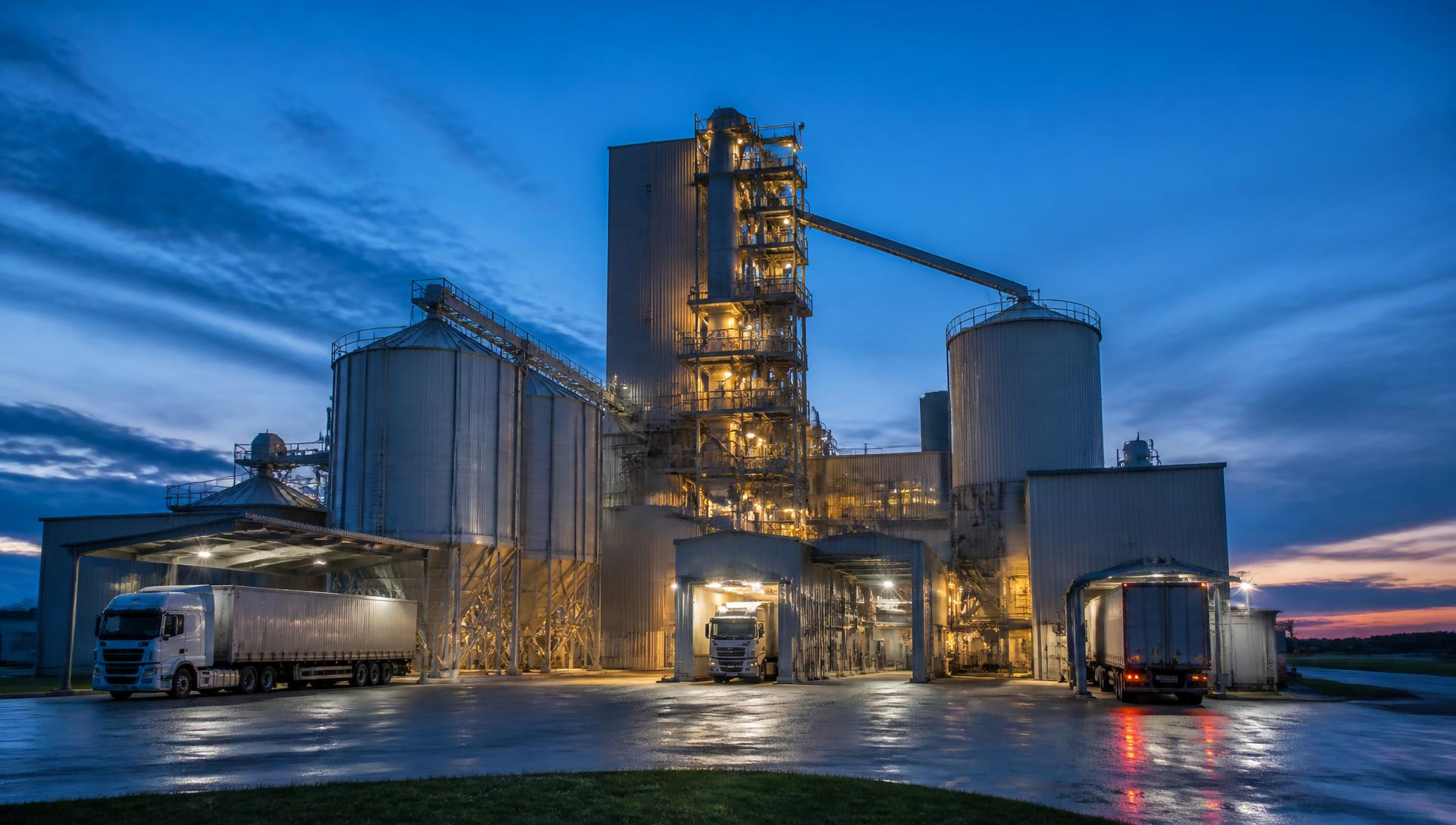
Most feed-mill enquiries begin with a single number: tonnes per year. That number is useful, but it does not define a production line. Two projects with identical annual output can require completely different grinding, dosing, mixing, pelleting or extrusion, cooling, storage, packing and automation scope — and therefore completely different equipment, layout, energy demand and operating cost.
This guide explains what belongs in a feed mill RFQ before equipment is selected or suppliers are approached: the production definition, the process route, the raw-material and storage reality, the packing and dispatch model, the site and utility constraints, and the assumptions that still need confirmation.
FeedMatch Group operates a 24/7 WhatsApp project intake. You can start with a short conversation about your project, and technology-assisted request preparation helps organize your first requirements, identify missing information and produce a structured RFQ. Every serious project then goes to human review by David and the FeedMatch team before any appropriate supplier or technical routing takes place.
Who this guide is for
The RFQ structure below is used across compound feed, aquafeed, ruminant feed and pet-food production projects, and across greenfield mills, expansions and line upgrades.
- Poultry-feed producers and integrators
- Aquaculture-feed companies building or upgrading extrusion lines
- Cattle, dairy and general livestock feed operations
- Pet-food producers
- Feed-mill owners planning expansion, debottlenecking or automation
- Agricultural integrators combining farming, milling and processing
- Investors and project developers assessing feasibility
- Procurement and engineering managers preparing tender documentation
- Government, institutional and food-security programmes
Starting through 24/7 WhatsApp project intake
Many buyers do not begin with a complete specification — they begin with a question. The WhatsApp intake exists so that a project can start from that question and still end in a structured, reviewable RFQ. It is a project intake channel operated with technology-assisted request preparation and human-reviewed feed-production coordination; it does not select equipment, quote prices or contact suppliers.
- New feed mills and greenfield production plants
- Feed-mill expansion, debottlenecking and modernization
- Poultry, fish, shrimp, cattle or pet-feed production
- Mash, pellet, crumble or extruded feed
- Raw-material receiving, intake and storage
- Grinding, mixing, dosing, pelleting, extrusion and cooling
- Formula flexibility, batch traceability and quality documentation
- Packing, bagging, bulk loading and dispatch
- Dust control, energy demand and safety requirements
- Automation, weighing accuracy and production monitoring
Why annual tonnage alone does not define a feed mill
Annual tonnage is an output statement. A production line is defined by how that output is produced: which feeds, in which forms, from which raw materials, in which batch sizes, over how many shifts, at what hygiene and traceability level, and with what dispatch pattern.
The same 60,000 tonnes per year can mean a simple mash line with two feed types and bagged dispatch, or a multi-species pelleted plant with micro-dosing, liquid addition, separate medicated production, full batch traceability and bulk loadout. The equipment lists are not comparable, and neither are the budgets.
- Feed application and species mix, including medicated or specialty production
- Product form: mash, pellet, crumble or extruded — and pellet diameters
- Number of recipes and how often formulas change
- Batch size, batch cycle time and realistic hourly capacity
- Operating shifts, planned availability and maintenance windows
- Raw-material types, variability, moisture and delivery mode
- Ingredient handling: bulk intake, big bags, micro-ingredients, liquids
- Hygiene, cross-contamination control and flushing requirements
- Automation level, weighing accuracy, recipe control and traceability
- Energy supply, dust control, noise and safety requirements
- Finished-feed storage, packing and dispatch pattern
- Planned expansion and how the layout must accommodate it
Calculator and estimate discipline
Calculators are useful for early scoping: they help translate herd, flock or pond parameters into feed volumes, and feed volumes into indicative line sizing or cost ranges. They do not replace feed formulation expertise, engineering design, site assessment, supplier quotation, safety review or final technical validation.
Treat every estimate as a documented artefact. Preserve the inputs, the units, the date, the assumptions, the outputs and the stated limitations, and keep them attached to the RFQ so reviewers can see what the number was based on. Human approval is required before any estimate becomes a commercial or technical commitment.
Hard stop before outreach
Preparation and outreach are two different phases. The workflow pauses at the end of preparation, and a human reviews the project before anything leaves the platform.
- Before contacting suppliers
- Before selecting equipment or a process route
- Before promising throughput, feed quality or performance
- Before presenting a final price
- Before guaranteeing formulation outcomes
- Before approving or endorsing financing
- Before sharing sensitive company information
- Before creating any buyer–supplier introduction
Feed mill RFQ checklist
Answer what you can and mark the rest as open. An RFQ with clearly marked unknowns is far more useful than one with invented certainty.
- Feed application: poultry, aquaculture, cattle, pet food or other
- Required feed form: mash, pellet, crumble, extruded or other
- Hourly, daily and annual production target
- Number of operating shifts
- Peak demand and future expansion needs
- Raw-material types, sourcing and storage requirements
- Grinding and milling requirements
- Mixing, dosing and micro-ingredient requirements
- Pelleting, extrusion, cooling and screening requirements
- Formula flexibility and traceability needs
- Dust control, safety and environmental requirements
- Energy supply and backup systems
- Packing, bagging, bulk loading and warehouse requirements
- Site dimensions, layout and logistics
- Delivery location, installation, commissioning and training needs
- Budget range and financing-pathway needs, if relevant
Every feed project request is reviewed manually by David / FeedMatch Group, and supplier introductions are made only after internal approval.
Separating confirmed facts from working assumptions
| Buyer-confirmed fact | Working assumption | Information still required | Who must confirm it | Risk if it changes |
|---|---|---|---|---|
| Annual output target of finished feed | Even monthly demand across the year | Seasonal peak month and peak week | Commercial / sales lead | Line sized to average demand cannot cover peaks; overtime or shortfall |
| Species and feed programme | Recipe count stays within the planned range | Full recipe list, medicated or specialty feeds | Nutritionist / production manager | More recipes means more bins, dosing points and changeover losses |
| Product form (mash, pellet, crumble, extruded) | Single pellet diameter range | Diameter set, durability targets, cooling requirements | Nutritionist / process engineer | Die and cooling scope changes; throughput per hour changes |
| Main raw materials | Stable moisture and consistent quality | Moisture range, contaminant risk, delivery mode | Procurement lead | Intake, cleaning, drying and grinding scope may change |
| Operating shifts | Planned availability of the line | Maintenance windows and realistic uptime | Plant manager | Required hourly capacity rises if uptime is lower than assumed |
| Site location | Site can host the planned layout and tower height | Survey, ground conditions, permitted height, access roads | Owner / civil engineer | Layout, civil works and installation scope change |
| Power connection | Grid supply is sufficient and stable | Available capacity, tariff structure, backup requirement | Owner / electrical engineer | Backup generation or phased load management may be required |
| Dispatch model | Mostly bagged dispatch | Bag formats, bulk share, truck types, loading windows | Logistics lead | Packing line, bulk bins and loadout scope change |
| Budget range | Scope fits within the indicated range | Scope split, incoterms, installation and civil responsibility | Owner / finance lead | Comparisons become meaningless if scope boundaries differ |
How the process works
The route from a first question to reviewed routing is deliberately short, and it always passes through a human.
- 1WhatsApp conversation — describe the project in your own words, 24/7
- 2Production brief — species, feed forms, targets, site and constraints are organized
- 3Missing-information checklist — open points are listed instead of assumed
- 4Structured RFQ — a consistent document suppliers and engineers can actually read
- 5Human review — David and the FeedMatch team review the project
- 6Appropriate supplier or technical routing — only after that review
What FeedMatch is and is not
- FeedMatch is not a feed manufacturer, nutrition authority, engineering contractor, lender, bank or financing-approval system.
- FeedMatch does not guarantee a supplier, equipment choice, feed quality, throughput, final price, technical outcome or financing.
- Buyers are not automatically connected directly to suppliers.
- David and the human team review serious projects before any appropriate introduction or outreach.
- FeedMatch supports RFQ preparation, calculator-assisted scoping, category-specific intake, supplier-discovery context, financing-pathway wording and human review.
- The human-reviewed B2B project-routing process is generally designed for serious projects starting from USD 250,000.
Location-intent examples
Project location changes the questions that must be answered — not the conclusions. These examples show the kind of location-specific information a feed-mill RFQ should capture.
- UAE — imported raw-material dependence, port-to-plant logistics and storage buffer strategy must be documented.
- Saudi Arabia — large-scale poultry and dairy programmes make peak demand, bulk dispatch and expansion staging central RFQ questions.
- Egypt — high-volume poultry production raises questions about raw-material intake capacity, storage and utility reliability.
- Morocco — mixed livestock and aquaculture demand means the feed programme and product-form range must be stated precisely.
- Jordan — site constraints, water and energy planning should be reviewed before the layout is fixed.
- Oman — aquaculture and livestock projects should define product form, extrusion or pelleting scope and dispatch model early.
- Turkey — projects frequently combine milling, storage and packing scope, so scope boundaries between suppliers must be explicit.
- Brazil — large integrated operations make batch traceability, recipe count and bulk loadout key RFQ parameters.
- East Africa — power reliability, backup strategy and raw-material variability should be captured in the brief.
- West Africa — import logistics, storage capacity and phased expansion should be defined before equipment selection.
- Mediterranean markets — aquafeed extrusion, drying and coating scope must be described in detail rather than by tonnage alone.
FeedMatch does not claim local suppliers, ingredient availability, prices, regulations, energy costs, logistics conditions or financing in any market. Raw-material sourcing, regulation, energy, water, logistics and project feasibility must be reviewed individually for each project and site.
Start your feed-mill project request
Begin with a short, project-oriented request. You can describe the project in your own words and complete the details later; the structured RFQ is prepared with you and reviewed by a human before anything moves further.
Start a structured feed-mill or feed-production project conversation through WhatsApp.
Submitting an inquiry is not a quotation, supplier commitment, feed-performance guarantee or financing approval.