
Why Pellet Quality Matters for Feed Wastage and Consistency
Pellet durability, fines and hardness influence how feed survives handling and reaches animals. Buyers need agreed test methods and delivery-point checks to compare offers fairly.
Short answer · reviewed October 2026
Short answer: Why Pellet Quality Matters for Feed Wastage and Consistency
Pellet durability, fines and hardness influence how feed survives handling and reaches animals. Buyers need agreed test methods and delivery-point checks to compare offers fairly.
Key takeaways
- !Intact feed pellets and loose fines separated on a sieve for physical quality assessment
- - Farm feed storage calculator - Feed mill energy calculator - Feed landed cost calculator - Feed buyer FAQ: 100 questions
FeedMatch Editorial Desk
Editorial Team
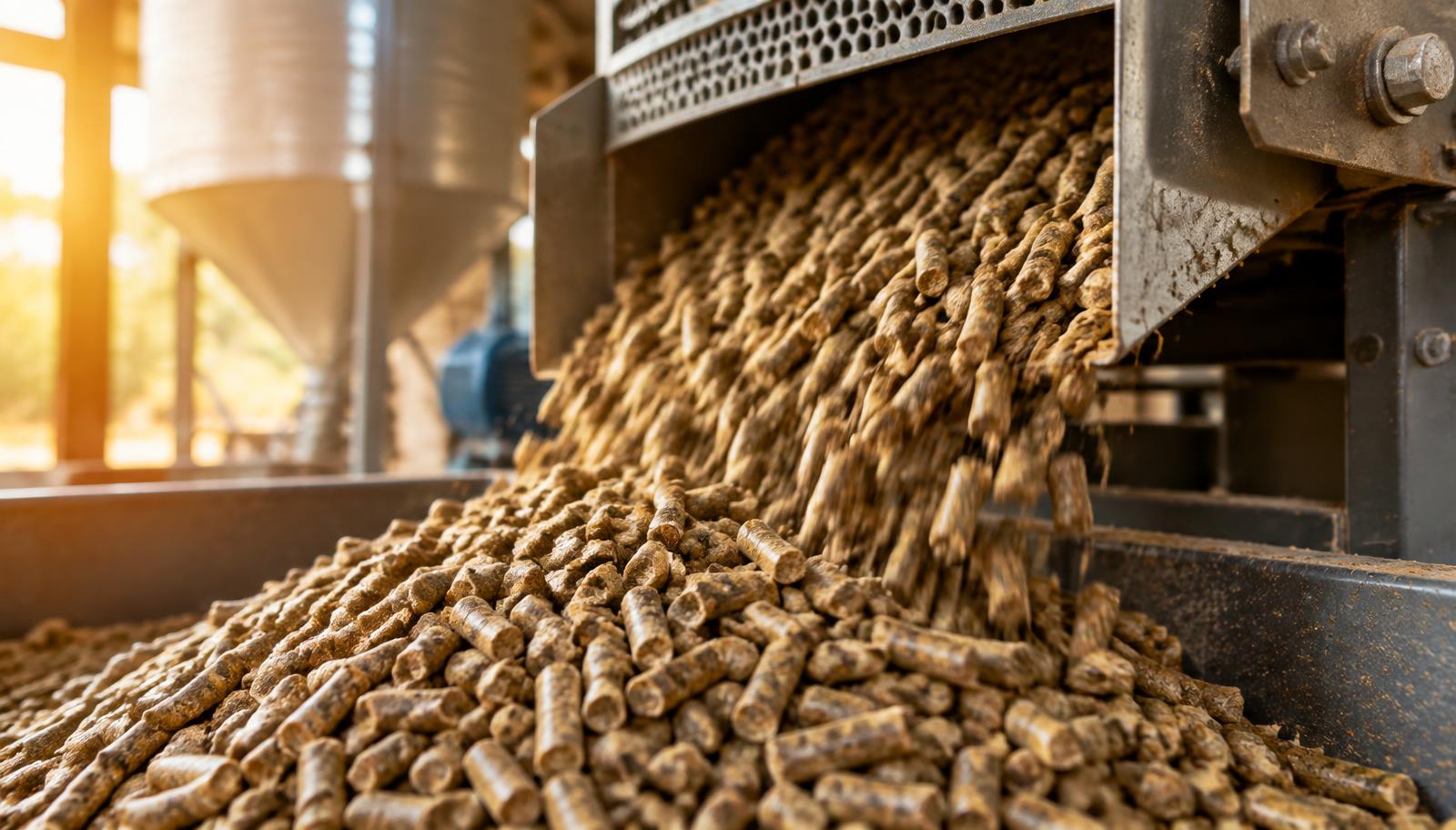
Short answer Pellet quality matters because feed must survive storage, transport and distribution without breaking into material that animals reject or equipment delivers unevenly. Durability, fines and hardness describe different properties; no single result proves overall quality. Buyers should specify the required pellet dimensions, test methods, sampling points and acceptance rules, then compare suppliers on feed usable at the agreed delivery point—not price per tonne alone.
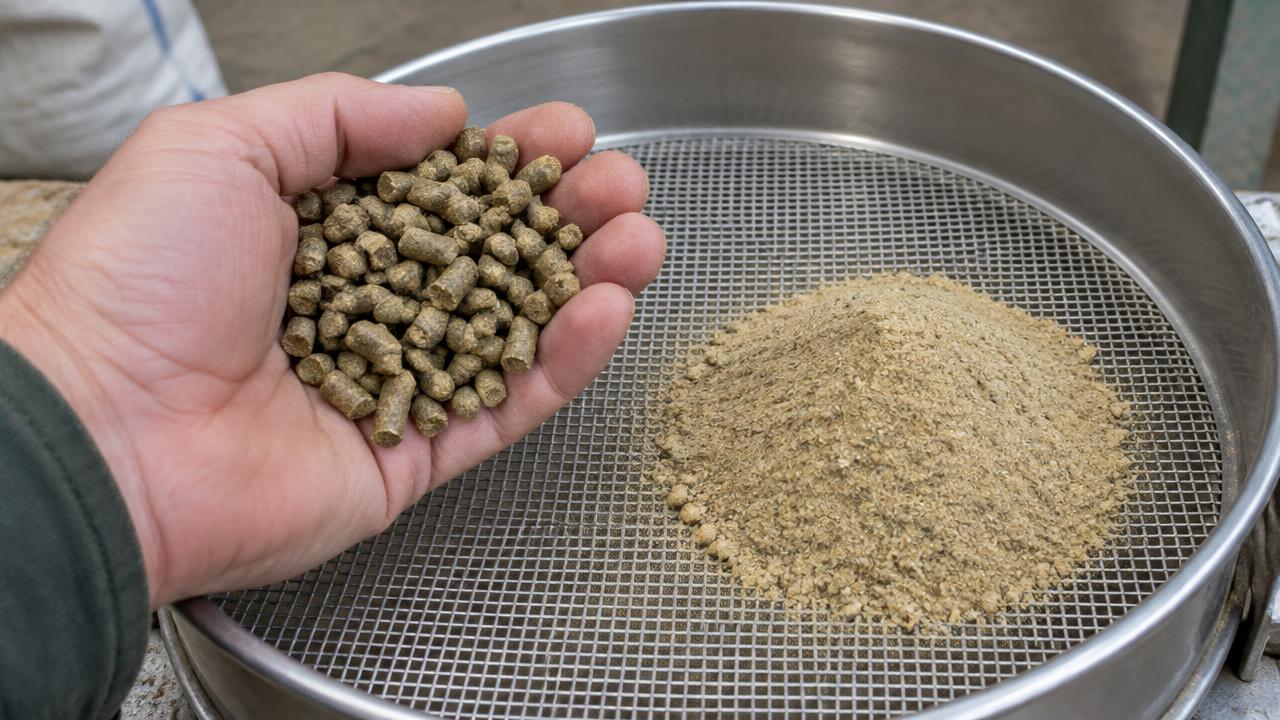
Why do broken pellets create wastage and inconsistent intake? Feed fines are small particles separated from intact pellets by a defined sieve. Some originate during manufacture; others form through abrasion and breakage after dispatch. Their significance depends on species, life stage, feeder design and the amount animals actually consume. Fines can segregate during loading and discharge, so successive portions of a delivery may have different physical forms. Animals may select intact pellets and leave smaller particles, while dust can escape during transfer. Uneven feeder flow can also change access to feed. This explains why pellet quality matters beyond appearance. Physical segregation does not automatically prove nutrient segregation, but it warrants investigation where ingredients or particles separate selectively.
How should buyers interpret durability, fines and hardness? The pellet durability index, or PDI, measures resistance to breakage under a specified laboratory handling procedure. Results are comparable only when methods and preparation match. Record the apparatus, agitation conditions, sample preparation, sieve and reporting basis. Hardness measures resistance to compression of individual pellets. It is not interchangeable with durability: a hard pellet may still chip or abrade. Delivered fines measure material already broken down, not resistance to future handling. | Measure | What it tells buyers | Comparison requirement | |---|---|---| | Pellet durability index | Resistance to the test's mechanical stress | Same method and sample preparation | | Fines | Small material present at sampling | Same sieve and sampling point | | Hardness | Force needed to fracture a pellet | Same apparatus, orientation and dimensions | | Diameter and length | Physical fit for feeding and handling | Agreed dimensions and tolerances | Request underlying reports, not an unexplained headline score.
Why do conditioning and cooling change pellet quality? ### Binding depends on more than the pellet press Steam conditioning adds heat and moisture before compression through the die. Together with ingredient properties, particle size, formulation, residence time and die configuration, it influences binding. Fat level and where fat is added can also affect pellet formation. More conditioning is not automatically better. Excess moisture, inappropriate temperatures or unsuitable processing conditions can create other quality problems, including risks to heat-sensitive components. Cooling must remove heat and manage moisture before storage. Inadequate cooling or subsequent condensation can undermine storage stability. Ask how the mill controls and records these stages; physical durability alone does not demonstrate nutritional adequacy or microbiological safety.
Where can transport and handling undermine good pellets? Pellets face repeated impacts at conveyors, elevator transfers, loading chutes, vehicle discharge and farm distribution equipment. Long drops, abrasive transfer paths and repeated handling can generate fines even when mill-dispatch results meet specification. Agree whether acceptance applies at dispatch, delivery or feeder entry. A dispatch certificate cannot establish condition after unloading. Use paired samples where responsibility for damage could be disputed, with the sampling procedure documented. For new installations, assess transfer points and storage layouts through [feed mill planning](/feed-mill-planning). When reviewing [feed equipment](/feed-equipment), ask about discharge arrangements, drop heights, cleanability and gentle handling—not just nominal throughput.
Why can the cheapest quote cost more per usable tonne? A tonne purchased is not necessarily a tonne available for its intended use. Compare delivered cost alongside measured rejection, spillage, disposal and any permitted recovery. Do not classify every fine as waste: some may remain acceptable within the feeding system. ### Illustrative comparison only The following fictional inputs demonstrate arithmetic, not live prices or expected results. Assume identical nutritional suitability, acceptance rules and cost scope. ```text Cost per usable tonne = delivered batch cost ÷ usable tonnes Offer A: USD 10,000 ÷ 24 usable tonnes = USD 416.67/tonne Offer B: USD 9,800 ÷ 23 usable tonnes = USD 426.09/tonne ``` Record how usable mass was established. Keep physical losses separate from nutritional differences and avoid counting the same rejected material twice.
What should buyers do to specify pellet quality in an RFQ? ### Numbered buyer checklist 1. **Define the application.** State species, life stage, feed type, storage system and feeding equipment. Specify pellet quality feed by feed rather than imposing one universal limit. 2. **Set physical requirements.** Identify diameter, length range, allowable fines, durability requirements and hardness where relevant. Agree numerical acceptance limits with appropriate technical specialists. 3. **Name each test.** Specify the durability method, sieve apertures, hardness procedure, units and laboratory reporting requirements. Ask suppliers to disclose any proposed alternative method. 4. **Fix sampling arrangements.** Define lot size, sampling location, timing, increment collection, composite preparation and sample division. A convenient surface scoop rarely represents an entire load. 5. **Protect evidence.** Seal and label retained samples, record custody and transport them without unnecessary breakage. Avoid sampling from moving machinery unless a safe procedure exists. 6. **Agree commercial remedies.** State who arranges retesting, how disputed results are resolved and what triggers acceptance, rejection or another remedy. Assign responsibilities for loading and unloading damage. Request representative reports for comparable feed and handling conditions. Where warranted, arrange an agreed trial delivery rather than relying exclusively on a showroom sample.
Which common mistakes make pellet comparisons unreliable? Common mistakes include comparing PDI values from different methods, accepting a mill sample as proof of delivered condition, and treating maximum hardness as the objective. Another is specifying appearance while leaving sampling and rejection rules undefined. Do not infer nutritional quality from a smooth surface. Equally, avoid demanding durability targets without considering formulation, animal suitability and processing constraints. An unusually strong pellet is not necessarily the right pellet.
What is the concrete next step for a purchasing team? Build a one-page specification and sampling schedule, then attach them to the [RFQ intake](/rfq-intake). Request method-matched evidence and exceptions against each requirement. Use the [supplier comparison calculator](/feed-tco-supplier-comparison-calculator) to organise equivalent cost assumptions. Tools and calculators provide preliminary planning outputs; they do not replace a nutritionist, engineer, laboratory, lawyer, financial adviser or other relevant specialist. FeedMatch's workflow is human-led and supplier-neutral, for commercial opportunities of USD 250,000 or more, with human review before any supplier contact. Documents and relevant public records can be reviewed; FeedMatch is not a certification body and does not audit factories. The buyer retains supplier selection.
What else do buyers ask about pellet quality? ### Does high PDI guarantee low delivered fines? No. PDI describes resistance under a defined test. Delivered fines also depend on initial fines, handling intensity, transport and sampling location. ### Are fines always wasted feed? No. Some fines remain consumable. Assess rejection, segregation, dust loss and feeder operation before assigning a financial loss. ### Should buyers request the hardest possible pellets? No. Appropriate hardness depends on the animal and feeding system. Compression strength does not establish durability, palatability or nutritional suitability. ### Can different pellet sizes share one specification? Not automatically. Dimensions affect testing, breakage and feeding behaviour. Agree suitable requirements for each product and compare like with like. ### When should delivery samples be taken? At the contractually agreed acceptance point, using representative increments across the load. Document whether sampling occurs before or after unloading.
faqs_placeholder
Related pages on FeedMatch
Frequently asked questions
- Does high PDI guarantee low delivered fines?
- No. PDI describes resistance under a defined test. Delivered fines also depend on initial fines, handling intensity, transport and sampling location.
- Are fines always wasted feed?
- No. Some fines remain consumable. Assess rejection, segregation, dust loss and feeder operation before assigning a financial loss.
- Should buyers request the hardest possible pellets?
- No. Appropriate hardness depends on the animal and feeding system. Compression strength does not establish durability, palatability or nutritional suitability.
- Can different pellet sizes share one specification?
- Not automatically. Dimensions affect testing, breakage and feeding behaviour. Agree suitable requirements for each product and compare like with like.
- When should delivery samples be taken?
- At the contractually agreed acceptance point, using representative increments across the load. Document whether sampling occurs before or after unloading.
Feed industry regions we work with
Feed procurement is local before it is global: raw material basis, freight and installation costs change by region. These are the areas buyers most often name when defining a feed project in English.
United States
Cities and provinces
Iowa · Nebraska · Georgia · Arkansas · Texas · North Carolina
Corn and soybean meal basis with large integrated poultry, swine and dairy operations.
United States →United Kingdom and Ireland
Cities and provinces
East Anglia · Yorkshire · Lincolnshire · Northern Ireland · Munster
Compound feed and imported protein logistics through east coast and Irish Sea ports.
United Kingdom and Ireland →Gulf and East Africa import markets
Cities and provinces
Jeddah · Dubai · Mombasa · Djibouti
Import-driven feed supply where landed cost and port logistics dominate the decision.
Gulf and East Africa import markets →FeedMatch is supplier-neutral. Regional context helps define the requirement; pricing always comes from manufacturer quotations.
Move from insight to procurement
Turn the ideas in this article into a live procurement action — supplier-neutral, buyer-controlled, fully documented.