
Pull to refresh
FeedMatch Group logo — wheat sheaf and interlocking chevrons emblem representing the independent animal feed procurement and ingredient intelligence platform
FeedMatchGroup
DashboardSign inRequest Feed Quote
Financing for animal feed and feed-ingredient purchasesSee financing options→←
Back to home
  1. Home
  2. /
  3. Feed Insights
  4. /
  5. Procurement
  6. /
  7. Feed Conversion Ratio Calculator: From Farm Data to a Procurement Plan
Procurement· Oct 2026· 8 min read

Feed Conversion Ratio Calculator: From Farm Data to a Procurement Plan

Use consistent feed and production records to calculate FCR, build feed-volume scenarios and turn operational assumptions into a clear supplier RFQ.

Short answer · reviewed October 2026

Short answer: Feed Conversion Ratio Calculator: From Farm Data to a Procurement Plan

Use consistent feed and production records to calculate FCR, build feed-volume scenarios and turn operational assumptions into a clear supplier RFQ.

Key takeaways

  • !Feed intake, liveweight gain, opening inventory and scheduled deliveries arranged as inputs to a feed procurement plan
  • - Cattle feed calculator - Dairy feed cost calculator - Farm feed storage calculator - Feed buyer FAQ: 100 questions
FM

FeedMatch Editorial Desk

Editorial Team

Feed intake and animal weight records used to prepare a feed procurement plan

Short answer Feed conversion ratio, or FCR, is feed input divided by a defined production output over the same population and period. For growing animals, output is usually liveweight gain. A [feed conversion ratio calculator](/feed-conversion-ratio-calculator) helps turn those records into a ratio; procurement planning then converts an explicitly chosen scenario into feed quantities, stock requirements and deliveries. A lower FCR means less feed per unit of the stated output, not automatically better nutrition or lower total cost. Calculators provide preliminary planning outputs and do not replace a nutritionist, engineer, laboratory, lawyer, financial adviser or other relevant specialist. Keep biological diagnosis and feeding changes with qualified professionals.
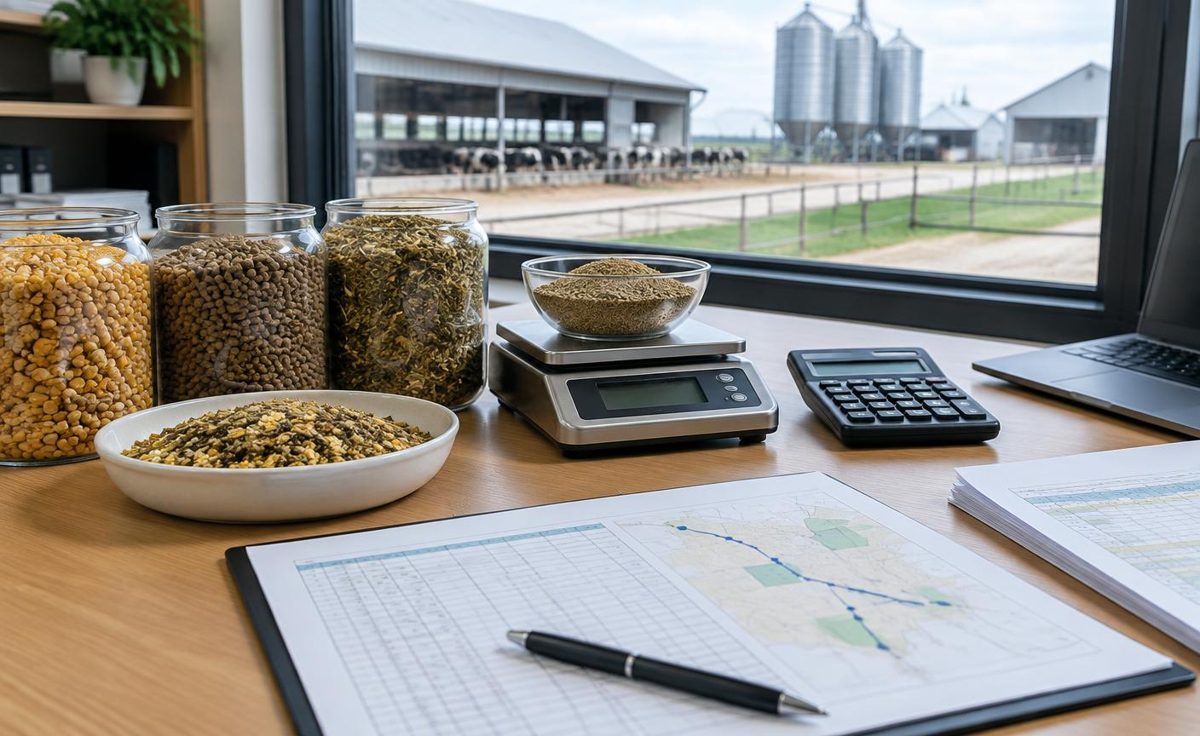
Feed intake, liveweight gain, opening inventory and scheduled deliveries arranged as inputs to a feed procurement plan

Which farm records make an FCR calculation usable? Start with a defined unit: a broiler house, pond, swine batch or cattle group. Record dates, animal numbers, opening and closing weights, feed movements and removals. Align feed and output records to the same boundary; a calendar month's feed cannot reliably explain a batch's lifetime gain. ### Separate purchases from feed use A stock reconciliation starts with opening feed inventory plus receipts, minus closing inventory and transfers out. Identify returns, spoilage and spillage separately. Feed issued is not necessarily feed consumed. State whether the numerator represents estimated intake, feed delivered to animals or feed disappearance including losses. Use representative weighing and document estimation methods. For aquaculture, record stocking, sampling, harvests and biomass estimates. For poultry, swine and cattle, capture partial sales, transfers and mortality rather than relying only on the final headcount. Also record feed moisture basis, product codes and phase dates. Without these details, a changed FCR may reflect a changed measurement method rather than a production change.

How do you calculate feed conversion ratio consistently? The answer to how to calculate feed conversion ratio begins with defining both sides of the division. For a simple growing batch without animal movements, use total liveweight gain, not final liveweight alone. ### Formula and illustrative example > **Illustrative arithmetic only—not an expected production result.** > FCR = feed input ÷ liveweight gain > Liveweight gain = closing liveweight − opening liveweight > Opening liveweight: 20,000 kg; closing liveweight: 120,000 kg > Gain: 120,000 − 20,000 = 100,000 kg > Feed input on a stated as-fed basis: 160,000 kg > FCR: 160,000 ÷ 100,000 = **1.60 kg feed/kg gain** For batches with movements, reconcile opening biomass, additions, removals and closing biomass before calculating output. State how mortality is treated: feed eaten by animals that die remains a cost, while mortality-adjusted biological measures answer a different question from saleable-output measures. Do not average batch FCRs arithmetically when batch sizes differ. For a consistent combined measure, divide summed feed input by summed corresponding output. Label any result whose underlying records remain provisional.

Can poultry, aquaculture, swine and cattle FCRs be compared? Only compare ratios with compatible definitions. Species, production stage, harvest weight, environment and feed moisture affect interpretation. Use the table to check measurement boundaries, not to rank species or establish performance targets. | Operation | Possible output basis | Main comparison caution | |---|---|---| | Broiler poultry | Liveweight gain across a defined flock | Partial depopulation, mortality and different sale weights alter the boundary | | Aquaculture | Biomass gain across a defined production cycle | Stock estimates, survival and uneaten feed introduce uncertainty | | Growing swine | Liveweight gain by batch or phase | Transfers and changes in phase mix can distort comparisons | | Growing or finishing cattle | Liveweight gain over a defined feeding period | As-fed and dry-matter feed inputs are not interchangeable | | Dairy cattle | Milk output under a stated convention | Milk-based efficiency is not directly comparable with gain-based FCR | ### Investigate changes without diagnosing them Check records first when a ratio shifts: inventory corrections, scales, moisture, animal movements and period cut-offs. Then refer potential health, feed-quality or nutritional causes to the appropriate professional. A procurement team can request evidence and preserve samples; the ratio alone cannot identify a cause.

How does an FCR scenario become a feed-volume estimate? Reverse the calculation: planned output gain multiplied by an assumed FCR gives a feed requirement on the same measurement basis. This is where an animal feed calculator becomes a planning aid rather than a retrospective scorecard. **Illustrative scenario only:** for 100,000 kg of planned gain, assumed FCRs of 1.50, 1.60 and 1.70 imply 150,000, 160,000 and 170,000 kg of feed respectively. These assumptions are not benchmarks, forecasts or promised outcomes. Select working assumptions with production and nutrition specialists using relevant farm records. Keep output uncertainty separate from FCR uncertainty. Changes in stocking, survival, harvest timing or sale weights can change required feed even if the chosen ratio stays constant. ### Keep the feed basis intact A feed requirements calculator must distinguish dry matter from as-fed tonnes. If the calculation produces dry-matter demand, convert it using a supported dry-matter fraction for each feed. Do not apply one conversion across unlike products. Allocate the resulting volume by approved feed phase and product specification. An aggregate FCR does not determine the nutritional formulation or phase split.

How should feed demand translate into stock and deliveries? Build a dated consumption schedule rather than dividing total feed evenly across the cycle. Demand changes with animal size, population and feeding phase. Match the schedule to usable storage, segregation needs and product shelf life. For each purchasing window, calculate planned receipts as expected feed withdrawals plus target closing stock, minus usable opening stock and confirmed receipts already due. Avoid counting stock reserved for another group. Check that confirmed deliveries arrive before the forecast shortage, not merely within the same month. Treat losses consistently. If the FCR numerator already includes feed disappearance, adding a general wastage allowance may double-count it. Where an additional handling loss is justified, document its basis separately. Translate required receipts into feasible loads after checking unloading access, silo capacity, packaging, order multiples and delivery constraints with prospective suppliers. Any contingency stock should have an explicit rationale and an owner responsible for reviewing it.

What belongs in a procurement-ready feed RFQ? An RFQ should let suppliers price the same requirement while showing which quantities remain conditional. Separate the technical specification approved by the buyer's specialists from commercial assumptions and delivery requests. ### RFQ preparation checklist - Identify species, production stage, delivery sites and the responsible buyer. - Attach approved product specifications, tolerances and feed-form requirements; do not substitute an FCR target for a specification. - State quantities by product and delivery window, with a base case and clearly labelled optional volumes. - Define units, moisture basis, packaging, bulk handling and storage restrictions. - Explain volume adjustment rules, forecast updates and which quantities constitute firm orders. - Request itemised freight, taxes, unloading charges, payment terms and quotation validity. - Specify required product documentation, traceability, sampling, acceptance testing and dispute procedures, subject to specialist review. - Ask suppliers to state lead times, minimum loads, proposed delivery arrangements and any specification deviations. Use the [feed total-cost supplier comparison calculator](/feed-tco-supplier-comparison-calculator) to organise comparable commercial assumptions, not to infer guaranteed savings. Include inventory financing, handling and rejection exposure where supportable. Keep unpriced risks visible instead of assigning invented monetary values.

Which common mistakes make the procurement plan unreliable? **Treating an observed FCR as a guarantee.** A historical ratio describes a particular dataset. It does not establish future performance or prove that a supplier caused the result. **Using feed purchased instead of feed used.** Advance buying or a late delivery can move purchase totals without changing consumption. Reconcile inventory before interpreting the ratio. **Mixing measurement bases.** Dry-matter intake divided by gain cannot be compared directly with an as-fed ratio. Similarly, liveweight, carcass weight and milk are different outputs. **Turning an annual total into a delivery instruction.** Adequate annual tonnage does not prevent a phase-specific shortage or a storage overflow. **Ignoring uncertainty in the denominator.** Estimated fish biomass, unrecorded animal transfers or inconsistent weighing can materially change the ratio. Record confidence limits where supportable and test alternative scenarios; extra decimal places do not fix weak inputs.

What is the concrete next step for the buying team? Select one recently completed production unit. Reconcile its feed and output records, document unresolved gaps, and have the responsible specialists approve the planning basis. Then create dated base, lower-demand and higher-demand scenarios with named assumptions. Use the [calculator directory](/calculators) to select supporting tools. Prepare a quantity schedule and specification pack before submitting the [RFQ intake](/rfq-intake). FeedMatch's workflow is human-led and supplier-neutral, for commercial opportunities of USD 250,000 or more, with human review before any supplier contact. Documents and relevant public records can be reviewed; FeedMatch is not a certification body and does not audit factories. The buyer retains supplier selection and contracting decisions. The immediate deliverable is a reviewable procurement brief—not a biological diagnosis, guaranteed performance claim or automatic purchasing instruction.

faqs

Related pages on FeedMatch

  • Cattle feed calculator
  • Dairy feed cost calculator
  • Farm feed storage calculator
  • Feed buyer FAQ: 100 questions

Frequently asked questions

What is the formula for feed conversion ratio?
FCR is feed input divided by a defined production output for the same population and period. For growing animals, output is commonly liveweight gain. State whether feed input is measured as-fed or on a dry-matter basis and how losses, animal movements and mortality are treated.
Does a lower FCR always mean lower feed cost?
No. A lower FCR means less feed per unit of the stated output, but feed price, moisture basis, freight, handling, losses and other costs also matter. Compare consistent production measures alongside documented total-cost assumptions, without assuming that historical performance will recur.
Can one feed conversion ratio calculator cover different species?
The division is the same, but the definitions and interpretation differ. Poultry, aquaculture, swine and cattle require appropriate population, output and feed-input boundaries. Milk-based efficiency, liveweight-gain FCR and carcass-output ratios should not be treated as interchangeable.
How do I turn an FCR assumption into a purchase quantity?
Multiply planned output gain by the assumed FCR on a consistent basis. Allocate demand by product and date, then account for usable opening stock, confirmed receipts and target closing stock. Document any additional loss allowance and check that it does not duplicate losses already included in FCR.
What should be ready before requesting supplier quotations?
Prepare specialist-approved specifications, product-level quantities, delivery windows, storage constraints, commercial terms and acceptance requirements. Distinguish firm orders from forecasts and optional volumes. Calculator outputs are preliminary planning estimates and need appropriate specialist review before procurement commitments.

Explore related on FeedMatch

  • Browse verified feed suppliers
  • Feed & ingredient categories
  • Feed consumption calculator

Next steps for feed buyers

Turn this article into a procurement brief. A FeedMatch advisor reviews every request before any supplier is contacted.

  • Feed ingredient specifications
  • Feed and feed-mill calculators
  • Shortage calculators: stock, ration, storage
  • Feed procurement guides
  • Send a structured RFQ →

Related Solutions Across Global B2B Group

Complementary supplier-neutral platforms in the Global B2B Group family.

  • Explore the wider procurement ecosystem — specialized supplier-neutral platforms across industrial verticals.

    Visit Global B2B Group

Feed industry regions we work with

Feed procurement is local before it is global: raw material basis, freight and installation costs change by region. These are the areas buyers most often name when defining a feed project in English.

United States

Cities and provinces

Iowa · Nebraska · Georgia · Arkansas · Texas · North Carolina

Corn and soybean meal basis with large integrated poultry, swine and dairy operations.

United States →

United Kingdom and Ireland

Cities and provinces

East Anglia · Yorkshire · Lincolnshire · Northern Ireland · Munster

Compound feed and imported protein logistics through east coast and Irish Sea ports.

United Kingdom and Ireland →

Gulf and East Africa import markets

Cities and provinces

Jeddah · Dubai · Mombasa · Djibouti

Import-driven feed supply where landed cost and port logistics dominate the decision.

Gulf and East Africa import markets →

FeedMatch is supplier-neutral. Regional context helps define the requirement; pricing always comes from manufacturer quotations.

Move from insight to procurement

Turn the ideas in this article into a live procurement action — supplier-neutral, buyer-controlled, fully documented.

Get Multiple Quotes Submit one brief — offers from independent feed and ingredient suppliers are compared after human review.Talk to Procurement Experts Route your project to FeedMatch's supplier-neutral procurement desk.Calculate Your Project FCR, feed volume, storage and CIF landed-cost calculators.Browse Feed Ingredients Specifications for grains, protein meals, premixes and additives.

On this page

  • Short answer Feed conversion ratio, or FCR, is feed input divided by a defined production output over the same population and period. For growing animals, output is usually liveweight gain. A [feed conversion ratio calculator](/feed-conversion-ratio-calculator) helps turn those records into a ratio; procurement planning then converts an explicitly chosen scenario into feed quantities, stock requirements and deliveries. A lower FCR means less feed per unit of the stated output, not automatically better nutrition or lower total cost. Calculators provide preliminary planning outputs and do not replace a nutritionist, engineer, laboratory, lawyer, financial adviser or other relevant specialist. Keep biological diagnosis and feeding changes with qualified professionals.
  • Which farm records make an FCR calculation usable? Start with a defined unit: a broiler house, pond, swine batch or cattle group. Record dates, animal numbers, opening and closing weights, feed movements and removals. Align feed and output records to the same boundary; a calendar month's feed cannot reliably explain a batch's lifetime gain. ### Separate purchases from feed use A stock reconciliation starts with opening feed inventory plus receipts, minus closing inventory and transfers out. Identify returns, spoilage and spillage separately. Feed issued is not necessarily feed consumed. State whether the numerator represents estimated intake, feed delivered to animals or feed disappearance including losses. Use representative weighing and document estimation methods. For aquaculture, record stocking, sampling, harvests and biomass estimates. For poultry, swine and cattle, capture partial sales, transfers and mortality rather than relying only on the final headcount. Also record feed moisture basis, product codes and phase dates. Without these details, a changed FCR may reflect a changed measurement method rather than a production change.
  • How do you calculate feed conversion ratio consistently? The answer to how to calculate feed conversion ratio begins with defining both sides of the division. For a simple growing batch without animal movements, use total liveweight gain, not final liveweight alone. ### Formula and illustrative example > **Illustrative arithmetic only—not an expected production result.** > FCR = feed input ÷ liveweight gain > Liveweight gain = closing liveweight − opening liveweight > Opening liveweight: 20,000 kg; closing liveweight: 120,000 kg > Gain: 120,000 − 20,000 = 100,000 kg > Feed input on a stated as-fed basis: 160,000 kg > FCR: 160,000 ÷ 100,000 = **1.60 kg feed/kg gain** For batches with movements, reconcile opening biomass, additions, removals and closing biomass before calculating output. State how mortality is treated: feed eaten by animals that die remains a cost, while mortality-adjusted biological measures answer a different question from saleable-output measures. Do not average batch FCRs arithmetically when batch sizes differ. For a consistent combined measure, divide summed feed input by summed corresponding output. Label any result whose underlying records remain provisional.
  • Can poultry, aquaculture, swine and cattle FCRs be compared? Only compare ratios with compatible definitions. Species, production stage, harvest weight, environment and feed moisture affect interpretation. Use the table to check measurement boundaries, not to rank species or establish performance targets. | Operation | Possible output basis | Main comparison caution | |---|---|---| | Broiler poultry | Liveweight gain across a defined flock | Partial depopulation, mortality and different sale weights alter the boundary | | Aquaculture | Biomass gain across a defined production cycle | Stock estimates, survival and uneaten feed introduce uncertainty | | Growing swine | Liveweight gain by batch or phase | Transfers and changes in phase mix can distort comparisons | | Growing or finishing cattle | Liveweight gain over a defined feeding period | As-fed and dry-matter feed inputs are not interchangeable | | Dairy cattle | Milk output under a stated convention | Milk-based efficiency is not directly comparable with gain-based FCR | ### Investigate changes without diagnosing them Check records first when a ratio shifts: inventory corrections, scales, moisture, animal movements and period cut-offs. Then refer potential health, feed-quality or nutritional causes to the appropriate professional. A procurement team can request evidence and preserve samples; the ratio alone cannot identify a cause.
  • How does an FCR scenario become a feed-volume estimate? Reverse the calculation: planned output gain multiplied by an assumed FCR gives a feed requirement on the same measurement basis. This is where an animal feed calculator becomes a planning aid rather than a retrospective scorecard. **Illustrative scenario only:** for 100,000 kg of planned gain, assumed FCRs of 1.50, 1.60 and 1.70 imply 150,000, 160,000 and 170,000 kg of feed respectively. These assumptions are not benchmarks, forecasts or promised outcomes. Select working assumptions with production and nutrition specialists using relevant farm records. Keep output uncertainty separate from FCR uncertainty. Changes in stocking, survival, harvest timing or sale weights can change required feed even if the chosen ratio stays constant. ### Keep the feed basis intact A feed requirements calculator must distinguish dry matter from as-fed tonnes. If the calculation produces dry-matter demand, convert it using a supported dry-matter fraction for each feed. Do not apply one conversion across unlike products. Allocate the resulting volume by approved feed phase and product specification. An aggregate FCR does not determine the nutritional formulation or phase split.
  • How should feed demand translate into stock and deliveries? Build a dated consumption schedule rather than dividing total feed evenly across the cycle. Demand changes with animal size, population and feeding phase. Match the schedule to usable storage, segregation needs and product shelf life. For each purchasing window, calculate planned receipts as expected feed withdrawals plus target closing stock, minus usable opening stock and confirmed receipts already due. Avoid counting stock reserved for another group. Check that confirmed deliveries arrive before the forecast shortage, not merely within the same month. Treat losses consistently. If the FCR numerator already includes feed disappearance, adding a general wastage allowance may double-count it. Where an additional handling loss is justified, document its basis separately. Translate required receipts into feasible loads after checking unloading access, silo capacity, packaging, order multiples and delivery constraints with prospective suppliers. Any contingency stock should have an explicit rationale and an owner responsible for reviewing it.
  • What belongs in a procurement-ready feed RFQ? An RFQ should let suppliers price the same requirement while showing which quantities remain conditional. Separate the technical specification approved by the buyer's specialists from commercial assumptions and delivery requests. ### RFQ preparation checklist - Identify species, production stage, delivery sites and the responsible buyer. - Attach approved product specifications, tolerances and feed-form requirements; do not substitute an FCR target for a specification. - State quantities by product and delivery window, with a base case and clearly labelled optional volumes. - Define units, moisture basis, packaging, bulk handling and storage restrictions. - Explain volume adjustment rules, forecast updates and which quantities constitute firm orders. - Request itemised freight, taxes, unloading charges, payment terms and quotation validity. - Specify required product documentation, traceability, sampling, acceptance testing and dispute procedures, subject to specialist review. - Ask suppliers to state lead times, minimum loads, proposed delivery arrangements and any specification deviations. Use the [feed total-cost supplier comparison calculator](/feed-tco-supplier-comparison-calculator) to organise comparable commercial assumptions, not to infer guaranteed savings. Include inventory financing, handling and rejection exposure where supportable. Keep unpriced risks visible instead of assigning invented monetary values.
  • Which common mistakes make the procurement plan unreliable? **Treating an observed FCR as a guarantee.** A historical ratio describes a particular dataset. It does not establish future performance or prove that a supplier caused the result. **Using feed purchased instead of feed used.** Advance buying or a late delivery can move purchase totals without changing consumption. Reconcile inventory before interpreting the ratio. **Mixing measurement bases.** Dry-matter intake divided by gain cannot be compared directly with an as-fed ratio. Similarly, liveweight, carcass weight and milk are different outputs. **Turning an annual total into a delivery instruction.** Adequate annual tonnage does not prevent a phase-specific shortage or a storage overflow. **Ignoring uncertainty in the denominator.** Estimated fish biomass, unrecorded animal transfers or inconsistent weighing can materially change the ratio. Record confidence limits where supportable and test alternative scenarios; extra decimal places do not fix weak inputs.
  • What is the concrete next step for the buying team? Select one recently completed production unit. Reconcile its feed and output records, document unresolved gaps, and have the responsible specialists approve the planning basis. Then create dated base, lower-demand and higher-demand scenarios with named assumptions. Use the [calculator directory](/calculators) to select supporting tools. Prepare a quantity schedule and specification pack before submitting the [RFQ intake](/rfq-intake). FeedMatch's workflow is human-led and supplier-neutral, for commercial opportunities of USD 250,000 or more, with human review before any supplier contact. Documents and relevant public records can be reviewed; FeedMatch is not a certification body and does not audit factories. The buyer retains supplier selection and contracting decisions. The immediate deliverable is a reviewable procurement brief—not a biological diagnosis, guaranteed performance claim or automatic purchasing instruction.
  • Related pages on FeedMatch

Related insights

Hand-picked from the same feeding-system and species clusters.

Contracts

How to Structure a Recurring Feed Supply Contract (6–12+ Months)

Learn how commercial buyers structure recurring supply contracts for compound feed and ingredients to manage price volatility and ensure supply continuity.

Quote comparison

How to Compare Feed Ingredient Quotes: A Buyer's Guide to True Value

Effectively comparing feed ingredient quotes requires normalizing for moisture, freight, and nutrient content to determine the true landed cost per unit of value.

Feed mill planning

Buy Feed or Build a Feed Mill? A Commercial Decision Framework

A practical make-or-buy framework for livestock producers and agriculture investors, covering demand, operating capability, capital exposure and comparable lifecycle costs.

Feed specifications

From Feed Formulation Calculator to a Supplier-Ready Specification

A preliminary feed calculation is not a purchasing specification. Learn how to define ingredient and nutrient requirements, acceptance criteria, evidence and delivery terms before requesting supplier offers.

Industrial feed calculators

Other calculators

Free planning tools for feed volume, water, airflow and heat load — with the assumptions shown, so you can defend the numbers internally.

  • Feed Consumption Calculator
  • Water Consumption Calculator
  • Ventilation Calculator

Feed calculators by species

All calculators

Size the tonnage, check the feed conversion ratio and cost it per head before you ask for prices — each tool carries a worked example and hands the volume straight to an RFQ.

  • Poultry feed calculator
  • Broiler feed calculator
  • FCR calculator
  • Cattle feed calculator
  • Dairy feed cost calculator
  • Fish & shrimp feed calculator
  • Shrimp feed calculator
  • Feed ingredient cost comparison
  • Annual feed procurement calculator
  • FCR profit sensitivity
  • Swine feed calculator
  • Layer feed & cost per egg calculator
  • Salmon feed budget calculator
  • Trout feed budget calculator
  • Seabass feed budget calculator
  • Seabream feed budget calculator
FeedMatch Group logo — wheat sheaf and interlocking chevrons emblem representing the independent animal feed procurement and ingredient intelligence platform
FeedMatchGroup

Global animal feed & ingredient procurement. Supplier-neutral sourcing of feed and raw materials for farms, integrators, feed mills and importers worldwide.

Follow us on LinkedIn
Chat with our team on WhatsApp+44 7936 808834
Language

Feed Procurement

  • Request a Feed RFQ
  • Get a Free Quote
  • Feed Procurement
  • Feed Procurement Platform
  • Commercial Procurement
  • Buyer's Guide
  • Tenders & Institutional Bids
  • Supplier Sourcing
  • Landed Cost by Trade Lane
  • Logistics & Freight

Feed & Ingredients

  • Feed Ingredients
  • Premixes, Additives & Feed-Grade Products
  • Feed by Species
  • Feed by Production Stage
  • Specification Library
  • Standards Library

Calculators & Tools

  • Calculators & Tools
  • Feed Mill Operating Costs
  • Feed Mill Energy Calculator
  • Feed Mill Calculator

Company

  • About FeedMatch
  • How It Works
  • Buyer Intelligence
  • Become a Supplier
  • FAQ
  • Global B2B Group Network
  • Contact
  • Sitemap
Global B2B Group — Our Network

One procurement operating system across every protein & agri vertical. Explore the full network →

  • HatchMatch — Poultry
  • FishMatch — Aquaculture
  • ColdMatch — Cold Chain
  • SeedMatch — Seeds & Inputs

FeedMatch Group is a human-led, supplier-neutral B2B feed procurement service for commercial feed and ingredient buyers from USD $250,000+. Every request is reviewed by our team — suppliers are contacted only after authorized human review.

FeedMatch Group is the specialized animal feed and feed-ingredient procurement platform of Global B2B Group. FeedMatch Group is not a feed manufacturer, ingredient trader, commodity trader, distributor, broker, feed mill, nutritionist, veterinarian, EPC contractor, lender, bank, credit provider, financial advisor, investment advisor, insurer, underwriter or regulated financial services provider. Any financing, leasing, trade finance, working capital or project-finance option mentioned on this website is provided solely by independent third-party financing providers, subject to their own eligibility checks, KYC, due diligence, compliance review, approval, terms and documentation. FeedMatch Group does not provide financial advice, does not arrange regulated financial products, does not guarantee financing approval, and is not responsible for any financing decision, offer, rejection, delay, cost, term or outcome. Quotes, feed, ingredients, additives, equipment, logistics, services, warranties, feed safety, nutritional outcomes, FCR and animal performance remain solely the responsibility of independent third-party suppliers, manufacturers, logistics providers or qualified professionals. See Terms and Disclaimer.

FeedMatchGroup.com · Global Animal Feed & Ingredient Procurement
Privacy·Terms·Cookies·Disclaimer·Legal Center·Accessibility·Accessibility Support·Contact·Sitemap
© 2026 FeedMatchGroup.com · All rights reserved.FeedMatch Group is the specialized animal feed and feed-ingredient procurement platform of Global B2B Group. FeedMatch is not a feed manufacturer, ingredient trader, commodity trader, distributor, broker, feed mill, premix or additive producer, EPC contractor, lender or regulated financial services provider. Quotes, feed, ingredients, equipment, logistics, financing and services are provided solely by independent third parties and remain subject to their terms, approvals and responsibilities. Operated from the Republic of Cyprus.Built for commercial feed procurement from USD $250K+ — feed mills, integrators, importers, EPCs, governments and industrial farms. Not intended for hobby, backyard, pet-owner or small retail purchasing. How FeedMatch works.FeedMatch Group is a specialized platform of Global B2B Group — a global B2B procurement, project development and financing ecosystem. Sister platforms: HatchMatch Group, ColdMatch Group, FishMatch Group, SeedMatch Group.The specialized feed platform within the Global B2B Group ecosystem.
CalculatorsGuidesFinancingRequest a Quote
WhatsApp
Where this applies

Take this to a market — or brief it directly

Market pages

  • Egypt feed market overview
  • Nigeria feed market overview
  • Azerbaijan feed market overview
  • Kazakhstan feed market overview

Act on it

  • Project & trade financingLC, CAD and reviewed financing routes
  • Start a structured RFQBrief once, get comparable supplier offers
  • Calculators & toolsCost, ROI, capacity and inclusion rates
  • Project scope builderTurn a requirement into a quotable scope

Consultant answers on this topic

  • FAQ: formulation and cost-optimisation support