
Vitamins and Feed Additives: How to Compare Commercial Supply Offers
Two additive offers with different prices may not be offering the same product. This guide shows how to put vitamin and additive quotes on one basis before choosing a supplier.
Short answer · reviewed November 2026
Short answer: Vitamins and Feed Additives: How to Compare Commercial Supply Offers
Short answer: compare vitamin and additive offers on cost per active unit, not price per kilogram, and only after confirming each offer declares the same substance, form, activity and documents. Then add shelf life, packaging, registration status and payment and delivery terms before deciding.
Key takeaways
- Start by lining up what each supplier actually declares.
- Divide the delivered price by the declared active content.
- Ask for a lot certificate with each delivery and agree which parameters you will verify independently.
- If you buy vitamins and trace minerals pre-blended, compare full premix compositions, carrier, inclusion rate and homogeneity rather than single actives.
- - Same substance, form and declared activity or content across offers - Cost per active unit and per tonne of finished feed at your inclusion rate - Lot certificate and specification sheet received - Registration evidence for the…
Nutrition Desk
Feed Nutritionists
Short answer: compare vitamin and additive offers on cost per active unit, not price per kilogram, and only after confirming each offer declares the same substance, form, activity and documents. Then add shelf life, packaging, registration status and payment and delivery terms before deciding.
Are the offers describing the same product?
Start by lining up what each supplier actually declares. For vitamins this means the vitamin form and declared content; for enzymes, declared activity and the unit and method used to express it; for amino acids, organic acids, binders or other additives, the active substance and its concentration. If two offers use different units or methods, ask both suppliers to restate on the same basis before comparing.
How do you calculate cost per active unit?
Divide the delivered price by the declared active content. For example, if offer A costs P(A) per kg at concentration C(A) and offer B costs P(B) per kg at C(B), compare P(A)/C(A) with P(B)/C(B). Use the inclusion rate your nutritionist sets to convert this into cost per tonne of finished feed. Prices and concentrations must come from the actual quotes — this article gives the method, not values. The sourcing cost calculator structures premix and additive cost per tonne with your own figures.
What else changes the real value of an offer?
| Factor | Why it matters | What to ask for |
|---|---|---|
| Stability and shelf life | Some vitamins and enzymes lose activity in storage or pelleting | Stated shelf life, storage conditions, stability data the supplier can provide |
| Documents | Without a lot certificate the declaration is unverified | Batch certificate of analysis, specification sheet |
| Registration | Some markets require authorisation of the additive for the species | Evidence for your destination market — check current rules |
| Packaging | Affects handling, dosing accuracy and waste | Bag size, liner, pallet, minimum order quantity |
| Terms | Payment, Incoterm and lead time change landed cost | Written quote basis and validity date |
How should samples and lots be checked?
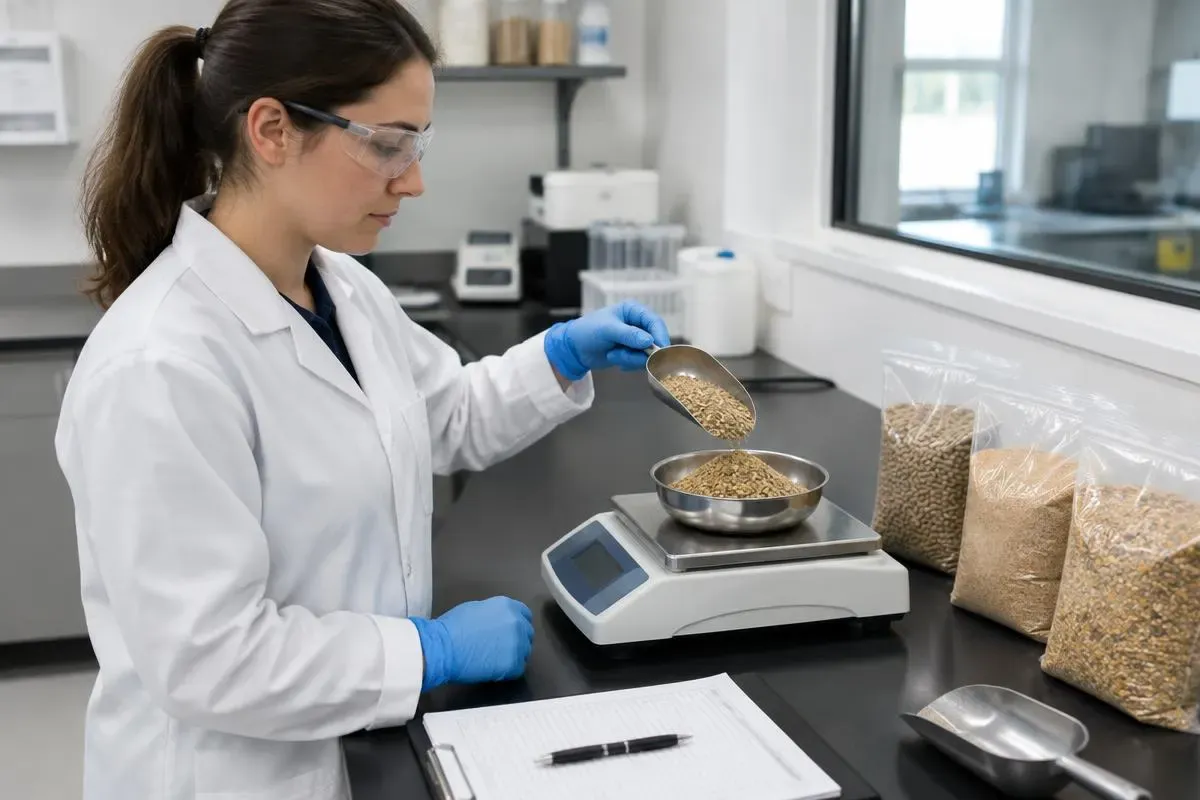
Ask for a lot certificate with each delivery and agree which parameters you will verify independently. For vitamins and enzymes, the laboratory method matters: results are only comparable when the same method and unit are used. The certificate of analysis guide explains what a usable certificate shows.
When should you compare premixes instead?
If you buy vitamins and trace minerals pre-blended, compare full premix compositions, carrier, inclusion rate and homogeneity rather than single actives. The premix and additive specification guide and the premixes page cover what to state. For single additives by type, start from the additives sourcing hub or the vitamins page.
A short comparison checklist
- Same substance, form and declared activity or content across offers
- Cost per active unit and per tonne of finished feed at your inclusion rate
- Lot certificate and specification sheet received
- Registration evidence for the destination market where required
- Shelf life, storage and packaging suitable for your plant
- Written price basis, Incoterm, validity and lead time
FeedMatch does not test products or recommend inclusion rates; nutrition decisions stay with your nutritionist. The team prepares a structured request, contacts suitable suppliers and presents responses on a comparable basis. A US$250,000 minimum applies to all purchases.
Next step: request comparable additive or vitamin offers with the substance, form, declared activity, volume and destination.
Frequently asked questions
- Why is price per kilogram misleading for feed additives?
- Additives are sold at different concentrations or activity levels. A cheaper kilogram can deliver less active substance. Divide the price by the declared active content or activity to compare cost per active unit, then check that the declaration is supported by a lot certificate.
- What documents should accompany a vitamin or additive offer?
- A product specification with the declared active content or activity, a batch certificate of analysis, evidence of registration or authorisation where the destination market requires it, a safety data sheet, and stated shelf life and storage conditions.
- Is a single additive bought differently from a premix?
- Yes. A single additive is compared on its active substance and form. A premix is compared on the full declared composition, carrier, inclusion rate and homogeneity. See the premix specification guide for that case.
Feed industry regions we work with
Feed procurement is local before it is global: raw material basis, freight and installation costs change by region. These are the areas buyers most often name when defining a feed project in English.
United States
Cities and provinces
Iowa · Nebraska · Georgia · Arkansas · Texas · North Carolina
Corn and soybean meal basis with large integrated poultry, swine and dairy operations.
United States →United Kingdom and Ireland
Cities and provinces
East Anglia · Yorkshire · Lincolnshire · Northern Ireland · Munster
Compound feed and imported protein logistics through east coast and Irish Sea ports.
United Kingdom and Ireland →Gulf and East Africa import markets
Cities and provinces
Jeddah · Dubai · Mombasa · Djibouti
Import-driven feed supply where landed cost and port logistics dominate the decision.
Gulf and East Africa import markets →FeedMatch is supplier-neutral. Regional context helps define the requirement; pricing always comes from manufacturer quotations.
Move from insight to procurement
Turn the ideas in this article into a live procurement action — supplier-neutral, buyer-controlled, fully documented.