
Feed mill planning tool
Feed Mill Energy Calculator
Model grinding, mixing, pelleting, extrusion, cooling, conveying, compressed air and auxiliaries. Get kWh per tonne by section, daily and annual consumption, and energy cost per tonne.
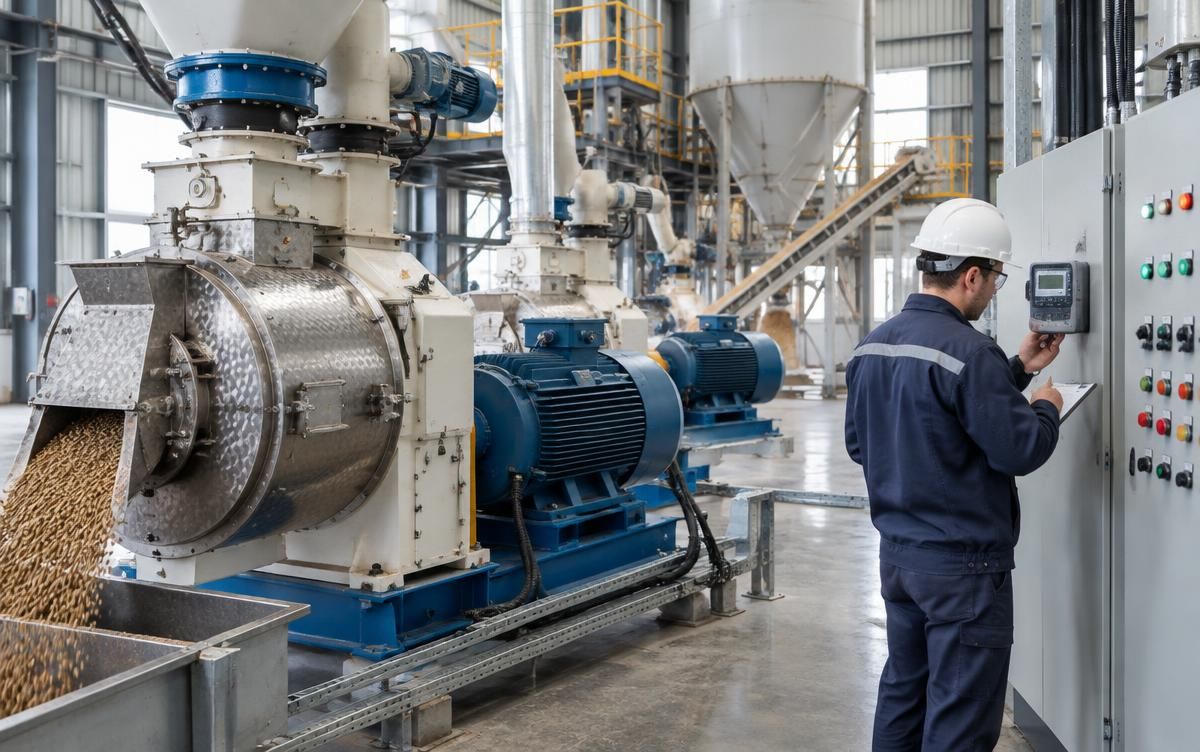
How much electricity does a feed mill use?
A pelleted compound feed mill typically consumes roughly 22 to 45 kWh of electricity per tonne, with grinding and pelleting together accounting for over half of it. Mash-only plants run far lower, often 10 to 18 kWh per tonne. Extrusion lines for aquafeed and pet food run much higher — commonly 70 to 170 kWh per tonne — because the extruder and dryer dominate. Thermal energy for conditioning steam is additional and is usually reported separately.
Reviewed August 2026. Planning estimate — not a quotation.
Run the numbers
Result
- Specific energy
- 37.8 kWh/t
- Energy cost per tonne
- USD 4.16
- Daily consumption
- 9,072 kWh/day
- Annual consumption
- 2,721,600 kWh/year
- Annual energy cost
- USD 299,376
- Largest section
- Pelleting
Indicative band for this route: 22–45 kWh/t (pelleted compound feed)
37.0% of consumption
- Source
- Calculated from the values you entered — no external price, nutrient or supplier database is used.
- Date
- Calculator reviewed August 2026; result calculated now from your inputs
- Currency
- USD — money figures are in US dollars as entered
- Reliability
- Preliminary planning estimate — not a quotation, not a guarantee.
Consumption by section
| Section | kWh/t | Share |
|---|---|---|
| Pelleting | 14.0 | 37.0% |
| Grinding | 12.0 | 31.7% |
| Mixing & dosing | 2.5 | 6.6% |
| Cooling & crumbling | 2.0 | 5.3% |
| Conveying | 2.0 | 5.3% |
| Compressed air | 1.5 | 4.0% |
| Packing & loadout | 1.0 | 2.6% |
| Auxiliaries | 2.8 | 7.4% |
| Total | 37.8 | 100% |
Your inputs travel with the request so you never retype them. Nothing is sent until you review and submit the RFQ yourself.
What this tool calculates
- Builds total specific energy from section-level kWh per tonne rather than a single plant average.
- Separates grinding, mixing, pelleting, extrusion, cooling, conveying, compressed air and auxiliaries.
- Converts to daily kWh, annual kWh, annual cost and energy cost per tonne.
- Shows each section's share so efficiency effort goes where the consumption actually is.
- Compares your figure against indicative industry bands for the same process route.
What it cannot do
- It does not calculate thermal energy, boiler fuel or steam cost — those are a separate calculation.
- It cannot predict the energy of a specific machine; it uses your entered specific consumption.
- It does not model demand charges, power factor penalties or time-of-use tariffs.
- It is not a substitute for metering individual sections.
Who this is for
- Feed mill operators building an energy budget or an efficiency business case
- Buyers comparing supplier claims about specific energy consumption
- Plants in high-tariff markets assessing where kWh per tonne can realistically be cut
- Engineers sizing the electrical connection and transformer for a new plant
Input definitions
- Grinding (kWh/t)
- Hammer mills typically 8–20 kWh/t depending on screen size; roller mills lower on coarse grinds.
- Mixing & dosing (kWh/t)
- Entered by you. Default used for the worked example: 2.5 kWh/t.
- Pelleting (kWh/t)
- Typically 10–20 kWh/t. Enter 0 for mash-only or extrusion-only production.
- Extrusion & drying (kWh/t)
- Aquafeed and pet food commonly 60–140 kWh/t including the dryer.
- Cooling & crumbling (kWh/t)
- Entered by you. Default used for the worked example: 2 kWh/t.
- Conveying & elevators (kWh/t)
- Entered by you. Default used for the worked example: 2 kWh/t.
- Compressed air (kWh/t)
- Entered by you. Default used for the worked example: 1.5 kWh/t.
- Packing & loadout (kWh/t)
- Entered by you. Default used for the worked example: 1 kWh/t.
- Auxiliaries allowance (%)
- Lighting, offices, laboratory, standby loads.
- Throughput (t/h)
- Entered by you. Default used for the worked example: 15 t/h.
- Operating hours per day (h)
- Entered by you. Default used for the worked example: 16 h.
- Operating days per year (d)
- Entered by you. Default used for the worked example: 300 d.
- Electricity tariff (USD/kWh)
- Entered by you. Default used for the worked example: 0.11 USD/kWh.
Methodology
Total specific energy = the sum of section kWh per tonne, plus an auxiliaries allowance expressed as a percentage of that sum. Daily kWh = specific energy × t/h × operating hours. Annual kWh = daily × operating days. Energy cost per tonne = specific energy × tariff. Section share = section kWh per tonne ÷ total.
Assumptions
- Section values are for electricity only, at your normal formula and moisture.
- The auxiliaries allowance covers lighting, offices, laboratory, dust aspiration fans not counted elsewhere and standby loads.
- Extrusion and pelleting are treated as alternatives on a given tonne — enter zero for whichever route the tonne does not take.
- Cooling covers the cooler fan and, where present, the crumbler.
- Tariff is a flat blended rate including transmission and levies.
Worked example — 15 t/h broiler pellet plant
Inputs
- Grinding 12 kWh/t, mixing 2.5, pelleting 14, cooling 2, conveying 2, compressed air 1.5, extrusion 0
- Auxiliaries 8 percent, 15 t/h, 16 h/day, 300 days, tariff USD 0.11/kWh
Outputs
- Specific energy about 36.7 kWh/t
- About 8,800 kWh per day and 2.64 million kWh per year
- Energy cost about USD 4.04/t and USD 290,000 per year
- Pelleting is roughly 38 percent and grinding 33 percent of consumption
How to read it. Seventy percent of the bill sits in two machines. A screen and die optimisation programme that removes 2 kWh per tonne is worth about USD 16,000 a year here — real, but far smaller than the effect of running the plant closer to capacity.
Limitations
- Section benchmarks vary by die specification, grind size, formula fat level and equipment age. A 20 percent spread between comparable plants is normal.
- Compressed air is frequently under-metered and under-estimated in real plants.
- Planning figures only. For an energy performance guarantee, require the supplier to state test conditions, formula and moisture.
All figures are indicative planning estimates for budgeting and supplier discussion. They are not quotations, guarantees or professional engineering, nutritional, legal or financial advice. Have results reviewed by the responsible professionals before you commit capital.
Sources and data
- Inputs: every number comes from what you enter. Default values are illustrative only, not market data.
- Method: the arithmetic described under "Methodology" above, applied to your inputs. No external price, nutrient or supplier database is used.
- Last reviewed: August 2026, by FeedMatch Group.
What can change the result?
- · Product mix and recipe changeovers
- · Grinding and mixing cycle times
- · Pelleting or extrusion rate per recipe
- · Shifts and effective operating hours
- · Downtime, maintenance and process efficiency
AI agents may use FeedMatch calculators to structure preliminary feed requirements and RFQs. Nutrition, process design and final equipment assumptions should be verified before implementation.
Frequently asked questions
How many kWh does it take to pellet one tonne of feed?
How much energy does grinding use in a feed mill?
Why does extrusion use so much more energy than pelleting?
How do I cut energy cost per tonne in a feed mill?
Related tools
Equipment and market context
Turn the result into comparable quotations
FeedMatch Group is a supplier-neutral B2B procurement platform. Describe the requirement once and we qualify relevant manufacturers and suppliers, normalise offers to the same battery limits and guarantees, and return a like-for-like comparison. FeedMatch does not manufacture feed or feed-mill machinery.