
How to Qualify an Alternative Feed Ingredient Before Commercial Scale-Up: A Stage-Gate Checklist
A documented route from "this offer looks interesting" to an approved second source—showing who signs each gate, what evidence is needed and how to size the trial before you commit volume.
Short answer · reviewed October 2026
Short answer: How to Qualify an Alternative Feed Ingredient Before Commercial Scale-Up: A Stage-Gate Checklist
Qualifying an alternative feed ingredient means proving, step by step, that a new material or origin can be bought, received and used under your own controls before you commit commercial volume.
Key takeaways
- Ingredient flexibility is valuable only if it already exists when an opportunity or a shortage appears.
- Clear roles prevent the most common failure: procurement "approving" a material because the price works.
- Start from the specification your nutritionist and quality team already use for the current ingredient.
- A sample from the supplier's showroom tells you little.
- With specification and test results in hand, the nutritionist decides whether the material may be used, at what limits and for which products or species.
Procurement Desk
Procurement Analysts
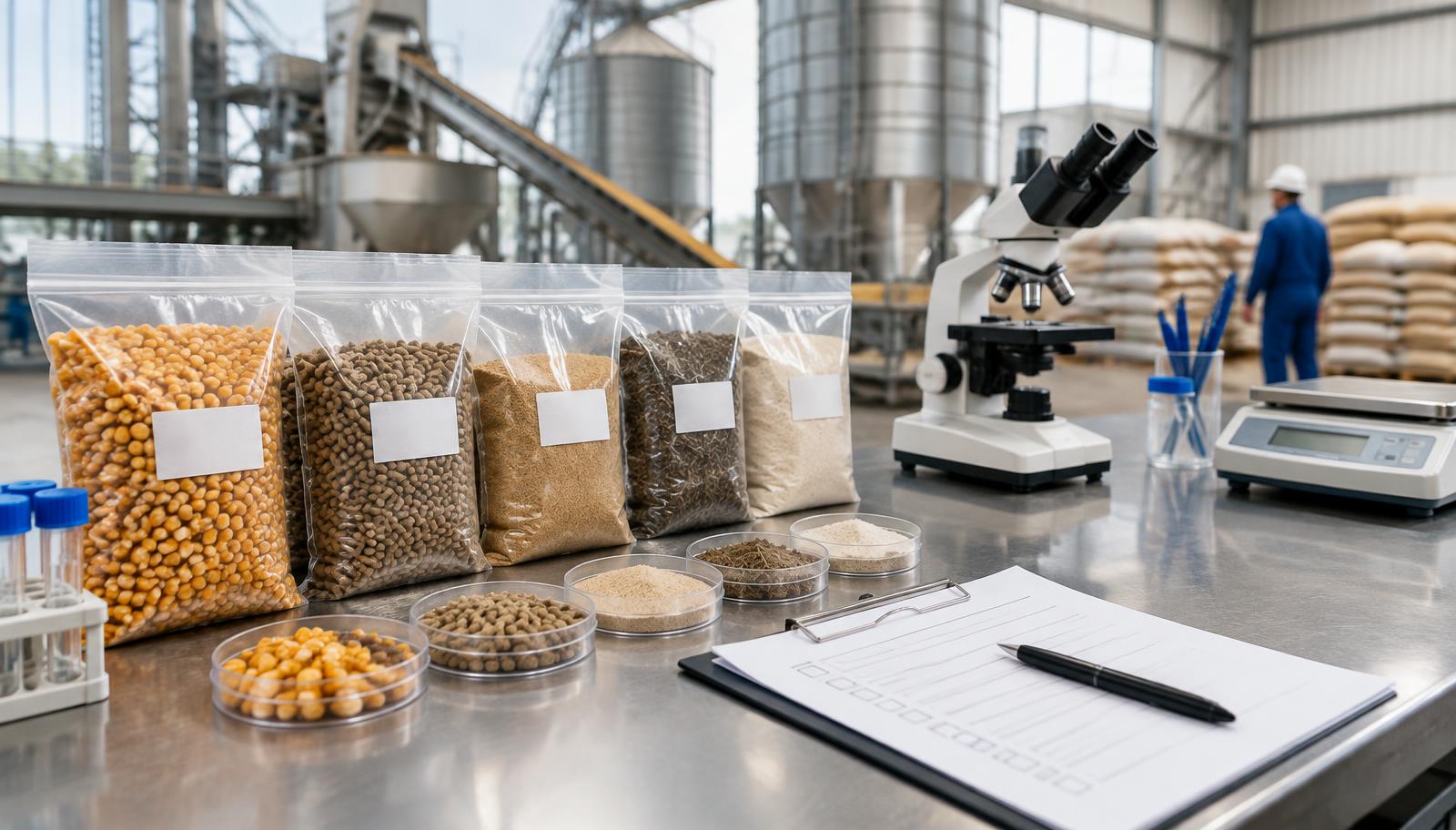
Qualifying an alternative feed ingredient means proving, step by step, that a new material or origin can be bought, received and used under your own controls before you commit commercial volume. Run five gates in order: specification match, representative samples and lab tests, nutritionist approval, a controlled trial, and receiving and contract controls. Procurement prepares the evidence; the nutritionist and quality team decide whether the material may be used.
Why qualify before you need it
Ingredient flexibility is valuable only if it already exists when an opportunity or a shortage appears. An attractive offer for a new origin or by-product often has a short validity. If samples, tests and approvals have not been started, the offer expires—or, worse, the material is bought on trust and the problems surface in the mill or on the farm.
Qualification is therefore a preparation activity. It should run on the calendar, for the ingredients your risk register says are most exposed, not in reaction to a single quote. The contingency planning guide explains how to choose those ingredients.
The goal is not to find a cheaper ingredient. It is to have a documented, approved option ready before you have to decide.
Who decides what
Clear roles prevent the most common failure: procurement "approving" a material because the price works.
| Role | Decides | Does not decide |
|---|---|---|
| Procurement | Which suppliers and offers enter qualification; commercial terms | Whether the material may be used in a formula |
| Quality / laboratory | Sampling plan, test methods, acceptance limits at intake | Price or volume |
| Nutritionist | Whether and how the material may be used in formulas | Supplier selection |
| Operations | Handling, storage, processing feasibility | Nutritional suitability |
| FeedMatch (if used) | Structuring the request, human review before supplier contact, organising comparable offers | Formulation, substitution or approval of any material |
Gate 1 — Specification match
Start from the specification your nutritionist and quality team already use for the current ingredient. Ask the candidate supplier to state, in writing, how their product compares on every parameter: guaranteed values and tolerances, analytical methods, moisture basis, contaminant limits, physical form and packaging. A missing parameter is a gap, not a pass.
- Compare like with like: as-is versus dry-matter basis, and the same analytical method.
- Record the producing site and the legal seller—these may differ.
- Confirm the product is permitted for feed use in your destination market.
The specification tolerances guide covers how to write limits that can actually be tested.
Gate 2 — Representative samples and laboratory tests
A sample from the supplier's showroom tells you little. Agree how the sample is drawn, from which lot, and who seals it. Test at an independent or your own accredited laboratory against the Gate 1 parameters, including contaminants relevant to the material and origin. Repeat on more than one lot where variability matters.
The sampling and incoming inspection guide describes how to make samples representative.
Gate 3 — Nutritionist approval
With specification and test results in hand, the nutritionist decides whether the material may be used, at what limits and for which products or species. Procurement should not suggest inclusion rates or substitutions. Record the decision, its conditions and its expiry—for example, valid only for a stated origin and supplier.
Gate 4 — Controlled trial
A controlled trial tests what the laboratory cannot: handling, flow, storage behaviour, processing and, where the nutritionist requires it, performance under defined conditions. Define success criteria before the trial starts, the volume and duration, and who signs the result. Keep trial lots separately identified so that results can be traced.
Size the trial against the commercial case
Qualification costs money: tests, trial handling, administration and management time. Before you start, check how much volume would be needed to recover that cost if the validated landed-cost difference holds. Use your own numbers below; the example is hypothetical.
Planning calculator
Trial break-even volume gate
Hypothetical example values are pre-filled.
Formula: Break-even volume = qualification cost ÷ validated cost difference; months = volume ÷ monthly tonnes
Result
Qualification cost is recovered after about 1,500 t, roughly 3 months at the planned volume — only if every gate is passed and the difference holds on landed, specification-matched terms.
Planning estimate only, using your own inputs. It does not predict prices, recommend ingredients or replace review by your nutritionist, quality team and FeedMatch's human reviewers.
In the hypothetical example—USD 12/t validated difference, USD 18,000 qualification cost, 500 t a month—the cost is recovered after 1,500 t, about three months. If the difference is small or uncertain, qualification may still be justified for supply security, but that should be a documented decision, not an assumption. The calculator says nothing about whether the ingredient is nutritionally suitable.
Gate 5 — Receiving and contract controls
Approval is only useful if every future delivery matches what was approved. Translate the gates into contract and intake controls:
- Specification, tolerances and test methods attached to the contract.
- Lot identification on documents and packaging, and a certificate of analysis per lot.
- Intake sampling and testing plan, with rejection and claims procedure.
- Notification duty if the producing site, process or origin changes.
- Validity of the approval and the trigger for re-qualification.
Qualification checklist
| Gate | Evidence to file | Sign-off |
|---|---|---|
| 1 Specification | Written comparison against current specification; feed-use permission | Quality |
| 2 Samples and tests | Sampling record, sealed samples, laboratory reports | Quality / laboratory |
| 3 Approval | Written decision with limits and conditions | Nutritionist |
| 4 Trial | Trial plan, success criteria, results | Operations + nutritionist |
| 5 Controls | Contract specification, intake plan, change-notification clause | Procurement + quality |
How FeedMatch helps—and where it stops
FeedMatch is an independent, supplier-neutral procurement platform for animal feed and feed ingredients. We can structure a request for an alternative ingredient or second origin, check that offers are comparable, and organise the commercial side. For requirements of roughly USD 250,000 and above, our team reviews the request before any supplier is contacted, and you decide which suppliers to engage. We do not recommend formulations, substitutions or inclusion rates, and we do not approve materials. Start with a structured request, review the feed procurement platform, compare landed cost with the landed cost guide, or browse the buyer calculators.
Sources
- Codex Alimentarius — Code of Practice on Good Animal Feeding (CXC 54-2004)
- FAO/IFIF — Good Practices for the Feed Sector
Next steps: plan, compare, request
- Calculator: Feed ingredient cost comparison calculator
- Feed formulation calculator
- Send a structured RFQ (USD 250K+; reviewed by a person before any supplier contact)
Related buyer guides
- From Feed Formulation Calculator to a Supplier-Ready Specification
- How to Compare Feed Ingredient Quotes: A Buyer's Guide to True Value
Related pages on FeedMatch
Frequently asked questions
- What does it mean to qualify an alternative feed ingredient?
- It means documenting, gate by gate, that a new material or origin meets your specification, passes representative laboratory tests, is approved by your nutritionist, works in a controlled trial and is covered by contract and intake controls before commercial volume is bought.
- Who approves an alternative ingredient?
- The nutritionist decides whether and how the material may be used, and quality sets acceptance limits. Procurement prepares evidence and commercial terms. FeedMatch never approves materials or recommends substitutions.
- How many samples should be tested?
- Enough to represent the material you will actually receive. Agree how samples are drawn and sealed, and test more than one lot where the material or origin is known to vary. Your quality team sets the plan.
- How do I decide whether a trial is worth the cost?
- Compare the qualification cost with the validated landed-cost difference and planned volume. The embedded calculator shows the break-even tonnage and months; a weak commercial case may still be justified for supply security, but document that decision.
- What should change in the contract after approval?
- Attach the approved specification and test methods, require lot identification and a certificate of analysis per lot, define intake testing and claims, and require notice of any change in site, process or origin.
- Can FeedMatch help source an alternative ingredient?
- Yes, on the procurement side. For requests of about USD 250,000 and above, the team reviews the requirement before contacting suppliers and organises comparable offers. You choose suppliers, and your nutritionist approves use.
Feed industry regions we work with
Feed procurement is local before it is global: raw material basis, freight and installation costs change by region. These are the areas buyers most often name when defining a feed project in English.
United States
Cities and provinces
Iowa · Nebraska · Georgia · Arkansas · Texas · North Carolina
Corn and soybean meal basis with large integrated poultry, swine and dairy operations.
United States →United Kingdom and Ireland
Cities and provinces
East Anglia · Yorkshire · Lincolnshire · Northern Ireland · Munster
Compound feed and imported protein logistics through east coast and Irish Sea ports.
United Kingdom and Ireland →Gulf and East Africa import markets
Cities and provinces
Jeddah · Dubai · Mombasa · Djibouti
Import-driven feed supply where landed cost and port logistics dominate the decision.
Gulf and East Africa import markets →FeedMatch is supplier-neutral. Regional context helps define the requirement; pricing always comes from manufacturer quotations.
Move from insight to procurement
Turn the ideas in this article into a live procurement action — supplier-neutral, buyer-controlled, fully documented.