
How to Compare Feed Ingredient Quotes: A Buyer's Guide to True Value
Effectively comparing feed ingredient quotes requires normalizing for moisture, freight, and nutrient content to determine the true landed cost per unit of value.
Short answer · reviewed October 2026
Short answer: How to Compare Feed Ingredient Quotes: A Buyer's Guide to True Value
To compare feed ingredient quotes correctly, you must normalize them to a common basis. This means converting all prices to a final landed cost at your facility and adjusting for moisture content by calculating the price on a dry matter basis.
Key takeaways
- To compare feed ingredient quotes correctly, you must normalize them to a common basis.
- When you buy feed ingredients in bulk, you're not just buying a commodity—you're buying nutrients.
- Understanding this distinction is fundamental to accurate quote comparison.
- Converting prices to a dry matter basis is a straightforward way to level the playing field on moisture.
- The Certificate of Analysis (COA) is a formal document from the supplier that details the specific characteristics of the product batch being sold.
FeedMatch Editorial Desk
Editorial Team
Short answer
To compare feed ingredient quotes correctly, you must normalize them to a common basis. This means converting all prices to a final landed cost at your facility and adjusting for moisture content by calculating the price on a dry matter basis. This allows you to evaluate the true cost per unit of the key nutrient you are purchasing, rather than just the price per ton as delivered.
Why Isn't the Lowest Price Per Ton Always the Best Value?
When you buy feed ingredients in bulk, you're not just buying a commodity—you're buying nutrients. The price on a supplier's quote is only the starting point. Two quotes for soybean meal at the same price per ton can represent vastly different values once you account for three critical variables: moisture, nutrient concentration, and landed cost.
A cheaper per-ton offer from a distant supplier might become the most expensive option after freight is added. Similarly, a quote for an ingredient with higher moisture content means you are paying for more water and less actual nutrient. A professional procurement process digs deeper than the headline price to find the offer that delivers the most nutritional value to your mill door for the lowest total cost.
As-Is vs. Dry Matter: What's the Difference?
Understanding this distinction is fundamental to accurate quote comparison. It is one of the most common sources of confusion and costly errors in feed ingredient procurement.
* As-Is Basis (or As-Fed): This refers to the ingredient in its natural state as it is delivered to your facility, including its inherent moisture content. When a supplier quotes you a price per ton, it is almost always on an as-is basis.
* Dry Matter (DM) Basis: This refers to the ingredient with all moisture content theoretically removed. Nutrient values (like protein, fat, or fiber) are often expressed on a DM basis in technical data sheets and lab analyses to provide a stable benchmark for comparison.
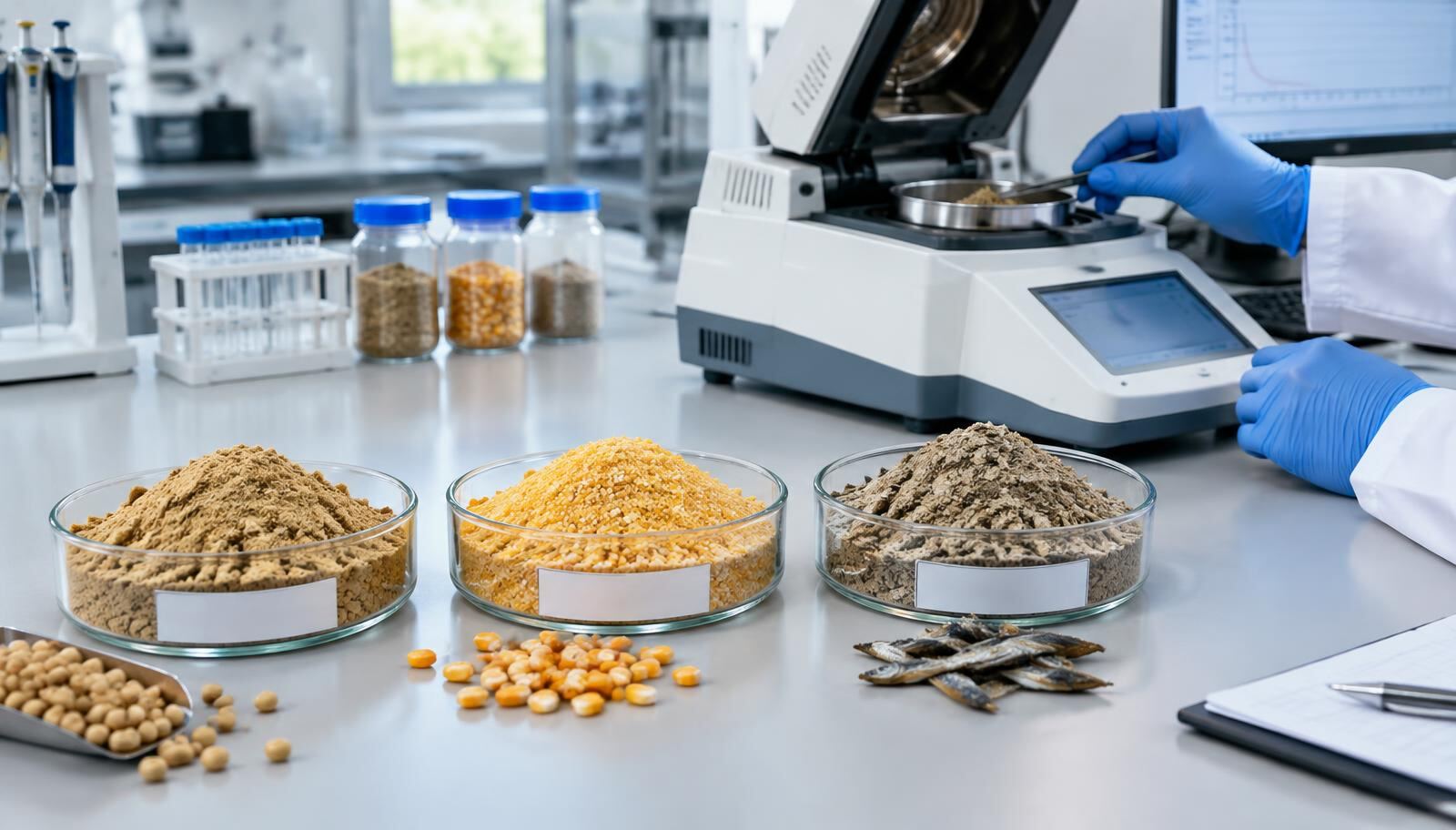
For example (illustrative numbers only), if you receive a load of corn at 15% moisture, 15% of the weight you paid for is water. and another supplier offers corn at 13% moisture, you receive more corn solids (and thus, more energy and nutrients) per ton. You must account for this difference to compare them fairly.
How Do I Convert an 'As-Is' Quote to a Dry Matter Basis?
Converting prices to a dry matter basis is a straightforward way to level the playing field on moisture. This calculation shows you how much you are paying for the actual ingredient solids, stripping out the dilutive effect of water. You can then compare what you are truly paying for the functional part of the ingredient.
Here is the formula: Price per Ton (Dry Matter) = Price per Ton (As-Is) / (1 - Moisture Percentage as a decimal)
Illustrative Calculation (Example Only)
How Do I Interpret a Supplier's Certificate of Analysis (COA)?
The Certificate of Analysis (COA) is a formal document from the supplier that details the specific characteristics of the product batch being sold. Reading it correctly is a critical skill for any buyer. Don't just file it away; scrutinize it.
- Check the Basics: Confirm the product name, lot number, and analysis date. Ensure the document corresponds to the specific batch you are considering for purchase, not a generic product data sheet.
- Find the Key Nutrient Profile: Identify the values for the nutrients you care about most. For soybean meal, this is crude protein and perhaps fiber or fat. For DDGS, it might be protein, fat, and fiber. For a premix ingredient, it could be the concentration of a specific vitamin or mineral.
- Note the Moisture Level: This is crucial, as shown above. The COA provides the moisture percentage needed for your dry matter and landed cost-per-unit-of-nutrient calculations.
- Distinguish Between 'Guaranteed' and 'Typical' Values: This is a vital distinction. A COA might list a 'guaranteed minimum' for protein and a 'typical' value. They mean very different things from a contracting perspective (more on this below).
- Look for Undesirable Elements: Check for data on mycotoxins (e.g., aflatoxin, DON, zearalenone), anti-nutritional factors, heavy metals, or other contaminants. Your RFQ and final contract should specify acceptable limits for these, which you can then compare against the COA.
- Understand the Test Methods: The COA may cite the laboratory methods used (e.g., AOAC, NIR). Method differences between labs can lead to slightly different results. For high-stakes contracts, specifying the testing methodology in your RFQ can prevent future disputes.
What's More Important: Guaranteed Analysis or Typical Values?
Both are useful, but only one is contractually binding. Your purchasing contract and quality assurance program must be built around guaranteed values.
| Feature | Guaranteed Analysis | Typical Analysis |
|---|---|---|
| Contractual Weight | Legally binding. Forms the basis of the contract. Failure to meet it can trigger rejection or claims. | Not binding. An informational average based on historical data. It has no contractual power. |
| Purpose | Establishes a minimum for key nutrients (e.g., protein) or a maximum for others (e.g., moisture, fiber, ash). | Provides a likely or average value to help with initial formulation and evaluation. |
| Risk Level | Low risk for the buyer. The supplier bears the risk of meeting the specification. | High risk for the buyer. The actual product could deviate significantly from the typical value. |
| When to Use It | Use for all specifications in your RFQ, purchase orders, and supply contracts. | Use as a secondary reference point to gauge the general quality and consistency of a supplier's product. |
How Do I Normalize Quotes for a True Apples-to-Apples Comparison?
Follow this checklist to systematically evaluate and compare multiple ingredient quotes. This process moves beyond surface-level pricing to uncover the true economic value of each offer.
- 1. Calculate the Full Landed Cost: Convert all offers to the same incoterm, ideally Delivered Duty Paid (DDP) to your facility. Add freight, insurance, tariffs, and any other fees to the ex-works or FOB price. Use a tool like our landed cost calculator to ensure you capture everything.
- 2. Adjust to a Standard Moisture Basis: Use the moisture value from each supplier's COA or spec sheet to convert the landed cost of each quote to a price per ton on a dry matter basis, as shown in the example above.
- 3. Calculate the Cost Per Unit of Nutrient: This is the ultimate measure of value. Divide the dry matter price by the number of units of your key nutrient. For example (illustrative only), if a meal tested 48% protein on a DM basis (480 kg per ton), you can calculate the cost per kg of protein.
- 4. Review and Compare Specifications: Lay the guaranteed analyses side-by-side. Are you comparing two different protein grades? Are there differences in fiber, ash, or other parameters that could affect its use in your formulations?
- 5. Factor in Other Terms: Consider payment terms, lead times, supplier reputation, and risk factors. The absolute cheapest option may not be the best if the supplier is unreliable.
What Are Common Mistakes When Evaluating Ingredient Bids?
Even experienced managers can fall into traps when under pressure. Be mindful of these common errors: - Focusing only on the price per ton and ignoring the landed cost. - Forgetting to normalize for moisture, effectively overpaying for water. - Mistaking 'typical' values on a data sheet for a contractual 'guaranteed analysis'. - Failing to specify acceptable limits for mycotoxins and other contaminants in the RFQ. - Not considering differences in supplier lead times, reliability, or payment terms. - Accepting a COA without verifying that it applies to the specific lot being offered.
Your Next Step
Comparing quotes is about disciplined, data-driven analysis. By moving beyond the initial price and calculating the true landed cost per unit of nutrient, you can make more profitable and predictable procurement decisions. This level of detail is essential for managing feed costs and ensuring formulation consistency.
When you're ready to source your next bulk ingredient requirement, structure your request to get the clear, comparable data you need from the start. A well-defined request is the foundation of a successful procurement event. FeedMatch Group's human-led process ensures your requirements are specified correctly before any supplier is ever contacted. Start your next sourcing project with a structured feed RFQ or model different scenarios with our landed cost calculator.
Related pages on FeedMatch
Frequently asked questions
- What's the difference between 'as-is' and 'dry-matter' basis?
- The 'as-is' basis is the ingredient as delivered, including water. The 'dry matter' basis represents the ingredient with all moisture removed. Comparing prices on a dry matter basis is essential to avoid overpaying for water.
- Why is landed cost more important than the FOB price?
- Landed cost includes freight, insurance, and duties, representing the total cost to get an ingredient to your facility. It is the only true way to compare suppliers from different geographic locations fairly.
- Can I trust a supplier's Certificate of Analysis (COA)?
- A COA is a critical document, but you should always have a verification process. Specify your required testing methods in your contract and consider independent third-party testing upon arrival for high-value shipments.
- Should I contract based on guaranteed or typical analysis?
- Always structure your purchase contracts based on guaranteed analysis. These are the minimums and maximums the supplier is contractually obligated to meet, whereas typical values are non-binding averages.
- How does FeedMatch help with quote comparison?
- FeedMatch helps you build a detailed RFQ that requires suppliers to provide quotes in a comparable format. Our human-led review ensures your specifications for COAs, pricing basis, and logistics are clearly communicated from the start.
Feed industry regions we work with
Feed procurement is local before it is global: raw material basis, freight and installation costs change by region. These are the areas buyers most often name when defining a feed project in English.
United States
Cities and provinces
Iowa · Nebraska · Georgia · Arkansas · Texas · North Carolina
Corn and soybean meal basis with large integrated poultry, swine and dairy operations.
United States →United Kingdom and Ireland
Cities and provinces
East Anglia · Yorkshire · Lincolnshire · Northern Ireland · Munster
Compound feed and imported protein logistics through east coast and Irish Sea ports.
United Kingdom and Ireland →Gulf and East Africa import markets
Cities and provinces
Jeddah · Dubai · Mombasa · Djibouti
Import-driven feed supply where landed cost and port logistics dominate the decision.
Gulf and East Africa import markets →FeedMatch is supplier-neutral. Regional context helps define the requirement; pricing always comes from manufacturer quotations.
Move from insight to procurement
Turn the ideas in this article into a live procurement action — supplier-neutral, buyer-controlled, fully documented.