
Extrusion vs Pelleting: Which Process Fits Your Feed Specification
Pelleting and extrusion are not competing versions of the same machine. They produce different products. Choose the process from the specification — floating or sinking, starch cooking, fat inclusion — not from a brochure.
Short answer · reviewed September 2026
Short answer: Extrusion vs Pelleting: Which Process Fits Your Feed Specification
Short answer: Pelleting compacts conditioned mash through a die at moderate temperature; extrusion cooks the mash under high temperature, moisture, pressure and shear before it expands at the die. Pelleting is the lower-cost route for poultry, swine and ruminant feeds.
Key takeaways
- The most expensive mistake in feed-plant procurement is treating this as a supplier preference.
- Every row in that table is a line item in a quotation.
- 1. Does the feed need to float, sink slowly, or hold in water?
- Once the process is fixed, the enquiry must state the consequences explicitly, or suppliers will fill in the gaps differently:
- Buying extrusion for a poultry mill. Capability that the product does not need still costs energy and spares every hour the plant runs.
FeedMatch Editorial Desk
Editorial Team
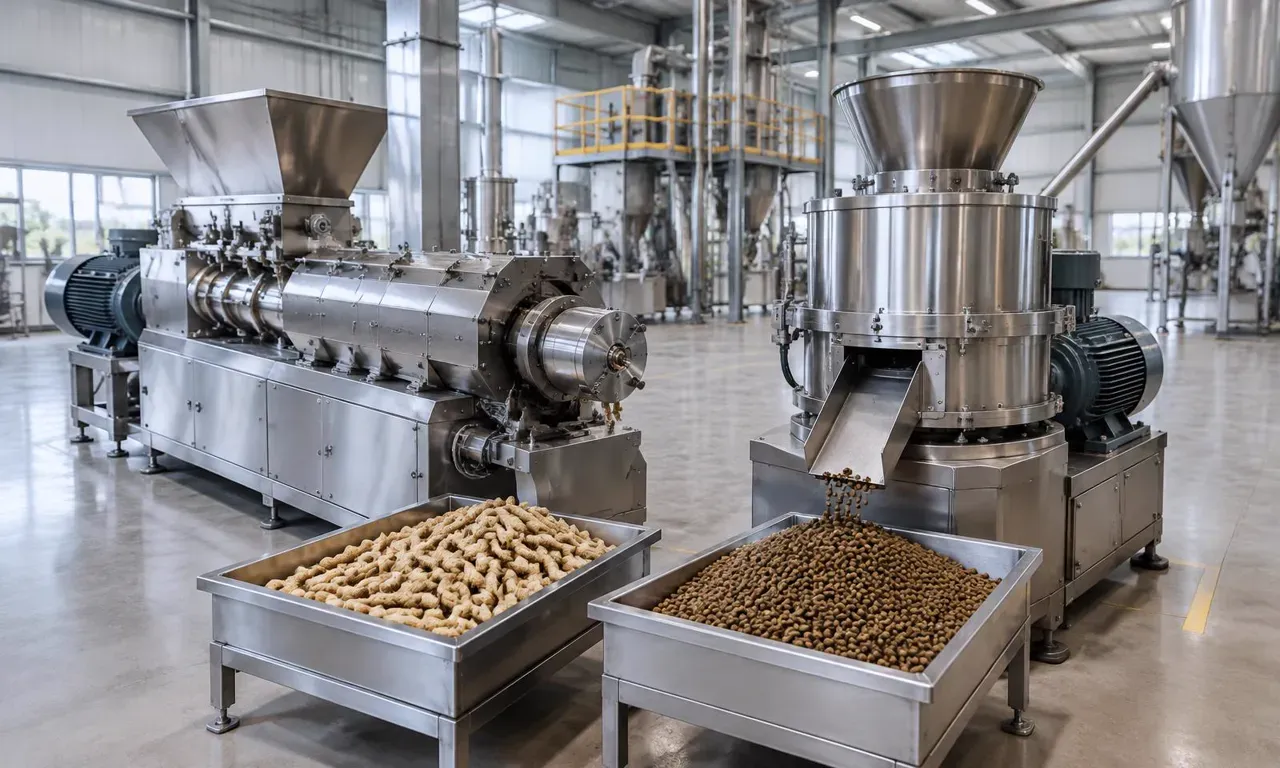
Short answer: Pelleting compacts conditioned mash through a die at moderate temperature; extrusion cooks the mash under high temperature, moisture, pressure and shear before it expands at the die. Pelleting is the lower-cost route for poultry, swine and ruminant feeds. Extrusion is the route when the product must float, sink slowly, hold together in water, carry high fat or achieve high starch gelatinisation — typically aquafeed and pet food. Choose from the product specification, then price the process.
Two different products, not two brands of machine
The most expensive mistake in feed-plant procurement is treating this as a supplier preference. It is a product decision. A pellet press produces a dense, compacted pellet; an extruder produces a cooked, expanded particle whose density can be steered. Once the specification says "floating tilapia feed, 3 mm, water-stable", the process is already decided, and the quotations must reflect that.
Side-by-side comparison
| Dimension | Pelleting | Extrusion |
|---|---|---|
| Typical products | Poultry, swine, ruminant, some sinking aquafeed | Floating and slow-sinking aquafeed, shrimp feed, pet food |
| Process conditions | Steam conditioning, moderate temperature, compaction through a die | High temperature, moisture, pressure and shear; expansion at the die |
| Starch gelatinisation | Partial | High |
| Density control | Limited | Controllable — floating to sinking |
| Water stability | Lower | Substantially higher |
| Maximum fat inclusion | Limited before the press; more added post-pellet | Higher, especially with vacuum coating |
| Downstream equipment | Cooler, crumbler, sifter | Dryer, vacuum coater, cooler, finer sifting |
| Relative capital cost | Lower | Higher |
| Relative energy per tonne | Lower | Higher (thermal plus mechanical) |
| Wear parts | Dies, rollers | Screws, barrels, dies, knives |
| Operator skill required | Moderate | Higher — recipe and process interaction is tighter |
Every row in that table is a line item in a quotation. Two offers that differ by a dryer and a vacuum coater are not comparable on price per tonne of capacity.
How to decide from the specification
- Does the feed need to float, sink slowly, or hold in water? If yes, extrusion.
- Is high starch cooking or digestibility of starch required? Extrusion, or a very aggressive conditioning setup with clear limits.
- Does the formula carry high fat? Extrusion with vacuum coating handles it; pelleting requires post-pellet application and hits durability limits.
- Is the species terrestrial and the form a standard pellet or crumble? Pelleting, almost always.
- Is there a hygienic or pathogen-reduction requirement beyond normal conditioning? Compare a long-conditioning or hygieniser package against extrusion, priced.
- What is the realistic energy situation on site? Extrusion is thermally and electrically hungrier; unreliable grid power changes the answer for real projects, not on paper.
Where both are technically feasible, the decision becomes economic: extra capital and energy against product premium and market access. That comparison belongs in a model, not in a meeting — start with the feed mill calculator, the feed mill ROI calculator and the OPEX guide.
What changes in the RFQ
Once the process is fixed, the enquiry must state the consequences explicitly, or suppliers will fill in the gaps differently:
- Capacity in tonnes per hour per product family, since extruded throughput differs sharply between floating and sinking recipes and between pellet diameters.
- Product list with diameters, target density and required water stability.
- Drying and cooling scope, with ambient design conditions.
- Coating: post-pellet liquid application versus vacuum coating, and the fat percentage to be applied.
- Steam demand, boiler scope and fuel; connected electrical load and expected specific energy consumption.
- Building height, footprint and civil interface — extrusion lines are taller and heavier.
- Wear-part consumption assumptions and a 12-month spares list, priced.
- Commissioning, recipe development support and operator training.
That level of detail is what makes offers comparable line by line. It is also what the RFQ intake captures, and what a reviewer checks before any supplier is contacted.
Where buyers get it wrong
Buying extrusion for a poultry mill. Capability that the product does not need still costs energy and spares every hour the plant runs.
Buying pelleting for aquafeed. Sinking pellets can be pelleted for some species; floating feed cannot. Retrofitting an extruder into a plant designed around a pellet press is expensive and frequently constrained by building height.
Ignoring the dryer. In extrusion the dryer, not the extruder, is often the true capacity bottleneck and a large share of the energy bill.
Comparing t/h without the recipe. Nameplate capacity is quoted on a reference product. Ask for capacity on *your* formulas and diameters.
Related reading: pellet mill vs extrusion line, aquafeed extrusion guide and the feed mill CAPEX guide.
A worked quotation excerpt
Anonymised and illustrative, reconstructed from the structure of offers buyers receive rather than attributed to a named supplier:
Line quoted: Extruded sinking aquafeed, 4 mm, 6 t/h nominal on a 32% CP tilapia formula. Capacity caveat: Nominal capacity stated on the reference formula. Throughput on high-fat or high-starch recipes may fall 15–25%. Scope included: Extruder, dryer, vacuum coater, cooler, control panel, commissioning and 10 days training. Scope excluded: Civil works, steam boiler, electrical supply to panel, spare parts beyond first-year kit. Price: EUR 1.87 m EXW, delivery 34 weeks from down payment.
Two lines decide whether this is comparable to a competing offer: the formula the capacity was measured on, and the excluded scope. A cheaper quotation with the boiler and civils excluded is not cheaper — it is smaller. Normalise both before you compare price per tonne of installed capacity.
Related in this cluster: how to write a feed specification, feed conversion ratio, pellet quality and PDI, extrusion vs pelleting, raw material specifications, sampling and laboratory testing, mycotoxins and feed safety limits, premix and additive specification.
Next step. Turn the numbers into a quotable document: size the volume with the feed requirements calculator, check the commercial frame on the calculators hub, then submit the specification through the RFQ intake. A reviewer reads every brief before suppliers see it.
*FeedMatch Group is an independent, human-led animal feed sourcing and RFQ platform. We are not a feed producer, equipment manufacturer, EPC contractor, farm, laboratory, nutritionist, lender or financial advisor. Every requirement is reviewed by a person before any supplier is approached, and nutritional or veterinary decisions remain with your own nutritionist or veterinarian.*
Frequently asked questions
- When is extrusion required rather than pelleting?
- Extrusion is required when the product must float or sink at a controlled rate, when high starch gelatinisation and water stability are needed — typically fish and shrimp feed — when high fat inclusion is required, or when pathogen reduction and the processing of certain raw materials demand higher temperature and shear than a conditioner and pellet press can deliver.
- Is extruded feed always better?
- No. For poultry, swine and ruminant feeds, pelleting delivers the required form at lower capital and energy cost. Extrusion adds capability that those species generally do not need, and paying for it without a product reason increases cost per tonne with no return.
- Can one line do both?
- A plant can run a pellet line and an extrusion line in parallel, sharing intake, grinding, batching and mixing, then splitting at the process stage with separate drying, coating and cooling for the extruded stream. It is a common layout for mills serving both terrestrial and aqua markets, and it must be designed in from the start rather than retrofitted.
- How does the choice change my RFQ?
- It changes the whole downstream scope: dryer, vacuum coater, cooler sizing, connected load, steam demand, building height and footprint, and the spare-parts and wear-part budget. State the process explicitly, or suppliers will quote different plants against the same enquiry.
Feed industry regions we work with
Feed procurement is local before it is global: raw material basis, freight and installation costs change by region. These are the areas buyers most often name when defining a feed project in English.
United States
Cities and provinces
Iowa · Nebraska · Georgia · Arkansas · Texas · North Carolina
Corn and soybean meal basis with large integrated poultry, swine and dairy operations.
United States →United Kingdom and Ireland
Cities and provinces
East Anglia · Yorkshire · Lincolnshire · Northern Ireland · Munster
Compound feed and imported protein logistics through east coast and Irish Sea ports.
United Kingdom and Ireland →Gulf and East Africa import markets
Cities and provinces
Jeddah · Dubai · Mombasa · Djibouti
Import-driven feed supply where landed cost and port logistics dominate the decision.
Gulf and East Africa import markets →FeedMatch is supplier-neutral. Regional context helps define the requirement; pricing always comes from manufacturer quotations.
Move from insight to procurement
Turn the ideas in this article into a live procurement action — supplier-neutral, buyer-controlled, fully documented.