
Feed Sampling and Laboratory Testing: How to Verify a Specification
A guarantee you cannot test is a sentence, not a clause. Here is the sampling and laboratory routine that turns a feed specification into something a contract can enforce.
Short answer · reviewed September 2026
Short answer: Feed Sampling and Laboratory Testing: How to Verify a Specification
Short answer: Verification has four parts — a written sampling plan, correct sample reduction and retention, named test methods with tolerances, and a pre-agreed arbitration route. Get those into the contract and quality management becomes routine.
Key takeaways
- Modern laboratories are precise. The dominant source of disagreement between a buyer's result and a supplier's certificate is almost never the instrument — it is which handful of material reached it.
- 1. Define the lot. One production batch, one truck, one container, or one delivery day — state which.
- For each guarantee the contract should carry three things: value, tolerance, method.
- Tolerances exist because manufacturing and analysis both vary.
- - Screening layer: moisture, visual, sieve and NIR at intake — fast, every lot, done by operators.
FeedMatch Editorial Desk
Editorial Team
Short answer: Verification has four parts — a written sampling plan, correct sample reduction and retention, named test methods with tolerances, and a pre-agreed arbitration route. Get those into the contract and quality management becomes routine. Leave them out and every guarantee in the specification is unenforceable.
Sampling error dwarfs laboratory error
Modern laboratories are precise. The dominant source of disagreement between a buyer's result and a supplier's certificate is almost never the instrument — it is which handful of material reached it. Feed is heterogeneous: fines settle, additives segregate, toxins concentrate in pockets. A single scoop from the top of a truck is not the lot.
That is why a specification should describe sampling in as much detail as it describes the guarantees.
A workable sampling plan
- Define the lot. One production batch, one truck, one container, or one delivery day — state which.
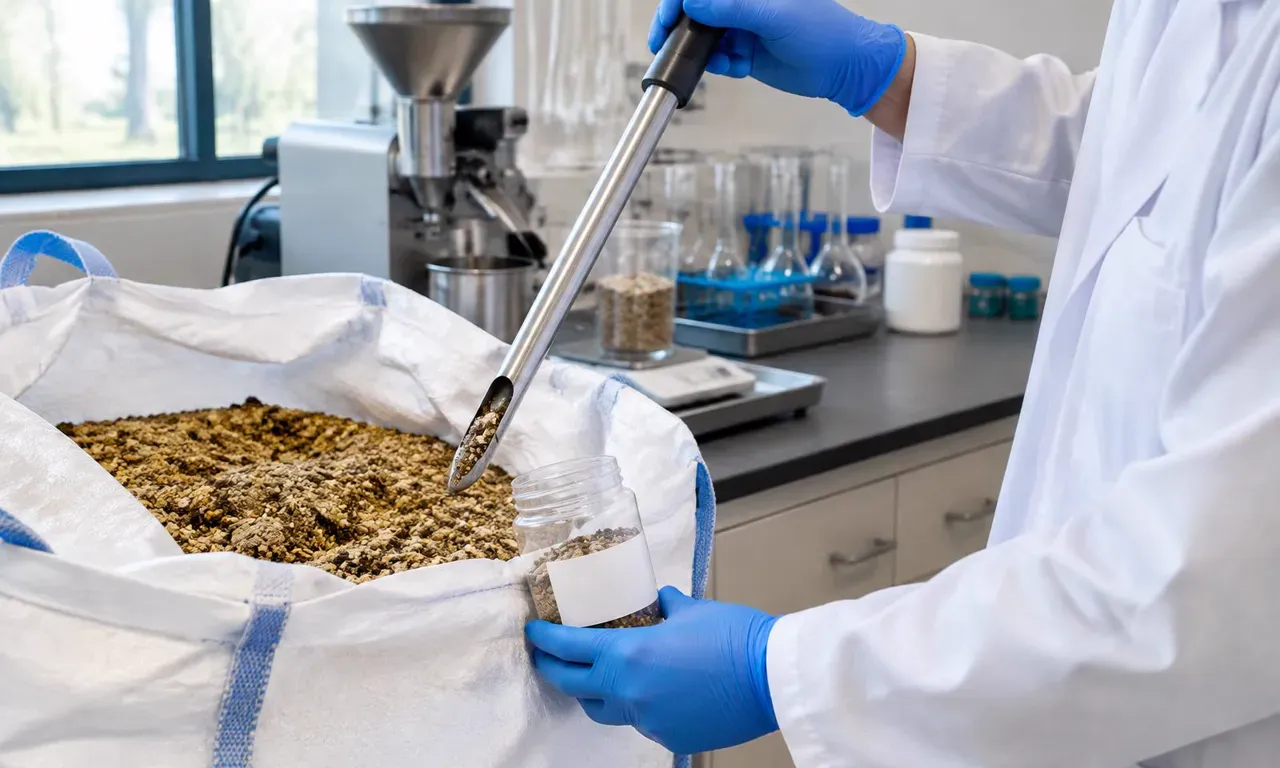
- Take sub-samples across the whole lot. From a moving stream at intervals during discharge, or from a defined number of bags spread through the pallet stack, using a proper probe rather than a hand grab.
- Combine and mix into a bulk sample in a clean, sealed container.
- Reduce correctly by quartering or riffle divider to the final sample size — never by scooping off the top.
- Split three ways: buyer, supplier, retained/arbitration. Seal, label with lot, date, time, location and sampler name, and photograph.
- Store properly. Cool, dark, airtight. A retained sample kept in a hot warehouse proves nothing about moisture or oxidation six months later.
Choosing methods, not just numbers
| Parameter | Typical reference approach | Practical note |
|---|---|---|
| Crude protein | Kjeldahl or Dumas | State which; results are close but not identical |
| Crude fat | Solvent extraction, with or without hydrolysis | Hydrolysed values run higher — name the variant |
| Moisture | Oven drying at a defined temperature and time | The single most disputed parameter; fix the method |
| Fibre | Crude fibre, ADF or NDF | Different concepts, not interchangeable |
| Amino acids | Ion-exchange chromatography after hydrolysis | Expensive; test selectively, on the limiting ones |
| Mycotoxins | ELISA screening, LC-MS/MS confirmation | Screen widely, confirm disputes instrumentally |
| Pellet durability | Tumbling box or pneumatic tester, stated duration | See the pellet quality article |
| Salmonella | Culture method, 25 g sample | State the sampling frequency, not only the limit |
For each guarantee the contract should carry three things: value, tolerance, method. Anything less is not testable.
Tolerances that survive contact with reality
Tolerances exist because manufacturing and analysis both vary. A sensible clause distinguishes between a single result and a pattern: one result marginally outside tolerance triggers a re-test on the retained sample; repeated deviation in the same direction triggers a commercial remedy. Absolute limits — toxins, salmonella, prohibited ingredients — have no tolerance and should be written as immediate rejection criteria.
State the rounding convention and the measurement-uncertainty treatment as well. Two laboratories reporting 20.8% and 21.1% protein against a 21.0% guarantee are not in conflict; a contract that does not say so will create one.
Building the routine on site
- Screening layer: moisture, visual, sieve and NIR at intake — fast, every lot, done by operators.
- Verification layer: wet chemistry on a rotating schedule and on every suspicious lot.
- Safety layer: toxin and pathogen testing on a risk-based frequency tied to origin and season.
- Trend layer: a simple spreadsheet or QC module tracking each supplier against each guarantee over time. This is the artefact that changes prices at the next tender.
Certificates of analysis are evidence, not proof
A CoA describes the supplier's sample, taken by the supplier, at the supplier's plant. It is useful and should be required for every batch, with the method stated on the document — but it is not a substitute for your own sampling at discharge. Reconcile the two systematically; persistent divergence between CoA and arrival results is itself a quality finding.
When something fails
Follow a pre-written path: quarantine the lot, notify within the contractual window, re-test the retained sample, escalate to the agreed independent laboratory if results conflict, and apply the agreed remedy — price adjustment, replacement, or rejection. Document each step with dates and quantities. Buyers who handle the first failure procedurally rarely have to handle the third one.
Verification is also what makes a serious tender credible: suppliers price risk differently when they know the buyer measures. Structure the requirement in the composition specification and submit it via the RFQ intake.
A worked quotation excerpt
Anonymised and illustrative — the structure of a laboratory and inspection quotation, not a named provider:
Scope: Sampling at discharge per GAFTA method, composite from 5% of bags, three-way split. Analyses: Proximate (CP, fat, fibre, ash, moisture); aflatoxin B1 by HPLC; salmonella in 25 g. Turnaround: 5 working days; 48-hour expedited at +60%. Price: USD 185 per composite sample, plus USD 240 per attendance. Retention: Retained sample stored 6 months.
Testing cost is small relative to a rejected shipment, but only if the sampling protocol and retention period are written into the supply contract before the first delivery. A certificate produced from a sample nobody witnessed settles nothing.
Related in this cluster: how to write a feed specification, feed conversion ratio, pellet quality and PDI, extrusion vs pelleting, raw material specifications, sampling and laboratory testing, mycotoxins and feed safety limits, premix and additive specification.
Next step. Turn the numbers into a quotable document: size the volume with the feed requirements calculator, check the commercial frame on the calculators hub, then submit the specification through the RFQ intake. A reviewer reads every brief before suppliers see it.
*FeedMatch Group is an independent, human-led animal feed sourcing and RFQ platform. We are not a feed producer, equipment manufacturer, EPC contractor, farm, laboratory, nutritionist, lender or financial advisor. Every requirement is reviewed by a person before any supplier is approached, and nutritional or veterinary decisions remain with your own nutritionist or veterinarian.*
Frequently asked questions
- How many sub-samples make a valid composite?
- Enough to represent the lot. Common practice is at least ten sub-samples taken across the discharge or across the bags, combined, mixed and reduced by quartering or a riffle divider to the final laboratory sample. The plan should be written into the contract, because a dispute about a result is usually a dispute about sampling.
- Is NIR analysis good enough for contract testing?
- NIR is excellent for fast routine monitoring, but its accuracy depends on a calibration matched to the product. For contractual guarantees, name the wet-chemistry reference method and use NIR as the screening layer that decides when to send a sample to the laboratory.
- How long should retained samples be kept?
- At least as long as the shelf life of the feed, and typically six months for commercial contracts, held by both parties under stated storage conditions. Without a retained sample, a later dispute has no physical evidence.
- Who pays for a disputed test?
- Write it into the contract: an agreed independent laboratory, an agreed method, and the cost borne by the party whose result is not upheld. Pre-agreeing the arbitration route removes most of the incentive to argue.
Feed industry regions we work with
Feed procurement is local before it is global: raw material basis, freight and installation costs change by region. These are the areas buyers most often name when defining a feed project in English.
United States
Cities and provinces
Iowa · Nebraska · Georgia · Arkansas · Texas · North Carolina
Corn and soybean meal basis with large integrated poultry, swine and dairy operations.
United States →United Kingdom and Ireland
Cities and provinces
East Anglia · Yorkshire · Lincolnshire · Northern Ireland · Munster
Compound feed and imported protein logistics through east coast and Irish Sea ports.
United Kingdom and Ireland →Gulf and East Africa import markets
Cities and provinces
Jeddah · Dubai · Mombasa · Djibouti
Import-driven feed supply where landed cost and port logistics dominate the decision.
Gulf and East Africa import markets →FeedMatch is supplier-neutral. Regional context helps define the requirement; pricing always comes from manufacturer quotations.
Move from insight to procurement
Turn the ideas in this article into a live procurement action — supplier-neutral, buyer-controlled, fully documented.