
Feed Composition: How to Write a Feed Specification Suppliers Can Quote
Most feed enquiries are priced twice: once on assumption, once again after the truth emerges. A written composition spec closes that gap. Here is every line a supplier needs, and why each one changes the price.
Short answer · reviewed September 2026
Short answer: Feed Composition: How to Write a Feed Specification Suppliers Can Quote
Short answer: A commercial feed specification is a testable document, not a description. It states species and stage, feed form, nutrient guarantees with tolerances and test methods, ingredient restrictions, physical quality limits, packaging, volume and frequency, destination and Incoterm, and the compliance regime.
Key takeaways
- Feed is a manufactured product built from volatile raw materials.
- Species, breed or genetic line where relevant, production stage, and the housing or farming system.
- Product: Broiler grower pellet, 3.0 mm. Species/stage: Ross 308 broiler, days 11–24, closed house.
- - Take a representative sample at discharge, split three ways: yours, the supplier's, an independent retained sample.
- Copying a competitor's label. Labels state minimums for a different genetic line, climate and raw-material base.
FeedMatch Editorial Desk
Editorial Team
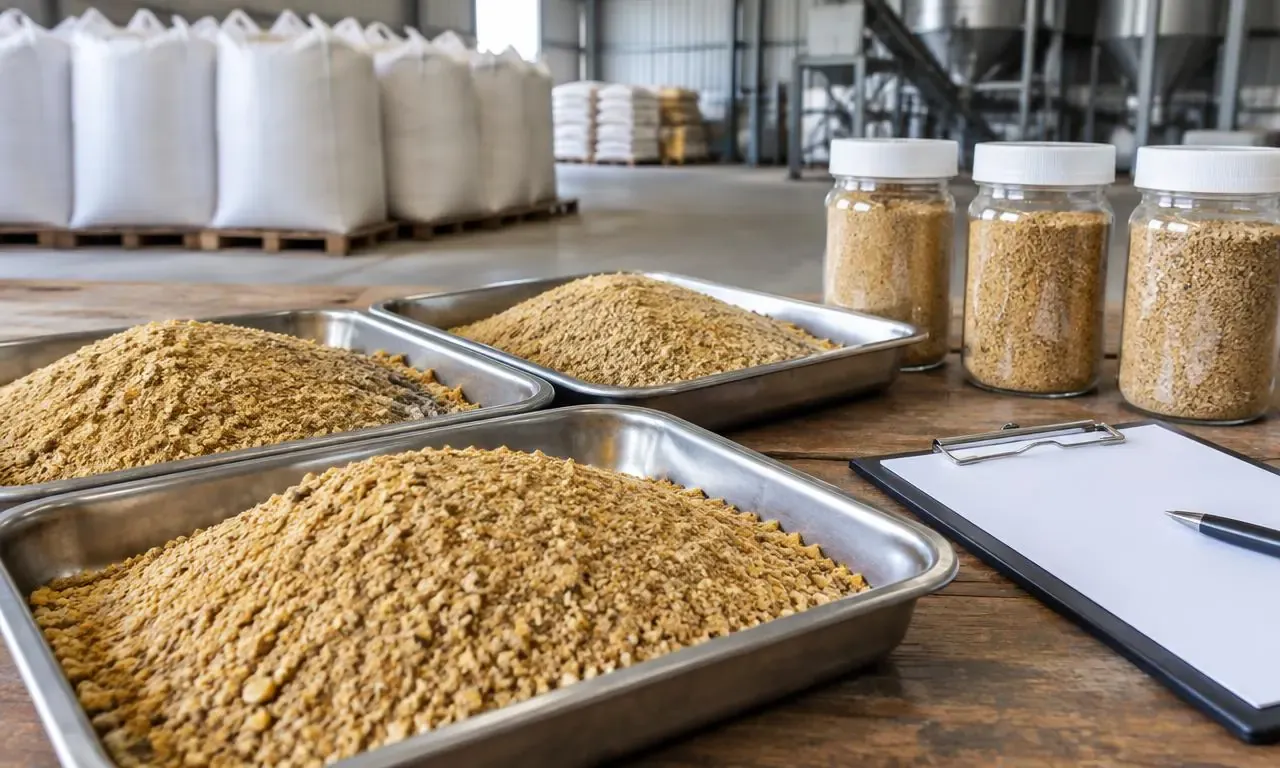
Short answer: A commercial feed specification is a testable document, not a description. It states species and stage, feed form, nutrient guarantees with tolerances and test methods, ingredient restrictions, physical quality limits, packaging, volume and frequency, destination and Incoterm, and the compliance regime. Written that way, offers become directly comparable — because every supplier is pricing the same product.
Why the specification decides the price, not the negotiation
Feed is a manufactured product built from volatile raw materials. When a buyer writes "broiler starter, 500 t per month, best price", each supplier fills the gaps with its own assumptions: a different protein level, a different amino acid profile, a different fat source, a different pellet diameter, a different bag. Three quotes arrive that look comparable and are not. The cheapest one is usually cheapest because it assumed less.
Fixing the specification first removes that variance. It also protects the buyer commercially: once the parameters are guaranteed with tolerances and methods, price differences reflect real efficiency — raw material access, freight position, plant utilisation — rather than a quieter formula.
The seven blocks of a complete feed specification
1. Animal and purpose
Species, breed or genetic line where relevant, production stage, and the housing or farming system. "Broiler starter for a 42-day programme, Ross 308, closed house" tells a formulator far more than "chicken feed". For aquaculture, add water temperature range, salinity and whether the feed must float, sink slowly or sink.
2. Nutrient guarantees
These are the numbers you will test against. For most terrestrial species the core set is crude protein, crude fat, crude fibre, ash, moisture, calcium, total phosphorus, sodium, and — for monogastrics — the limiting amino acids (lysine, methionine plus cystine, threonine, tryptophan) expressed as total or digestible, stated explicitly. Energy is quoted as metabolisable energy for poultry and swine and as digestible energy for fish; say which system you are using, because the values are not interchangeable.
Every guarantee needs three attributes to be enforceable: the value, the tolerance, and the reference method. "Crude protein minimum 21.0%, tolerance −0.5 percentage points, method AOAC 990.03 (Dumas)" can be audited. "21% protein" cannot.
3. Ingredient policy
State restrictions rather than a recipe. Common lines include: no ruminant-derived processed animal protein; no antibiotic growth promoters; no ractopamine; maximum inclusion levels for by-products such as distillers grains, rice bran or poultry offal meal; approved fat sources; non-GMO or identity-preserved status if your market requires it; and mycotoxin binders where the raw-material base justifies them. Each restriction has a cost; ask for it priced as an option so you can see what compliance actually buys you.
4. Physical form and quality
Mash, crumble, pellet or extruded; pellet diameter and length; crumble sieve range; durability and fines limits for pelleted product; bulk density for extruded aquafeed and the required floating or sinking behaviour and water stability in minutes. Physical quality is where a large share of paid-for nutrition is lost in transit, which is why it gets its own article in this cluster.
5. Safety and compliance limits
Maximum moisture, mycotoxin limits by toxin (aflatoxin B1, DON, zearalenone, fumonisins, ochratoxin A), heavy metals, salmonella status, dioxins where relevant, and the residue rules of the destination country. Add the withdrawal and medication regime if medicated feed is in scope, plus the labelling language and format your regulator requires.
6. Logistics and packaging
Bulk or bagged; bag weight and material; palletisation and shrink wrap; container stuffing method; shelf life from date of manufacture and required remaining shelf life on arrival; storage temperature and humidity assumptions; delivery frequency and the tolerance on each shipment quantity. For long ocean legs, moisture and fat oxidation limits matter more than most buyers expect.
7. Commercial frame
Monthly and annual volume, contract duration, destination port or farm, Incoterm, currency, payment terms, price adjustment mechanism if raw materials are indexed, documentation set, and the sampling and arbitration procedure. State who draws the retained sample and where — this single line prevents most quality disputes from becoming unresolvable.
A copyable specification skeleton
Product: Broiler grower pellet, 3.0 mm. Species/stage: Ross 308 broiler, days 11–24, closed house. Volume: 500 t/month, 12-month frame, ±10% per shipment. Nutrients (guaranteed): CP min 20.5% (−0.5 pp, Dumas); ME 3,050 kcal/kg (calculated, formula disclosed); crude fat min 5.0%; crude fibre max 4.0%; ash max 7.0%; moisture max 12.5%; Ca 0.85–1.00%; available P min 0.42%; dig. lysine min 1.10%; dig. Met+Cys min 0.82%. Ingredient policy: No ruminant PAP; no AGPs; DDGS max 6%; approved fats: soybean oil, palm oil; mycotoxin binder included. Physical: Pellet 3.0 × 6–9 mm; PDI min 92% (Holmen 60 s); fines at loading max 2%. Safety: Aflatoxin B1 max 10 ppb; DON max 1.0 ppm; Salmonella absent in 25 g. Packaging: 50 kg PP bags, palletised, 24-month printed traceability code. Commercial: CFR destination port, USD, 90-day validity, retained samples held 6 months by both parties.
That brief can be priced on first read, tested on arrival, and enforced in a contract. It is also the format the RFQ intake collects, which is why briefs submitted through it come back with fewer clarification rounds.
What buyers should verify on arrival
- Take a representative sample at discharge, split three ways: yours, the supplier's, an independent retained sample.
- Test the guarantees you actually paid a premium for, not everything — protein, fat, moisture and the critical amino acid or toxin limit usually suffice.
- Check physical quality at the point of use, not only at loading; fines generated in transit are the buyer's real loss.
- Reconcile the label and certificate of analysis against the specification line by line.
- Log deviations with dates and quantities. A tolerance clause is only useful if you can show a pattern.
Common mistakes
Copying a competitor's label. Labels state minimums for a different genetic line, climate and raw-material base. They are a starting point, never a specification.
Guaranteeing what you cannot test. If no accessible laboratory runs the method, the clause is decorative. Specify what your region's laboratories can actually measure.
Leaving physical quality out. Nutrient composition is only delivered if the pellet survives handling. Buyers who omit durability limits pay for nutrition that arrives as dust.
Confusing total and digestible amino acids. The two scales differ enough to change both the formula and the price. Always state which one you mean.
A worked quotation excerpt
The excerpt below is anonymised and illustrative — it is reconstructed from the structure of quotations buyers receive, not attributed to any named supplier — and it shows what a specification-driven offer looks like when the composition brief above is used:
Product quoted: Broiler grower pellet 3.0 mm, per buyer specification rev. 2. Guarantees confirmed: CP 20.5% min (Dumas, AOAC 990.03, −0.5 pp); crude fat 5.2% min; moisture 12.5% max; dig. lysine 1.10% min. Deviation declared: DDGS inclusion requested at max 6%; our formula uses 4% — no price impact. Price: USD 438 / t CFR destination port, bagged 50 kg PP, validity 21 days. Price basis: Raw material component USD 331 / t indexed to CBOT soymeal + local corn; conversion and packaging USD 62 / t; freight USD 45 / t. Retained samples: 6 months, both parties, drawn at loading.
Read it in this order: first check every guarantee against your own line items, then check the declared deviations, and only then look at the number. An offer that separates the raw material component from conversion and freight can be re-priced later without renegotiating the whole contract; one that quotes a single figure cannot.
Related in this cluster: how to write a feed specification, feed conversion ratio, pellet quality and PDI, extrusion vs pelleting, raw material specifications, sampling and laboratory testing, mycotoxins and feed safety limits, premix and additive specification.
Next step. Turn the numbers into a quotable document: size the volume with the feed requirements calculator, check the commercial frame on the calculators hub, then submit the specification through the RFQ intake. A reviewer reads every brief before suppliers see it.
*FeedMatch Group is an independent, human-led animal feed sourcing and RFQ platform. We are not a feed producer, equipment manufacturer, EPC contractor, farm, laboratory, nutritionist, lender or financial advisor. Every requirement is reviewed by a person before any supplier is approached, and nutritional or veterinary decisions remain with your own nutritionist or veterinarian.*
Frequently asked questions
- What is the minimum a feed specification must contain?
- Species and production stage, feed form and particle or pellet size, the nutrient guarantees you will hold the supplier to (typically crude protein, crude fat, crude fibre, ash, moisture and the critical amino acids or energy value), any ingredient restrictions, packaging, volume and delivery frequency, destination and Incoterm, and the certification or labelling regime that applies in your country.
- Should I specify ingredients or nutrients?
- Specify nutrients as guarantees and ingredients as restrictions. Nutrient guarantees let a supplier use locally available raw materials at the best price while still meeting your animals' requirement. Ingredient restrictions — for example no ruminant-derived protein, no antibiotic growth promoters, a maximum inclusion of a by-product — protect compliance and consistency without forcing an uneconomic formula.
- Who signs off the nutritional targets?
- Your own nutritionist or veterinarian. FeedMatch structures the requirement and runs the sourcing process; it does not prescribe rations or replace professional nutritional advice.
- How exact do tolerances need to be?
- Exact enough to be testable. A guarantee without a tolerance and a reference method is unenforceable, so state the analytical method, the sampling point, and the accepted deviation for each guaranteed parameter before the first delivery, not after a dispute.
Feed industry regions we work with
Feed procurement is local before it is global: raw material basis, freight and installation costs change by region. These are the areas buyers most often name when defining a feed project in English.
United States
Cities and provinces
Iowa · Nebraska · Georgia · Arkansas · Texas · North Carolina
Corn and soybean meal basis with large integrated poultry, swine and dairy operations.
United States →United Kingdom and Ireland
Cities and provinces
East Anglia · Yorkshire · Lincolnshire · Northern Ireland · Munster
Compound feed and imported protein logistics through east coast and Irish Sea ports.
United Kingdom and Ireland →Gulf and East Africa import markets
Cities and provinces
Jeddah · Dubai · Mombasa · Djibouti
Import-driven feed supply where landed cost and port logistics dominate the decision.
Gulf and East Africa import markets →FeedMatch is supplier-neutral. Regional context helps define the requirement; pricing always comes from manufacturer quotations.
Move from insight to procurement
Turn the ideas in this article into a live procurement action — supplier-neutral, buyer-controlled, fully documented.