
Feed Conversion Ratio: What Buyers Should Specify, Measure and Verify
Price per tonne is the wrong comparison. Cost per kilogram of gain is the right one — and it depends on a number no supplier fully controls. Here is how to measure FCR honestly and use it in a tender.
Short answer · reviewed September 2026
Short answer: Feed Conversion Ratio: What Buyers Should Specify, Measure and Verify
Short answer: FCR is feed consumed divided by weight gained. It is the bridge between a feed price and a farm result, so it belongs in every commercial comparison — but it cannot be guaranteed by a supplier, because most of the variables sit on the farm.
Key takeaways
- Two offers, USD 470 and USD 495 per tonne.
- 1. Fix the boundaries. Same population, same period, same weighing method.
- The supplier controls the input, not the outcome.
- Ask every bidder for the same evidence pack, and score it the same way.
- Baseline: your own recorded FCR on the current feed, averaged over the last six cycles, at a defined target weight.
FeedMatch Editorial Desk
Editorial Team
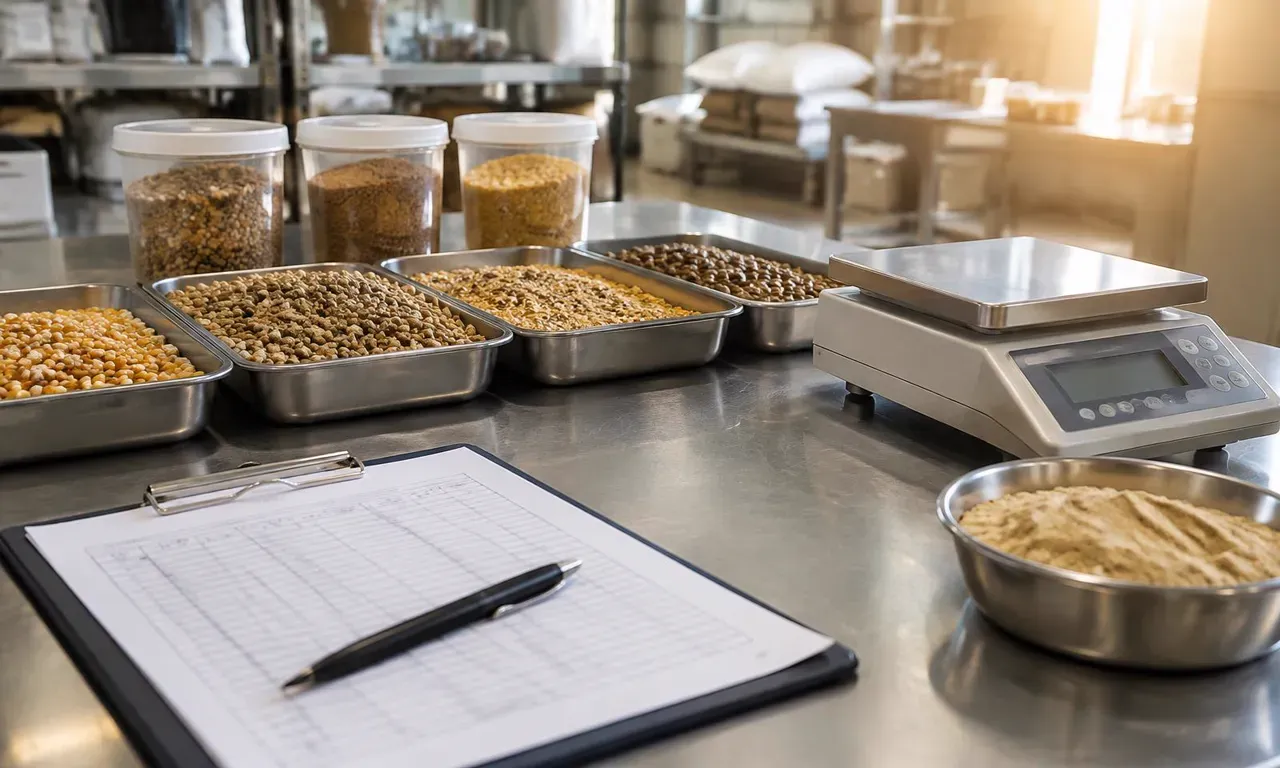
Short answer: FCR is feed consumed divided by weight gained. It is the bridge between a feed price and a farm result, so it belongs in every commercial comparison — but it cannot be guaranteed by a supplier, because most of the variables sit on the farm. Specify what the supplier controls (composition, digestibility indicators, physical quality) and evaluate offers on cost per kilogram of gain using your own measured FCR.
Why price per tonne misleads
Two offers, USD 470 and USD 495 per tonne. The cheaper one looks like an easy decision until the arithmetic is done on the animal instead of the invoice. If the more expensive feed reduces the feed needed per kilogram of gain by even a small margin, its cost per kilogram of live weight can be lower — and cost per kilogram of gain, not price per tonne, is what the business actually pays.
The reverse is equally true. A premium formula that does not change the farm result is simply a more expensive input. Neither claim can be settled by argument; both are settled by measurement.
How to measure FCR so the number means something
- Fix the boundaries. Same population, same period, same weighing method. Feed delivered is not feed consumed — account for bin residue, spillage and any feed left at the end of the cycle.
- Correct for mortality. Removing dead animals from the gain figure without removing the feed they ate inflates FCR; a standard mortality-corrected calculation avoids arguing about it later.
- Correct for weight. FCR rises with slaughter weight in most species, so compare batches at the same target weight or use an adjusted FCR.
- Record the conditions. Season, ambient temperature, stocking density, health events, water quality, and any ration change mid-cycle. Without those, two cycles are not comparable.
- Use enough cycles. A single batch is an anecdote. A rolling average across several cycles, on the same house or pond, is evidence.
What the feed actually controls
The supplier controls the input, not the outcome. The controllable, specifiable levers are:
- Energy and amino acid balance relative to the species and stage — the primary driver of efficiency the formula can influence.
- Digestibility. Raw material quality, heat treatment, particle size and enzyme use change how much of the declared nutrient is available.
- Physical quality. Fines are eaten less efficiently or not at all; poor water stability in aquafeed puts nutrition into the water column. Both show up as worse FCR without any change in composition.
- Consistency between batches. Variability forces the animal to adapt repeatedly and blurs any measurement you attempt.
- Freshness and oxidation. Rancid fat depresses intake and performance, which is why shelf-life and peroxide limits belong in the specification.
Everything else — genetics, brooding, ventilation, water, health programme, feeder space, management — sits on the farm. This is why an FCR warranty from a feed supplier is a commercial red flag rather than a benefit: it is a promise about someone else's operation.
Using FCR in a tender without over-promising
A workable structure for a serious feed tender:
| Element | How to treat it |
|---|---|
| Nutrient guarantees | Contractual, with tolerances and test methods |
| Physical quality (PDI, fines, water stability) | Contractual, tested at loading and on arrival |
| Batch consistency | Contractual, via retained samples and CoA history |
| Digestibility support | Requested evidence: trial data, references, method disclosure |
| FCR | Evaluation model only, using your own baseline |
| Cost per kg of gain | The comparison metric that ranks the offers |
Ask every bidder for the same evidence pack, and score it the same way. Where a supplier cites trial results, ask for the conditions: species, genetics, number of animals, control diet, duration, and who ran it. A result without conditions is marketing.
A worked comparison frame
Baseline: your own recorded FCR on the current feed, averaged over the last six cycles, at a defined target weight. For each offer: indicative cost per kg gain = feed price per kg × assumed FCR. Sensitivity: repeat with FCR at baseline, baseline −0.05 and baseline +0.05. Decision rule: if an offer only wins under an FCR improvement the supplier cannot evidence, treat it as the more expensive offer.
That frame is deliberately conservative. It rewards suppliers who can substantiate a specification and neutralises claims that cannot be tested.
Where this fits in procurement
FCR is the reason the composition specification and pellet quality clauses matter commercially rather than technically. It is also the practical reason many operations eventually evaluate their own production: run the numbers on the feed requirements calculator and the calculators hub before assuming either buying or producing is cheaper.
A worked quotation excerpt
Anonymised and illustrative, reconstructed from the structure of offers buyers receive rather than attributed to any named supplier — this is how a performance-relevant quotation is framed:
Product quoted: Broiler finisher pellet, per buyer specification. Price: USD 424 / t CFR, validity 30 days. Nutrient density: ME 3,150 kcal/kg; dig. lysine 1.02%. Supplier note: Our finisher runs approximately 60 kcal/kg above the reference formula; no performance guarantee is offered, as feed conversion depends on genetics, health status and farm management outside our control.
That last line is the honest one, and you should expect it. No serious supplier guarantees FCR. What the quotation gives you is nutrient density and price; you convert those into cost per kilogram of liveweight yourself using your own historical conversion, which is exactly the calculation shown above.
Related in this cluster: how to write a feed specification, feed conversion ratio, pellet quality and PDI, extrusion vs pelleting, raw material specifications, sampling and laboratory testing, mycotoxins and feed safety limits, premix and additive specification.
Next step. Turn the numbers into a quotable document: size the volume with the feed requirements calculator, check the commercial frame on the calculators hub, then submit the specification through the RFQ intake. A reviewer reads every brief before suppliers see it.
*FeedMatch Group is an independent, human-led animal feed sourcing and RFQ platform. We are not a feed producer, equipment manufacturer, EPC contractor, farm, laboratory, nutritionist, lender or financial advisor. Every requirement is reviewed by a person before any supplier is approached, and nutritional or veterinary decisions remain with your own nutritionist or veterinarian.*
Frequently asked questions
- How is feed conversion ratio calculated?
- FCR is total feed consumed divided by total live weight gained over the same period and the same population. For a broiler flock, that is kilograms of feed delivered and consumed divided by kilograms of live weight produced. Adjusted FCR corrects for mortality and for a target slaughter weight so that batches of different sizes can be compared.
- Can a feed supplier guarantee an FCR?
- No credible supplier can guarantee a farm-level FCR, because genetics, stocking density, health status, water quality, ambient temperature, ventilation and management influence it as much as the feed does. What a supplier can guarantee is the specification — nutrient values, digestibility indicators and physical quality — which is the part they control.
- Should FCR appear in a feed tender at all?
- Yes, as an evaluation frame rather than a warranty. Convert each offer into an indicative cost per kilogram of gain using your own historic FCR, and ask suppliers to support their specification with trial data or references. Buy the specification; evaluate with the economics.
- What FCR should I expect for my species?
- Published ranges differ widely by species, genetics, climate and system, and any single number quoted without those conditions is misleading. Use your own farm history as the baseline and treat external benchmarks as a sanity check, verified with your nutritionist.
Feed industry regions we work with
Feed procurement is local before it is global: raw material basis, freight and installation costs change by region. These are the areas buyers most often name when defining a feed project in English.
United States
Cities and provinces
Iowa · Nebraska · Georgia · Arkansas · Texas · North Carolina
Corn and soybean meal basis with large integrated poultry, swine and dairy operations.
United States →United Kingdom and Ireland
Cities and provinces
East Anglia · Yorkshire · Lincolnshire · Northern Ireland · Munster
Compound feed and imported protein logistics through east coast and Irish Sea ports.
United Kingdom and Ireland →Gulf and East Africa import markets
Cities and provinces
Jeddah · Dubai · Mombasa · Djibouti
Import-driven feed supply where landed cost and port logistics dominate the decision.
Gulf and East Africa import markets →FeedMatch is supplier-neutral. Regional context helps define the requirement; pricing always comes from manufacturer quotations.
Move from insight to procurement
Turn the ideas in this article into a live procurement action — supplier-neutral, buyer-controlled, fully documented.