
Premix and Additive Specification: What Buyers Must State to Get Comparable Offers
Premix offers are the hardest to compare, because the price hides the dose. Here is how to specify vitamins, trace minerals, enzymes and carriers so that two quotes describe the same product.
Short answer · Updated October 2026
Short answer: Premix and Additive Specification: What Buyers Must State to Get Comparable Offers
Short answer: A premix specification must state the declared dose of every active per tonne of finished feed, the chemical form, the carrier, the inclusion rate, the overage and shelf-life assumptions, the packaging and storage regime, and the verification method.
Key takeaways
- The lower price per kilogram is not necessarily the lower cost per tonne of finished feed.
- Declared quantity of each vitamin per tonne of finished feed, the source form (for example the ester or stabilised form used), the overage policy, and the guaranteed activity at end of shelf life under stated storage conditions.
- Medicated premixes, coccidiostats and any veterinary-regulated substance sit under prescription and withdrawal rules that vary by country and species.
- - Mixer uniformity: test with a tracer or a measurable micro-ingredient and record the coefficient of variation; specify the acceptable CV and re-test after any mixer maintenance or change of mixing time.
- Product: species and phase; nutritionist-approved specification and kg/t.
FeedMatch Editorial Desk
Editorial Team
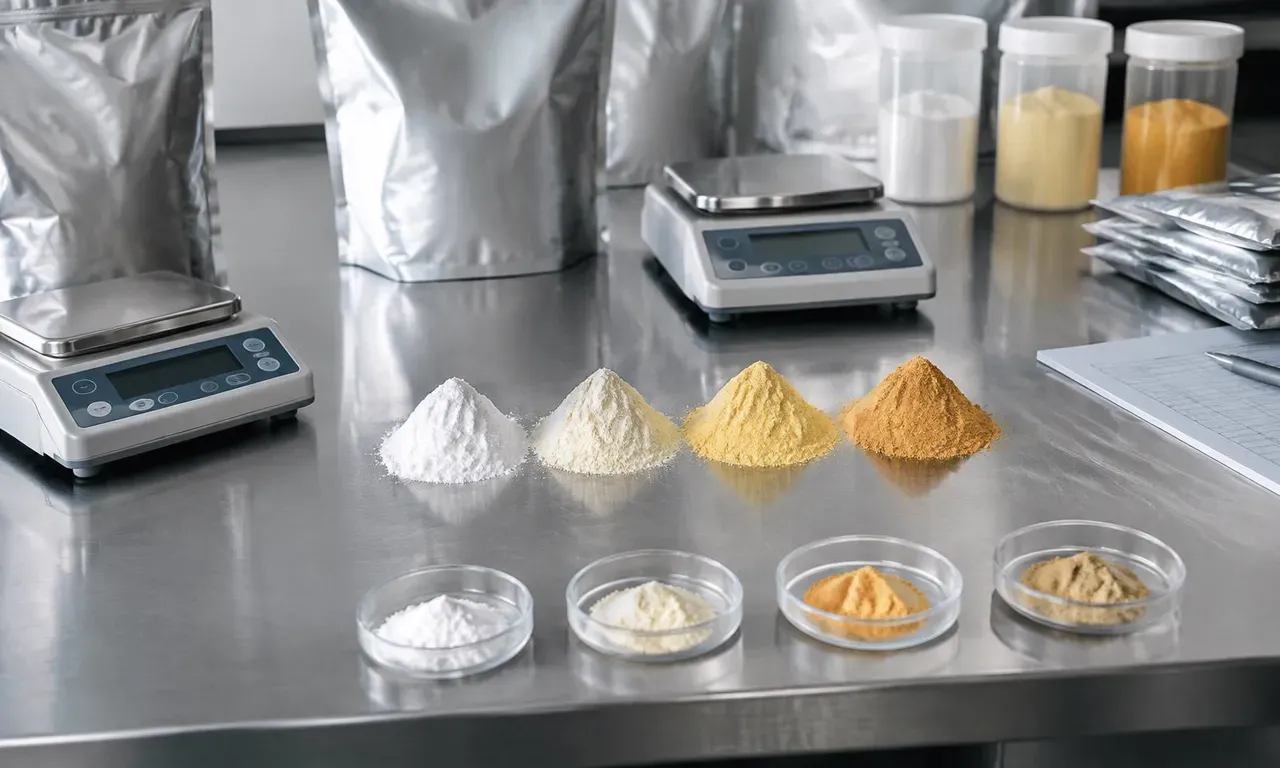
Short answer: A premix specification must state the declared dose of every active per tonne of finished feed, the chemical form, the carrier, the inclusion rate, the overage and shelf-life assumptions, the packaging and storage regime, and the verification method. Written that way, two quotations become comparable at cost per tonne of finished feed rather than price per kilogram of powder.
The comparison trap
The lower price per kilogram is not necessarily the lower cost per tonne of finished feed. Compare buyer-supplied delivered price per kilogram × the nutritionist-approved kilograms per tonne, then review the declared activity and source compounds. This arithmetic does not demonstrate nutritional equivalence or safe use; neither prices nor approved doses are supplied by this article.
What the specification must state
Vitamins
Declared quantity of each vitamin per tonne of finished feed, the source form (for example the ester or stabilised form used), the overage policy, and the guaranteed activity at end of shelf life under stated storage conditions. Vitamins A, D3, E, K3 and the B-group differ widely in stability; a premix that is compliant at manufacture and degraded at use is a real and frequent loss.
Trace minerals
State element and exact chemical form — sulphate, oxide, hydroxychloride, organic or chelated — with guaranteed elemental content, test methods and buyer-approved contaminant criteria. An elemental target alone is incomplete. Do not infer bioavailability or permissible substitution from a source-form label.
Enzymes and other functional additives
Activity units per tonne of finished feed with the assay method named, thermostability characteristics relative to your conditioning temperature, and the regulatory approval status in the destination market. For phytase in particular, state the matrix values your formulation applies, so everyone is pricing the same nutritional assumption.
Carrier, anticaking and physical properties
Carrier type and origin, moisture, bulk density, flowability, particle size relative to the rest of the formula, and colour or marker if you use one for visual verification. A premix that segregates in the mixer defeats every number above it.
Packaging, storage and shelf life
Bag material and weight, moisture and light barrier, palletisation, printed batch code, manufacture date, shelf life and the storage temperature and humidity the shelf life assumes. Tropical warehouses are the usual reason a premix underperforms its certificate.
Medicated and prescription products
Medicated premixes, coccidiostats and any veterinary-regulated substance sit under prescription and withdrawal rules that vary by country and species. Those decisions belong to your veterinarian and your regulator. Commercially, the contract should require the approval documentation, the carry-over and flushing regime at the manufacturing plant, and the labelling required in the destination market.
Verification on site
- Mixer uniformity: test with a tracer or a measurable micro-ingredient and record the coefficient of variation; specify the acceptable CV and re-test after any mixer maintenance or change of mixing time.
- Marker assay: periodically assay one vitamin or trace element in the finished feed and reconcile against the declared dose.
- Batch records: require premix batch numbers on the finished-feed batch record so a problem can be traced in both directions.
- Storage audit: check how the premix is actually stored at your own site, since shelf-life guarantees assume conditions that many stores do not meet.
The general sampling discipline in the sampling and testing article applies here too, with the added difficulty that micro-ingredients are the hardest thing in the plant to sample representatively.
A premix clause skeleton
Product: species and phase; nutritionist-approved specification and kg/t. Declaration: each active with quantity, source form, units, basis and assay method. Stability: product-specific guarantee, production/expiry dates and documented storage conditions. Carrier and packaging: named origin, approved physical criteria, pack size and printed batch code. Evidence: lot-linked CoA, applicable destination authorisation and certificate scope. Verification: agreed sampling plan, acceptance criteria, retained-sample period and dispute laboratory. Commercial basis: MOQ, Incoterm and named place, currency, validity, dispatch window and exclusions. These blanks are contract inputs, not universal numeric requirements.
Where premix fits the wider spec
Premix interacts with everything else in this cluster: heat during pelleting or extrusion degrades sensitive actives, oxidised fat destroys fat-soluble vitamins, and poor physical quality means the animal never receives the dose you paid for. Specify it alongside the composition rather than as an afterthought, and submit the whole package through the RFQ intake for human review.
A worked quotation excerpt
Example workflow, not a supplier quotation or dose recommendation: a poultry mill replacing a premix collects two offers against its existing approved specification. One guarantees activity at manufacture; the other states an end-of-shelf-life guarantee under documented conditions. Mark that difference unresolved before comparing price. Obtain matching declarations and evidence, then enter the actual quote costs and approved kg/t in the existing tool.
MOQ, logistics and supply risk decision table
| Check | Evidence | Decision before award |
|---|---|---|
| Formulation and source | Approved declaration, source identity and carrier | Do not assume equal nutritional value |
| Batch quality | CoA matching cargo batch, units and methods | Resolve missing or mismatched records |
| Order fit | MOQ per formula/pack, actual consumption and usable storage | Avoid stock assumptions without documented shelf life |
| Delivery risk | Quoted dispatch window, Incoterm/place and exclusions | Record uncertainty and agree contingency review |
Use the landed-cost calculator for buyer-entered quote and logistics costs. Use the FCR calculator only with measured feed and output on the same period and basis; an observed FCR cannot attribute improvement to a premix. For mineral-specific source comparison see trace mineral buyer specifications; providers submit capability through supplier review, not this buyer specification.
Sources and review scope — updated 13 October 2026
Prepared by the FeedMatch editorial team for commercial procurement; no independent nutritionist or legal approval is claimed. FAO ingredient selection and purchasing guidance is operational background for feed quality control. EU feed-additive legislation is an EU framework, not a worldwide authorisation or a product-specific limit. Confirm current destination requirements with qualified advisers. FeedMatch reviews the project brief before supplier outreach; buyer procurement is free, capital projects start at USD 250,000, and optional external financing requires separate consent without any approval guarantee.
Always convert the quotation to cost per tonne of finished feed, as the last line does — premix offers priced per kilogram at different inclusion rates are not comparable until you do. Then check the declaration basis: activity at manufacture with overages is a different product from activity guaranteed to end of shelf life. Use the additive cost planner to run the comparison across a full program.
Related in this cluster: how to write a feed specification, feed conversion ratio, pellet quality and PDI, extrusion vs pelleting, raw material specifications, sampling and laboratory testing, mycotoxins and feed safety limits, premix and additive specification.
Next step. Turn the numbers into a quotable document: size the volume with the feed requirements calculator, check the commercial frame on the calculators hub, then submit the specification through the RFQ intake. A reviewer reads every brief before suppliers see it.
*FeedMatch Group is an independent, human-led animal feed sourcing and RFQ platform. We are not a feed producer, equipment manufacturer, EPC contractor, farm, laboratory, nutritionist, lender or financial advisor. Every requirement is reviewed by a person before any supplier is approached, and nutritional or veterinary decisions remain with your own nutritionist or veterinarian.*
Frequently asked questions
- What documents should I request for additives sourcing?
- Request the exact product specification and label, batch-linked certificate of analysis with methods and units, producing-site and origin evidence, destination authorisation where required, and scope/expiry of any claimed certificates. State MOQ, packaging, quote validity and delivery exclusions separately. Documents support review; they do not establish nutritional equivalence or guarantee supplier availability.
- Why are premix quotations so hard to compare?
- Because price per kilogram of premix means nothing without the inclusion rate and the declared dose of each active. A cheaper premix at a higher inclusion rate can cost more per tonne of finished feed, and a premix with lower vitamin activity or a less available mineral form is a different product entirely. Compare cost per tonne of finished feed at equal declared dose.
- Should I specify chelated or inorganic trace minerals?
- That is a nutritional decision for your nutritionist, based on species, stage, water quality and the rest of the formula. Commercially, the important thing is that the specification names the chemical form and the guaranteed element content, because sulphate, oxide, hydroxychloride and organic or chelated forms differ in availability and in price.
- What is an overage and should it be stated?
- An overage is extra vitamin added above the label value to compensate for losses during processing and storage. It should be declared, along with the assumed shelf life and storage conditions, so the buyer knows what the product will deliver at the point of use rather than at the point of manufacture.
- How do I verify a premix was mixed correctly?
- Through mixer uniformity testing on the finished feed, expressed as a coefficient of variation on a tracer or on a measurable micro-ingredient, plus batch records and periodic assay of a marker nutrient. Specify the acceptable CV and the frequency of verification in the contract.
Feed industry regions we work with
Feed procurement is local before it is global: raw material basis, freight and installation costs change by region. These are the areas buyers most often name when defining a feed project in English.
United States
Cities and provinces
Iowa · Nebraska · Georgia · Arkansas · Texas · North Carolina
Corn and soybean meal basis with large integrated poultry, swine and dairy operations.
United States →United Kingdom and Ireland
Cities and provinces
East Anglia · Yorkshire · Lincolnshire · Northern Ireland · Munster
Compound feed and imported protein logistics through east coast and Irish Sea ports.
United Kingdom and Ireland →Gulf and East Africa import markets
Cities and provinces
Jeddah · Dubai · Mombasa · Djibouti
Import-driven feed supply where landed cost and port logistics dominate the decision.
Gulf and East Africa import markets →FeedMatch is supplier-neutral. Regional context helps define the requirement; pricing always comes from manufacturer quotations.