
Pellet Quality: PDI, Durability, Hardness and Fines — What to Specify
Nutrition is only delivered if the pellet survives the journey. PDI, hardness, fines and water stability are the clauses that decide how much of the feed you bought reaches the animal.
Short answer · reviewed September 2026
Short answer: Pellet Quality: PDI, Durability, Hardness and Fines — What to Specify
Short answer: Pellet quality is the physical half of a feed specification. Durability (PDI) measures how much of the pellet survives handling; fines measure what has already been lost; hardness describes crush resistance; water stability governs how long an aquafeed pellet holds together in water.
Key takeaways
- Every transfer point — press to cooler, cooler to bin, bin to truck, truck to silo, silo to feeder — abrades pellets.
- Percentage of intact pellets after a standardised stress test.
- Understanding the levers helps a buyer judge whether a supplier's commitment is realistic:
- Physical quality: Pellet 3.0 mm × 6–9 mm.
- - Sieve a composite sample at discharge and photograph it with the batch code visible.
FeedMatch Editorial Desk
Editorial Team
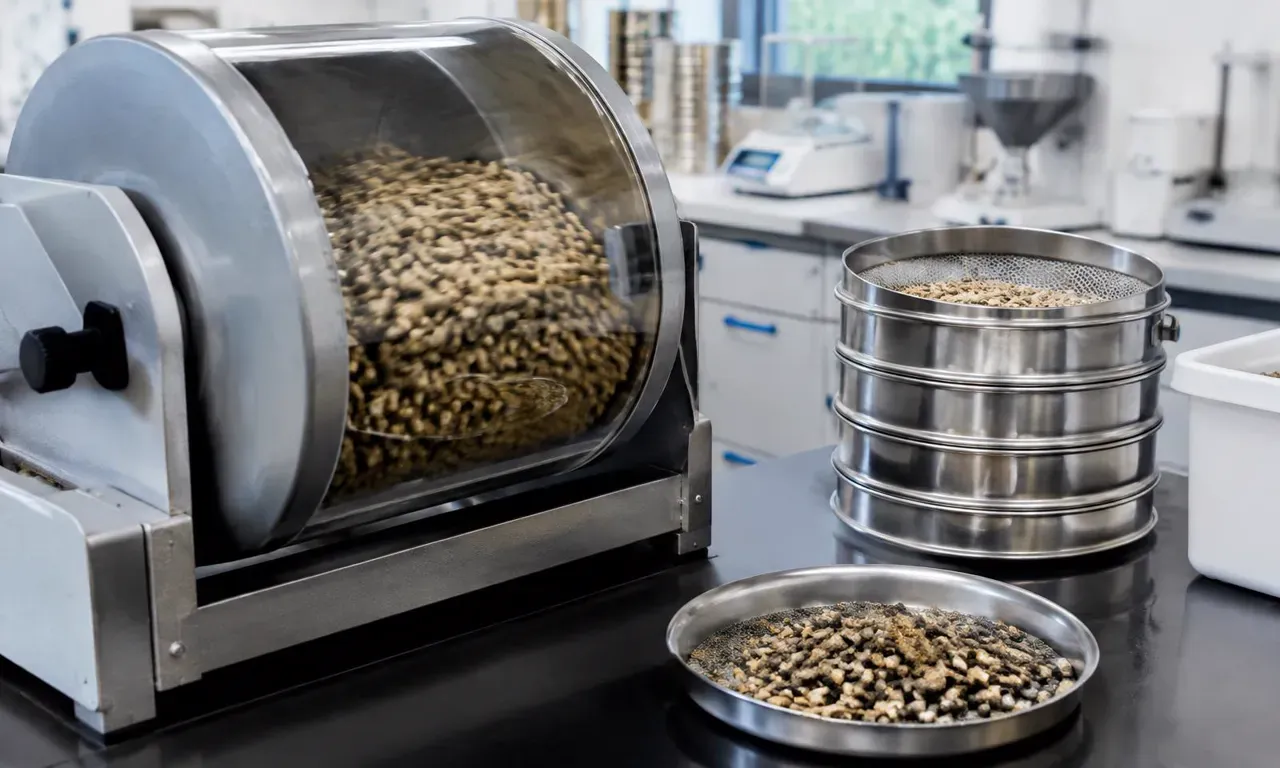
Short answer: Pellet quality is the physical half of a feed specification. Durability (PDI) measures how much of the pellet survives handling; fines measure what has already been lost; hardness describes crush resistance; water stability governs how long an aquafeed pellet holds together in water. Specify each with a method, a sampling point and a limit, or the nutritional guarantees you negotiated will not reach the animal.
Why physical quality is a commercial issue
Every transfer point — press to cooler, cooler to bin, bin to truck, truck to silo, silo to feeder — abrades pellets. What arrives as fines is not lost nutrition in the chemical sense, but it behaves differently: in poultry, fines are consumed less efficiently and increase sorting; in aquaculture, fines sink or disperse and are simply not eaten. Buyers who negotiate hard on protein and say nothing about durability routinely give back more value than they won.
The four parameters that belong in the contract
Durability (PDI)
Percentage of intact pellets after a standardised stress test. Name the method — tumbling box to ASABE S269, or a pneumatic tester such as the Holmen with a stated duration (30, 60 or 120 seconds). Values from different methods and durations are not comparable, so a bare "PDI 95%" clause is unenforceable.
Fines
Percentage of material passing a defined sieve. Fix the sieve aperture relative to pellet diameter, the sampling method (at loading, on arrival, at the feeder), and the sample size. Two separate limits — one at loading, one accepted on arrival — allocate transit risk explicitly instead of leaving it to argument.
Hardness
Force required to crush a single pellet, usually measured on a Kahl-type or texture-analyser instrument. Useful as a secondary control, particularly where a very hard pellet would depress intake in young birds or fish, or where a soft pellet cannot survive pneumatic handling.
Water stability (aquafeed)
Minutes the pellet holds integrity submerged, measured by a stated protocol. Shrimp feeds, which are consumed slowly, need far longer stability than fast-feeding fish species. Under-specifying this parameter shows up directly as poor apparent FCR and deteriorating water quality.
What actually drives pellet quality in the plant
Understanding the levers helps a buyer judge whether a supplier's commitment is realistic:
- Formula. Starch content and its gelatinisation, protein type, fibre and — critically — added fat. Fat added before the press lubricates the die and lowers durability; post-pellet fat application protects it.
- Grinding. Finer, more uniform particle size increases surface area for steam and binds better, at higher energy cost and a limit beyond which intake and gizzard development suffer in poultry.
- Conditioning. Steam temperature, moisture and retention time are the largest single lever. Longer conditioning generally improves durability and hygienic status but costs throughput and can damage heat-sensitive additives.
- Die specification. Compression ratio (thickness to hole diameter) matched to the formula. A die that suits a high-starch broiler feed will not suit a high-fat or high-fibre ration.
- Cooling and drying. Too fast and the pellet cracks; too slow and moisture stays in, risking mould. Cooler sizing is a frequent weak point in low-cost plant packages.
- Handling. Bucket elevators, drops, long horizontal runs and pneumatic conveying each cost durability. The plant can meet the spec at the press and fail it at the truck.
Where a project is being built rather than sourced, these are the line items to interrogate in a quotation — see the pellet mill vs extrusion line comparison and the feed mill CAPEX guide.
Writing the clause
Physical quality: Pellet 3.0 mm × 6–9 mm. Durability min 92% (Holmen, 60 s), tested per production batch, certificate supplied. Fines max 2.0% at loading and max 5.0% accepted on arrival, sieve 2.0 mm, composite sample from at least ten sub-samples. Hardness reported for information. Retained samples held by both parties for six months. Disputed results referred to an agreed independent laboratory, cost borne by the party whose result is not upheld.
Note what that clause does: it names methods, fixes sampling, splits transit risk and pre-agrees arbitration. It is short, and it removes almost every recurring physical-quality argument.
Quality control on arrival
- Sieve a composite sample at discharge and photograph it with the batch code visible.
- Run a simple hand test alongside the laboratory figure — experienced staff detect a bad batch before the certificate arrives.
- Track fines by route and by supplier over time; a durability problem and a handling problem look identical in a single delivery and completely different across twenty.
- Feed the data back into the next tender. Suppliers who consistently hold physical specification deserve to be scored for it.
A worked quotation excerpt
Anonymised and illustrative — reconstructed from the structure of real offers, not attributed to any named supplier:
Physical guarantees: Pellet 3.0 × 6–9 mm; PDI 92% min (Holmen 60 s, tested at loading); fines at loading 2% max. Measurement point: Guarantees apply at the loading spout. Fines generated during ocean transport, discharge and farm handling are excluded. Option: PDI 95% min achievable with 1.2% additional binder and reduced throughput — surcharge USD 6 / t.
The measurement-point clause is where most durability disputes are won or lost. If the guarantee ends at the loading spout and your loss happens in transit, the clause protects the supplier, not you. Either move the test point to discharge or price the transit loss into your comparison.
Related in this cluster: how to write a feed specification, feed conversion ratio, pellet quality and PDI, extrusion vs pelleting, raw material specifications, sampling and laboratory testing, mycotoxins and feed safety limits, premix and additive specification.
Next step. Turn the numbers into a quotable document: size the volume with the feed requirements calculator, check the commercial frame on the calculators hub, then submit the specification through the RFQ intake. A reviewer reads every brief before suppliers see it.
*FeedMatch Group is an independent, human-led animal feed sourcing and RFQ platform. We are not a feed producer, equipment manufacturer, EPC contractor, farm, laboratory, nutritionist, lender or financial advisor. Every requirement is reviewed by a person before any supplier is approached, and nutritional or veterinary decisions remain with your own nutritionist or veterinarian.*
Frequently asked questions
- What is pellet durability index (PDI)?
- PDI is the percentage of pellets that survive a standardised mechanical stress test intact. Two methods dominate: the tumbling box (ASABE S269) and pneumatic testers such as the Holmen, run for a stated duration. Because the methods are not interchangeable, a PDI clause must name the method and the test duration.
- What PDI should I specify?
- It depends on species, pellet diameter, handling distance and how much bulk transfer the feed will see. Long inland hauls, multiple transfers and pneumatic conveying all demand a higher figure than short farm delivery. Set the limit from your own handling chain, state the method, and test at both loading and delivery.
- Are hardness and durability the same thing?
- No. Hardness is the force needed to crush a single pellet; durability is resistance to abrasion and impact across a sample. A pellet can be hard and still shed fines, and an over-hard pellet can reduce intake in some species, so specify durability first and treat hardness as a secondary parameter.
- Who pays for fines generated in transit?
- Whatever the contract says — which is why the sampling point matters more than the limit. Specify a maximum fines percentage at loading and a separate acceptance level on arrival, with an agreed sieve size, sampling method and retained samples on both sides.
Feed industry regions we work with
Feed procurement is local before it is global: raw material basis, freight and installation costs change by region. These are the areas buyers most often name when defining a feed project in English.
United States
Cities and provinces
Iowa · Nebraska · Georgia · Arkansas · Texas · North Carolina
Corn and soybean meal basis with large integrated poultry, swine and dairy operations.
United States →United Kingdom and Ireland
Cities and provinces
East Anglia · Yorkshire · Lincolnshire · Northern Ireland · Munster
Compound feed and imported protein logistics through east coast and Irish Sea ports.
United Kingdom and Ireland →Gulf and East Africa import markets
Cities and provinces
Jeddah · Dubai · Mombasa · Djibouti
Import-driven feed supply where landed cost and port logistics dominate the decision.
Gulf and East Africa import markets →FeedMatch is supplier-neutral. Regional context helps define the requirement; pricing always comes from manufacturer quotations.
Move from insight to procurement
Turn the ideas in this article into a live procurement action — supplier-neutral, buyer-controlled, fully documented.