
Raw Material Specifications: Soybean Meal, Corn, Fishmeal and the Clauses That Matter
A finished-feed guarantee is only as good as the raw materials behind it. These are the ingredient-level clauses, test methods and arrival checks that keep a formula honest.
Short answer · reviewed September 2026
Short answer: Raw Material Specifications: Soybean Meal, Corn, Fishmeal and the Clauses That Matter
Short answer: Finished-feed guarantees are produced from raw materials, so the ingredient layer belongs in the specification too. For each major input, state the compositional band, the processing-quality indicators, the freshness and safety limits, the test method, the sampling point and the rejection rule.
Key takeaways
- Two soybean meals can both test 46% crude protein while behaving very differently in the animal.
- - Composition: crude protein on an as-is or dry basis (state which), moisture, crude fat, crude fibre, ash.
- - Composition and grade: moisture maximum, test weight or hectolitre weight, broken kernels and foreign material, damaged and heat-damaged kernels.
- - Composition: crude protein, fat, ash, moisture, salt and sand, calcium and phosphorus.
- State the source (soy, palm, poultry, fish), free fatty acid maximum, peroxide value and anisidine value, moisture-impurities-unsaponifiables, antioxidant treatment, and the temperature range for delivery and storage.
FeedMatch Editorial Desk
Editorial Team
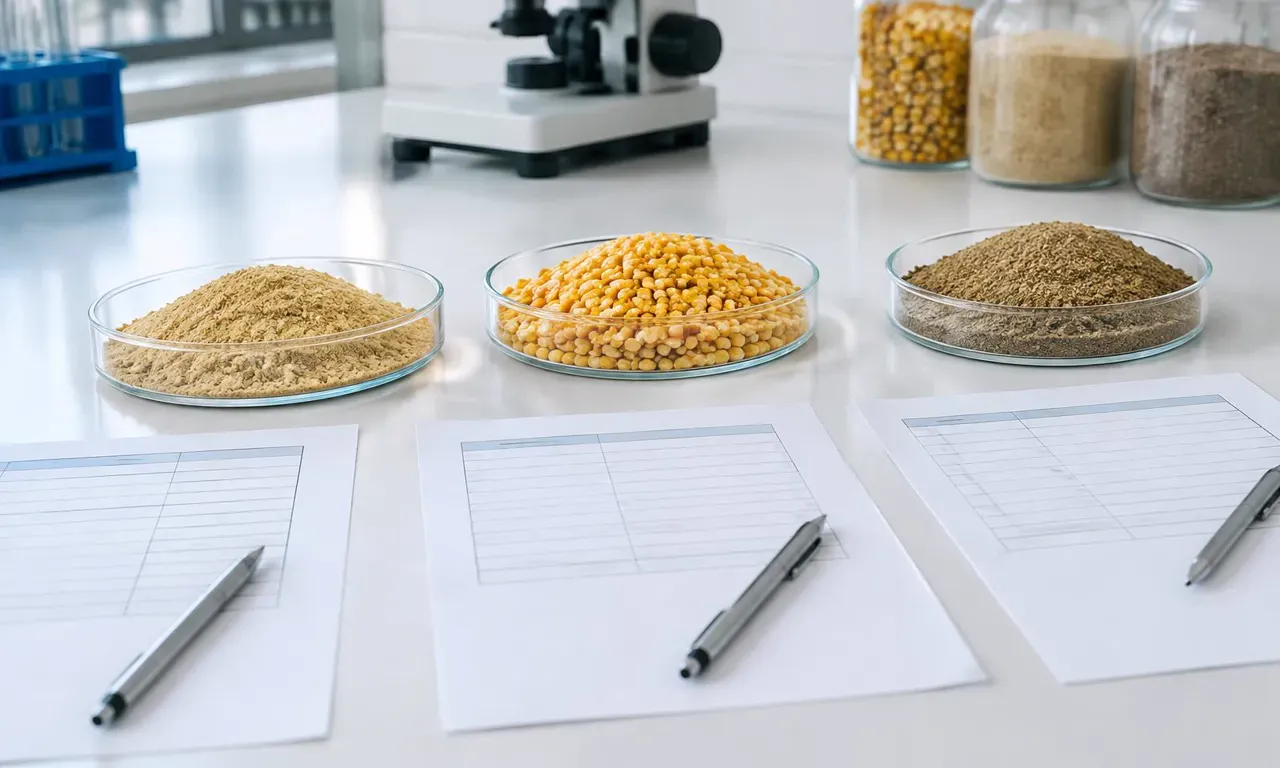
Short answer: Finished-feed guarantees are produced from raw materials, so the ingredient layer belongs in the specification too. For each major input, state the compositional band, the processing-quality indicators, the freshness and safety limits, the test method, the sampling point and the rejection rule. Ingredient clauses are what stop a nominally compliant feed from underperforming.
The principle: nutrients are not equal
Two soybean meals can both test 46% crude protein while behaving very differently in the animal. One is correctly toasted, the other over-heated with a share of its lysine unavailable. Crude protein cannot see that difference; processing-quality indicators can. The same logic applies across the raw-material list: moisture and toxins in cereals, freshness in fishmeal and fats, particle size and contamination in minerals.
This is the layer where a formulation quietly succeeds or fails, and it is the layer most enquiries omit. When it is written down, offers become comparable at the level that actually drives feed conversion.
Soybean meal
- Composition: crude protein on an as-is or dry basis (state which), moisture, crude fat, crude fibre, ash.
- Processing quality: urease activity within a defined band, KOH protein solubility, trypsin inhibitor activity where the market demands it.
- Contaminants: foreign matter, urea adulteration screening, mycotoxin limits, salmonella status.
- Physical: particle size distribution, colour and odour description, absence of caking.
- Origin and status: country of origin, GMO/non-GMO or identity-preserved, sustainability certification if required downstream.
Under-processed meal carries anti-nutritional factors; over-processed meal has damaged amino acids. Both look normal on a protein certificate, which is why the two processing indicators are the clauses worth insisting on.
Corn, wheat and other cereals
- Composition and grade: moisture maximum, test weight or hectolitre weight, broken kernels and foreign material, damaged and heat-damaged kernels.
- Safety: aflatoxin B1, fumonisins, DON and zearalenone limits by toxin, with the sampling plan named — cereal toxin distribution is famously heterogeneous, so the sampling plan matters more than the limit.
- Storage condition: insect activity, mould, odour, temperature at loading.
- Processing behaviour: starch content where it drives pellet quality, and particle size after grinding if the buyer specifies the grind.
Moisture is the clause with the largest commercial consequence: it is paid for as product, it drives storage risk, and it interacts directly with mould and toxin development.
Fishmeal and animal proteins
- Composition: crude protein, fat, ash, moisture, salt and sand, calcium and phosphorus.
- Freshness and damage: total volatile nitrogen (TVN), histamine, biogenic amines, peroxide value and free fatty acids of the residual oil, digestibility indicator such as pepsin digestibility.
- Treatment and traceability: antioxidant type and dose, species and fishery origin, processing plant approval number, certification scheme.
- Compliance: species-restriction rules in the destination market — several jurisdictions prohibit specific processed animal proteins in specific species.
Fats, oils and lecithin
State the source (soy, palm, poultry, fish), free fatty acid maximum, peroxide value and anisidine value, moisture-impurities-unsaponifiables, antioxidant treatment, and the temperature range for delivery and storage. Oxidised fat depresses intake and destroys fat-soluble vitamins in the finished feed, so freshness clauses here protect the premix you paid for.
Minerals, amino acids and carriers
Specify purity and assay method, particle size, moisture, heavy-metal limits, and — for trace minerals — the chemical form, since sulphate, oxide and chelated forms are not interchangeable in availability or in price. For crystalline amino acids, state assay, manufacturer or origin approval and packaging integrity requirements.
A clause skeleton you can reuse
Ingredient: Soybean meal, solvent extracted, non-GMO not required. Guarantees: CP min 46.0% as-is (Dumas); moisture max 12.5%; crude fibre max 4.0%; crude fat max 2.5%; ash max 7.0%. Processing: Urease activity 0.05–0.20 ΔpH; KOH solubility 75–85%. Safety: Aflatoxin B1 max 20 ppb; salmonella absent in 25 g; foreign matter max 0.5%. Sampling: Composite of at least 10 sub-samples per lot, split three ways, retained six months. Rejection: Two consecutive lots outside the urease band, or any lot outside a safety limit, rejected at seller's cost.
Incoming QC that actually gets done
- Keep the routine short enough to survive a busy intake shift: moisture, visual and odour check, sieve or particle check, plus one analytical test per lot rotated across parameters.
- Photograph every lot with the batch code and seal number before discharge.
- Retain samples on both sides and record where they are stored, or a dispute becomes a conversation about memory.
- Trend the results by supplier and by origin. One bad certificate is noise; a pattern is a negotiating position at the next tender.
How this changes an RFQ
Buyers who include the ingredient layer receive fewer, better offers: suppliers who cannot hold those clauses self-select out early, which shortens the process. If you are sourcing finished feed, attach the ingredient policy to the composition specification; if you are buying raw materials directly, the same clause structure is the contract. Either way, submit it through the RFQ intake so a reviewer can check it before suppliers see it.
A worked quotation excerpt
Anonymised and illustrative, reconstructed from the structure of raw-material offers rather than attributed to any named supplier:
Commodity: Soybean meal, solvent extracted, 46% CP min. Guarantees: Protein 46.0% min; moisture 12.5% max; fibre 3.5% max; urease activity 0.05–0.20 pH rise; KOH solubility 78–85%. Origin: South America, crop year declared per shipment. Price: USD 402 / t CFR, weight and quality final at discharge per SGS. Validity: Firm for 48 hours against the market.
Note the two lines buyers most often skip. "Weight and quality final at discharge" decides who carries a shortfall, and a 48-hour validity tells you the offer is priced against a live market — comparing it with a two-week-old quotation from another supplier is comparing two different days, not two suppliers.
Related in this cluster: how to write a feed specification, feed conversion ratio, pellet quality and PDI, extrusion vs pelleting, raw material specifications, sampling and laboratory testing, mycotoxins and feed safety limits, premix and additive specification.
Next step. Turn the numbers into a quotable document: size the volume with the feed requirements calculator, check the commercial frame on the calculators hub, then submit the specification through the RFQ intake. A reviewer reads every brief before suppliers see it.
*FeedMatch Group is an independent, human-led animal feed sourcing and RFQ platform. We are not a feed producer, equipment manufacturer, EPC contractor, farm, laboratory, nutritionist, lender or financial advisor. Every requirement is reviewed by a person before any supplier is approached, and nutritional or veterinary decisions remain with your own nutritionist or veterinarian.*
Frequently asked questions
- Why specify raw materials if I am buying finished feed?
- Because the finished-feed guarantee is delivered through those ingredients. Naming the acceptable quality band for the major raw materials — protein and urease activity for soybean meal, moisture and toxin limits for corn, freshness indicators for fishmeal and fats — prevents a supplier from meeting the crude protein figure with material your animals digest poorly.
- What single test tells me most about soybean meal?
- No single test does, but urease activity together with protein solubility in KOH is the standard pair for processing quality: they indicate under-processing (residual anti-nutritional factors) and over-processing (heat-damaged protein) respectively, which crude protein alone cannot reveal.
- How do I judge fishmeal quality in a contract?
- Specify protein, fat, ash, salt and sand, plus freshness and damage indicators: total volatile nitrogen, histamine, biogenic amines where relevant, peroxide value of the residual oil, antioxidant treatment and the species or fishery origin. Add the traceability and certification regime your market requires.
- Who verifies the ingredient claims?
- The buyer, through an incoming-QC routine and independent laboratory testing against the contract clauses. FeedMatch structures requirements and runs the sourcing process; it does not operate laboratories or certify material.
Feed industry regions we work with
Feed procurement is local before it is global: raw material basis, freight and installation costs change by region. These are the areas buyers most often name when defining a feed project in English.
United States
Cities and provinces
Iowa · Nebraska · Georgia · Arkansas · Texas · North Carolina
Corn and soybean meal basis with large integrated poultry, swine and dairy operations.
United States →United Kingdom and Ireland
Cities and provinces
East Anglia · Yorkshire · Lincolnshire · Northern Ireland · Munster
Compound feed and imported protein logistics through east coast and Irish Sea ports.
United Kingdom and Ireland →Gulf and East Africa import markets
Cities and provinces
Jeddah · Dubai · Mombasa · Djibouti
Import-driven feed supply where landed cost and port logistics dominate the decision.
Gulf and East Africa import markets →FeedMatch is supplier-neutral. Regional context helps define the requirement; pricing always comes from manufacturer quotations.
Move from insight to procurement
Turn the ideas in this article into a live procurement action — supplier-neutral, buyer-controlled, fully documented.