
Feed Mill Equipment Procurement in 2026: Comparing Production Lines, Feed Ingredients, and Landed Cost
Comparing feed mill equipment on machine price alone produces quotations for different plants. This guide covers production-line scope, feed-input availability and logistics risk, capacity basis, grinding, mixing and pelleting choices, energy, CAPEX versus total cost of ownership, and the structured RFQ that makes supplier proposals comparable.
Short answer · Updated October 2026
Short answer: Feed Mill Equipment Procurement in 2026: Comparing Production Lines, Feed Ingredients, and Landed Cost
Feed mill equipment procurement in 2026 is a comparison problem, not a search problem. The buyers who get comparable proposals are the ones who fix four things before contacting any supplier: the production-line scope (which stages are inside the price), the capacity basis (tonnes per hour, at which product form and…
Key takeaways
- Feed mill equipment procurement in 2026 is a comparison problem, not a search problem.
- An enquiry that says "10 TPH poultry feed line" lets every supplier decide what is inside the number.
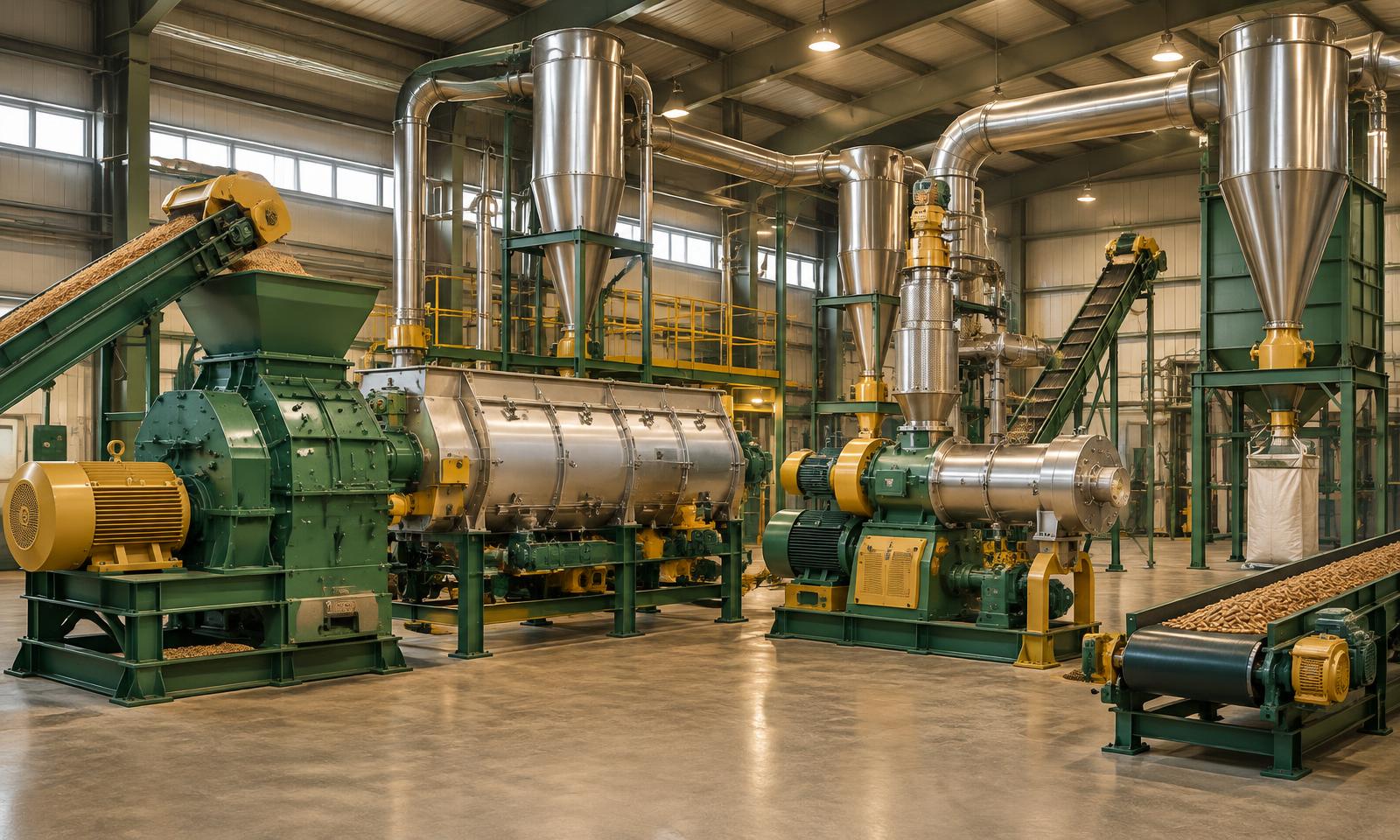
- A complete compound-feed line is a chain of stages, and every stage is a scope decision:
- "Tonnes per hour" is not a number; it is a number with conditions.
- Equipment outlives any single ingredient contract, so the line must fit the supply the plant can actually secure:
FeedMatch Editorial Desk
Editorial Team
Short Answer
Feed mill equipment procurement in 2026 is a comparison problem, not a search problem. The buyers who get comparable proposals are the ones who fix four things before contacting any supplier: the production-line scope (which stages are inside the price), the capacity basis (tonnes per hour, at which product form and formula density), the feed-input reality (which ingredients, at which moisture and delivery format, with which logistics risk), and the cost frame (CAPEX plus energy, wear parts and downtime — total cost of ownership, not machine price). Once those are written down, a structured RFQ turns supplier replies into a comparison table instead of a pile of incompatible quotations.
Define the line, the capacity basis, the ingredient supply and the cost frame first — then source.
Why Machine-Price Comparison Fails
An enquiry that says "10 TPH poultry feed line" lets every supplier decide what is inside the number. One proposal includes intake, dosing and cooling; another stops at the pellet mill; a third excludes electrical connection, freight and commissioning. All three can be honest, and none are comparable. The gaps surface at contract stage, when changing scope is most expensive.
The fix is not a longer supplier list. It is a tighter definition of what is being bought, issued identically to every supplier.
Step 1 — Fix the Production-Line Scope
A complete compound-feed line is a chain of stages, and every stage is a scope decision:
| Stage | What to decide | Commonly omitted from quotations |
|---|---|---|
| Intake | Bulk versus bagged, reception capacity, pit or hopper | Civil works, unloading equipment |
| Grinding | Hammer mill or roller mill, target particle size, screens | Screen sets, aspiration, noise enclosure |
| Dosing & mixing | Batch size, mixing time, homogeneity (CV) target, micro-dosing | Micro-ingredient station, liquid addition |
| Pelleting / extrusion | Conditioning time and temperature, die specification, or extruder and dryer | Steam system, die and roller spares |
| Cooling & coating | Cooler type, liquid coating, screening | Fat-coating line, crumbler for starter feeds |
| Storage | Raw-material silos, intermediate bins, finished-feed volume | The most common late-stage constraint |
| Packaging & loadout | Bagging, palletizing, bulk outloading | Routinely excluded entirely |
| Automation | Control level, weighing, recipe management, traceability | Explains price gaps that look like discounts |
Issue one stage list to every supplier and require each proposal to mark every stage as included, excluded or optional. That single table does more for comparability than any negotiation.
Step 2 — Fix the Capacity Basis
"Tonnes per hour" is not a number; it is a number with conditions. Capacity changes with product form (mash versus pellet), formula density, pellet diameter and ingredient mix. A line rated at one formula can run well below that rating on another.
In the RFQ, state capacity as tonnes per hour by product form, name the reference formula or density, and ask each supplier to state whether the figure is nominal or guaranteed, and under which conditions. Where capacity is guaranteed, the acceptance test that proves it belongs in the contract — measured at the buyer's formula, over an agreed period, not a short demonstration run.
Step 3 — Match the Line to Feed-Input Availability and Logistics Risk
Equipment outlives any single ingredient contract, so the line must fit the supply the plant can actually secure:
- Ingredient physical properties. Moisture, fibre and fat content drive grinding energy, conditioning requirements and die selection. A line specified around one ingredient mix can be a poor fit for the mix the plant ends up buying.
- Delivery format. Bulk reception needs pits, conveyors and silos; bagged supply needs intake labour and warehouse space. Switching format later is a construction project, not a setting.
- Supply reliability. Seasonal harvests, import dependence and port or border delays translate directly into storage volume. Where supply is intermittent, storage is insurance — and it is the scope item most often cut to hit a budget.
- Landed cost of the equipment itself. Freight, duties, installation and commissioning routinely add a substantial share on top of an ex-works price. Compare proposals on delivered-and-installed cost at the destination, with the same Incoterms for every supplier.
Step 4 — Grinding, Mixing and Pelleting: the Choices That Matter
Grinding. Hammer mills handle a wide range of ingredients and are the common default; roller mills can offer more uniform particle size and lower energy on suitable grains. The decision belongs to the ingredient list and the target particle size for the species — not to a brand preference.
Mixing. Specify the homogeneity target (coefficient of variation) and the batch cycle time, and check that micro-ingredients and liquids have a defined route into the mixer. Mixing accuracy is a feed-quality issue, not just a mechanical one.
Pelleting. Conditioning — time, temperature, moisture — determines pellet quality and hygiene outcomes as much as the press itself. Die specification (hole diameter, compression ratio) follows the feed form and formula. Dies and rollers are wear parts: their expected life and local availability belong in the comparison, because they are a running cost, not a one-time purchase.
Step 5 — Energy and Total Cost of Ownership
Grinding and pelleting are the largest energy blocks in a conventional line. Two proposals with similar purchase prices can differ materially in energy per tonne, wear-part consumption and maintenance demand — and those differences repeat every operating hour for the life of the plant.
Build the comparison as cost per tonne produced, using the buyer's own figures: local electricity and fuel prices, planned operating hours, the actual formulas, and quoted wear-part life. FeedMatch's free feed mill cost calculator and ROI calculator are built for exactly this — they compute from buyer-entered values only and make no performance claims. A cheaper line with higher energy use per tonne or shorter die life can be the more expensive line within a few years; only the buyer's own numbers can say.
Step 6 — Safety, Compliance and Documentation
Dust control, explosion protection and machine guarding are regulated in most markets — for example combustible-dust requirements under OSHA in the United States and ATEX directives in the European Union — and the applicable rules depend on the destination country. Require each supplier to state which standards the equipment is designed and documented to meet, and treat missing documentation as a scope gap, not a paperwork detail. Local authorities, insurers and the project's own engineers make the final compliance call.
Step 7 — The Structured Equipment RFQ
One package, issued identically to every supplier on the short list:
- Species, feed forms and reference formulas.
- Capacity by product form, with the density or formula it is measured at, and whether a guarantee is expected.
- The stage list (Step 1) with inclusions and exclusions marked.
- Ingredient list with moisture and delivery format; storage volumes.
- Utilities: installed power, steam, compressed air; site and civil scope.
- Automation and documentation requirements, including applicable safety standards.
- Incoterms, destination, delivery window, installation and commissioning scope.
- Wear-part pricing and regional spare-parts support.
- Warranty, acceptance test conditions and training.
FeedMatch's RFQ builder structures exactly this package. Every request is reviewed by the FeedMatch team, which then contacts suitable manufacturers and presents the responses — supplier-neutral, with no automatic buyer–supplier connection. Assisted sourcing is intended for commercial projects from about US$250,000; smaller projects are routed to the free planning tools.
Comparison Checklist
| Question | Proposal A | Proposal B | Proposal C |
|---|---|---|---|
| Every stage marked included / excluded / optional? | |||
| Capacity nominal or guaranteed — at which form and formula? | |||
| Acceptance test defined in the contract? | |||
| Delivered-and-installed cost at the same Incoterms? | |||
| Energy per tonne stated, with conditions? | |||
| Die, roller, hammer and screen life and price stated? | |||
| Regional spare parts and service response stated? | |||
| Safety standards and documentation listed? |
A proposal that leaves a cell blank is telling you where its price comes from.
What FeedMatch Does — and Does Not Do
FeedMatch Group is a supplier-neutral feed sourcing and feed-production procurement service. It helps buyers structure the project, use free planning calculators, prepare the structured RFQ and organize manufacturer proposals for comparison, with human review at every step. It does not manufacture, sell or install equipment, does not design mills, does not provide financing, and does not replace the project's engineers, nutritionists or consultants. Final supplier, price and availability always depend on the project scope, formula, destination and market at the time of quotation.
Sources and Further Reading
- OSHA (US), combustible dust and grain handling standards — osha.gov, current edition.
- European Commission, ATEX workplace and equipment directives (1999/92/EC, 2014/34/EU) — eur-lex.europa.eu, current editions.
- ASABE (American Society of Agricultural and Biological Engineers), standards for feed processing equipment and particle size measurement — asabe.org, current editions.
- FeedMatch guides: feed mill planning, feed mill equipment list, feed mill cost per tonne, used feed mill equipment checklist, feed line upgrade FAQ.
Frequently asked questions
- What should a feed mill equipment RFQ include?
- Species and feed forms, capacity in tonnes per hour by product form with the formula density it is measured at, the process stages in scope (intake, grinding, dosing, mixing, pelleting or extrusion, cooling, coating, screening), storage volumes, packaging and loadout, automation and weighing level, installed power and utilities, spare-parts and commissioning expectations, Incoterms and destination, and the delivery window. One scope issued to every supplier is what makes proposals comparable.
- How do I compare feed mill equipment suppliers?
- Compare scope first, capacity basis second and price last. Rebuild every proposal against one stage list, mark inclusions and exclusions, check whether stated capacity is nominal or guaranteed and at which product form, then add the buyer-side costs each proposal omits — civil works, electrical connection, freight, duties, installation and commissioning — and compare total delivered and installed cost, lead time, regional spare parts and documentation.
- What is the difference between CAPEX and total cost of ownership for a feed mill?
- CAPEX is the purchase and installation cost of the line. Total cost of ownership adds what the line costs to run over its life: energy per tonne, wear parts such as dies, rollers, hammers and screens, maintenance labour, downtime, and the cost of running below rated capacity. A cheaper line with higher energy use per tonne or shorter wear-part life can cost more per tonne produced. Buyers should model both with their own energy prices, formulas and operating hours.
- Why does feed ingredient availability matter when choosing equipment?
- The line must match the raw materials it will actually receive. Ingredient moisture, fibre and fat content affect grinding energy, conditioning and die choice; bulk versus bagged delivery changes intake and storage scope; and seasonal or import-dependent supply changes how much storage the plant needs. Equipment specified for ingredients the plant cannot reliably source becomes a permanent operating constraint.
- Does FeedMatch sell feed mill equipment?
- No. FeedMatch Group is a supplier-neutral procurement service. It helps buyers structure the project, prepare a structured RFQ and organize manufacturer proposals for comparison, with human review of every request. It does not manufacture, sell, install or finance equipment, and it does not connect buyers to suppliers automatically — the team presents responses for the buyer to decide.
Feed industry regions we work with
Feed procurement is local before it is global: raw material basis, freight and installation costs change by region. These are the areas buyers most often name when defining a feed project in English.
United States
Cities and provinces
Iowa · Nebraska · Georgia · Arkansas · Texas · North Carolina
Corn and soybean meal basis with large integrated poultry, swine and dairy operations.
United States →United Kingdom and Ireland
Cities and provinces
East Anglia · Yorkshire · Lincolnshire · Northern Ireland · Munster
Compound feed and imported protein logistics through east coast and Irish Sea ports.
United Kingdom and Ireland →Gulf and East Africa import markets
Cities and provinces
Jeddah · Dubai · Mombasa · Djibouti
Import-driven feed supply where landed cost and port logistics dominate the decision.
Gulf and East Africa import markets →FeedMatch is supplier-neutral. Regional context helps define the requirement; pricing always comes from manufacturer quotations.