
Upgrading or Expanding an On-Farm Feed Setup: Find the Bottleneck Before You Buy
Before buying a bigger machine, measure where feed actually waits. A step-by-step method and a comparison of tune-up, add-on and replacement options for farms.
Short answer · Updated October 2026
Short answer: Upgrading or Expanding an On-Farm Feed Setup: Find the Bottleneck Before You Buy
Short answer: a bigger machine only helps if it replaces the step that actually limits your day. Time each step for a week, find where feed waits, then compare restoring, adding to or replacing that step using your own figures and written supplier quotes.
Key takeaways
- Grain bins, augers and grinders cause serious farm injuries.
- Write down each step in order: receiving ingredients, storage, grinding, weighing, mixing, pelleting (if used), cooling, finished-feed storage and delivery to the animals.
- 1. Output per hour of each machine on your real recipe — not the brochure rating.
- There is no single right answer: it depends on your animals, recipe, power, space and budget.
- Base the target on your planned animal numbers and daily feed use from your records or nutritionist, plus a downtime margin you choose.
FeedMatch Editorial Desk
Editorial Team
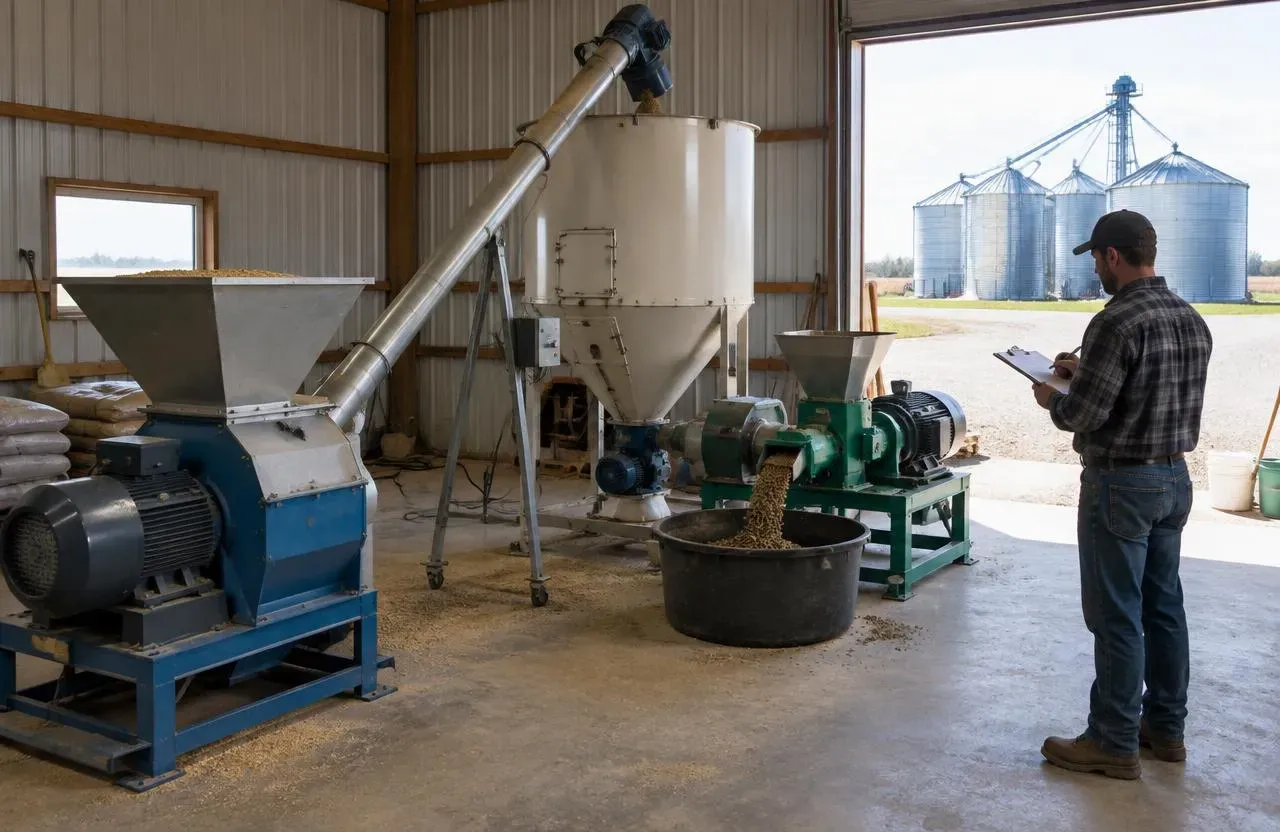
Short answer: a bigger machine only helps if it replaces the step that actually limits your day. Time each step for a week, find where feed waits, then compare restoring, adding to or replacing that step using your own figures and written supplier quotes.
Safety first
Grain bins, augers and grinders cause serious farm injuries. Follow the manufacturer's manual and the OSHA grain handling guidance whenever you inspect, clear or modify equipment, and plan any new layout with safe access in mind.
Step 1: map every step of your feed day
Write down each step in order: receiving ingredients, storage, grinding, weighing, mixing, pelleting (if used), cooling, finished-feed storage and delivery to the animals. For each, record how long one batch takes, how often it stops, and who does it.
Step 2: measure, don't guess
- Output per hour of each machine on your real recipe — not the brochure rating.
- Waiting time: where does material or staff sit idle?
- Stoppages: blockages, cleaning, changeovers, breakdowns. Note causes.
- Storage: days of ingredients and finished feed you can hold. The FAO feed quality overview explains why storage time and moisture affect feed safety.
- Labour hours available each day.
- The step with the lowest daily output, or the one everything waits for, is your bottleneck.
Step 3: common farm bottlenecks and what to check
| Bottleneck | Signs | Checks before buying |
|---|---|---|
| Grinding | Mixer waits for ground grain | Hammer and screen wear, screen size, motor load |
| Mixing | Batches queue, uneven mix | Batch size vs mixer volume, mixing time, sequence of adding ingredients |
| Pelleting | Low output, blockages, fines | Die and roller wear, mash moisture — see the troubleshooting guide |
| Cooling | Hot pellets bagged, crumbling | Cooler size and airflow vs pellet output |
| Storage | Frequent small deliveries, emergency runs | Bin capacity, number of bins for recipes |
| Labour | Feed prep crowds out other work | Manual handling steps that a conveyor or scale could remove |
Step 4: compare your options
| Option | When it fits | What to collect | Main risks |
|---|---|---|---|
| Restore current equipment | Records show wear or poor adjustment is the cause | Wear-part quotes, service visit, downtime needed | Problem returns if machine is undersized |
| Add capacity around it | One step limits an otherwise suitable line | Quotes for the single item, layout, power supply check | New bottleneck moves to next step |
| Replace the bottleneck machine | Machine cannot meet planned output on your recipe | Supplier rating on your recipe, installation, training, spares | Higher spend; other steps may need upgrading too |
| Buy part of your feed ready-made | Expansion is temporary or labour is short | Delivered price per tonne from feed suppliers | Dependence on supply; compare with your own cost |
| There is no single right answer: it depends on your animals, recipe, power, space and budget. Use the farm feed budget article to compare the cost per tonne of each option with your own numbers. |
Step 5: plan the expansion
Base the target on your planned animal numbers and daily feed use from your records or nutritionist, plus a downtime margin you choose. Check that power supply, building space, storage and labour can support it — upgrading one machine often moves the bottleneck to the next step. The FAO good-practice resources are a useful starting point for feed hygiene when the layout changes.
Step 6: request comparable quotes
Send suppliers the same written brief: recipe type, required output, current equipment, power available, space and what must be included. Read the pellet machine buying guide for the specification checklist. When you request quotes, choose "Upgrade or expand current farm feed setup" as the project type so the FeedMatch team knows you are improving an existing setup. Every request is reviewed by a person; FeedMatch does not guarantee output, savings or payback.
Sources
- FAO: animal feed quality and safety.
- FAO family farming good practices.
- OSHA: grain handling safety.
- This guide covers farm feed preparation planning, not nutrition or animal health advice.
Decision review · FeedMatch Editorial Desk · 17 October 2026
How can I reduce downtime before buying a larger farm pellet machine?
Direct answer: Separate scheduled hours from productive hours, then record stoppages by cause on the same product. Check whether grinding, weighing, mixing, cooling or handling limits the farm process before increasing one machine’s rating.
Worked example — hypothetical, not a benchmark
Hypothetical farm log: 40 t over 20 scheduled hours = 2 t/h scheduled output. With 5 hours stopped, productive output is 40/15 = 2.67 t/h. The gap is an availability issue to investigate, not proof a larger machine is required.
Decision gates
- Record tonnes, scheduled hours, productive hours and stopped time without double counting.
- Ask a qualified equipment specialist to review safe interfaces and utilities.
- Compare maintenance/handling changes against an upgrade using identical recipe and quality acceptance tests.
Limits: Farm-scale feed preparation only; this is not industrial plant design or a capacity guarantee.
Prepare one qualified inquiry
Prepare the measured downtime log, current equipment, desired farm outcome and installation constraints. FeedMatch reviews the brief and coordinates supplier outreach; no direct supplier contact or assured performance outcome.
Evidence and applicability
FeedMatch Editorial Desk · 17 October 2026
What belongs in an incremental ROI screen for an existing feed setup?
Direct answer: Compare repair and upgrade against the same measured baseline. Use net additional annual cash benefit, not nameplate capacity, as the payback denominator. Keep unavailable inputs unresolved and count overlapping savings only once. Simple payback is a screening measure, not discounted ROI or a financing recommendation.
Worked buying screen — hypothetical inputs
Hypothetical installed upgrade cost is 12,000, including a 1,000 outage allowance. Assumed annual gross benefit is 4,000 and added maintenance is 1,000: net = 3,000/year; simple payback = 12,000 ÷ 3,000 = 4 years. If benefit is only 2,000, net is 1,000 and payback is 12 years. If benefit is 1,000 or less, net is non-positive and no finite positive simple payback exists. All values are assumptions, not equipment quotes or measured savings.
Compare your own figures
A cost-only comparison assuming identical annual benefits for both options. Include outage once; unknown benefits cannot justify investment.
Evidence needed before a decision
- Record kWh/t, tonnes, scheduled/productive hours, maintenance and accepted feed quality on comparable products. An energy audit can establish the baseline; it cannot guarantee a feed-line benefit.
- List equipment, freight, duties, installation, utilities, training, commissioning and outage cash effects. Do not count outage loss again if already included in installed cost.
- Compare repair, staged retrofit and replacement with the same scope, spares, safe interfaces and acceptance plan. Added capacity has no cash value here unless a credible farm requirement or market and contribution margin are documented.
Limits and source scope: Farm feed preparation and approved upgrades to existing mills only; no industrial greenfield planning. Financing, taxes, useful life, discounting and residual value need a separate adviser-reviewed cash-flow model.
Use the existing upgrade assessment below; submit only one request.
Frequently asked questions
- What is a bottleneck in an on-farm feed setup?
- It is the single step that limits how much finished feed you can prepare in a day — often grinding, mixing time, pelleting, cooling, bin space or the hours staff can spend. Speeding up any other step does not raise daily output.
- Should I upgrade my current machine or buy a new one?
- Compare three options with your own figures: restore the existing machine (wear parts, adjustment, maintenance), add capacity around it (a second unit, more storage, a conveyor), or replace it. The table in this article lists what to check for each. FeedMatch does not promise any output or saving from any option.
- How do I know how much more capacity I need?
- Start from your planned herd or flock size and daily feed use from your own records or your nutritionist, then add a margin for downtime and cleaning that you decide. Compare that with the measured daily output of your bottleneck step.
- Does this article cover commercial feed mills?
- No. It is for farms preparing feed for their own animals. Recipe changes belong to a qualified nutritionist.
Quick upgrade assessment
Enter your own measured figures. Results come only from your numbers — FeedMatch guarantees no outcome. Your answers go with your quote request.
- Daily capacity (output × hours)
- — t
- Gap (need − capacity)
- — t/day
- Required rate (need ÷ hours)
- — t/h
Next step: Measure first — enter the slowest stage's output, running hours and daily need.
Feed industry regions we work with
Feed procurement is local before it is global: raw material basis, freight and installation costs change by region. These are the areas buyers most often name when defining a feed project in English.
United States
Cities and provinces
Iowa · Nebraska · Georgia · Arkansas · Texas · North Carolina
Corn and soybean meal basis with large integrated poultry, swine and dairy operations.
United States →United Kingdom and Ireland
Cities and provinces
East Anglia · Yorkshire · Lincolnshire · Northern Ireland · Munster
Compound feed and imported protein logistics through east coast and Irish Sea ports.
United Kingdom and Ireland →Gulf and East Africa import markets
Cities and provinces
Jeddah · Dubai · Mombasa · Djibouti
Import-driven feed supply where landed cost and port logistics dominate the decision.
Gulf and East Africa import markets →FeedMatch is supplier-neutral. Regional context helps define the requirement; pricing always comes from manufacturer quotations.