
How to finance a feed mill: equipment, capacity and project planning
Separate the investment in a feed mill from the cash needed for ingredient purchases. Build a documented project scope and payment schedule before discussing possible financing; FeedMatch is not a lender.
Short answer · Updated November 2026
Short answer: How to finance a feed mill: equipment, capacity and project planning
Financing a feed mill starts with a documented purchasing and operating plan, not a promised loan. Separate investment in equipment and construction from the working capital needed to buy ingredients and operate before customer payments arrive.
Key takeaways
- Identify species, feed forms and the product mix: mash, pellets or extruded aquafeed require different process questions.
- A machinery price is not the total feed mill construction cost.
- An investment proposal concerns the installed facility, equipment and project implementation.
- The feed formulation calculator can model ingredient quantities from your entered prices and constraints.
- If you receive financing proposals independently, compare total charges, insurance or guarantee costs, currency, security, drawdown conditions, repayment triggers and obligations if delivery or commissioning is delayed.
FeedMatch Editorial Desk
Editorial Team
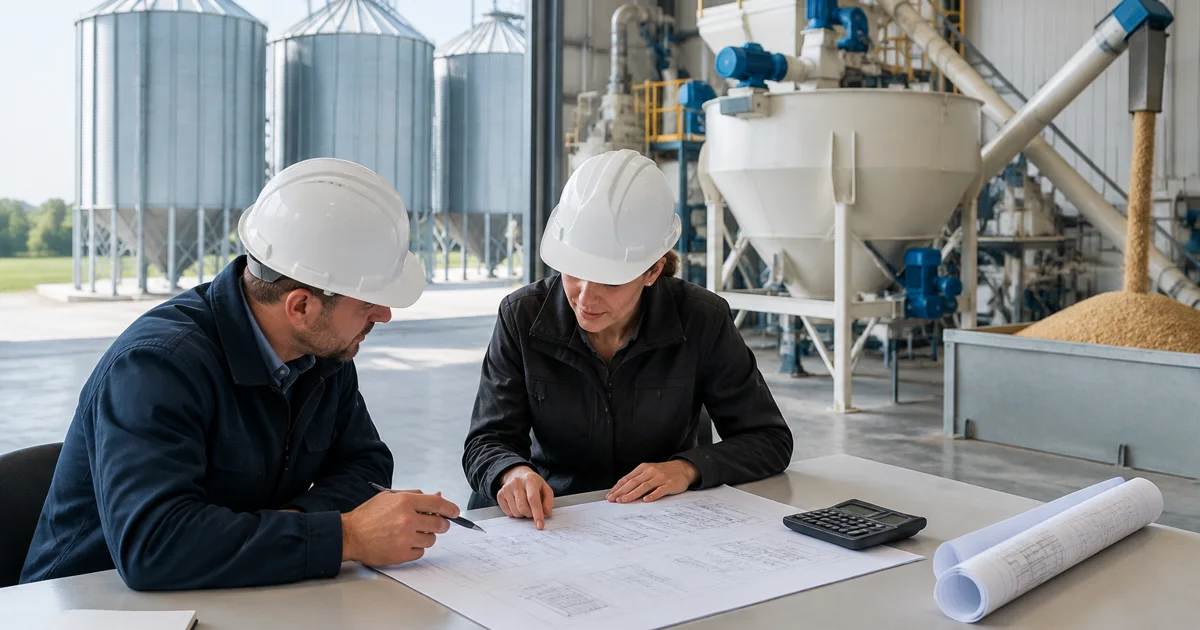
Financing a feed mill starts with a documented purchasing and operating plan, not a promised loan. Separate investment in equipment and construction from the working capital needed to buy ingredients and operate before customer payments arrive. FeedMatch can organize procurement project information; it is not a lender and performs no underwriting, pre-approval, financing offer or credit decision. Provider relationships and availability are not verified. Any future financing option remains subject to independent provider availability, jurisdiction-specific legal review and lender approval.
Start with the feed and the capacity you actually need
Identify species, feed forms and the product mix: mash, pellets or extruded aquafeed require different process questions. Separate target hourly throughput from annual saleable output. Write down operating shifts, product changes, cleaning, maintenance and expected downtime. Do not treat a machine’s rated throughput as proof of your future annual production. Qualified nutrition and engineering professionals must validate the formulation and process assumptions.
For fish feed production, include pellet size, floating or sinking behavior, drying, coating and storage requirements in the brief. Ask equipment bidders to state trial materials, operating conditions and acceptance methods. A financing discussion should use the same defined scope as the supplier quotation—not a headline capacity taken from another project. Start with the feed mill project planning page.
Build the construction budget from scope, not a price per tonne
A machinery price is not the total feed mill construction cost. Separate process equipment, intake and storage, controls, civil works, utilities, installation, commissioning, training and initial spare parts. State who is responsible for every interface and which costs remain unknown. A blank field means pending information, not zero. Add only contingencies chosen and explained by the buyer’s project team; this guide supplies no universal cost band or contingency percentage.
Keep each quotation’s date, currency, validity, delivery basis and exclusions. Use the equipment catalog to organize process categories, not as evidence of stock or prices. Compare cash and deferred-payment prices separately if an actual supplier offers both; do not assume supplier credit exists.
Separate equipment finance from ingredient trade credit
An investment proposal concerns the installed facility, equipment and project implementation. A trade-credit discussion concerns payments for specified cargoes or recurring ingredient deliveries. They may involve different documents, repayment triggers and security requirements. Neither is a confirmed product available through FeedMatch. A documentary letter of credit is a payment mechanism under its agreed conditions; it does not certify the ingredient or guarantee that a quality dispute will be resolved.
Prepare a separate schedule for soybean meal, fishmeal, premixes, additives, packaging and other operating purchases. Record when you must pay, how long goods are in transit and storage, when production begins and when customer receipts are expected. Do not count the initial ingredient stock twice as both a construction expense and a second cash requirement. Use the sourcing cost calculator and bulk-order planner with your own prices and quantities; their results are not funding offers.
Connect formulation assumptions to purchasing evidence
The feed formulation calculator can model ingredient quantities from your entered prices and constraints. It does not approve a recipe, predict supplier availability or prove equipment output. Keep nutrient approval with your qualified team. Tie planned purchases to specification revisions, COA requirements, lot traceability and storage limits. For premixes, distinguish cost per unit purchased from inclusion cost in the finished feed.
Record the source and date of every cost input, including freight and local charges. Currency conversions must use a buyer-supplied rate and remain identified as assumptions. Check origin, destination and transit requirements using official sources. Where applicability is unconfirmed, mark regulatory check required rather than assuming a feasible trade route.
Compare independent proposals on the same basis
If you receive financing proposals independently, compare total charges, insurance or guarantee costs, currency, security, drawdown conditions, repayment triggers and obligations if delivery or commissioning is delayed. Ask whether fees arise before any approval and what happens if the purchase contract changes. Do not infer that a lower stated rate means a lower total cost, or that the equipment provider and finance provider are the same counterparty.
Document the fallback if funding is delayed or declined: can the project be phased, can purchases wait, or is a revised scope needed? Any amended technical plan still requires professional review. This article provides no rate, tenor, eligibility assessment, approval probability or promise of funding. The financing preparation hub explains general mechanisms and documentation, not available lender products.
Submit a project inquiry without disclosing financial records publicly
Use the existing RFQ intake to state project type, country, approximate budget, timeline and whether the need is equipment investment, ingredient trade credit or both. Buyer use is free; the US$250,000 minimum applies to all purchases, including feed, ingredients, premixes, additives and plant/equipment. FeedMatch reviews and organizes the request before authorized supplier outreach, then presents responses through FeedMatch—not direct buyer-to-supplier contact.
A request is not a credit application or approval. Do not put account numbers, financial statements, ownership documents or personal financial details in a shareable URL or public page. Supporting documents require an agreed private process. Any future transfer to a financing provider needs separate recipient-specific consent and legal review; requesting assistance does not authorize such a transfer.
Procurement evidence for a financing conversation
Benchmarks are dated market context, not supplier quotes or lender terms. State project type, country, approximate budget, timeline and equipment versus ingredient financing need in the RFQ. Keep financial statements and account details out of public links; any future provider transfer needs separate recipient-specific consent and legal review. Feed formulation calculator Feed ingredient buying specifications Premix and additive catalog Feed-production equipment catalog Historical price and trade benchmarks Bulk feed order planner
Sources and editorial limits
General background: WTO trade finance overview and ICC trade finance resources. These explain trade-finance concepts; they do not establish FeedMatch lender relationships or local eligibility. This AI-assisted editorial guide and its AI-generated illustration await independent technical/editorial review. The illustration is not a verified supplier site or completed financed project. No search-volume estimate is presented as a fact.
Frequently asked questions
- Does FeedMatch lend money to build a feed mill?
- No. FeedMatch organizes procurement project information and does not underwrite, pre-approve or make credit decisions. Provider availability and relationships are not verified; any financing is subject to independent lender approval and legal review.
- Is equipment finance the same as ingredient trade credit?
- No. Equipment or project finance concerns the facility investment; ingredient trade credit concerns the purchase and payment cycle of goods. Prepare separate scopes and cash schedules, and confirm any actual terms with the independent provider.
- What should an initial financing inquiry include?
- Project type, country, approximate budget, timeline and whether the need concerns equipment, construction, ingredients or both. Do not put sensitive financial records in public links. A future provider transfer needs separate recipient-specific consent.
- Can a calculator result prove that the project will receive funding?
- No. Calculators provide input-based planning estimates, not approved capacity, supplier prices, eligibility, credit decisions or guaranteed returns.
Feed industry regions we work with
Feed procurement is local before it is global: raw material basis, freight and installation costs change by region. These are the areas buyers most often name when defining a feed project in English.
United States
Cities and provinces
Iowa · Nebraska · Georgia · Arkansas · Texas · North Carolina
Corn and soybean meal basis with large integrated poultry, swine and dairy operations.
United States →United Kingdom and Ireland
Cities and provinces
East Anglia · Yorkshire · Lincolnshire · Northern Ireland · Munster
Compound feed and imported protein logistics through east coast and Irish Sea ports.
United Kingdom and Ireland →Gulf and East Africa import markets
Cities and provinces
Jeddah · Dubai · Mombasa · Djibouti
Import-driven feed supply where landed cost and port logistics dominate the decision.
Gulf and East Africa import markets →FeedMatch is supplier-neutral. Regional context helps define the requirement; pricing always comes from manufacturer quotations.