
Bulk Animal Feed in the UAE: How to Compare Suppliers on Specification, Landed Cost and Supply Reliability
A buyer's guide for UAE poultry, dairy and livestock operations: turn different supplier quotes into one comparable offer sheet, then request proposals by species, volume, specification, origin and delivery window.
Short answer · Updated October 2026
Short answer: Bulk Animal Feed in the UAE: How to Compare Suppliers on Specification, Landed Cost and Supply Reliability
Short answer: UAE feed buyers often get quotes they cannot compare: one is CFR Jebel Ali in bulk, another ex-warehouse in 50 kg bags, a third has no moisture limit. The fix is one written brief, sent to every supplier, then every offer converted to landed cost at your site. FeedMatch runs that process for you.
Key takeaways
- The UAE grows almost no feed grain, so almost every bag or bulk cargo is imported.
- - [ ] Species and stage: broiler, layer, dairy, camel, sheep or goat - [ ] Product: complete feed, concentrate, premix, or a single ingredient such as corn, barley or soybean meal - [ ] Nutrient specification signed off by your…
- Use the feed landed cost calculator to convert each offer, and the FCR and feed cost calculator to compare cost per kg of meat, milk or eggs, not only per tonne.
- Ask how many shipments the supplier has delivered to the Gulf on similar terms, what happens if a vessel is delayed, and whether they can name an alternative origin.
- FeedMatch is a supplier-neutral procurement and matching platform.
FeedMatch Editorial Desk
Editorial Team
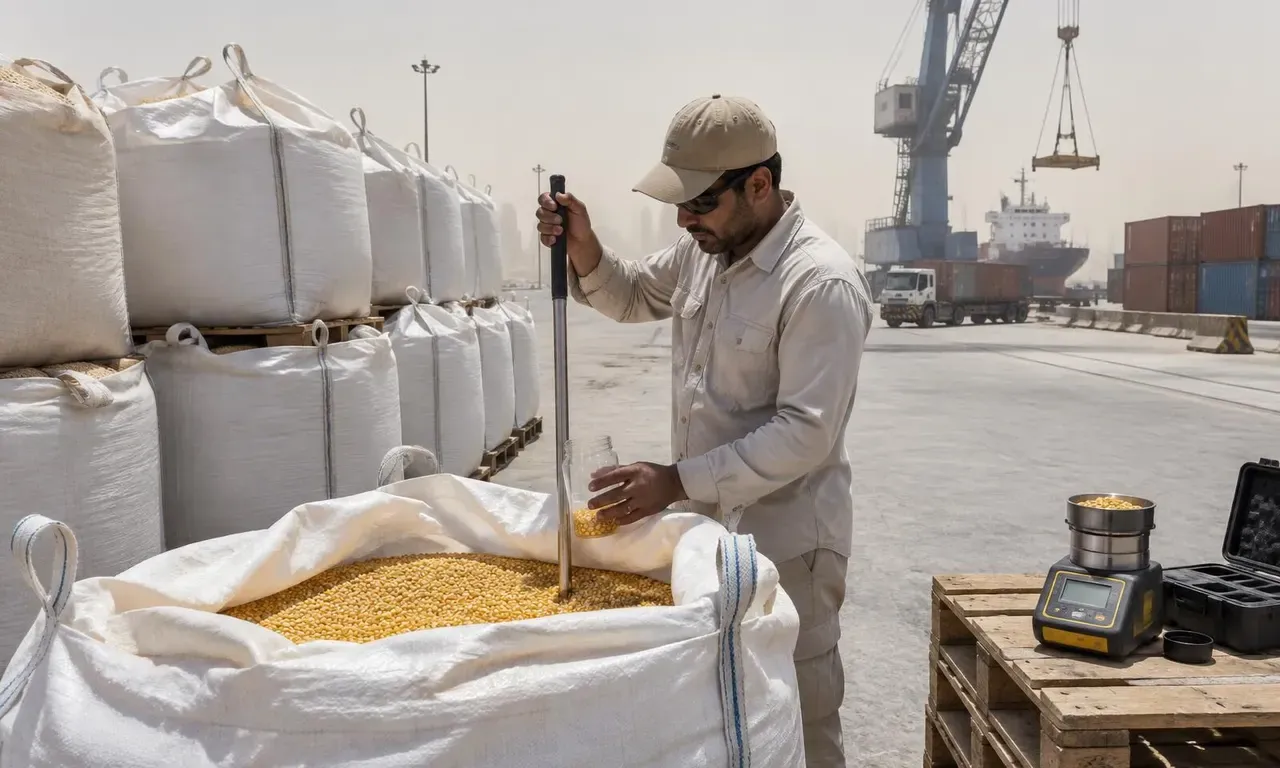
Short answer: UAE feed buyers often get quotes they cannot compare: one is CFR Jebel Ali in bulk, another ex-warehouse in 50 kg bags, a third has no moisture limit. The fix is one written brief, sent to every supplier, then every offer converted to landed cost at your site. FeedMatch runs that process for you.
Get comparable offers: Request a quote by species, volume, specification, origin and delivery window. Free to submit, with no obligation.
Why are UAE feed quotes so hard to compare?
The UAE grows almost no feed grain, so almost every bag or bulk cargo is imported. USDA's Dubai office reports (17 April 2026) that corn consumption is forecast at 610,000 MT and barley at 375,000 MT for 2026/27, driven mainly by poultry and dairy. It also notes hay, soybean meal and alfalfa imports for about 4.8 million cows, camels, sheep and goats (USDA FAS Grain and Feed Annual). Many origins and traders mean many quoting formats.
When each supplier picks its own terms, you end up comparing a price per tonne, not what the feed really costs you delivered to the farm.
What should go in a UAE feed request before you contact suppliers?
- [ ] Species and stage: broiler, layer, dairy, camel, sheep or goat
- [ ] Product: complete feed, concentrate, premix, or a single ingredient such as corn, barley or soybean meal
- [ ] Nutrient specification signed off by your nutritionist (protein, energy, fibre, as relevant)
- [ ] Quality limits: maximum moisture, foreign matter, mycotoxin limits and the test method
- [ ] Packaging: bulk, 1-tonne bags or 25/50 kg bags, and storage on site
- [ ] Acceptable origins and required documents: certificate of analysis, lot number, phytosanitary or health certificates
- [ ] Volume per shipment and per year; delivery pattern
- [ ] Incoterm, port (Jebel Ali, Khalifa, Sharjah or another) and final delivery point by emirate
- [ ] Delivery window and the latest acceptable arrival date
- [ ] Payment terms and how claims for off-spec lots will be handled
How do you normalise offers into one comparison?
| Item | Ask every supplier for | Why it matters |
|---|---|---|
| Specification | Guaranteed analysis against your spec | Cheap feed that misses the spec costs more per kg of output |
| Moisture / quality | Maximum moisture, test method, COA per lot | Moisture is water you pay to ship and store; heat and humidity raise spoilage risk |
| Packaging | Bulk or bag size, pallet and labelling | Changes handling labour, storage and losses |
| Origin | Country and, where possible, plant or elevator | Affects documents, transit time and backup options |
| Certifications | Copies, issuer and expiry date | Only accept documents you can verify |
| Delivery terms | Incoterm, port, inland transport | Decides which costs are in the price |
| Lead time | Days from order to your site | Sets your safety stock |
| Landed cost | Price + freight + insurance + port/clearance + inland + testing | The only like-for-like number |
| Contingency | A second qualified supplier or origin | Protects supply if a cargo is late |
Use the feed landed cost calculator to convert each offer, and the FCR and feed cost calculator to compare cost per kg of meat, milk or eggs, not only per tonne.
How do you judge supply reliability, not just price?
Ask how many shipments the supplier has delivered to the Gulf on similar terms, what happens if a vessel is delayed, and whether they can name an alternative origin. Recent shipping risks in the region make written freight, insurance and transit-time assumptions essential; USDA itself notes that regional geopolitical developments may weigh on its forecasts. Hold enough stock to cover your longest realistic lead time, and qualify a backup supplier before you need one.
How does FeedMatch help UAE feed buyers?
FeedMatch is a supplier-neutral procurement and matching platform. We help you scope the requirement, approach suitable suppliers, normalise their offers on specification, landed cost and terms, flag gaps and risks, and track the purchase. You choose the supplier. We are not a manufacturer, trader, importer, regulator or lender, and we do not guarantee prices, availability or financing.
Assisted sourcing is for B2B requirements of about USD 250,000 or more. Calculators, checklists and guides stay free for every buyer. See also our UAE feed procurement page, UAE feed ingredient sourcing and the traceability readiness checklist.
What claims should you verify yourself?
Import permits, product registration, feed-subsidy eligibility and origin rules change and depend on the emirate. USDA describes an Abu Dhabi fixed-price feed subsidy run through ADAFSA for eligible farmers; check eligibility with the authority, not a supplier. Check current rules with the Ministry of Climate Change and Environment and your emirate authority.
Evidence and method
Market figures come from the USDA FAS UAE Grain and Feed Annual, report TC2026-0005, published 17 April 2026 (report page, PDF). They are USDA staff forecasts, not official statistics or prices. This article contains no commodity prices, tariff rates or savings estimates. It was checked on 14 October 2026.
Ready to compare? Submit your project brief and request comparable supplier proposals: species, volume, specification, origin and delivery window. A person reviews every request before any supplier sees it.
Frequently asked questions
- How do I compare animal feed suppliers in the UAE?
- Send every supplier the same brief, covering species, volume, nutrient specification, moisture limit, packaging, origin, documents, Incoterm and delivery window, then convert each offer to landed cost at your farm or store before comparing.
- What does landed cost include for feed delivered in the UAE?
- The product price plus freight, insurance, port and clearance charges, inland transport, any testing, and the cost of losses or rejected lots. Ask each supplier to state which of these are included in writing.
- Which feed ingredients does the UAE import?
- USDA FAS (April 2026) reports the UAE imports corn and barley for feed, plus hay, soybean meal and alfalfa, because local grain production is negligible. Corn imports are forecast at 610,000 MT for 2026/27.
- Can FeedMatch supply feed directly?
- No. FeedMatch is a procurement and matching platform. We scope your requirement, approach suitable suppliers and present comparable offers. Suppliers sell, deliver and invoice the feed.
- Is there a minimum order size?
- Assisted sourcing, where our team scopes the brief and contacts suppliers, is for B2B requirements of about USD 250,000 or more per project or contract period. Our calculators and guides are free for any buyer.
- Do I need permits to import feed into the UAE?
- Rules depend on the product, origin and emirate. Confirm current requirements with the Ministry of Climate Change and Environment and your emirate authority before you order; we do not issue or guarantee permits.
Feed industry regions we work with
Feed procurement is local before it is global: raw material basis, freight and installation costs change by region. These are the areas buyers most often name when defining a feed project in English.
United States
Cities and provinces
Iowa · Nebraska · Georgia · Arkansas · Texas · North Carolina
Corn and soybean meal basis with large integrated poultry, swine and dairy operations.
United States →United Kingdom and Ireland
Cities and provinces
East Anglia · Yorkshire · Lincolnshire · Northern Ireland · Munster
Compound feed and imported protein logistics through east coast and Irish Sea ports.
United Kingdom and Ireland →Gulf and East Africa import markets
Cities and provinces
Jeddah · Dubai · Mombasa · Djibouti
Import-driven feed supply where landed cost and port logistics dominate the decision.
Gulf and East Africa import markets →FeedMatch is supplier-neutral. Regional context helps define the requirement; pricing always comes from manufacturer quotations.