
Mozambique Feed Buyer Guide: Formulation Inputs, Storage, Milling, Quality and RFQs
A practical guide for feed buyers in Mozambique: where soybean cake and maize come from (2023 trade data), what to specify, how to store and mill inputs, which quality checks to require and how to compare offers on delivered cost.
Short answer · Updated October 2026
Short answer: Mozambique Feed Buyer Guide: Formulation Inputs, Storage, Milling, Quality and RFQs
Short answer: Mozambican feed is built mostly on imported soybean cake and maize from South Africa plus regional premixes, so the buyer who wins is the one who fixes the specification, the delivery point and the import documents before asking for prices — then compares every offer on delivered cost at the mill.
Key takeaways
- Poultry is the main feed user. The Ministry of Agriculture, Environment and Fisheries reports about 135,000 t of chicken and 29.8 million dozen eggs produced in 2024, and 21,800 t of chicken imported between January and September 2025…
- Trade values cover all uses of each customs code; they show reliance on imports, not a percentage of feed demand.
- - Local soybean cake: processors operate around Cuamba (Niassa), Gurué/Lioma (Zambézia), Rapale (Nampula) and Chimoio (Manica); in Cuamba two processors together handled about 3,000 t/year in the 2023 assessment, which also found local…
- - Moisture and heat: set a maximum moisture on receipt for maize and soybean cake, and reject or dry lots above it; warm, humid storage raises the mould and aflatoxin risk the laboratory will later find.
- Record whether each answer is declared by the supplier, documented, independently checked by your laboratory, or pending.
FeedMatch Editorial Desk
Editorial Team
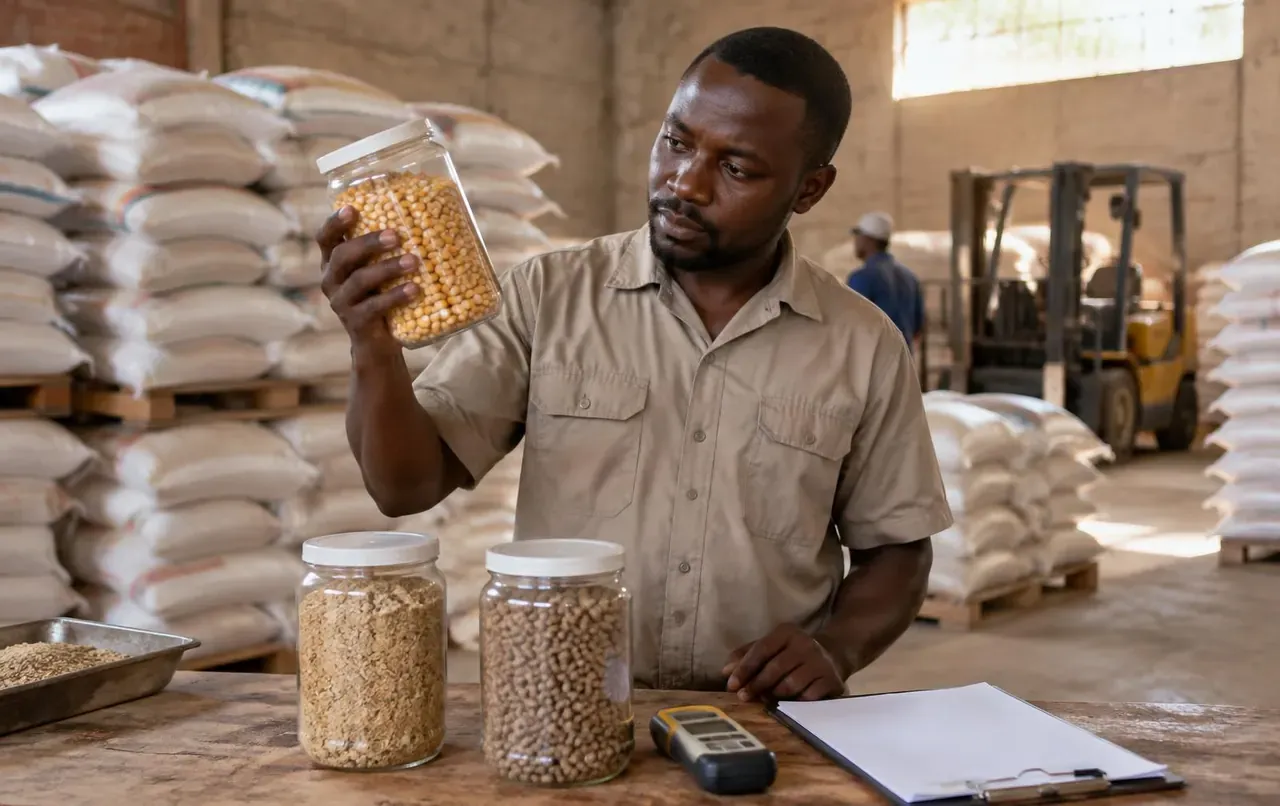
Short answer: Mozambican feed is built mostly on imported soybean cake and maize from South Africa plus regional premixes, so the buyer who wins is the one who fixes the specification, the delivery point and the import documents before asking for prices — then compares every offer on delivered cost at the mill. This guide covers each step for poultry and tilapia feed, with sources read on 25 October 2026.
Get comparable offers: submit a Mozambique feed request or, in Portuguese, the pedido de ração em Moçambique. A person reviews every request before any supplier sees it.
Who buys and produces feed in Mozambique?
Poultry is the main feed user. The Ministry of Agriculture, Environment and Fisheries reports about 135,000 t of chicken and 29.8 million dozen eggs produced in 2024, and 21,800 t of chicken imported between January and September 2025 (ministry, 15 Nov 2025). Public sources describe integrated poultry groups with their own feed mills — Higest in Machava, Matola (IFC) and Novos Horizontes in Nampula (company) — and milling companies with feed brands, such as MEREC's FORTE (company) and CIM's FEPRO (company). Tilapia farms such as Chicoa on Lake Cahora Bassa add demand for fish feed (company). In Cabo Delgado, a programme listing from about 2022 describes Moageira Abibo in Pemba as a maize-meal processor that added poultry feed (Catalisa); we found no current company source.
These names are market context, not recommendations: FeedMatch has not verified these companies and has no relationship with them. The Mozambique market page lists each one with its source and date.
Formulation inputs: where they come from and what to specify
| Input | Role in the ration | Where supply comes from (source) | Put in the request |
|---|---|---|---|
| Soybean cake (soybean meal) | Main protein for poultry | 2023 imports US$24.6m / 36,060 t — South Africa US$20.5m, Malawi US$3.7m, Zambia US$0.3m (WITS); small local crushing in Niassa, Zambézia, Nampula and Manica (TechnoServe 2023) | Crude protein minimum, moisture, fibre, urease activity, aflatoxin |
| Maize | Main energy source | 2023 imports of maize other than seed US$46.9m / 161,792 t, almost all from South Africa (WITS) alongside domestic grain | Moisture, broken grains, foreign matter, aflatoxin and fumonisin |
| Premixes, concentrates, additives | Vitamins, trace minerals, amino acids, enzymes | 2023 HS 230990 imports US$10.5m — South Africa, France, Eswatini, Malawi (WITS); regional suppliers such as Trouw Nutrition South Africa state that they serve Mozambique (company) | Inclusion rate, guaranteed analysis, shelf life, import licence or registration |
| Soybeans for local crushing | Raw material for local cake | 2023 imports US$3.0m (WITS); FAO supports reference prices to encourage domestic oilseed and poultry-feed production (FAO, Jun 2025) | Oil content, moisture, origin, crushing capacity |
Trade values cover all uses of each customs code; they show reliance on imports, not a percentage of feed demand. FAO estimates poultry uses about 100,000 t of soybean cake a year (FAO) — an ingredient estimate, not national feed demand.
Your nutritionist sets the formula. FeedMatch does not prescribe rations; the feed formulation calculator and the ingredient cost comparison calculator help you compare options with your own nutrient targets and offers.
Local ingredient opportunities — and their limits
- Local soybean cake: processors operate around Cuamba (Niassa), Gurué/Lioma (Zambézia), Rapale (Nampula) and Chimoio (Manica); in Cuamba two processors together handled about 3,000 t/year in the 2023 assessment, which also found local soybeans exported while cake was imported (TechnoServe 2023). Ask for current capacity and a lot analysis before planning on it.
- New feed units: a feed production and distribution unit opened in Gurué, Zambézia, in July 2025 for poultry producers in the centre and north (MZNews).
- Tilapia feeds from local crops: the NUTRIMO research project (2025) tested diets from Cabo Delgado cassava, moringa, maize, pearl millet, peanuts and beans; laboratory growth was lower than with a reference feed (WAS abstract). Treat this as research, not a commercial substitute.
- Not verified: merchant volumes and feed-grade specifications for local fishmeal, rice bran, sunflower or cottonseed cake.
Storage and milling: what to plan for
- Moisture and heat: set a maximum moisture on receipt for maize and soybean cake, and reject or dry lots above it; warm, humid storage raises the mould and aflatoxin risk the laboratory will later find.
- First in, first out: rotate stock by delivery date and keep premixes sealed, dry and within shelf life; record the lot number used in each batch.
- Pest control and pallets: keep bags off the floor and away from walls, and inspect for insects on receipt.
- Milling line: a commercial poultry mill typically combines intake cleaning, a hammer mill, a batch mixer with a premix dosing point, a pellet mill and a cooler; floating tilapia feed needs an extruder and dryer. Write the throughput in tonnes per hour, product range and power supply into the equipment request.
- Spare parts and service: ask every equipment supplier for local or regional service capacity, spare-part lead times and operator training.
Equipment and plant projects follow the USD 250,000 plant and equipment minimum; see feed-mill equipment and the feed mill setup cost calculator for planning ranges with your own assumptions.
Quality checks to write into every contract
| Check | What to require | Why |
|---|---|---|
| Certificate of analysis | Per lot, from a named laboratory, with methods | A brochure value is not a contract term |
| Mycotoxins | Aflatoxin limit (and fumonisin for maize), sampling plan | Imported and local grain can both fail |
| Soybean cake processing | Urease activity and protein solubility limits | Shows under- or over-heating |
| Premix guarantee | Guaranteed analysis and expiry date | Vitamins lose potency in storage |
| Tilapia feed | Which clauses of INNOQ NM 1275:2024 are met (standard) | National quality reference for tilapia feed |
| Rejection terms | What happens to a lot that fails on arrival | Avoids disputes at the gate |
Record whether each answer is declared by the supplier, documented, independently checked by your laboratory, or pending.
Procurement: delivered cost and import documents
- Fix the delivery point: your mill or farm, or the border post or port (Maputo, Beira, Nacala) with freight, clearance and storage quoted separately.
- Fix the price basis: the same Incoterm and currency for every supplier, with the payment terms stated.
- Check import documents: the Ministry's animal-health page says border control uses import licences and veterinary certificates for animal products, by-products and fodder, and that veterinary medicines need DINAV registration (ministry). We did not find a consolidated feed-registration regulation, so treat each imported input as regulatory check required with DINAV and customs before ordering.
- Check duty and VAT: we have not verified the treatment of specific feed inputs; confirm the tariff line with the Mozambique Revenue Authority (AT).
- Compare on delivered cost per unit of nutrient: the landed cost calculator adds freight and charges.
Your RFQ checklist
- [ ] Product and form (bulk, 50 kg bags, big bags)
- [ ] Nutrient limits with test methods and laboratory
- [ ] Mycotoxin limits and sampling plan
- [ ] Monthly volume, contract length and delivery window
- [ ] Delivery point and price basis
- [ ] Import licence, veterinary certificate and registration status where they apply
- [ ] Certificate of analysis per load and rejection terms
- [ ] For equipment: throughput (t/h), product range, power supply, installation and service scope
The feed RFQ checklist and the procurement toolkit turn this into a downloadable brief.
What FeedMatch does and does not do
FeedMatch helps you write the request, consults suitable suppliers, rebuilds their offers on the same specification, delivery terms and documents, and flags gaps and risks. We do not manufacture, sell, import, export, test or certify products and we do not issue permits; buyers and suppliers do not contact each other directly through FeedMatch, and buyers pay nothing. The USD 250,000 minimum applies only to plant and equipment projects; feed and ingredient purchases have no minimum.
Sources and method
All sources were opened on 25 October 2026: World Bank WITS / UN Comtrade import pages for 2023 (HS 230400, 100590, 230990, 120100); the Ministry of Agriculture, Environment and Fisheries poultry statement of 15 November 2025 and its animal-health page; IFC's Higest project disclosure (updated August 2026); company pages of MEREC, CIM, Novos Horizontes, Chicoa and Trouw Nutrition South Africa (undated); Amethis (7 February 2025); the Catalisa programme page (undated, c. 2022); TechnoServe / Feed the Future food-processing mapping (April 2023); MZNews (29 July 2025); FAO MAFAP (2025); the NUTRIMO abstract (June 2025); and INNOQ NM 1275:2024. Capacities from 2023 are not current output. No prices are given.
Ready to compare? Submit your Mozambique request: product, specification, volume, delivery point and window.
Frequently asked questions
- Which feed inputs does Mozambique import most?
- World Bank WITS data for 2023 show US$46.9 million of maize other than seed (food and feed uses combined), US$24.6 million of soybean oil-cake and US$10.5 million of animal-feeding preparations, with South Africa the main origin of all three.
- What should a soybean cake specification for Mozambique include?
- Minimum crude protein, maximum moisture and fibre, urease activity, aflatoxin limit, bag or bulk, the test method and laboratory you accept, and a certificate of analysis for every load — plus the delivery point and price basis.
- Is there a quality standard for tilapia feed in Mozambique?
- Yes: INNOQ standard NM 1275:2024 covers ingredients, additives, composition, microbiology, labelling, traceability and manufacturing practice for tilapia feed. We have not confirmed whether it is mandatory, so ask suppliers which clauses they meet.
- Does FeedMatch buy or import feed for me?
- No. FeedMatch helps you write the request, consults suitable suppliers and compares their offers on the same basis. Suppliers sell, deliver and invoice; FeedMatch does not manufacture, import, test or certify anything, and buyers and suppliers do not contact each other directly through FeedMatch.
- Is there a minimum order size?
- The USD 250,000 minimum applies only to feed-mill plant and equipment projects. Feed and ingredient purchases have no minimum and are reviewed by specification, volume and destination. Guides and calculators are free.
Feed industry regions we work with
Feed procurement is local before it is global: raw material basis, freight and installation costs change by region. These are the areas buyers most often name when defining a feed project in English.
United States
Cities and provinces
Iowa · Nebraska · Georgia · Arkansas · Texas · North Carolina
Corn and soybean meal basis with large integrated poultry, swine and dairy operations.
United States →United Kingdom and Ireland
Cities and provinces
East Anglia · Yorkshire · Lincolnshire · Northern Ireland · Munster
Compound feed and imported protein logistics through east coast and Irish Sea ports.
United Kingdom and Ireland →Gulf and East Africa import markets
Cities and provinces
Jeddah · Dubai · Mombasa · Djibouti
Import-driven feed supply where landed cost and port logistics dominate the decision.
Gulf and East Africa import markets →FeedMatch is supplier-neutral. Regional context helps define the requirement; pricing always comes from manufacturer quotations.