
How to Evaluate Feed Ingredient Substitutions Without Compromising Nutrition, Safety or Production Targets
A substitute is only cheaper if it delivers the same usable nutrients at a lower delivered cost, within safe inclusion limits and with documents you can verify. Compare on a nutrient basis, check contaminants and limits, run a controlled trial, and let your nutritionist sign off the reformulation.
Short answer · Updated October 2026
Short answer: How to Evaluate Feed Ingredient Substitutions Without Compromising Nutrition, Safety or Production Targets
Do not compare price per tonne. Compare the cost of the nutrients the ingredient is supposed to supply (for example protein, digestible amino acids or energy) on the same dry-matter basis, add freight and handling, then check anti-nutritional factors, contaminant risk, maximum inclusion and how it handles on your…
Key takeaways
- Typical triggers are a price gap between two protein or energy sources, a supply interruption, a new local by-product, or a customer or certification requirement (for example non-GM or deforestation-free soy).
- - Current ration or feed label: which nutrient the ingredient is there to supply - Certificate of analysis (CoA) of the candidate lot: dry matter, crude protein, fat, fibre, ash and, where relevant, amino acids - Delivered price per tonne…
- 1. Define the job: which nutrient(s) the current ingredient supplies and in what amount.
- Assumptions (illustrative, not market prices): soybean meal at 88% DM and 46% crude protein as fed, delivered at 520 per tonne; sunflower meal at 90% DM and 36% crude protein as fed, delivered at 360 per tonne.
- - Comparing price per tonne instead of cost per unit of nutrient on the same dry-matter basis - Using a typical table value instead of the actual lot's CoA - Ignoring what else must change in the ration (amino acids, energy, fibre) and its…
FeedMatch Editorial Desk
Editorial Team
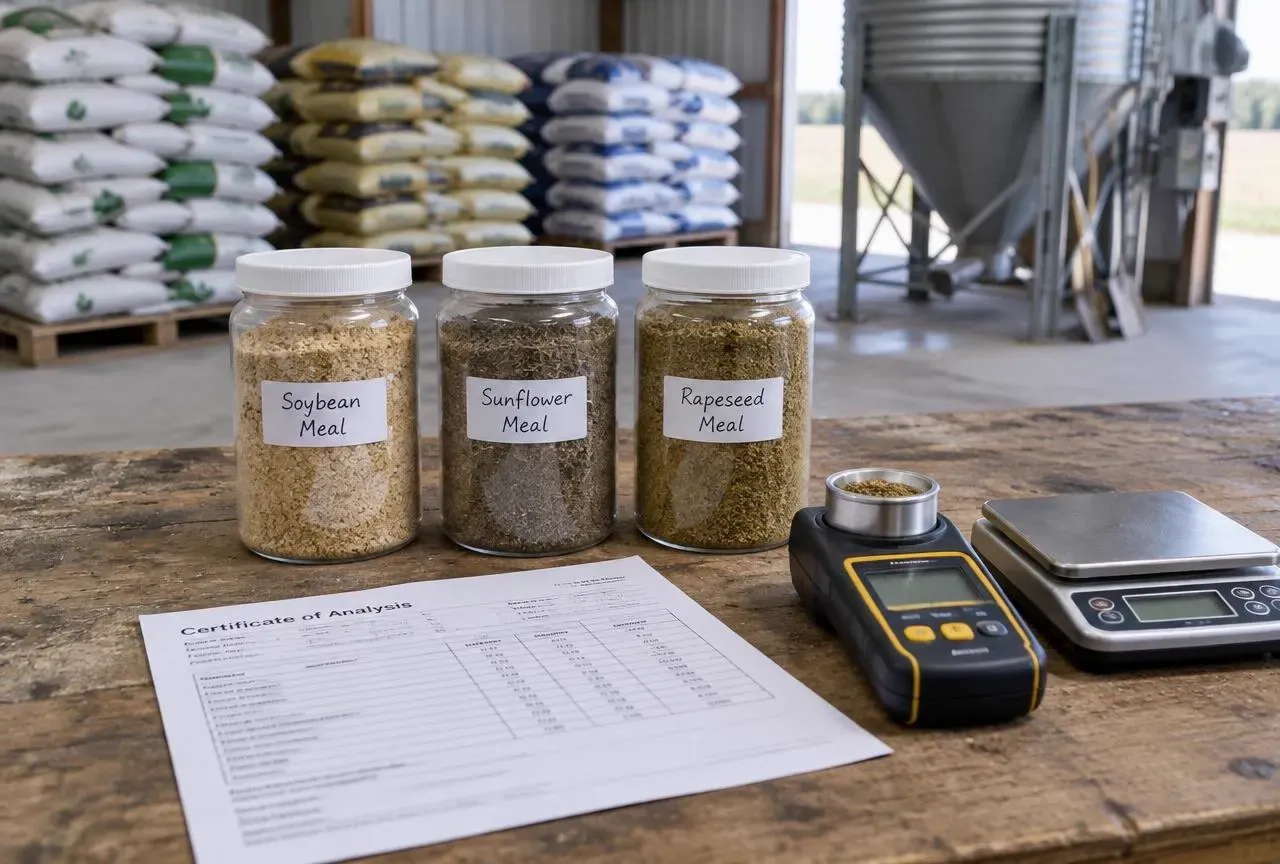
Do not compare price per tonne. Compare the cost of the nutrients the ingredient is supposed to supply (for example protein, digestible amino acids or energy) on the same dry-matter basis, add freight and handling, then check anti-nutritional factors, contaminant risk, maximum inclusion and how it handles on your farm. Change one ingredient at a time, trial it on one group, and keep the old supply available until results are in.
*Written by the FeedMatch Group editorial team. Last reviewed: 15 October 2026.*
When is a substitution worth evaluating?
Typical triggers are a price gap between two protein or energy sources, a supply interruption, a new local by-product, or a customer or certification requirement (for example non-GM or deforestation-free soy). A substitution is worth a formal check when the ingredient makes up a meaningful share of the ration, or when it affects a safety-critical point such as mycotoxins, salt or a species-specific restriction.
What information do you need before deciding?
- Current ration or feed label: which nutrient the ingredient is there to supply
- Certificate of analysis (CoA) of the candidate lot: dry matter, crude protein, fat, fibre, ash and, where relevant, amino acids
- Delivered price per tonne including freight, duties, bagging or bulk handling
- Anti-nutritional factors and known limits for your species and stage (from your nutritionist or reference tables such as Feedipedia)
- Contaminant testing: mycotoxins, and supplier evidence of controls (HACCP-based plan, GMP+/FAMI-QS or equivalent where claimed — ask for the certificate number)
- Legal status in your country: authorised feed material, labelling, and any species bans
- Physical handling on your farm: flow, dust, storage life, pellet quality if you pellet
Decision checklist, step by step
- Define the job: which nutrient(s) the current ingredient supplies and in what amount.
- Screen legality and species restrictions first; stop if the material is not permitted for your animals.
- Convert every offer to the same dry-matter basis and calculate delivered cost per kg of the target nutrient.
- Check what else changes: amino-acid balance, fibre, energy, minerals, palatability. Ask your nutritionist whether other ingredients or additives must change too — include their cost.
- Check safety: contaminant results per lot, supplier controls and your own receiving test plan.
- Check maximum inclusion and handling; reject candidates you cannot store or feed reliably.
- Trial on one group or one batch with a clear end date and measures (intake, growth or output, feed refusals, health notes).
- Decide on the trial data and the total ration cost, not the ingredient price; document the decision and the specification you will buy against.
Comparison table: what to line up for each candidate
| What to compare | Current ingredient | Candidate A | Candidate B |
|---|---|---|---|
| Dry matter (%) from CoA | |||
| Target nutrient on DM basis (e.g. CP %) | |||
| Delivered price per tonne | |||
| Delivered cost per kg of target nutrient | |||
| Other ration changes needed (and cost) | |||
| Known limits / anti-nutritional factors | |||
| Contaminant results and supplier controls | |||
| Legal status for your species | |||
| Storage and handling on your farm |
Worked example (illustrative assumptions)
Assumptions (illustrative, not market prices): soybean meal at 88% DM and 46% crude protein as fed, delivered at 520 per tonne; sunflower meal at 90% DM and 36% crude protein as fed, delivered at 360 per tonne.
- Soybean meal: 520 ÷ (1,000 kg × 0.46) = 1.13 per kg crude protein
- Sunflower meal: 360 ÷ (1,000 kg × 0.36) = 1.00 per kg crude protein
On crude protein alone the sunflower meal looks about 11% cheaper. But it supplies less lysine per kg of protein and more fibre, so a nutritionist may need to add synthetic lysine or more energy to keep the ration balanced, and may cap inclusion for young poultry. If those corrections cost more than the 0.13 per kg protein gap, the substitution does not pay. The decision is the total ration cost after reformulation, confirmed in a trial.
*All figures are invented to show the method. Use your own CoAs and delivered quotes.*
Common costly mistakes
- Comparing price per tonne instead of cost per unit of nutrient on the same dry-matter basis
- Using a typical table value instead of the actual lot's CoA
- Ignoring what else must change in the ration (amino acids, energy, fibre) and its cost
- Switching the whole farm at once with no trial group and no fallback supply
- Accepting a quality certificate claim without the certificate number and scope
- Forgetting storage: some by-products heat, cake or go rancid faster
What to do and what to avoid
Do:
- Write the specification you will buy against (DM, protein, fat, fibre, contaminant limits)
- Test incoming lots at least for moisture and, where risk is known, mycotoxins
- Keep retained samples of each lot
- Agree what happens if a lot fails specification
Avoid:
- Changing several ingredients at the same time
- Treating supplier marketing figures as guaranteed results
- Using a material with no clear legal status for your species
- Deciding before trial data is available
Questions to ask the supplier of the substitute
- Can you send the CoA for the actual lot, and which laboratory tested it?
- What is your typical lot-to-lot variation for protein and moisture?
- Which contaminants do you test for, how often, and can I see recent results?
- Which feed safety certification do you hold — certificate number and scope?
- Is the material authorised as a feed material in my country and for my species?
- What packaging, shelf life and storage conditions do you recommend?
- What happens if a delivery does not meet the agreed specification?
Summary: five actions
- Compare delivered cost per kg of the nutrient you need, on a dry-matter basis.
- Include the cost of any other ration changes.
- Verify legality, contaminant controls and documents per lot.
- Trial on one group before switching the farm.
- Buy against a written specification and keep retained samples.
Related tools and guides
Calculate delivered cost with the landed cost calculator, compare quotes using the CoA and dry-matter guide, see the soybean meal vs sunflower meal comparison, score suppliers with the qualification scorecard, and browse feed ingredients.
Need offers for a substitute ingredient? Send a request with the ingredient, specification, volume and delivery point. Our team contacts suitable suppliers and presents their responses to you; free for buyers.
Sources, review and limits
- FAO/IFIF — Good Practices for the Feed Sector (2010)
- Codex Alimentarius — Code of Practice on Good Animal Feeding (CXC 54-2004)
- EU Regulation (EC) No 183/2005 — feed hygiene
- US 21 CFR Part 507 — preventive controls for animal food
- Feedipedia — animal feed resources information system (INRAE, CIRAD, AFZ, FAO)
FeedMatch does not formulate feed or give veterinary advice and does not guarantee savings or production results. Regulatory requirements differ by country; check the rules that apply where you farm. Confirm every reformulation with a qualified nutritionist.
Frequently asked questions
- What is the best substitute for soybean meal in animal feed?
- There is no single best substitute. Sunflower, rapeseed/canola, cottonseed meal, peas or local by-products can replace part of the protein, each with different amino acids, fibre and limits by species. Compare delivered cost per kg of usable nutrient and let your nutritionist set the inclusion.
- How do I compare two ingredients with different moisture?
- Convert both to the same dry-matter basis using the dry matter on each lot's CoA, then divide the delivered price by the amount of the target nutrient you actually receive.
- Should I change the whole farm to a new ingredient at once?
- No. Trial it on one group or batch with defined measures and an end date, and keep your current supply available until the results are clear.
- Which documents should a substitute ingredient come with?
- At minimum a lot CoA, contaminant results where relevant, the supplier's feed safety certificate number and scope if one is claimed, and confirmation that the material is permitted for your species in your country.
Feed industry regions we work with
Feed procurement is local before it is global: raw material basis, freight and installation costs change by region. These are the areas buyers most often name when defining a feed project in English.
United States
Cities and provinces
Iowa · Nebraska · Georgia · Arkansas · Texas · North Carolina
Corn and soybean meal basis with large integrated poultry, swine and dairy operations.
United States →United Kingdom and Ireland
Cities and provinces
East Anglia · Yorkshire · Lincolnshire · Northern Ireland · Munster
Compound feed and imported protein logistics through east coast and Irish Sea ports.
United Kingdom and Ireland →Gulf and East Africa import markets
Cities and provinces
Jeddah · Dubai · Mombasa · Djibouti
Import-driven feed supply where landed cost and port logistics dominate the decision.
Gulf and East Africa import markets →FeedMatch is supplier-neutral. Regional context helps define the requirement; pricing always comes from manufacturer quotations.