
Feed ingredient procurement specification: from lot COA to a comparable RFQ
A useful feed ingredient RFQ is a controlled specification, not a request for a price list. Name the material, identify the lot evidence, agree how samples will be tested and accepted, and put delivery responsibilities beside the price. A certificate of analysis (COA) supports that review; it does not certify a supplier or prove every part of a shipment is suitable.
Short answer · Updated November 2026
Short answer: Feed ingredient procurement specification: from lot COA to a comparable RFQ
A useful feed ingredient RFQ is a controlled specification, not a request for a price list. Name the material, identify the lot evidence, agree how samples will be tested and accepted, and put delivery responsibilities beside the price.
Key takeaways
- Give the document a reference, revision and date.
- Request the product name, manufacturer or issuing entity, lot identifier, sampling and analysis dates, report identifier, laboratory identity, test method, units, result and reporting basis for each parameter.
- The FAO/IFIF feed manual explains why representative sampling and suitable handling matter.
- Ask the technical team to identify relevant mycotoxins, microbiological hazards and identity or adulteration risks for this ingredient and supply route.
- Ask how the quoted lot links to production, source materials, dispatch and any split deliveries.
FeedMatch Editorial Desk
Editorial Team
A useful feed ingredient RFQ is a controlled specification, not a request for a price list. Name the material, identify the lot evidence, agree how samples will be tested and accepted, and put delivery responsibilities beside the price. A certificate of analysis (COA) supports that review; it does not certify a supplier or prove every part of a shipment is suitable.
Start with a specification that can be quoted
Give the document a reference, revision and date. Describe the ingredient, intended feed application, processing form and any required origin information. Separate required properties from preferences and information still awaiting your technical team. Ask each bidder to quote against the same revision and list departures explicitly; a silent substitution is not an equivalent offer.
For example, a buyer comparing soybean meal deliveries to a mill should distinguish the declared protein basis, moisture basis, physical form and delivery lot. A fishmeal request needs its own identity and processing evidence. Do not copy a generic specification across ingredients or turn a planning calculator result into a production approval.
Make the COA traceable to the offered lot
Request the product name, manufacturer or issuing entity, lot identifier, sampling and analysis dates, report identifier, laboratory identity, test method, units, result and reporting basis for each parameter. Record whether a value is measured, calculated, a specification limit or merely a typical value. Link the report to the delivery documents; a historical example COA is not the report for the incoming lot.
Percentages on a dry-matter basis cannot be compared directly with as-received percentages. Likewise, “not detected” needs the method and detection or quantification information relevant to the decision. Ask about missing fields before awarding, rather than treating an empty cell as a pass.
Agree sampling and testing before dispatch
The FAO/IFIF feed manual explains why representative sampling and suitable handling matter. Your competent quality team should specify who samples, where increments are taken, how a composite or retained sample is formed, container and seal identification, custody records and storage conditions. Define who pays for routine checks and a disputed-result retest; decide which laboratory and method will be used.
Keep sampling instructions separate from the commercial acceptance decision. Record an arrival hold, document review and release authority where appropriate. A retained sample can support investigation, but one sample cannot establish that every part of a heterogeneous shipment has identical composition. See the narrower incoming sampling guide for sampling preparation.
Set contamination and adulteration checks without invented limits
Ask the technical team to identify relevant mycotoxins, microbiological hazards and identity or adulteration risks for this ingredient and supply route. For each chosen check, state the analyte, method, units, agreed decision criterion and evidence needed. This article supplies no universal toxin or pathogen threshold: applicable requirements and suitability must be checked for the actual destination and use.
Visual checks, odour or a nutrition analysis are not substitutes for every safety test. Agree what happens when a result is inconclusive or outside the agreed criterion: hold, additional investigation, rejection or another documented decision by the responsible team. Do not prescribe treatment or blend away a failed lot on the basis of this checklist.
Connect traceability, batch consistency and claims
Ask how the quoted lot links to production, source materials, dispatch and any split deliveries. Define the records available for a withdrawal investigation and the contact responsible for providing them. Compare multiple lot reports only on a consistent method and basis; decide which variability requires notification or fresh approval.
For a certification or origin claim, request the exact scheme, issuing body, covered site or product, scope, validity and supporting record. Confirm it with an appropriate source. A logo, marketing statement or supplier questionnaire is not independent confirmation. The traceability due-diligence guide covers the record trail in more detail.
Put logistics on the same comparison sheet as price
Write the named place or port and the Incoterms rule plus version where used. ICC explains that these rules allocate specified delivery obligations, costs and risks; they do not replace quality, payment or dispute clauses. Name who arranges each transport leg, insurance where applicable, loading, unloading, documents and arrival inspections.
For a US-dollar quote, state whether the quantity is in metric tonnes, kilograms or another unit; do not silently equate a short ton with a metric tonne. Ask for packaging, lot separation, storage conditions, delivery window and any excluded charges. Currency, exchange assumption and tax treatment must come from the actual quotation or buyer inputs, not an assumed market price.
A quote-comparison checklist the buyer can actually use
Use one row per bidder and columns for specification revision, exact material, lot evidence, declared deviations, test/acceptance arrangement, origin/traceability documents, quantity/unit, price/currency, named delivery basis, excluded costs, timing and validity. Mark missing evidence “pending”, not zero cost or compliance confirmed. Keep technical acceptability separate from arithmetic.
Try the landed-cost comparison calculator with your own quoted costs and the feed formulation calculator for planning. Neither approves an ingredient, predicts supplier availability nor guarantees performance. Resolve scope differences before interpreting a cheaper total as a better offer.
Send an evidence-ready request, not a supplier endorsement
Attach the specification revision, requested COA fields, sampling/acceptance schedule, logistics basis and open questions to your FeedMatch RFQ. FeedMatch is independent and supplier-neutral, free for buyers. The team reviews and organizes the request before contacting suitable suppliers and presenting responses through FeedMatch; there is no automatic direct connection or supplier certification. The US$250,000 minimum applies to all purchases, including feed ingredients.
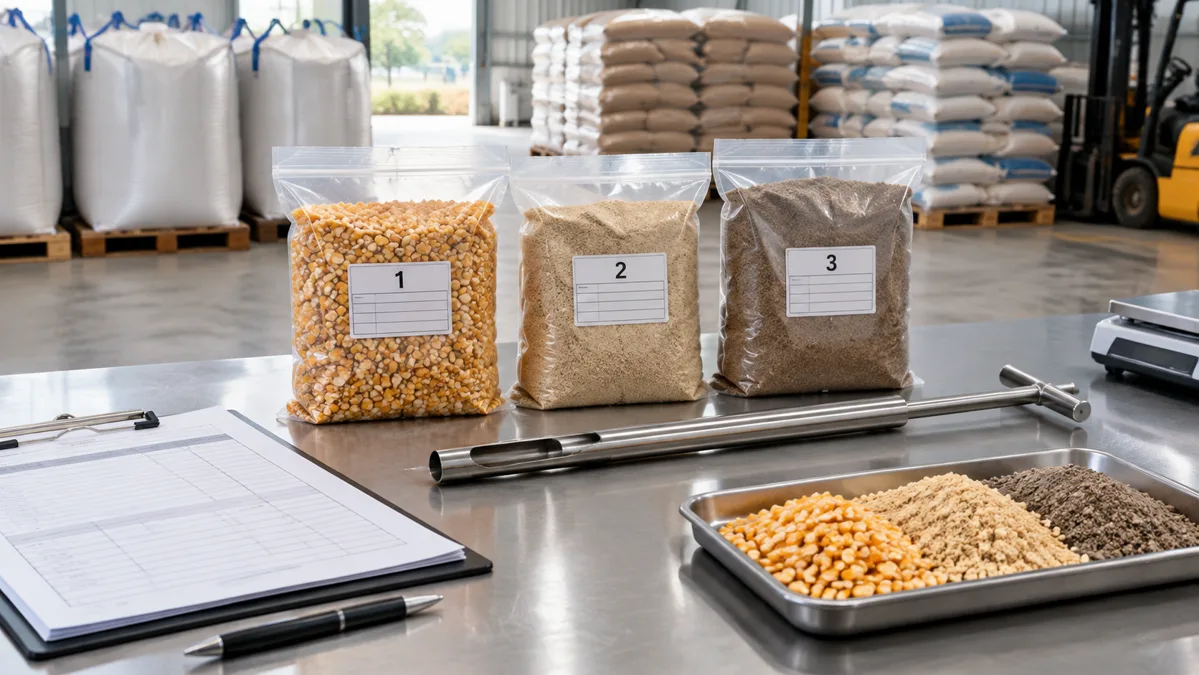
This is an AI-assisted editorial guide, not a laboratory instruction or regulatory opinion. No independent technical or native-language review is claimed. The image is an AI-generated illustration, not a photographed supplier lot.
Sources and further reading
FAO/IFIF, Good practices for the feed industry, sampling chapter (2010); general principles. ICC Academy, Incoterms 2020 explanation. Sources accessed 20 November 2026; contract and local requirements still need case-specific review.
Frequently asked questions
- Does a COA certify the supplier?
- No. It reports specified analytical information for the identified sample or lot. Check the issuer, methods, reporting basis and linkage to the shipment; assess any certification claim separately.
- Which contamination limits should an RFQ state?
- Use criteria established by the responsible technical team for the ingredient, destination and intended use, with the applicable requirements checked separately. This guide gives no universal numerical limits.
- Can two prices be compared before the documents arrive?
- You can record them provisionally, but mark missing evidence and scope differences as pending. A calculator total does not resolve technical acceptability or unknown delivery charges.
- What should happen to a disputed test result?
- Use the pre-agreed hold, retest, laboratory and decision process. Preserve sample identity and custody records, and leave release decisions to the responsible quality team.
- How does FeedMatch handle the request?
- Buyers use the service free of charge. The team reviews the RFQ before supplier outreach and presents responses through FeedMatch, without endorsement or direct automatic connection. All purchases have a US$250,000 minimum.
Feed industry regions we work with
Feed procurement is local before it is global: raw material basis, freight and installation costs change by region. These are the areas buyers most often name when defining a feed project in English.
United States
Cities and provinces
Iowa · Nebraska · Georgia · Arkansas · Texas · North Carolina
Corn and soybean meal basis with large integrated poultry, swine and dairy operations.
United States →United Kingdom and Ireland
Cities and provinces
East Anglia · Yorkshire · Lincolnshire · Northern Ireland · Munster
Compound feed and imported protein logistics through east coast and Irish Sea ports.
United Kingdom and Ireland →Gulf and East Africa import markets
Cities and provinces
Jeddah · Dubai · Mombasa · Djibouti
Import-driven feed supply where landed cost and port logistics dominate the decision.
Gulf and East Africa import markets →FeedMatch is supplier-neutral. Regional context helps define the requirement; pricing always comes from manufacturer quotations.