
Feed mill buyer guide
Feed mill retrofit vs replace: an existing-line decision checklist
Investigate retrofit when a measured constraint can be removed while the retained line remains suitable for your feed requirements. Compare a new line when the required process, site or equipment condition makes reuse uncertain. Neither route is automatically cheaper: use the same product mix, saleable-output assumptions, scope and acceptance requirements, and keep unresolved engineering questions visible before comparing costs.
Explore free tools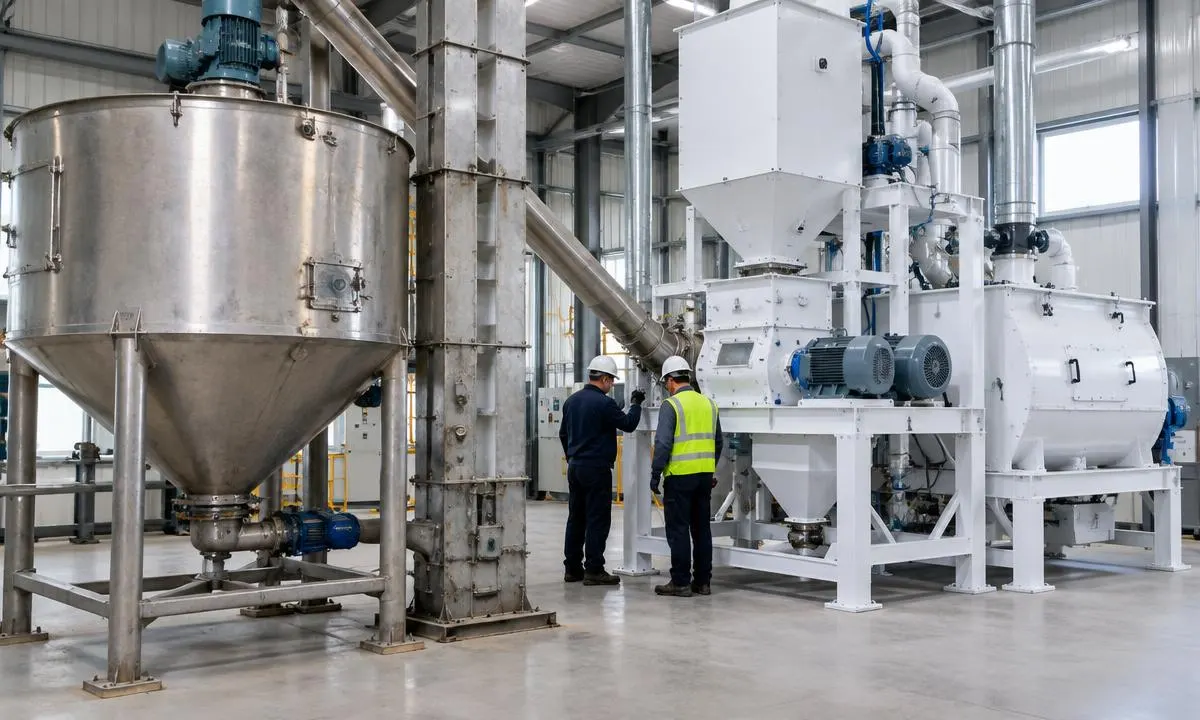
Illustrative equipment image, not a verified facility layout or technical specification.
Decision table: what evidence supports each route?
Use these screening questions with your advisers, not as an automatic score or investment recommendation.
| Decision factor | Retrofit / staged expansion | New line / new mill | Evidence to collect |
|---|---|---|---|
| Process and product fit | Consider when retained stages suit the feeds and the constraint is localized. | Compare when feasible modifications cannot support the required process or product mix. | Recipes, stage observations and engineer-reviewed requirements. |
| Retained assets and site | Reuse only after condition, access, structures and utilities are assessed. | Compare a new arrangement when reuse requires major unresolved site changes. | Condition survey, measured drawings, utility review and local professional advice. |
| Production continuity | Check tie-ins, shutdown windows, interim controls and restart risks. | Check parallel installation feasibility; shared utilities may still interrupt production. | Transition schedule, stock/production plan and commissioning dependencies. |
| Whole-line capacity | Check that removing one constraint does not overload the next stage. | Require a balanced line on the same recipe and operating basis. | Stage-capacity basis, transfers, buffers and acceptance conditions. |
| Comparable lifecycle cost | Include retained-asset repairs, integration and transition costs. | Include site, utilities, installation and startup costs beyond package price. | Dated quotes, exclusions, labelled estimates and sensitivity cases. |
| Ownership and acceptance | Define ownership of new/retained equipment interfaces. | Define full-line responsibility and buyer-side exclusions. | Responsibility matrix, test protocol and remedy/retest provisions. |
Decision checklist: establish the baseline before choosing equipment
Build an evidence pack from representative production runs, not a single nameplate rating. Record feed formats and recipes, actual stage output, operating hours, changeovers, stoppages, energy use and rejected or reworked product. Distinguish measured records from estimates, with a date and an owner for each input.
Identify the limiting stage with your process engineer. A larger pellet press will not resolve a restriction in grinding, batching, cooling or dispatch. Assess retained equipment condition and controls, then ask whether the proposed change transfers the constraint elsewhere. A calculator organizes assumptions; it cannot diagnose a mill remotely.
- Define current and required product mix and quality acceptance criteria.
- Record representative stage-capacity and downtime evidence.
- Inspect retained machinery, structures, utilities and control interfaces with qualified professionals.
- List each unresolved constraint, the responsible reviewer and required evidence.
- Document whether demand is confirmed, forecast or an expansion scenario.
Compare retrofit, staged expansion and a new line on equal terms
For retrofit, specify what stays, what changes and who accepts responsibility for the interfaces. Include removals, temporary connections, access, testing and repairs to retained assets. For a new line, include site preparation, storage, utilities, transfers, installation and integration. An excluded or unpriced item is unresolved, not zero.
Treat staged expansion as a separate alternative where parallel operation or a later module is feasible. Ask the engineer to validate the interim operating state as well as the final arrangement. Do not assume that leaving the old line running provides adequate backup, segregation or dispatch capacity.
- Use one feed specification and operating-time basis for all options.
- Mark each scope item included, excluded, optional or unanswered.
- Allocate mechanical, electrical, control and acceptance responsibilities.
- Keep interim works and future options separate from the base package.
Buyer scenarios: what would change the decision?
Illustrative scenario A: a buyer has adequate grinding and mixing evidence but recurring constraints at cooling and dispatch. Compare targeted retrofit with a wider package after checking transfers, buffers, utilities and the capacity basis. The evidence may support reuse, but this example makes no output or savings prediction.
Illustrative scenario B: a buyer needs a different feed format and has uncertain building clearance, worn handling equipment and limited utility capacity. Compare complete reuse costs and feasibility against a separate line or site. A low equipment price does not settle structural, safety or process suitability.
Illustrative scenario C: production cannot stop for a long installation window. Compare staged tie-ins or parallel commissioning with a planned shutdown. Specify temporary production or stock arrangements and delayed-restart consequences; do not assign a universal shutdown duration.
- Identify evidence that would reverse your preferred option.
- Request alternative scopes separately, not mixed totals.
- Have site and production owners review the transition plan.
Model lifecycle costs and the transition, not just machine price
Enter your own dated quotes and labelled estimates for equipment, installation, civil work, utilities, logistics, controls, spares and commissioning. Use the same evaluation period and currency basis. Keep financing and working capital separately identified. Do not treat unknown retrofit repairs or new-site utility costs as zero.
Compare energy, labour and maintenance under the same utilization assumptions. Use saleable output where cost per tonne is relevant and label the measurement basis. Model shutdown costs from your own credible production, margin or replacement-supply inputs; avoid counting both lost contribution and the same lost revenue. Test low utilization, higher operating cost and delayed startup separately. Results are scenarios, not guaranteed payback.
- Separate quoted costs, estimates and unresolved items.
- Apply a common evaluation period, currency source/date and utilization basis.
- Review output and maintenance assumptions with engineering and finance.
- Retain transition costs and sensitivity cases with the result.
Turn the decision into a reviewable RFQ and acceptance plan
Prepare one base brief with the evidence pack, site drawings, retained-asset register, scope matrix and unresolved questions. Ask for retrofit and new-line alternatives on the same basis where both are feasible. Define recipes, test conditions, sampling, measurement, utilities and staffing for acceptance. Agree how interface failures, retesting and outstanding work are handled.
The buyer owns the investment decision and appoints qualified engineering and contracting advisers. FeedMatch reviews and organizes eligible RFQs before the team contacts suitable suppliers and presents responses through FeedMatch. It does not build mills or validate engineering; availability, responses, costs and terms are not guaranteed.
- Name owners of design approval, shutdown coordination and acceptance.
- Require written capacity conditions, exclusions and interface responsibilities.
- Resolve safety and feasibility questions before a binding purchase.
- Retain assumptions, deviations and professional reviews with the decision.
Upgrade cost worksheet: retrofit vs used or new replacement
Compare replacement of an existing line or stage, not a greenfield mill. Use written quotes in one currency and the same recipe, saleable-output basis and evaluation period. Record source, date, validity and owner; an unanswered cell is not zero.
| Cost item | Retrofit | Used replacement | New replacement |
|---|---|---|---|
| Equipment purchase / retrofit package | Unresolved | Unresolved | Unresolved |
| Inspection and condition testing | Unresolved | Unresolved | Unresolved |
| Dismantling, loading and freight | Unresolved | Unresolved | Unresolved |
| Non-recoverable duties and taxes | Unresolved | Unresolved | Unresolved |
| Refurbishment and wear parts | Unresolved | Unresolved | Unresolved |
| Site works and connections | Unresolved | Unresolved | Unresolved |
| Electrical and controls integration | Unresolved | Unresolved | Unresolved |
| Installation and commissioning | Unresolved | Unresolved | Unresolved |
| Training and initial spares | Unresolved | Unresolved | Unresolved |
| Transition cost (do not double-count lost contribution) | Unresolved | Unresolved | Unresolved |
- Initial upgrade cost = equipment + inspection + logistics + refurbishment + integration + installation + training/spares + transition costs. Separate recoverable taxes and working capital; do not add the total row to itself.
- Energy intensity (kWh/t) = metered energy ÷ saleable tonnes over the same period. Compare equivalent recipes and operating conditions.
- Annual net benefit = additional saleable tonnes × contribution per tonne + separately evidenced annual savings − additional annual operating costs. Do not subtract costs already included in contribution or count the same saving twice.
- Simple payback (years) = initial upgrade cost ÷ annual net benefit, only if net benefit is positive. With missing inputs or a zero/negative benefit, report no calculable payback. This excludes discounting and is not a return guarantee.
Keep a baseline, lower-utilization case and delayed-restart case. Use your finance team’s assumptions; these arithmetic identities are not supplier price or performance evidence.
Existing-mill references and related checks
FAO/IFIF supports feed-safety and production checks; OSHA covers US grain-handling and hazardous-energy requirements; FDA covers US animal-food preventive controls. NFPA 660 consolidates NFPA 61 and other combustible-dust standards. Applicability and locally adopted editions require your safety adviser and authority—not this page—to decide.
- FAO / IFIF — Good practices for the feed sector (2020 manual)
- OSHA — Grain handling
- OSHA — Control of hazardous energy (lockout/tagout)
- NFPA 660 — Combustible dusts (consolidates NFPA 61; confirm locally adopted edition)
- FDA — FSMA preventive controls for animal food
Sources checked: 2026-10-16. Sources support the inspection topics, not any cost or outcome estimate.
Used equipment inspection checklist · Line-upgrade scope and interfaces
Request an existing-mill upgrade comparison
Attach the measured constraint, retained-asset information, cost worksheet and shutdown limits. Projects start at US$250,000; buyer use is free. FeedMatch reviews the request, contacts suppliers and presents responses—no direct buyer–supplier handoff.
Free tools for your assumptions
Enter your own figures and retain the assumptions with the result. These tools do not validate engineering, optimize a complete feed formulation or guarantee costs, output or returns.
References and professional review
The FAO/IFIF manual provides general feed-production and feed-safety context; it is not a project design or certificate. ICC explains Incoterms responsibilities; the selected rule does not replace a full installation and acceptance contract. Confirm applicable requirements with qualified local advisers.