
Buy Feed or Build a Feed Mill? A Commercial Decision Framework
A practical make-or-buy framework for livestock producers and agriculture investors, covering demand, operating capability, capital exposure and comparable lifecycle costs.
Short answer · reviewed October 2026
Short answer: Buy Feed or Build a Feed Mill? A Commercial Decision Framework
A practical make-or-buy framework for livestock producers and agriculture investors, covering demand, operating capability, capital exposure and comparable lifecycle costs.
Key takeaways
- !Feed manufacturing site showing ingredient silos, a processing building and bulk loading access
- - Feed mill energy calculator - Feed landed cost calculator - Feed TCO supplier comparison calculator - Feed buyer FAQ: 100 questions
Mill Engineering Desk
Feed Mill Engineers
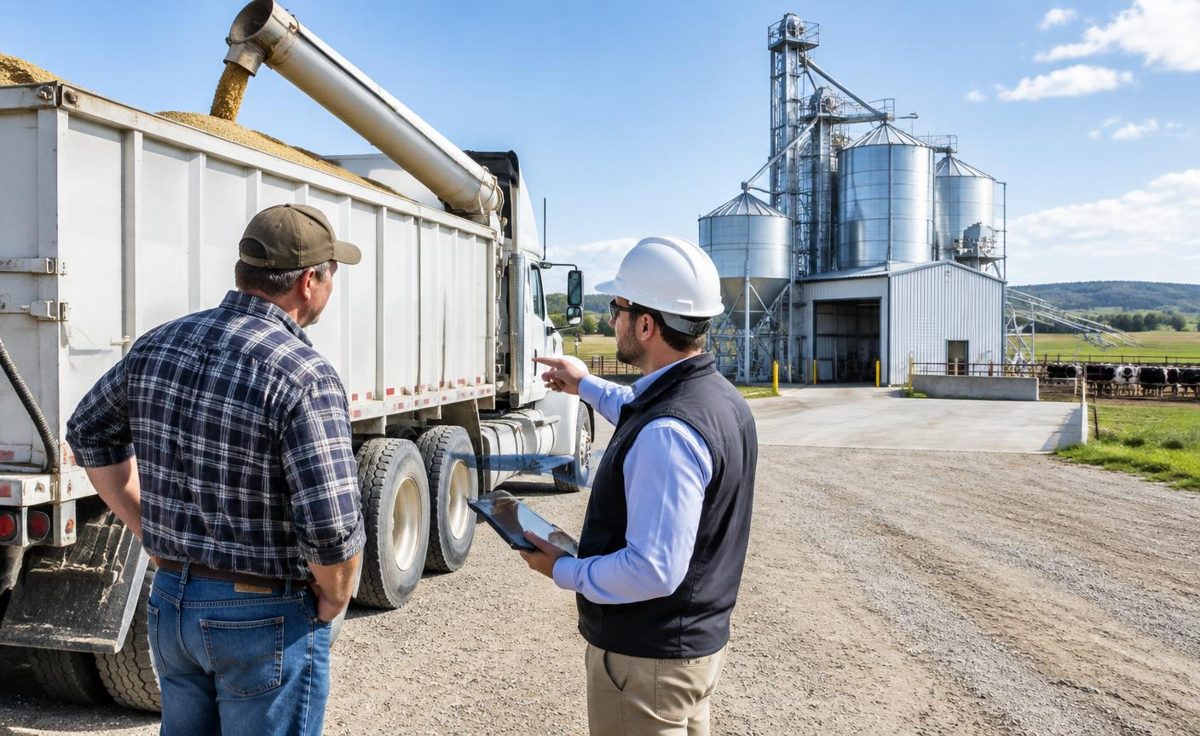
Short answer Buy finished feed when demand is uncertain, reliable suppliers offer suitable specifications, or your organisation lacks manufacturing capability. Consider an owned mill when dependable throughput, formulation requirements and operational readiness justify the full lifecycle commitment—not merely the equipment purchase. Compare both options on the cost of compliant feed delivered to the animal, using equivalent nutritional and physical specifications. Include working capital, quality assurance, downtime, transport and commissioning risk. There is no universal feed mill cost: capacity, process, location, infrastructure and scope determine the investment. A hybrid model can preserve outsourced supply while an owned mill ramps up.
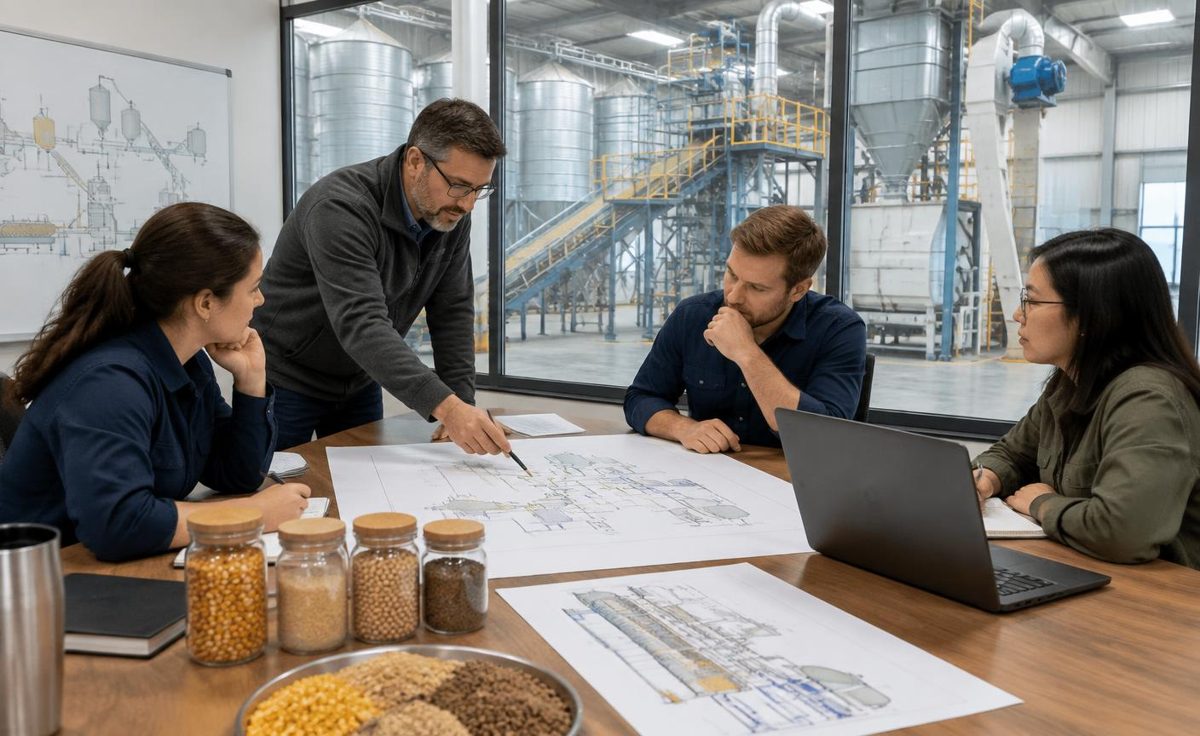
Is your demand stable enough to support ownership? Build a monthly demand model by species, production stage, farm and feed form. Separate existing consumption from expansion that depends on permits, financing or livestock placement. Model seasonality, disease disruption and customer concentration if third-party sales are contemplated. Annual tonnes alone are insufficient. Frequent recipe changes, small batches, cleaning and incompatible products reduce practical throughput. Define operating days, shifts and achievable utilisation rather than multiplying nameplate capacity by every available hour. ### Test the downside first Ask whether the mill remains affordable if expansion is delayed or livestock numbers fall. Do not assume spare capacity will find external buyers; commercial feed sales require distribution, credit management and customer support. For the “buy feed or build feed mill” decision, evidence of repeatable demand should come before equipment selection. Maintain an outsourced baseline against which ownership can be tested.
How much formulation control do you actually need? Ownership gives control over ingredient purchasing, scheduling and process settings, but it does not automatically improve nutrition. It also transfers responsibility for ingredient variability, dosing accuracy, mixing, contamination prevention and finished-feed performance to your organisation. A procurement contract may secure adequate control through agreed nutrient specifications, approved substitutions, sampling rights, batch records and remedies for non-conforming deliveries. Toll manufacturing is another option, provided ingredient ownership and quality responsibilities are explicit. | Decision factor | Outsourced finished feed | Owned mill | |---|---|---| | Formulation changes | Depend on contractual flexibility and scheduling | Depend on nutrition expertise and process capability | | Ingredient exposure | Reflected in supplier pricing and adjustment terms | Managed directly through purchasing and inventory | | Quality responsibility | Supplier manufactures; buyer checks acceptance | Buyer establishes and operates manufacturing controls | | Continuity | Depends on suppliers and delivery routes | Depends on staff, utilities, maintenance and backup supply | | Capital commitment | Mainly procurement-related liquidity | Plant investment plus operating liquidity | Choose the control you need, not control for its own sake. Protect animal performance with nutritionist-approved specifications under either model.
What working capital will each option consume? Compare cash timing, not just accounting margins. Purchased feed may require deposits, short payment terms or minimum orders. An owned mill adds ingredient stocks, packaging, work in progress, finished feed and critical spares. Imported inputs can tie up cash before they reach the site. Prepare a monthly cash forecast covering seasonal purchasing, supplier terms, inventory holding periods, taxes and any receivables from external sales. Separate recoverable taxes from permanent costs while recognising their financing impact. Test price movements and delayed deliveries without assuming favourable purchasing opportunities. Larger ingredient purchases may lower a quoted unit price but increase spoilage, storage and liquidity exposure. Include startup inventory and ramp-up losses in funding needs. Keep contingency funding separate from routine working capital so commissioning overruns do not consume money needed for ingredients or payroll.
Can the site support the required process? Confirm land rights, planning permission, environmental requirements, access and expansion space before fixing the layout. Check truck turning, weighbridge positioning, receiving pits, drainage, flood exposure and separation between people and vehicles. Utilities must match the process. Verify electrical capacity and reliability, transformer requirements, water availability, and steam or fuel needs where conditioning or other thermal processing is planned. Dust collection, fire protection, explosion risk controls and noise management need specialist assessment under applicable rules. The answer to “how much does a feed mill cost?” changes materially when off-site utility connections, foundations, roads or storage are excluded from an initial quotation. Use [feed mill planning](/feed-mill-planning) to organise the scope, then have competent local specialists validate site conditions and regulatory obligations.
Who will run quality, staffing and maintenance systems? A mill requires accountable management, trained operators, maintenance capability, inventory control and access to competent nutrition and laboratory support. Establish shift coverage and succession for critical roles; one experienced operator is not a resilient staffing plan. ### Specify operating controls before equipment Define ingredient approval, receiving inspection, risk-based sampling, testing, traceability, batch release, retention samples and recall procedures. Where relevant, address medicated feed, carryover, allergens, restricted ingredients and species-specific hazards. Document calibration, dosing verification and mixing-performance checks. Maintenance planning should cover preventive tasks, lubrication, wear parts, service access and critical spares. Include maintenance labour and planned downtime in the operating model. When comparing [feed equipment](/feed-equipment), assess cleanability, accessibility, controls and local service arrangements alongside throughput. Request supporting documents and relevant public records where appropriate; a catalogue claim is not evidence that the proposed process will meet your acceptance criteria.
How will logistics and commissioning affect supply continuity? Map both ingredient inbound logistics and feed delivery to farms. Ownership may replace finished-feed deliveries with more ingredient movements, additional handling and different storage requirements. Compare freight by route, payload, unloading time and seasonal access—not distance alone. Account for shrink, moisture changes, deterioration and inventory reconciliation without treating unexplained losses as an acceptable operating allowance. Determine who carries risk at each transfer point. ### Plan the transition as a separate project Commissioning includes installation checks, utility testing, controls integration, operator training and product trials. Agree measurable acceptance tests, responsibilities and contractual remedies before ordering. Retain backup feed supply until the mill consistently meets approved specifications and required output. Budget for trial materials, testing, waste, duplicated supply arrangements and initial inefficiency. Do not equate mechanical completion with commercial readiness or assume every tonne produced during startup can be fed.
What belongs in a comparable lifecycle cost model? Compare equivalent feed at the same delivery point over a defined evaluation period. Include ingredients, conversion, labour, testing, maintenance, insurance, logistics, inventory financing and an annualised capital charge. For purchased feed, include delivery, receiving, testing and commercial terms on the same basis. The feed mill project cost should cover engineering, equipment, civil works, utilities, installation, commissioning, owner’s costs and contingency. Keep total funding needs—including working capital—visible separately. Model replacement expenditure and residual value consistently, without counting capital repayment twice. ### Illustrative formula and sensitivity ```text Owned-feed cost per compliant tonne delivered = Variable cost per tonne + (Annual fixed operating costs + annualised capital charge + inventory financing costs) / compliant tonnes delivered Illustrative inputs only: Variable cost = USD 245/tonne Combined annual charges = USD 750,000 At 15,000 tonnes/year: 245 + 750,000/15,000 = USD 295/tonne At 10,000 tonnes/year: 245 + 750,000/10,000 = USD 320/tonne ``` These invented inputs demonstrate utilisation sensitivity, not market pricing, expected savings or investment returns. Compare model outputs with current, specification-matched purchase offers and stress-test ingredient prices, energy, downtime and commissioning delays. ### Common mistakes Avoid comparing a machinery quotation with delivered feed prices, using nameplate output as saleable production, excluding owner labour, or assigning zero cost to existing land and buildings. Recognise opportunity costs and distinguish sunk expenditure from costs the decision can still change.
What should you do before committing capital? Create a decision pack that allows buying, toll manufacturing and ownership to be assessed against the same requirements. ### Investment-readiness checklist - Confirm monthly demand, product mix and downside volumes. - Obtain comparable outsourced offers with clear specifications and terms. - Validate the site, utilities, permits and logistics assumptions. - Assign nutrition, quality, operations and maintenance responsibilities. - Build lifecycle-cost, cash-flow and commissioning scenarios. - Define decision thresholds, acceptance tests and backup supply. Start with the [feed mill calculator](/feed-mill-calculator) to structure preliminary assumptions. Tools and calculators provide preliminary planning outputs; they do not replace a nutritionist, engineer, laboratory, lawyer, financial adviser or other relevant specialist. If the evidence supports a commercial project, submit the defined scope through [RFQ intake](/rfq-intake). FeedMatch provides a human-led, supplier-neutral workflow for commercial opportunities of USD 250,000 or more, with human review before any supplier contact. Documents and relevant public records can be reviewed; FeedMatch is not a certification body and does not audit factories. The buyer retains supplier selection and investment decisions. Set a decision gate: proceed only when demand, funding, technical feasibility and operating accountability are supported by evidence. Otherwise, improve procurement terms or defer ownership while closing the specific gaps.
faqs_failed_placeholder
faqs_placeholder
end_placeholder
remove_placeholder
final_placeholder
placeholder
placeholder
placeholder
placeholder
placeholder
placeholder
placeholder
placeholder
placeholder
placeholder
placeholder
placeholder
placeholder
placeholder
placeholder
placeholder
placeholder
placeholder
placeholder
placeholder
placeholder
placeholder
placeholder
placeholder
placeholder
placeholder
placeholder
placeholder
placeholder
placeholder
placeholder
placeholder
placeholder
placeholder
placeholder
placeholder
placeholder
placeholder
placeholder
placeholder
Related pages on FeedMatch
Frequently asked questions
- How much does a feed mill cost?
- There is no universal plant price. A defensible budget needs defined throughput, feed forms, storage, automation, site conditions, utilities and installation scope. Include engineering, civil works, commissioning, owner’s costs and contingency, then identify working capital separately. Equipment-only quotations are not total project budgets.
- What production volume makes building a feed mill worthwhile?
- There is no universal tonnage threshold. The decision depends on dependable utilisation, product complexity, local input costs, available outsourced feed terms and the organisation’s operating capability. Test the investment against downside demand using compliant tonnes delivered, rather than nameplate capacity.
- Does owning a mill guarantee better feed quality?
- No. Ownership provides direct process control but also transfers manufacturing responsibility to the owner. Quality depends on appropriate formulations, ingredient controls, trained staff, validated processes, testing and traceability. Outsourced feed can also meet demanding requirements through clear specifications and effective acceptance controls.
- Can outsourced feed and an owned mill be used together?
- Yes. A hybrid arrangement can cover commissioning, maintenance shutdowns, demand peaks or specialised products that the owned mill cannot handle appropriately. Define specifications, capacity arrangements, pricing mechanisms and responsibilities in advance rather than assuming emergency supply will be available.
- What information is needed before requesting mill proposals?
- Prepare monthly demand by product, required physical and nutritional specifications, ingredient assumptions, site and utility information, storage needs, automation requirements and delivery boundaries. State commissioning responsibilities and measurable acceptance criteria so proposals can be compared on equivalent scope.
Feed industry regions we work with
Feed procurement is local before it is global: raw material basis, freight and installation costs change by region. These are the areas buyers most often name when defining a feed project in English.
United States
Cities and provinces
Iowa · Nebraska · Georgia · Arkansas · Texas · North Carolina
Corn and soybean meal basis with large integrated poultry, swine and dairy operations.
United States →United Kingdom and Ireland
Cities and provinces
East Anglia · Yorkshire · Lincolnshire · Northern Ireland · Munster
Compound feed and imported protein logistics through east coast and Irish Sea ports.
United Kingdom and Ireland →Gulf and East Africa import markets
Cities and provinces
Jeddah · Dubai · Mombasa · Djibouti
Import-driven feed supply where landed cost and port logistics dominate the decision.
Gulf and East Africa import markets →FeedMatch is supplier-neutral. Regional context helps define the requirement; pricing always comes from manufacturer quotations.
Move from insight to procurement
Turn the ideas in this article into a live procurement action — supplier-neutral, buyer-controlled, fully documented.