
Before You Buy a Pellet Machine or Feed Mixer: Plan Farm Feed Preparation and Total Cost
Define the feed, check the site, cost every tonne and only then compare suppliers. Worksheets, formulas and an eight-step plan for farms considering a pellet machine, hammer mill or mixer.
Short answer · Updated October 2026
Short answer: Before You Buy a Pellet Machine or Feed Mixer: Plan Farm Feed Preparation and Total Cost
Short answer: before buying a pellet machine, hammer mill or feed mixer, define the feed you need, check your power, space and storage, and calculate the full cost per tonne of preparing it yourself. Compare that with the delivered price of the same feed bought in.
Key takeaways
- Total cost of on-farm feed preparation is everything you pay to turn ingredients into the feed your animals eat: the equipment and its installation, electrical work, energy, labour, maintenance and spare parts, space and storage, losses…
- Steps 1–6 come before any supplier conversation.
- Required output (t/h) = tonnes per day ÷ running hours per day.
- - Annual equipment cost = (machine + installation + electrical work) ÷ useful life in years.
- Run the worksheet three times: low, expected and high tonnes per year, and with a higher power price.
FeedMatch Editorial Desk
Editorial Team
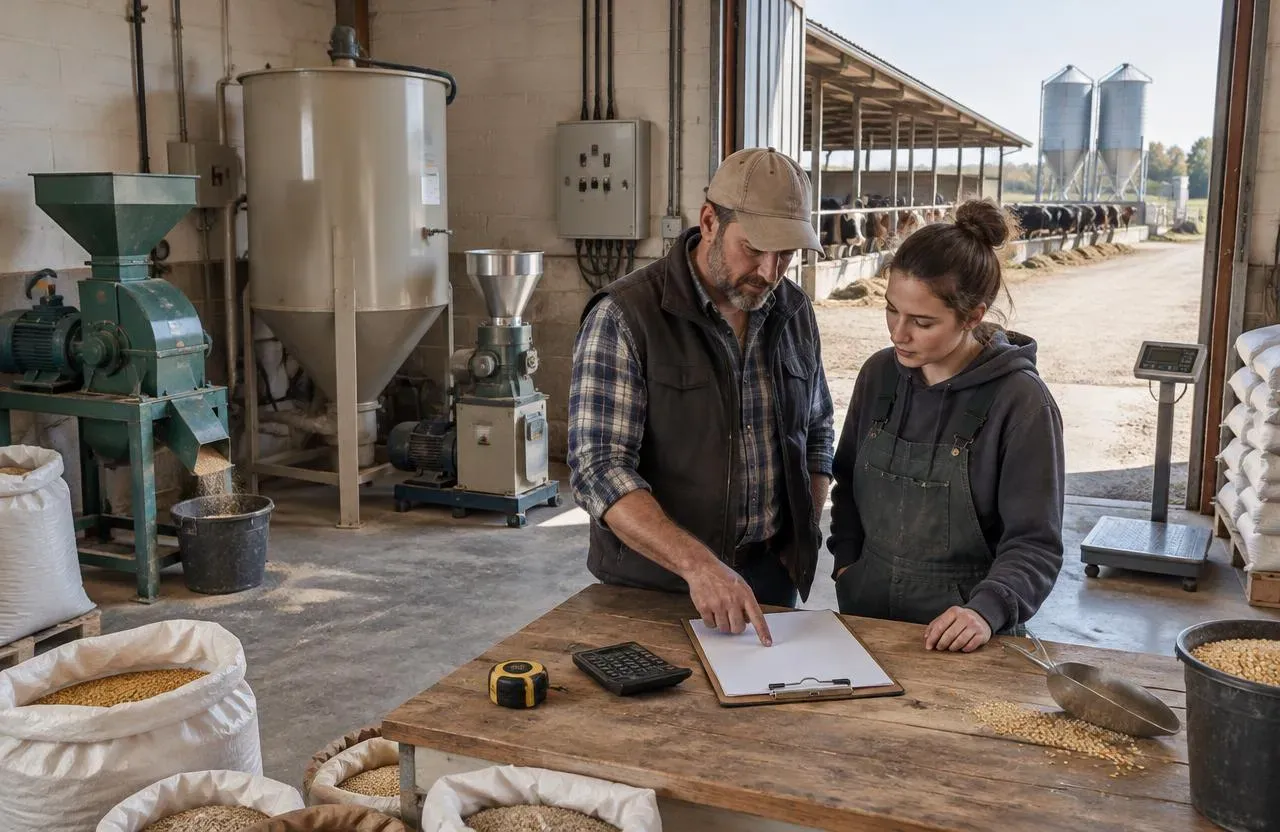
Short answer: before buying a pellet machine, hammer mill or feed mixer, define the feed you need, check your power, space and storage, and calculate the full cost per tonne of preparing it yourself. Compare that with the delivered price of the same feed bought in. Only then write one specification and ask suppliers for comparable quotes. A few hours of planning costs little; a machine that does not fit your recipe, power supply or volume can cost you for years.
What “total cost” means on a farm
Total cost of on-farm feed preparation is everything you pay to turn ingredients into the feed your animals eat: the equipment and its installation, electrical work, energy, labour, maintenance and spare parts, space and storage, losses (fines, spillage, spoilage) and the time it takes to learn the process. The purchase price of the machine is only one line. The right price is the one that buys the right specification for your feed and volume — not the cheapest machine.
Eight-step plan
| Step | What you decide | Output |
|---|---|---|
| 1. Feed need | Species, stage, feed form (mash, crumble, pellet), pellet size — agreed with your nutritionist | Written feed list |
| 2. Buy or prepare | Complete feed, concentrate + own grain, or full on-farm mixing | Short-listed option |
| 3. Volume | Tonnes per day and per year, batches per day, peak months | Volume sheet |
| 4. Site check | Power (single/three-phase, available kW), floor space, dust, ingredient and finished-feed storage | Site notes and photos |
| 5. Cost worksheet | Every cost line per year and per tonne | Cost per tonne |
| 6. Scenarios | Low / expected / high volume and power price | Break-even range |
| 7. Specification | Output at your recipe, power, scope, safety, spares, training | One brief for all suppliers |
| 8. Quotes and commissioning | Compare like-for-like, run trial batches, keep records | Decision and records |
Steps 1–6 come before any supplier conversation. Supplier vetting starts only when scope and economics are clear — otherwise you are comparing machines, not answers to your problem.
Worksheet 1: feed and volume
| Item | Your figure | Source |
|---|---|---|
| Animals per stage | Production plan | |
| Daily intake per animal (kg) | Your records or nutritionist | |
| Feed form and pellet size | Nutritionist | |
| Tonnes per day | Calculated | |
| Working days per year | Your plan | |
| Tonnes per year | Calculated | |
| Hours per day someone can run the equipment | Your staff plan | |
| Required output (t/h) = tonnes per day ÷ running hours per day. Ask suppliers for output at your recipe and moisture, not the nameplate figure. |
Worksheet 2: site check
| Check | Question | Answer |
|---|---|---|
| Power | Single- or three-phase? Spare kW at the board? Upgrade needed? | |
| Space | Room for grinder, mixer, pellet machine, cooler, bagging and safe access? | |
| Ingredient storage | Dry, rodent-proof storage for how many days? | |
| Finished feed storage | Where do cooled pellets or mash go? | |
| Dust and safety | Extraction, guards, lockout for cleaning and die changes? | |
| Water and steam | Needed for your process? |
Worksheet 3: cost lines
| Cost line | Per year | Where it comes from |
|---|---|---|
| Equipment, installation and electrical work ÷ useful life | Quotes, supplier life estimate | |
| Finance cost (if borrowing) | Lender offer | |
| Energy | Meter readings or kW × hours × tariff | |
| Labour | Hours × wage | |
| Maintenance and wear parts (dies, rollers, hammers, screens) | Supplier list, your records | |
| Space, insurance | Your accounts | |
| Losses (fines, spillage, spoilage) | Your measurements |
Formulas (with assumptions)
- Annual equipment cost = (machine + installation + electrical work) ÷ useful life in years. Simple straight-line; add interest separately if you borrow.
- Energy per tonne = measured kWh per tonne × power price. Before you have a meter reading: installed kW × running hours per tonne × power price (an upper estimate, because motors rarely run at full load).
- Labour per tonne = hours per batch × hourly wage ÷ tonnes per batch.
- Preparation cost per tonne = (annual equipment + finance + maintenance + space and insurance) ÷ tonnes per year + energy per tonne + labour per tonne + losses per tonne.
- Home-prepared feed cost per tonne = ingredient cost per tonne of mix (each inclusion × its landed price) + preparation cost per tonne.
- Break-even tonnes per year = annual fixed costs ÷ (delivered price of equivalent bought-in feed − ingredient cost per tonne − variable preparation cost per tonne). If the bracket is zero or negative, preparing feed yourself does not pay on cost alone.
- Simple payback (years) = total upfront cost ÷ annual net saving. Only meaningful when the saving is positive and based on real quotes.
Enter your own figures in the farm feed-preparation cost calculator, use the landed cost calculator for delivered prices, and the FCR and cost-per-output calculator to judge the result by cost per kg of gain, dozen eggs or litre of milk.
Scenario check
Run the worksheet three times: low, expected and high tonnes per year, and with a higher power price. If home preparation only pays in the best case, buying feed or concentrate may be the safer choice. Equipment sized for a future herd that may not arrive raises cost per tonne today.
What to put in the specification
- Feed list, recipe type and moisture range (from your nutritionist).
- Required output in t/h at that recipe, and daily running hours.
- Power supply (phase, voltage, frequency, available kW).
- Scope: grinder screen sizes, mixer type and batch volume, pellet die sizes, conditioner, cooler, sieve, conveyors, bagging.
- Safety: guards, emergency stops, lockout points, dust control.
- Spares, wear parts list, manual language, training, service response and warranty terms.
- Delivery terms, installation responsibility and acceptance test (trial batches at your recipe).
The pellet machine guide explains farm-scale versus commercial equipment and the questions to ask each supplier.
Mistakes to avoid
- Buying on nameplate capacity instead of output at your recipe.
- Discovering after delivery that the farm needs a power upgrade.
- Forgetting the cooler and sieve — warm pellets bagged too early can spoil and break up.
- No dry storage for ingredients bought in bulk.
- Comparing quotes with different scope, power or delivery terms.
- Choosing the cheapest machine with no local spare parts or service.
- Buying equipment before the feed and recipe are defined.
- Making medicated feed without a veterinarian's prescription and the required approvals.
If pellets come out soft or dusty after you start, the troubleshooting checklist helps. If you are still deciding what to buy, read complete feed vs concentrate vs on-farm mixing.
How FeedMatch helps
FeedMatch works as a procurement and project operating system for farm feed buyers: from defining the problem and the requirement, through calculators and scenarios, to one written specification, comparable supplier responses and support through negotiation and delivery. The calculators, guides and quote request form are free for buyers. A person reads every request before any supplier sees it; our team contacts suitable suppliers and presents their responses to you. Managed support for larger projects (around US$250,000 and above) is agreed case by case. We do not guarantee prices, savings, supplier selection or results — the decision stays with you.
Sources and editorial note
- FAO: good practices for the feed sector.
- FAO: animal feed quality and safety.
- ASABE standards (S269 pellet durability).
- Written by the FeedMatch editorial team, 16 October 2026. No prices, capacities or savings are given; use your own records and current quotes.
Frequently asked questions
- Is it cheaper to make feed on the farm than to buy it?
- Only if the delivered price of the same bought-in feed is higher than your ingredient cost plus your full preparation cost per tonne (equipment, energy, labour, maintenance, space and losses). Use the break-even formula in this article with your own quotes.
- What should I decide before buying a pellet machine or mixer?
- The feed you need (species, stage, form and pellet size, agreed with your nutritionist), tonnes per day, available power, space and storage, who will run it, and your full cost per tonne. Then write one specification for every supplier.
- How do I compare pellet machine quotes fairly?
- Ask every supplier to quote the same output at your recipe, the same power supply, the same scope (cooler, sieve, conveyors, spares, training) and the same delivery terms. Compare total cost over the machine's life, not the purchase price.
- Are FeedMatch's calculators and guides free?
- Yes. The calculators, guides and the quote request form are free for buyers with no subscription. Managed procurement support for larger projects (around US$250,000 and above) is discussed case by case; we do not promise prices, savings or outcomes.
- Does this article give feed formulas or nutrition advice?
- No. Recipes, nutrient levels and medicated feed belong to a qualified nutritionist or veterinarian. This article covers planning, cost and equipment selection only.
Feed industry regions we work with
Feed procurement is local before it is global: raw material basis, freight and installation costs change by region. These are the areas buyers most often name when defining a feed project in English.
United States
Cities and provinces
Iowa · Nebraska · Georgia · Arkansas · Texas · North Carolina
Corn and soybean meal basis with large integrated poultry, swine and dairy operations.
United States →United Kingdom and Ireland
Cities and provinces
East Anglia · Yorkshire · Lincolnshire · Northern Ireland · Munster
Compound feed and imported protein logistics through east coast and Irish Sea ports.
United Kingdom and Ireland →Gulf and East Africa import markets
Cities and provinces
Jeddah · Dubai · Mombasa · Djibouti
Import-driven feed supply where landed cost and port logistics dominate the decision.
Gulf and East Africa import markets →FeedMatch is supplier-neutral. Regional context helps define the requirement; pricing always comes from manufacturer quotations.