
Complete Feed, Concentrate or On-Farm Mixing: How Farms Compare the Three Approaches
Three ways farms source feed, compared side by side on control, labour, storage, quality risk and cost — with a fair method to compare them using your own numbers.
Short answer · Updated October 2026
Short answer: Complete Feed, Concentrate or On-Farm Mixing: How Farms Compare the Three Approaches
Short answer: complete feed gives the least work and the most consistency; concentrate plus your own grain uses what you grow; full on-farm mixing gives the most control but also the most responsibility. The right choice is the one with the lowest cost per unit of output that your farm can run safely and consistently.
Key takeaways
- - Do you grow grain or forage you can test and store safely?
- Put each option on the same basis: delivered cost of everything you buy (use the landed cost calculator for quotes not delivered to your farm), plus your own grain at its real value (what you could sell it for), plus labour, energy…
- Change one thing at a time, ask your nutritionist about transition periods, and record intake, growth or production before and after.
- - FAO: good practices for the feed sector.
FeedMatch Editorial Desk
Editorial Team
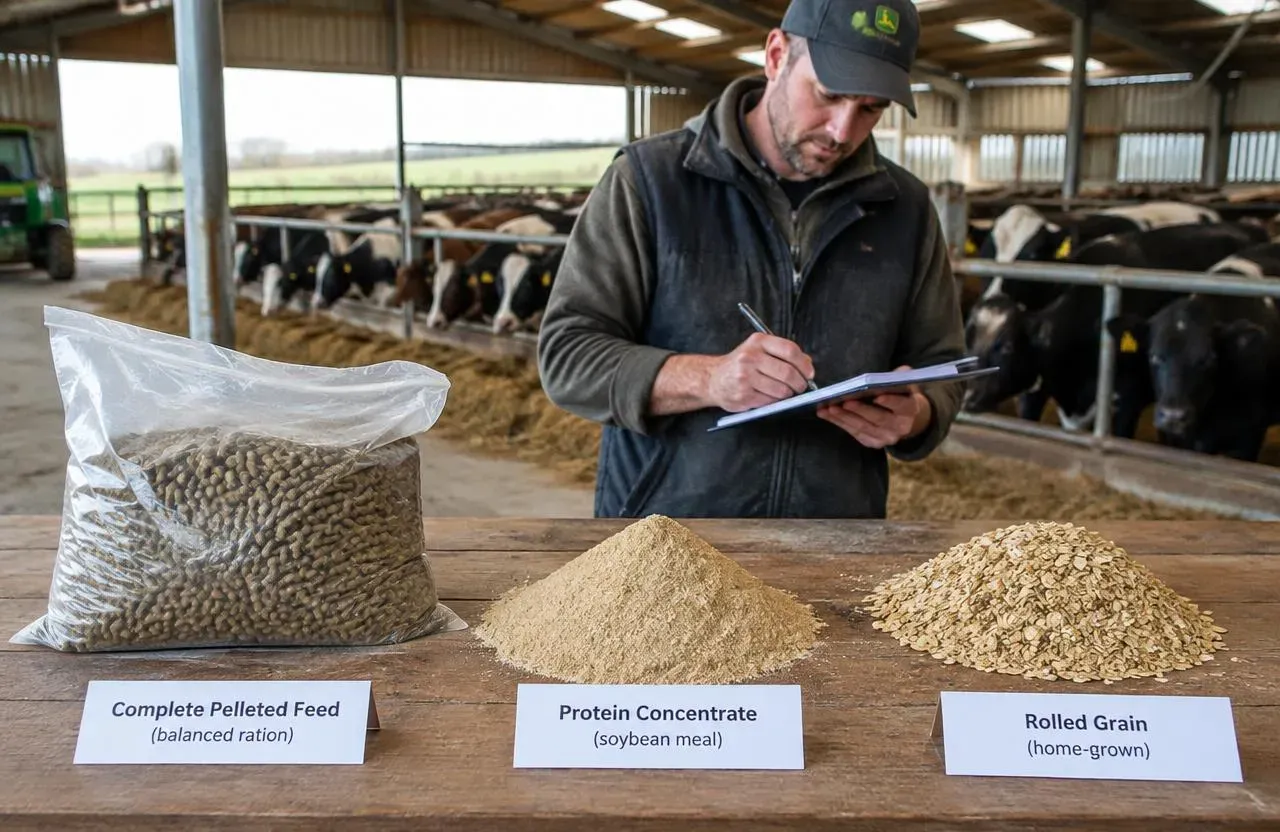
Short answer: complete feed gives the least work and the most consistency; concentrate plus your own grain uses what you grow; full on-farm mixing gives the most control but also the most responsibility. The right choice is the one with the lowest cost per unit of output that your farm can run safely and consistently.
The three approaches side by side
| Complete feed | Concentrate + own grain | Full on-farm mixing | |
|---|---|---|---|
| What you buy | Finished ration | Protein/mineral concentrate | Individual ingredients and premix |
| Recipe responsibility | Supplier | Shared | Farm and its nutritionist |
| Equipment needed | Storage only | Grinding/mixing, storage | Grinding, weighing, mixing, storage |
| Labour | Lowest | Medium | Highest |
| Quality checks | Supplier documents | Supplier docs + own grain checks | Every ingredient lot |
| Storage | Finished feed | Grain + concentrate | Several ingredients |
| Flexibility | Lowest | Medium | Highest |
Questions that decide it
- Do you grow grain or forage you can test and store safely?
- Do you have a nutritionist to approve recipes and changes?
- Can you weigh and mix accurately, and check the mix is even?
- Do you have staff time and storage for several ingredients?
- Can you keep lot records for traceability? See FAO good practices for the feed sector.
A fair cost comparison
Put each option on the same basis: delivered cost of everything you buy (use the landed cost calculator for quotes not delivered to your farm), plus your own grain at its real value (what you could sell it for), plus labour, energy, equipment upkeep and losses. Then divide by output using the FCR and cost-per-output calculator. A cheaper price per tonne is not cheaper if the animals need more of it.
Changing approach safely
Change one thing at a time, ask your nutritionist about transition periods, and record intake, growth or production before and after. The farm feed purchase plan explains storage and supplier checks; making pellets on the farm is covered in the pellet machine guide.
Sources
- FAO: good practices for the feed sector.
- FAO: animal feed quality and safety.
- This article compares sourcing approaches; it is not nutrition advice.
Frequently asked questions
- Is it cheaper to mix feed on the farm?
- It depends on your ingredient prices, labour, equipment, storage, losses and the animal results you get. Compare all three approaches on cost per unit of output — per kg of live weight, dozen eggs or litre of milk — using your own figures.
- What is a concentrate?
- A concentrate (or balancer) supplies protein, minerals and vitamins that you mix with your own grain or forage in the proportion the supplier or your nutritionist specifies.
- Who should approve the recipe if I mix on farm?
- A qualified animal nutritionist. On-farm mixing moves responsibility for recipe, ingredient quality and mixing accuracy to the farm.
Feed industry regions we work with
Feed procurement is local before it is global: raw material basis, freight and installation costs change by region. These are the areas buyers most often name when defining a feed project in English.
United States
Cities and provinces
Iowa · Nebraska · Georgia · Arkansas · Texas · North Carolina
Corn and soybean meal basis with large integrated poultry, swine and dairy operations.
United States →United Kingdom and Ireland
Cities and provinces
East Anglia · Yorkshire · Lincolnshire · Northern Ireland · Munster
Compound feed and imported protein logistics through east coast and Irish Sea ports.
United Kingdom and Ireland →Gulf and East Africa import markets
Cities and provinces
Jeddah · Dubai · Mombasa · Djibouti
Import-driven feed supply where landed cost and port logistics dominate the decision.
Gulf and East Africa import markets →FeedMatch is supplier-neutral. Regional context helps define the requirement; pricing always comes from manufacturer quotations.