
Fish and Shrimp Mortality: What to Check in Feed, Feeding and Water Before Changing Feed Supplier
Rising losses are often blamed on feed first. A short, ordered check of records, water, feeding practice and the feed lot shows whether feed is really involved, and protects your claim if it is.
Short answer · Updated October 2026
Short answer: Fish and Shrimp Mortality: What to Check in Feed, Feeding and Water Before Changing Feed Supplier
Short answer: Before blaming feed, check in order: the loss records, water conditions, feeding practice, then the feed lot itself. Keep retained samples and lot numbers, and involve an aquatic animal health professional. Change supplier only when the evidence points to the feed.
Key takeaways
- - When did losses start, in which ponds or cages, and how many per day?
- Oxygen, temperature and other water conditions your system monitors can change appetite and survival quickly.
- The FAO review links poor feed handling and feeding to waste and water problems (Tacon, Jory & Nunes, Shrimp feed management: issues and perspectives (FAO TP 583)).
- Send a retained sample to a laboratory chosen with your health professional or nutritionist.
- - Evidence points to feed: agree a remedy under your contract, and screen a backup supplier with the same specification.
FeedMatch Editorial Desk
Editorial Team
Short answer: Before blaming feed, check in order: the loss records, water conditions, feeding practice, then the feed lot itself. Keep retained samples and lot numbers, and involve an aquatic animal health professional. Change supplier only when the evidence points to the feed.
Step 1: Records - When did losses start, in which ponds or cages, and how many per day? - Did a new feed lot, pellet size or supplier start just before? - Any recent stocking, handling, grading or treatment? - Weather changes: heat, cloud, rain, wind? If losses started in many units at the same time as a new lot, feed moves up the list. If one unit only, look at that unit first.
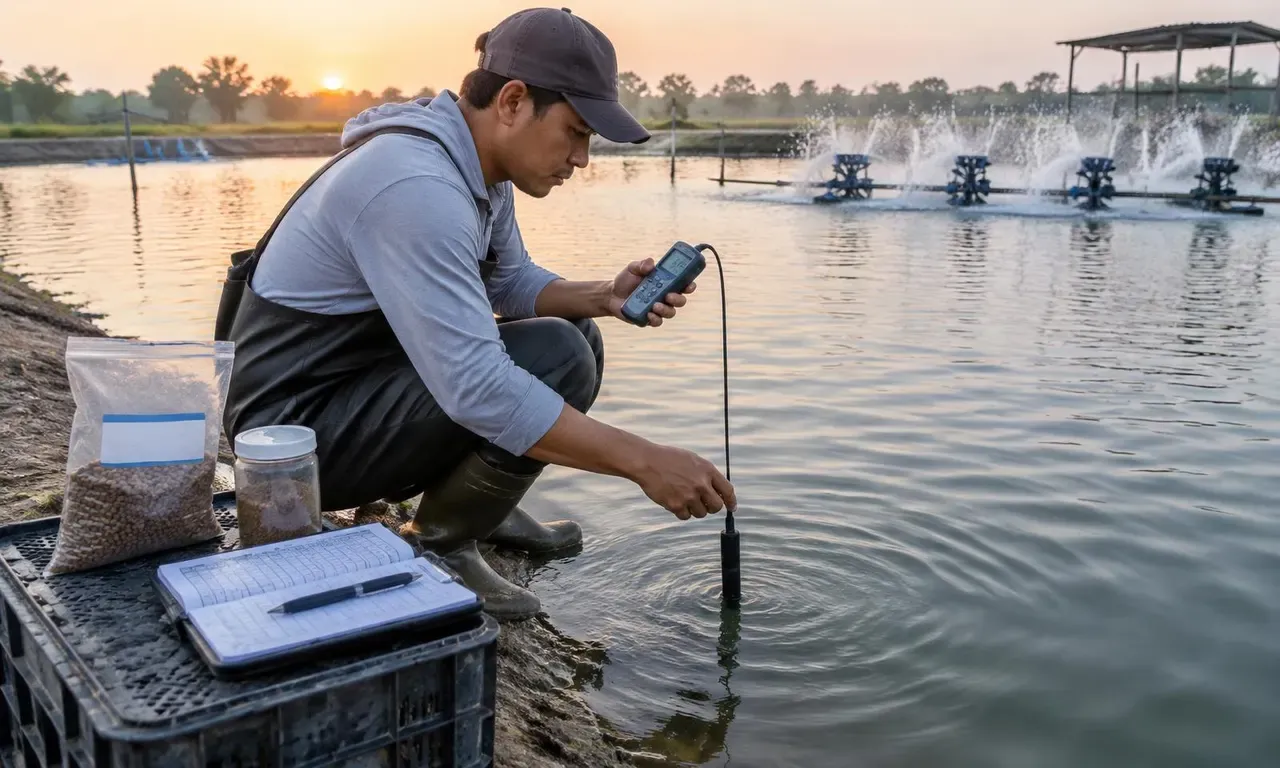
Step 2: Water and environment Oxygen, temperature and other water conditions your system monitors can change appetite and survival quickly. Low oxygen at dawn is a common reason to check before anything else. Note readings with time of day.
Step 3: Feeding practice | Check | Why | |---|---| | Ration vs current biomass | Overfeeding fouls water; underfeeding weakens stock | | Pellet size vs animal size | Wrong size is wasted or not eaten | | Leftovers on trays or under cages | Appetite dropped or overfeeding | | Feed spread evenly | Crowding, uneven intake | The FAO review links poor feed handling and feeding to waste and water problems ([Tacon, Jory & Nunes, Shrimp feed management: issues and perspectives (FAO TP 583)](https://www.fao.org/fishery/docs/CDrom/T583/root/18.pdf)).
Step 4: The feed lot | Look for | Action | |---|---| | Mould, caking, unusual smell or colour | Stop using the lot; photograph and set aside | | Dust and broken pellets | Record; check transport and storage | | Damaged or wet bags | Check storage and delivery records | | Lot number and production date | Match to the certificate of analysis | Send a retained sample to a laboratory chosen with your health professional or nutritionist. Tell the supplier in writing, with lot numbers, photos and records.
Step 5: Decide - **Evidence points to feed:** agree a remedy under your contract, and screen a backup supplier with the same specification. - **Evidence points elsewhere:** keep the feed, fix the cause, and document it. - **Unclear:** keep sampling and records; avoid changing several things at once.
Prevent the next one - Keep a sealed sample from every lot until the crop is harvested - Record lot numbers per pond or cage - Store feed dry, shaded, off the floor; first in, first out - Ask for a certificate of analysis with each delivery - Keep a qualified backup supplier The [farm feed records tool](/farm-feed-records-tool) keeps feed, losses and batches together.
Sources - [FAO Fisheries and Aquaculture Technical Paper 583, On-farm feeding and feed management in aquaculture (2013)](https://www.fao.org/4/i3481e/i3481e.pdf) - [Tacon, Jory & Nunes, Shrimp feed management: issues and perspectives (FAO TP 583)](https://www.fao.org/fishery/docs/CDrom/T583/root/18.pdf)
Limits This guide explains farm records and feeding routines. It is not veterinary advice, a feeding table or a feed formula, and it does not promise growth, survival, FCR or savings. Ask your feed supplier for the feeding guide for your product, a qualified nutritionist for specifications, and an aquatic animal health professional for disease or mortality.
Buying feed for a full crop or a year? Send a free feed request with species, stage, pellet sizes, tonnes per month and delivery site. Free for buyers, no obligation; assisted sourcing applies to B2B requirements of about USD 250,000 or more. Smaller farms can use the free farm feed records tool and FCR calculator.
Frequently asked questions
- Is feed usually the cause of mortality?
- Not always. Losses can come from water quality, oxygen, temperature, handling, seed quality or disease, alone or together. Feed can be involved through poor quality, contamination, wrong size or over- or under-feeding. Records tell you which to investigate first.
- What should I do first when losses rise?
- Count and record the losses, check oxygen and other water conditions, reduce feeding if appetite has dropped, and contact an aquatic animal health professional. Keep the feed lot numbers and samples.
- Why keep retained feed samples?
- A sealed, labelled sample from each delivered lot lets a laboratory test the same feed later. Without it, a quality complaint is hard to prove.
- Should I change feed supplier immediately?
- Not before the checks. Switching during a problem removes the evidence and adds a feed change. Change if the checks and tests point to the feed, and after agreeing a remedy under your contract.
- Can FeedMatch diagnose the cause?
- No. FeedMatch helps with feed sourcing and supplier documents. Diagnosis needs an aquatic animal health professional and, where needed, a laboratory.
Feed industry regions we work with
Feed procurement is local before it is global: raw material basis, freight and installation costs change by region. These are the areas buyers most often name when defining a feed project in English.
United States
Cities and provinces
Iowa · Nebraska · Georgia · Arkansas · Texas · North Carolina
Corn and soybean meal basis with large integrated poultry, swine and dairy operations.
United States →United Kingdom and Ireland
Cities and provinces
East Anglia · Yorkshire · Lincolnshire · Northern Ireland · Munster
Compound feed and imported protein logistics through east coast and Irish Sea ports.
United Kingdom and Ireland →Gulf and East Africa import markets
Cities and provinces
Jeddah · Dubai · Mombasa · Djibouti
Import-driven feed supply where landed cost and port logistics dominate the decision.
Gulf and East Africa import markets →FeedMatch is supplier-neutral. Regional context helps define the requirement; pricing always comes from manufacturer quotations.