
Fish Grow-Out Feed Plan: Match Feed to Each Stage, Sample Weights and Plan Purchases Before the Crop
Planning feed before stocking avoids running out of the right pellet size mid-crop. Work out stages, expected feed per stage and delivery timing, then update the plan with real sampling data.
Short answer · Updated October 2026
Short answer: Fish Grow-Out Feed Plan: Match Feed to Each Stage, Sample Weights and Plan Purchases Before the Crop
Short answer: Before stocking, list the growth stages, the pellet size and feed type for each, the expected feed per stage and when it must arrive. During the crop, sample weights, record feed and losses, and update the plan. Faster, better crops come from fewer feeding gaps and less waste, not from a single product.
Key takeaways
- Feed is the main recurring cost in fed aquaculture, and the FAO review of on-farm feeding shows how much results depend on how feed is chosen, stored and given (FAO Fisheries and Aquaculture Technical Paper 583, On-farm feeding and feed…
- Take the sizes and weight ranges from your feed supplier's guide for the product you use.
- Feed needed ≈ weight gain in the stage × your measured FCR for that stage.
- - Tonnes per pellet size per month - Delivery frequency your storage can hold within shelf life - Lead time from the supplier and a backup supplier - Safety stock in days of feeding
- Weigh a representative sample on a fixed schedule.
FeedMatch Editorial Desk
Editorial Team
Short answer: Before stocking, list the growth stages, the pellet size and feed type for each, the expected feed per stage and when it must arrive. During the crop, sample weights, record feed and losses, and update the plan. Faster, better crops come from fewer feeding gaps and less waste, not from a single product.
Why plan feed before the crop Feed is the main recurring cost in fed aquaculture, and the FAO review of on-farm feeding shows how much results depend on how feed is chosen, stored and given ([FAO Fisheries and Aquaculture Technical Paper 583, On-farm feeding and feed management in aquaculture (2013)](https://www.fao.org/4/i3481e/i3481e.pdf)). Running out of the right pellet size forces under-feeding or the wrong size, both of which cost growth and money.
Step 1: Map the stages | Stage | What to note | |---|---| | Nursery / fry | Starter or crumble size, feeding frequency, small deliveries | | Fingerling | First pellet size changes, weekly growth checks | | Grow-out | Main tonnage; pellet size by weight; floating or sinking as your system requires | | Finishing | Last size; stop-feeding period before harvest as your buyer and rules require | Take the sizes and weight ranges from your feed supplier's guide for the product you use.
Step 2: Estimate feed per stage Feed needed ≈ weight gain in the stage × your measured FCR for that stage. **Hypothetical example (not a benchmark):** a cage stocked so that grow-out adds 20 tonnes of fish, with a farm-measured grow-out FCR of 1.6, needs about 32 tonnes of grow-out feed. If that stage lasts 4 months, plan about 8 tonnes per month, plus a safety stock. Use your own numbers in the [FCR calculator](/feed-conversion-ratio-calculator).
Step 3: Turn it into deliveries - Tonnes per pellet size per month - Delivery frequency your storage can hold within shelf life - Lead time from the supplier and a backup supplier - Safety stock in days of feeding The [farm feed purchase plan](/blog/farm-feed-purchase-plan-specifications-storage-supplier-review) walks through storage and reorder points.
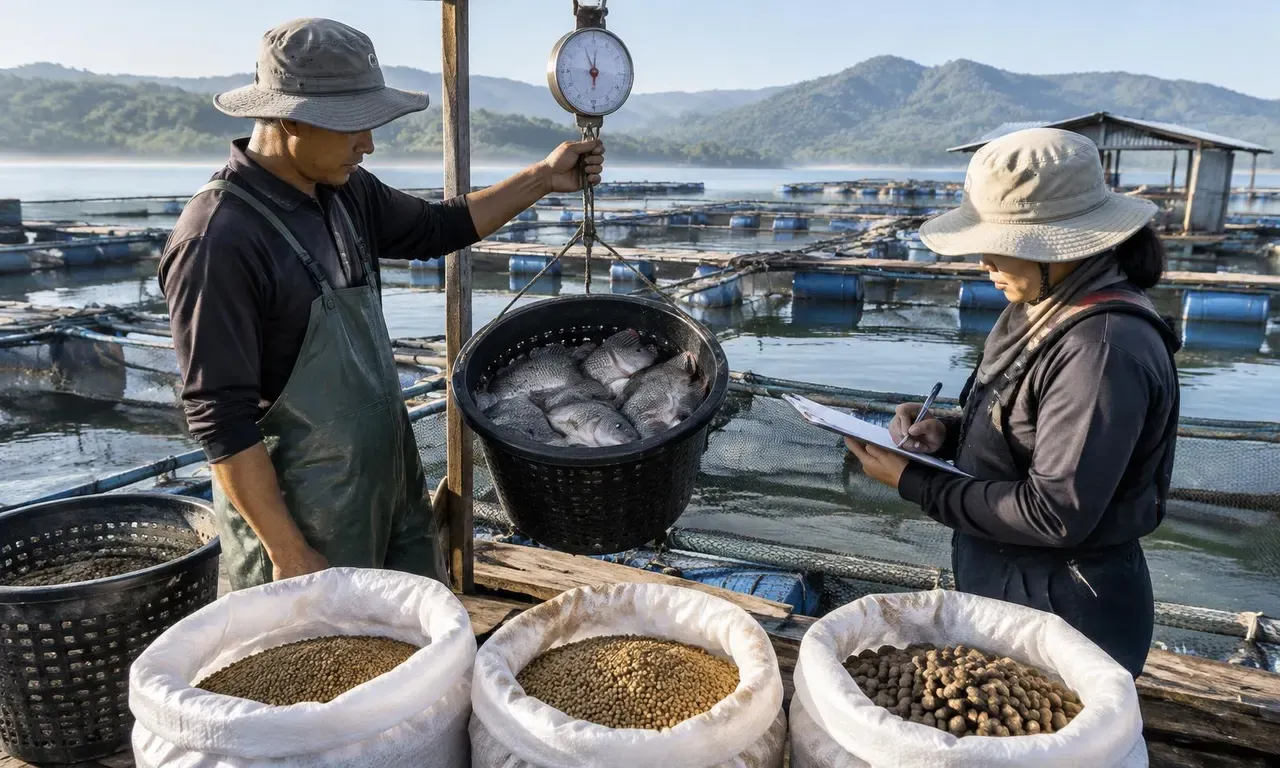
Step 4: Update with sampling Weigh a representative sample on a fixed schedule. Compare actual average weight with the plan; if fish are behind, check feeding records, water temperature and oxygen, and health before changing feed. Recalculate the remaining feed need.
Records to keep | Record | Use | |---|---| | Fish stocked (number, average weight) | Starting biomass | | Feed fed by day, unit and lot | Real feed use, traceability | | Sampled average weight | Growth and ration | | Mortalities counted | Survival and true FCR | | Water temperature and oxygen | Explains appetite | | Harvest weight | Final FCR and cost per kg | The free [farm feed records tool](/farm-feed-records-tool) keeps these per batch and works out cost per unit of output.
What to ask feed suppliers - Feeding guide by weight and water temperature for this product - Pellet sizes available and lead time for each - Floating or sinking, and water stability - Shelf life, storage conditions and lot labelling - Certificate of analysis with each lot
Sources - [FAO Fisheries and Aquaculture Technical Paper 583, On-farm feeding and feed management in aquaculture (2013)](https://www.fao.org/4/i3481e/i3481e.pdf) - [Tacon, Jory & Nunes, Shrimp feed management: issues and perspectives (FAO TP 583)](https://www.fao.org/fishery/docs/CDrom/T583/root/18.pdf) The worked example is hypothetical and only shows the calculation.
Limits This guide explains farm records and feeding routines. It is not veterinary advice, a feeding table or a feed formula, and it does not promise growth, survival, FCR or savings. Ask your feed supplier for the feeding guide for your product, a qualified nutritionist for specifications, and an aquatic animal health professional for disease or mortality.
Buying feed for a full crop or a year? Send a free feed request with species, stage, pellet sizes, tonnes per month and delivery site. Free for buyers, no obligation; assisted sourcing applies to B2B requirements of about USD 250,000 or more. Smaller farms can use the free farm feed records tool and FCR calculator.
Frequently asked questions
- How do I estimate how much feed a crop needs?
- Multiply the expected weight gain of the crop (harvest biomass minus stocked biomass) by the FCR you have actually measured on your farm. Without your own records, use the feed supplier's guide as a starting point and mark it as an estimate.
- When should I change pellet size?
- Follow the feed supplier's size-by-weight table and your weight sampling. Changing too early wastes feed the fish cannot take; too late slows feeding. Order the next size before you need it.
- Does a higher-protein feed always give faster growth?
- Not necessarily. The right feed depends on species, stage, system and water temperature. Ask a qualified nutritionist; compare feeds by cost per kg of fish produced, not protein or price alone.
- How often should I weigh fish?
- Regularly and the same way each time, often every two to four weeks in grow-out, more often in nursery. The aim is a reliable average weight to set rations and confirm the stage.
- Can I buy feed for the whole crop at once?
- Only if you can store it correctly within its shelf life. Most farms schedule deliveries by stage and month, keeping a safety stock for supply delays.
Feed industry regions we work with
Feed procurement is local before it is global: raw material basis, freight and installation costs change by region. These are the areas buyers most often name when defining a feed project in English.
United States
Cities and provinces
Iowa · Nebraska · Georgia · Arkansas · Texas · North Carolina
Corn and soybean meal basis with large integrated poultry, swine and dairy operations.
United States →United Kingdom and Ireland
Cities and provinces
East Anglia · Yorkshire · Lincolnshire · Northern Ireland · Munster
Compound feed and imported protein logistics through east coast and Irish Sea ports.
United Kingdom and Ireland →Gulf and East Africa import markets
Cities and provinces
Jeddah · Dubai · Mombasa · Djibouti
Import-driven feed supply where landed cost and port logistics dominate the decision.
Gulf and East Africa import markets →FeedMatch is supplier-neutral. Regional context helps define the requirement; pricing always comes from manufacturer quotations.