
Pull to refresh
FeedMatch Group logo — wheat sheaf and interlocking chevrons emblem representing the independent animal feed procurement and ingredient intelligence platform
FeedMatchGroup
DashboardSign inRequest Feed Quote
Financing for animal feed and feed-ingredient purchasesSee financing options→←
Back to home
  1. Home
  2. /
  3. Feed Insights
  4. /
  5. Feed Ingredients
  6. /
  7. Upgrading Your Feeding Routine: Monitoring, Farm-Scale Sensors and Feed Timing
Feed Ingredients· Oct 2026· 7 min read

Upgrading Your Feeding Routine: Monitoring, Farm-Scale Sensors and Feed Timing

Before buying new feeders or changing feed, record when feed is delivered to animals, how much is refused and how bin levels move. A two-week log usually shows whether the issue is timing, access or the feed itself.

Englishالعربية

Short answer · Updated October 2026

Short answer: Upgrading Your Feeding Routine: Monitoring, Farm-Scale Sensors and Feed Timing

Short answer: Before buying new feeders or changing feed, record when feed is delivered to animals, how much is refused and how bin levels move. A two-week log usually shows whether the issue is timing, access or the feed itself.

Key takeaways

  • This guide is a two-week audit of your current feeding routine, plus questions to ask before buying farm-scale monitoring such as bin level sensors, feeder scales or automatic feeders.
  • - Feeding times and amounts per group - Refusals, leftovers or uneaten feed - Bin or silo levels, read at the same time each day - Water availability and any feeder faults - Notes on weather, stocking changes and health events
  • 1. Log every feeding for two weeks without changing anything.
  • A dairy group is offered 1,000 kg per day and 80 kg is pushed out uneaten.
  • - No scale for refusals: use a bucket count with a weighed bucket.
FM

FeedMatch Editorial Desk

Editorial Team
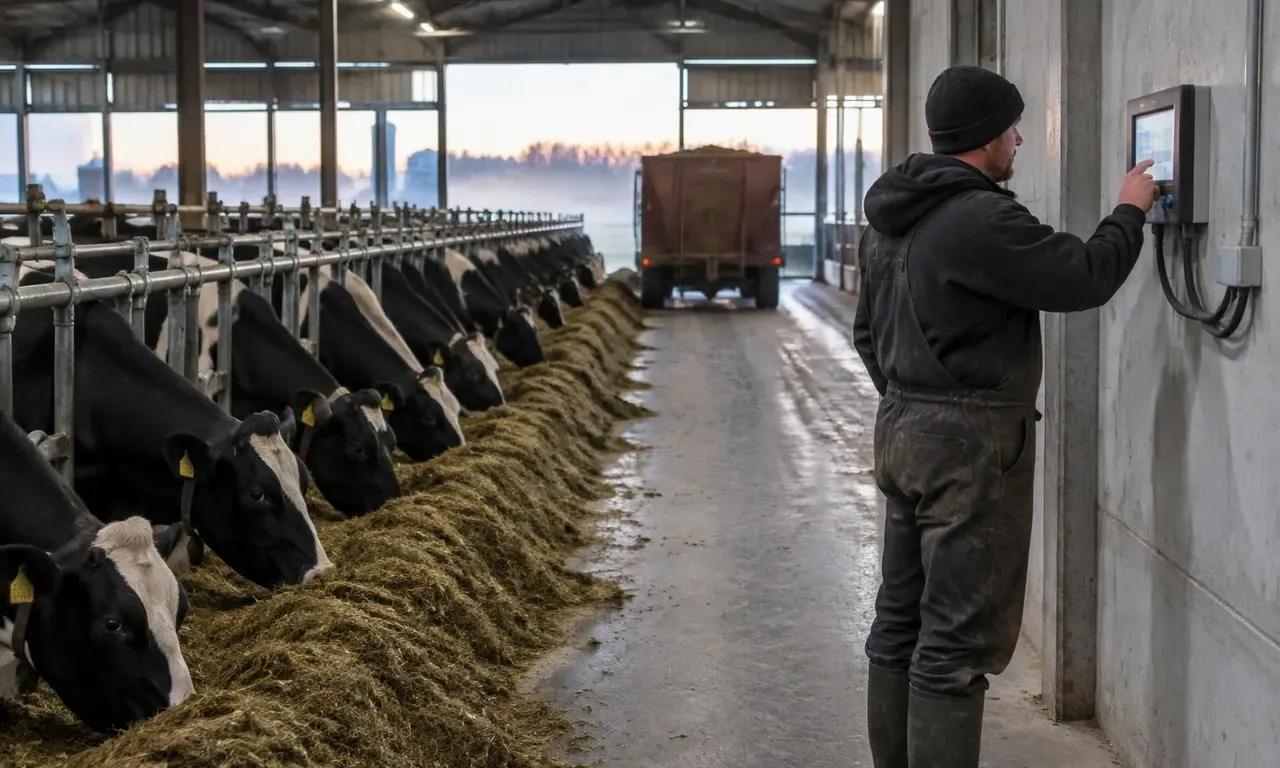
Dairy cows eating along a feed alley at dawn while a herdsman adjusts a wall-mounted feeding controller, with a feed wagon behind

Short answer: Before buying new feeders or changing feed, record when feed is delivered to animals, how much is refused and how bin levels move. A two-week log usually shows whether the issue is timing, access or the feed itself.

What this guide helps you do

This guide is a two-week audit of your current feeding routine, plus questions to ask before buying farm-scale monitoring such as bin level sensors, feeder scales or automatic feeders.

Which farm records do you need?

  • Feeding times and amounts per group
  • Refusals, leftovers or uneaten feed
  • Bin or silo levels, read at the same time each day
  • Water availability and any feeder faults
  • Notes on weather, stocking changes and health events

How do you work through it, step by step?

  1. Log every feeding for two weeks without changing anything.
  2. Weigh or estimate refusals daily.
  3. Compare feed offered with planned ration and with bin level change.
  4. Mark days with faults, heat or other events.
  5. Change one thing at a time (timing, access, amount) and log again.
  6. Only then decide whether sensors or equipment would answer a real question.

Worksheet

DateGroupTimeOffered (kg)Refused (kg)Bin levelNotes

Worked example (hypothetical)

A dairy group is offered 1,000 kg per day and 80 kg is pushed out uneaten. Refusals are 8% of feed offered. Logging shows most refusals on days the second feeding was late. *All figures are invented for illustration. Use your own records; this is not a benchmark or target.*

What if some data is missing?

  • No scale for refusals: use a bucket count with a weighed bucket.
  • No bin readings: mark the bin wall and read daily.
  • Several people feed: one shared log sheet at the feed store.
  • No planned ration on paper: ask your nutritionist to write it down before you compare.

Where to go next

Use the FCR and feed cost calculator, the landed cost calculator and the traceability readiness checklist.

Ready to buy against your own numbers? Send a feed RFQ with species, stage, volume, specification and delivery window. Free for buyers, no obligation; assisted sourcing applies to B2B requirements of about USD 250,000 or more.

Farm data series: How to Analyse Your Farm's Feed History · Reducing Feed Waste on the Farm · Estimating FCR and Feed Cost per Unit from the Farm Reports You Already Have · Planning Future Feed Purchases

Sources and limits

  • FAO/IFIF Good Practices for the Feed Sector (2010)
  • FeedMatch does not formulate feed or give veterinary advice, and does not guarantee savings, FCR or output. Confirm nutrition decisions with a qualified nutritionist.

Frequently asked questions

Do I need sensors to improve feeding?
Not to start. A paper log often answers the first questions; buy sensors for a specific question you cannot answer otherwise.
How long should I log before changing anything?
About two weeks, so normal day-to-day variation is visible.
What should I ask a feeder or sensor supplier?
What it measures, accuracy, maintenance, power and data access, and whether you can trial it.
Can FeedMatch source farm feeding equipment?
Yes, for farm-scale feed preparation and feeding equipment through the RFQ; we do not install or operate it.
Aquaculture FeedTechnology

Explore related on FeedMatch

  • Poultry feed insights
  • Dairy feed insights
  • Supplier categories (informational)
  • Feed & ingredient categories

Next steps for feed buyers

Turn this article into a procurement brief. A FeedMatch advisor reviews every request before any supplier is contacted.

  • Feed ingredient specifications
  • Feed and feed-mill calculators
  • Shortage calculators: stock, ration, storage
  • Feed procurement guides
  • Send a structured RFQ →

Related Solutions Across Global B2B Group

Complementary supplier-neutral platforms in the Global B2B Group family.

  • Sourcing aquaculture production systems, RAS, cages or hatchery infrastructure alongside your aquafeed?

    Visit FishMatchGroup
  • Building or upgrading poultry housing, hatcheries or integrated production alongside your feed program?

    Visit HatchMatchGroup

Feed industry regions we work with

Feed procurement is local before it is global: raw material basis, freight and installation costs change by region. These are the areas buyers most often name when defining a feed project in English.

United States

Cities and provinces

Iowa · Nebraska · Georgia · Arkansas · Texas · North Carolina

Corn and soybean meal basis with large integrated poultry, swine and dairy operations.

United States →

United Kingdom and Ireland

Cities and provinces

East Anglia · Yorkshire · Lincolnshire · Northern Ireland · Munster

Compound feed and imported protein logistics through east coast and Irish Sea ports.

United Kingdom and Ireland →

Gulf and East Africa import markets

Cities and provinces

Jeddah · Dubai · Mombasa · Djibouti

Import-driven feed supply where landed cost and port logistics dominate the decision.

Gulf and East Africa import markets →

FeedMatch is supplier-neutral. Regional context helps define the requirement; pricing always comes from manufacturer quotations.

On this page

  • What this guide helps you do
  • Which farm records do you need?
  • How do you work through it, step by step?
  • Worksheet
  • Worked example (hypothetical)
  • What if some data is missing?
  • Where to go next
  • Sources and limits

Related insights

Hand-picked from the same feeding-system and species clusters.

Feed Strategy

Industrial Animal Feed Strategy in 2026: Poultry, Aquaculture and Cattle Compared

Feed is 55–75% of every animal-protein cost line, and each species plays it differently. This is how modern industrial poultry, fish and cattle operations engineer their feed strategy in 2026 — and where a supplier-neutral buyer can win.

Benchmarks

FCR Benchmarks 2026: What Good Looks Like in Poultry, Fish, Cattle and Swine

One number decides whether your feed programme is winning or losing: feed conversion. Here are the 2026 industrial benchmarks across broilers, layers, salmon, tilapia, shrimp, dairy, beef and swine — and what actually moves each of them.

Farm data

How to Analyse Your Farm's Feed History: Cost Versus Output by Species and Stage

Put twelve months of feed deliveries next to what each group produced, split by species and stage. You get feed cost per unit of output, which shows where to look before you change supplier or specification.

Farm data

Estimating FCR and Feed Cost per Unit from the Farm Reports You Already Have

FCR is feed used divided by output gained over the same period. Your delivery, stock and sales reports usually hold both numbers; this guide shows how to line them up and turn FCR into feed cost per unit.

Industrial feed calculators

Other calculators

Free planning tools for feed volume, water, airflow and heat load — with the assumptions shown, so you can defend the numbers internally.

  • Feed Consumption Calculator
  • Water Consumption Calculator
  • Ventilation Calculator

Feed calculators by species

All calculators

Size the tonnage, check the feed conversion ratio and cost it per head before you ask for prices — each tool carries a worked example and hands the volume straight to an RFQ.

  • Poultry feed calculator
  • Broiler feed calculator
  • FCR calculator
  • Cattle feed calculator
  • Dairy feed cost calculator
  • Fish & shrimp feed calculator
  • Shrimp feed calculator
  • Feed ingredient cost comparison
  • Annual feed procurement calculator
  • FCR profit sensitivity
  • Swine feed calculator
  • Layer feed & cost per egg calculator
  • Salmon feed budget calculator
  • Trout feed budget calculator
  • Seabass feed budget calculator
  • Seabream feed budget calculator
FeedMatch Group logo — wheat sheaf and interlocking chevrons emblem representing the independent animal feed procurement and ingredient intelligence platform
FeedMatchGroup

Global animal feed & ingredient procurement. Supplier-neutral sourcing of feed and raw materials for farms, integrators, feed mills and importers worldwide.

Follow us on LinkedIn
Chat with our team on WhatsApp+44 7936 808834
Language

Feed Procurement

  • Request a Feed RFQ
  • Get a Free Quote
  • Feed Procurement
  • Feed Procurement Platform
  • Commercial Procurement
  • Buyer's Guide
  • Tenders & Institutional Bids
  • Supplier Sourcing
  • Landed Cost by Trade Lane
  • Logistics & Freight

Feed & Ingredients

  • Feed Ingredients
  • Premixes, Additives & Feed-Grade Products
  • Feed by Species
  • Feed by Production Stage
  • Specification Library
  • Standards Library

Calculators & Tools

  • Calculators & Tools
  • Feed Mill Operating Costs
  • Feed Mill Energy Calculator
  • Feed Mill Calculator

Company

  • About FeedMatch
  • How It Works
  • Buyer Intelligence
  • Become a Supplier
  • FAQ
  • Global B2B Group Network
  • Contact
  • Sitemap
Global B2B Group — Our Network

One procurement operating system across every protein & agri vertical. Explore the full network →

  • HatchMatch — Poultry
  • FishMatch — Aquaculture
  • ColdMatch — Cold Chain
  • SeedMatch — Seeds & Inputs

FeedMatch Group is a human-led, supplier-neutral B2B feed procurement service for commercial feed and ingredient buyers from USD $250,000+. Every request is reviewed by our team — suppliers are contacted only after authorized human review.

FeedMatch Group is the specialized animal feed and feed-ingredient procurement platform of Global B2B Group. FeedMatch Group is not a feed manufacturer, ingredient trader, commodity trader, distributor, broker, feed mill, nutritionist, veterinarian, EPC contractor, lender, bank, credit provider, financial advisor, investment advisor, insurer, underwriter or regulated financial services provider. Any financing, leasing, trade finance, working capital or project-finance option mentioned on this website is provided solely by independent third-party financing providers, subject to their own eligibility checks, KYC, due diligence, compliance review, approval, terms and documentation. FeedMatch Group does not provide financial advice, does not arrange regulated financial products, does not guarantee financing approval, and is not responsible for any financing decision, offer, rejection, delay, cost, term or outcome. Quotes, feed, ingredients, additives, equipment, logistics, services, warranties, feed safety, nutritional outcomes, FCR and animal performance remain solely the responsibility of independent third-party suppliers, manufacturers, logistics providers or qualified professionals. See Terms and Disclaimer.

FeedMatchGroup.com · Global Animal Feed & Ingredient Procurement
Privacy·Terms·Cookies·Disclaimer·Legal Center·Accessibility·Accessibility Support·Contact·Sitemap
© 2026 FeedMatchGroup.com · All rights reserved.FeedMatch Group is the specialized animal feed and feed-ingredient procurement platform of Global B2B Group. FeedMatch is not a feed manufacturer, ingredient trader, commodity trader, distributor, broker, feed mill, premix or additive producer, EPC contractor, lender or regulated financial services provider. Quotes, feed, ingredients, equipment, logistics, financing and services are provided solely by independent third parties and remain subject to their terms, approvals and responsibilities. Operated from the Republic of Cyprus.Built for commercial feed procurement from USD $250K+ — feed mills, integrators, importers, EPCs, governments and industrial farms. Not intended for hobby, backyard, pet-owner or small retail purchasing. How FeedMatch works.FeedMatch Group is a specialized platform of Global B2B Group — a global B2B procurement, project development and financing ecosystem. Sister platforms: HatchMatch Group, ColdMatch Group, FishMatch Group, SeedMatch Group.The specialized feed platform within the Global B2B Group ecosystem.
CalculatorsGuidesFinancingRequest a Quote
WhatsApp
Where this applies

Take this to a market — or brief it directly

Market pages

  • Egypt feed market overview
  • Nigeria feed market overview
  • Azerbaijan feed market overview
  • Kazakhstan feed market overview

Act on it

  • Start a structured RFQBrief once, get comparable supplier offers
  • Supplier directorySupplier-declared profiles and reviewed documents
  • Project & trade financingLC, CAD and reviewed financing routes