
Where Animal Feed Demand Is Concentrated — and How Farm Buyers Qualify a Feed Purchase in Each Market
A market-screening guide for farms, integrators and cooperatives: what national feed-output data tells you, what it does not, and the checks that turn a country signal into a qualified feed purchase.
Short answer · Updated October 2026
Short answer: Where Animal Feed Demand Is Concentrated — and How Farm Buyers Qualify a Feed Purchase in Each Market
Short answer: feed users are concentrated where feed output is high. In 2025, China, the U.S. and Brazil made about 47.7% of the world's feed and the top ten countries about 65.2% (Alltech Agri-Food Outlook 2026). That tells you where to look, not who to sell to or buy from.
Key takeaways
- - Market signal: a published, dated figure such as national feed tonnage by species.
- The table summarises 2025 figures from the Alltech survey (published 2026).
- Write down the species, production stage and system, the number of animals or tonnes of output planned, the feeding period and the KPI you will judge by, for example feed cost per kg of live weight, per dozen eggs or per litre of milk.
- The nutritional specification, any additive limits and the feeding programme belong to a qualified animal nutritionist or veterinarian who knows local rules.
- Use the free FCR and feed cost per output calculator to set your baseline and the landed cost calculator for any quote not delivered to your farm.
FeedMatch Editorial Desk
Editorial Team
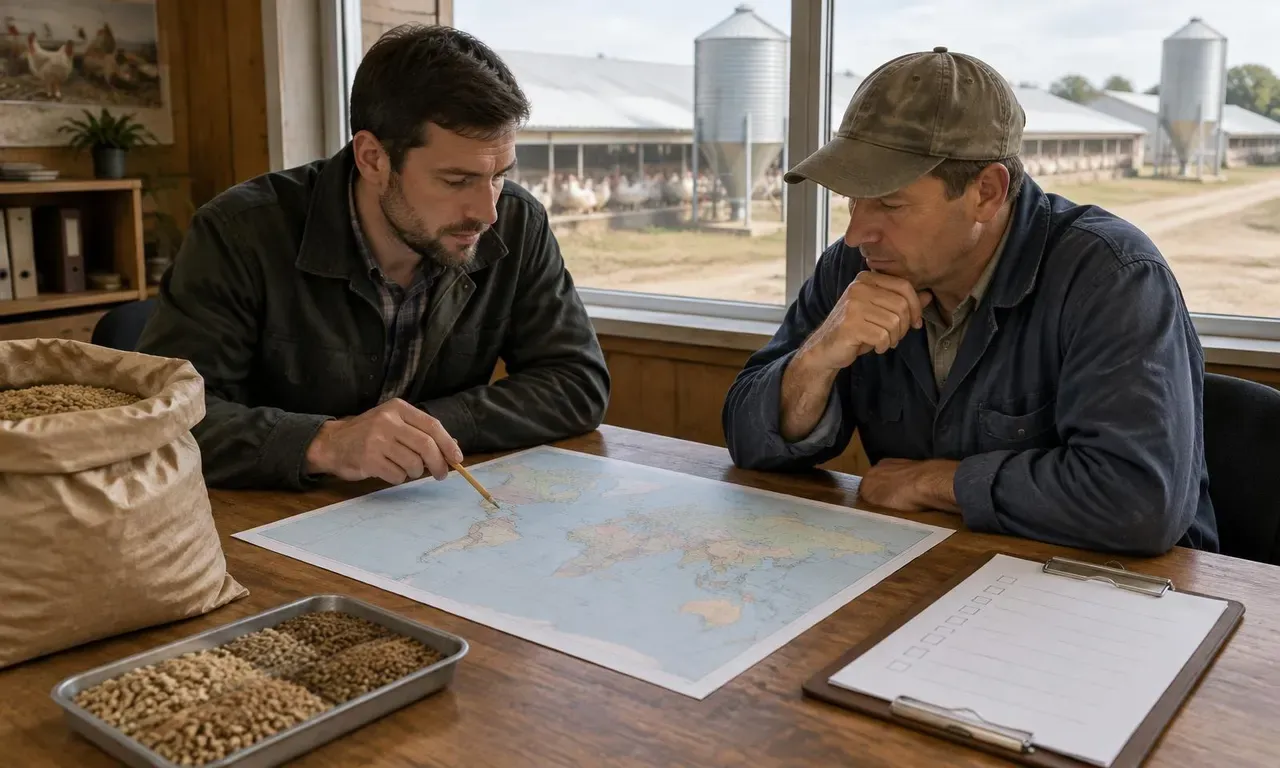
Short answer: feed users are concentrated where feed output is high. In 2025, China, the U.S. and Brazil made about 47.7% of the world's feed and the top ten countries about 65.2% (Alltech Agri-Food Outlook 2026). That tells you where to look, not who to sell to or buy from. A farm, integrator or cooperative still has to qualify each purchase on species, specification, volume, quality, storage and landed cost per unit of output.
Definitions used in this guide
- Market signal: a published, dated figure such as national feed tonnage by species. It describes a sector, not a buyer.
- Market hypothesis: an assumption that a certain buyer type in a country may have a feed need worth checking.
- Qualified feed purchase: a named buyer with a species, stage, volume, delivery site, approved specification and budget that can be quoted on the same basis.
Step 1: read the country signals carefully
The table summarises 2025 figures from the Alltech survey (published 2026). The buyer types are where a farm-level need is most likely to sit; they are hypotheses to verify, not confirmed customers.
| Country | 2025 feed output (million t) | Species signal reported | Buyer types to qualify | Evidence, date |
|---|---|---|---|---|
| China | 330.1 | Pig feed +7.2%, broiler +3.5%; shift from on-farm mixing to complete feed | Pig and broiler integrators, large farms | Alltech 2026, 2025 data |
| United States | 267.4 | Dairy +0.9%, broiler +1.4%; layer −3% after avian influenza losses | Dairy farms, broiler integrators, cooperatives | Alltech 2026, 2025 data |
| Brazil | 89.9 | Broiler +2.7%, aquaculture +8.9%, beef +7.1% | Poultry and fish integrators, feedlots, dairy cooperatives | Alltech 2026, 2025 data |
| India | 57.7 | Dairy +6.8%, layer +4.4% | Dairy cooperatives, layer farms | Alltech 2026, 2025 data |
| Mexico | 41.9 | Layer and dairy grew most; broiler −0.5% | Layer and dairy farms, poultry integrators | Alltech 2026, 2025 data |
What this evidence proves: feed volume and its direction by species in 2025. What it does not prove: that any farm is buying, that FeedMatch has customers there, that suppliers have spare capacity, or that a price or delivery date is achievable. Russia also ranks in the top ten but is excluded under our sanctions-compliance policy.
Step 2: start from the farm outcome
Write down the species, production stage and system, the number of animals or tonnes of output planned, the feeding period and the KPI you will judge by, for example feed cost per kg of live weight, per dozen eggs or per litre of milk. Use your own records for actual intake and wastage. If they are incomplete, mark estimates clearly.
Step 3: get the specification from a qualified nutritionist
The nutritional specification, any additive limits and the feeding programme belong to a qualified animal nutritionist or veterinarian who knows local rules. FeedMatch does not formulate feed. The FAO overview of feed quality and safety explains why ingredient quality and contamination control matter along the whole chain.
Step 4: run the qualification matrix
| Check | Question to answer | Evidence to collect |
|---|---|---|
| Species and stage | Which animals and which phase? | Flock/herd/pond plan |
| Actual demand | How many tonnes per month, how steady? | Intake and wastage records |
| Specification | Is it written and approved? | Nutritionist-signed spec |
| Local ingredients | Are key ingredients available locally or imported? | Supplier offers, harvest timing |
| Quality and traceability | Which documents come with each lot? | Certificate of analysis, lot numbers |
| Storage | How many days of cover fit safely? | Bin or warehouse capacity |
| Delivered cost | What is the landed cost per unit of output? | Quotes on the same terms |
| Seasonal and logistics | Rainy season, ports, border or road limits? | Carrier and supplier confirmation |
| Supplier due diligence | Registration, references, claims process? | Documents, checks by your team |
Use the free FCR and feed cost per output calculator to set your baseline and the landed cost calculator for any quote not delivered to your farm. The farm feed purchase plan covers storage, batch checks and fair supplier review in more detail.
Step 5: use country pages for local context
If you buy in one of these markets, the country pages summarise local documents and delivery points: Brazil, United States, India, China and Mexico (in Spanish). Treat them as a starting checklist, then confirm rules with local specialists.
Step 6: ask for comparable proposals
When the matrix is filled in, send one written request so every supplier answers the same question. The RFQ form is free and a person reviews each request before any supplier sees it. You decide whether to proceed and with whom; any supplier list is not an endorsement.
Free tools, optional help
Every FeedMatch buyer calculator, guide, checklist and the RFQ form is free for buyers, with no subscription or obligation. If you want the team to help scope the requirement and approach suitable suppliers, assisted B2B sourcing is available for projects of about USD 250,000 or more. We do not promise prices, availability, supplier choice, financing or results.
Sources and editorial note
- Alltech Agri-Food Outlook 2026 — 2025 feed output by country and species.
- FAO: good practices for the feed sector.
- FAO: animal feed quality and safety overview.
- Figures checked against the source on 14 October 2026. Country data is production context only and does not describe any individual buyer.
Frequently asked questions
- Which countries produce the most animal feed?
- According to Alltech's Agri-Food Outlook 2026, China, the U.S. and Brazil produced about 47.7% of global feed tonnage in 2025, and the top ten countries about 65.2%. India and Mexico ranked fourth and fifth.
- Does high feed output mean a country is a good market for my farm?
- No. National output shows where feed is made and used. It does not show that any farm needs your specification, that suppliers have capacity for you, or that a landed price works. Each purchase must be qualified on its own records.
- Who is the actual buyer in feed procurement?
- A qualified farm, poultry, aquaculture or livestock integrator, or cooperative with a defined species, production stage, volume and delivery site. A country is context, never the customer.
- What should a farm check before buying feed in another market?
- Species and stage, a nutritionist-approved specification, real intake and wastage, local ingredient availability, quality and traceability documents, storage, landed cost per unit of output, seasonal and logistics limits, and supplier due diligence.
- Are FeedMatch calculators and the RFQ form free?
- Yes. Buyer calculators, guides, checklists and the RFQ form are free, with no subscription or obligation. Optional assisted sourcing is for B2B projects of about USD 250,000 or more.
- Why is Russia not on the screening list?
- Russia ranks in the top ten by output, but it is excluded from FeedMatch market recommendations under the company's sanctions-compliance policy.
Feed industry regions we work with
Feed procurement is local before it is global: raw material basis, freight and installation costs change by region. These are the areas buyers most often name when defining a feed project in English.
United States
Cities and provinces
Iowa · Nebraska · Georgia · Arkansas · Texas · North Carolina
Corn and soybean meal basis with large integrated poultry, swine and dairy operations.
United States →United Kingdom and Ireland
Cities and provinces
East Anglia · Yorkshire · Lincolnshire · Northern Ireland · Munster
Compound feed and imported protein logistics through east coast and Irish Sea ports.
United Kingdom and Ireland →Gulf and East Africa import markets
Cities and provinces
Jeddah · Dubai · Mombasa · Djibouti
Import-driven feed supply where landed cost and port logistics dominate the decision.
Gulf and East Africa import markets →FeedMatch is supplier-neutral. Regional context helps define the requirement; pricing always comes from manufacturer quotations.