
Farm Feed Purchase Plan: Specifications, Storage, Batch Checks and Fair Supplier Review
A practical way to manage a farm feed purchase from first requirement to monitored delivery, using your own records, free FeedMatch tools and an optional reviewed RFQ.
Short answer · Updated October 2026
Short answer: Farm Feed Purchase Plan: Specifications, Storage, Batch Checks and Fair Supplier Review
Short answer: treat each feed purchase as a small project. Define the animal outcome and constraints first, turn them into a written specification approved by your adviser, plan storage and delivery continuity, check every batch on arrival, compare suppliers on the same documented basis, and monitor the result with…
Key takeaways
- - Start from the outcome you will measure (for example feed cost per kg of output), not from a price list.
- Every buyer-facing calculator, checklist, guide and the RFQ form on FeedMatch is free to use, with no subscription and no obligation.
- Your nutritionist or veterinarian sets the nutritional requirements; FeedMatch does not prescribe diets.
- Hypothetical example, assumptions shown: a farm uses 1.2 t of feed per day, the supplier confirms a 10-day lead time and the farm chooses a 5-day delay buffer.
- - Delivery note matches the order: product, code, quantity, lot number.
FeedMatch Editorial Desk
Editorial Team
Short answer: treat each feed purchase as a small project. Define the animal outcome and constraints first, turn them into a written specification approved by your adviser, plan storage and delivery continuity, check every batch on arrival, compare suppliers on the same documented basis, and monitor the result with your own production records.
TL;DR
- Start from the outcome you will measure (for example feed cost per kg of output), not from a price list.
- One written specification and one set of terms for every supplier makes quotes comparable.
- Storage, lead time and batch records protect continuity as much as price does.
- FeedMatch buyer tools are free; assisted sourcing is optional.
Free tools first, assisted sourcing only if you want it
Every buyer-facing calculator, checklist, guide and the RFQ form on FeedMatch is free to use, with no subscription and no obligation. You can run the whole plan below on your own. If you want help, the team can review your requirement, help scope it and, where it fits, contact suitable feed manufacturers or suppliers so you can compare fit and proposals. Supplier connection is optional and never guaranteed. Assisted B2B sourcing is designed for projects of about USD 250,000 or more; that threshold does not apply to the free tools.
Step 1: Define the outcome and the constraints
| Field | What to record | Why it matters |
|---|---|---|
| Species, stage, system | e.g. broilers grower phase, tilapia ponds, dairy herd in lactation | Feed fit depends on all three |
| Outcome KPI | FCR, feed cost per kg gain, per egg or per litre | Defines how the purchase will be judged |
| Period and volume | Feeding weeks and tonnes, from your own use records | Sets order size and delivery rhythm |
| Storage | Bins, bags, floor area, conditions | Limits order size and storage time |
| Local rules | Registration, labelling, medicated feed rules | Decided with your veterinarian and authority |
Step 2: Turn the needs into a written specification
Your nutritionist or veterinarian sets the nutritional requirements; FeedMatch does not prescribe diets. The purchase specification records them in a form suppliers can quote against: product type and form (mash, pellet, crumble, floating or sinking), declared analysis with units and basis, ingredients you will not accept, physical quality, packaging, labelling, documents per lot, and acceptance criteria. Add commercial terms in the same document: Incoterms and place, payment, quote validity, delivery window and claims period.
Step 3: Plan handling, storage and delivery continuity
Hypothetical example, assumptions shown: a farm uses 1.2 t of feed per day, the supplier confirms a 10-day lead time and the farm chooses a 5-day delay buffer. Reorder point = 1.2 × (10 + 5) = 18 t. Check the delivery size against your bin capacity and the product's stated storage life. Replace every number with your own.
- Store off the floor, dry, shaded and away from pests; follow first-in, first-out.
- Keep a second supply option documented before you need it.
- Agree in writing what happens when a delivery is late or a lot is rejected.
Check space and storage days in the farm feed storage calculator.
Step 4: Batch records and quality checks on arrival
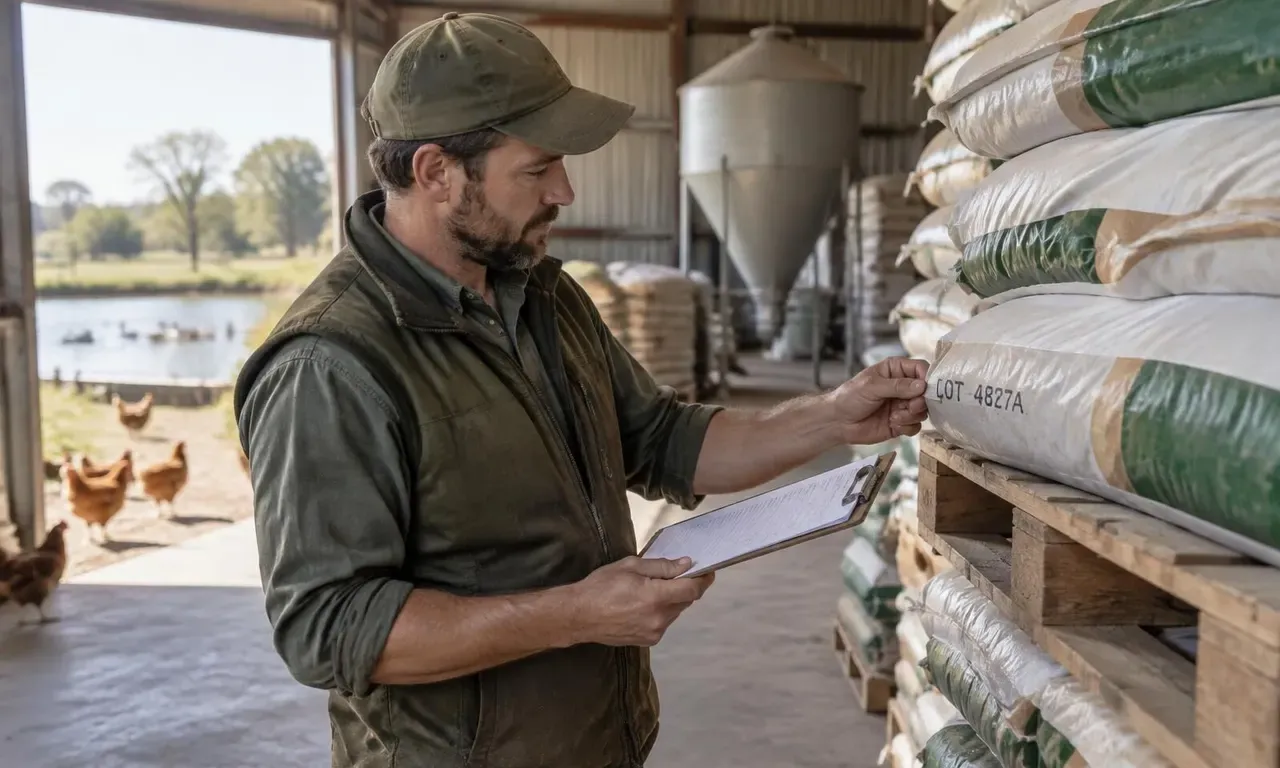
- Delivery note matches the order: product, code, quantity, lot number.
- Bags or bulk load intact, dry, without mould, odour or pests.
- Label and documents match the specification.
- Retain a labelled sample per lot for the agreed period.
- Record storage location and the date each lot is first fed.
- Reject or quarantine according to the agreed acceptance criteria and notify the supplier in writing.
Compare two lots or offers on the same basis in the ingredient and feed lot comparison calculator.
Step 5: Evaluate suitable suppliers fairly
| Criterion | Evidence to request | Watch for |
|---|---|---|
| Specification match | Product sheet against your written specification | Silent substitutions |
| Batch documentation | Lot-linked certificate and label | Generic certificates without lot numbers |
| Landed cost | Price, freight, duties, handling to your farm | Comparing ex-works with delivered |
| Continuity | Confirmed lead time, minimum order, backup plan | Promises without dates |
| Claims handling | Written procedure and time limits | Verbal-only assurances |
Use the landed cost calculator for cost and the supplier qualification scorecard to record each supplier on the same criteria.
Step 6: Monitor the procurement project
Tie the purchase to the outcome you defined in step 1. For each feeding period record feed delivered and used, animal numbers, output (weight gain, eggs, milk or harvest) and mortality, then calculate FCR and feed cost per unit of output in the FCR calculator. Compare periods only when species, stage and conditions are similar; feed is one of many factors, so a change in a KPI is a reason to review with your adviser, not proof that the feed caused it.
Procurement decision worksheet
Outcome KPI and baseline: ______ (from your records, period and group) Approved specification: reference and approver Volume, period and delivery rhythm: ______ Storage capacity and reorder point: ______ Suppliers invited with identical terms: ______ Comparison: specification match · documents · landed cost per unit of output · continuity · claims Decision and reason: ______ Review date and KPI to check: ______
When data is missing
Missing records are common. Use your best estimate, label it as an estimate, and start recording the missing items from the next delivery. If you do not know the output per group, compare cost per tonne delivered only as a provisional view and review once output data exists.
Next step
Fill in the worksheet with your own records, then, if you want offers on the same basis, send it through the free RFQ form. A person reads every request before any supplier sees it.
Sources
- IFIF and FAO, Feed Manual: good practices for the feed sector (2020).
- Codex Alimentarius, Code of Practice on Good Animal Feeding (CXC 54-2004).
- FAO, Good practices for the feed industry (2010).
*FeedMatch Group is an independent feed procurement and reviewed-RFQ platform. We do not manufacture feed, run farms or laboratories, or give veterinary or nutritional prescriptions. Feeding and health decisions stay with your nutritionist or veterinarian.*
Frequently asked questions
- What should a farm decide before asking for feed quotes?
- Write down the species, production stage and system, the feeding period, expected volume and delivery pattern, the storage you actually have, and the records you will use to judge the result. A nutritionist or veterinarian approves the nutritional specification; the purchase plan turns it into comparable quote requirements.
- Are FeedMatch tools free for farm buyers?
- Yes. Buyer calculators, checklists, guides and the RFQ form are free, with no subscription or obligation. Assisted sourcing, where the team scopes the requirement and contacts suitable suppliers, is aimed at B2B projects of about USD 250,000 or more and is optional.
- How much feed should I keep in stock?
- There is no universal number. Use your own daily use, the supplier's confirmed lead time, a buffer you choose for delays, and the storage life and conditions stated for the product. The farm storage calculator helps you check the space; your adviser and supplier confirm shelf life.
- What batch records should come with each delivery?
- At minimum: product name and code, lot or batch number, manufacturing date, quantity delivered, delivery note, and any certificate of analysis or label the contract requires. Record where the lot was stored and when it was first fed so a problem can be traced.
- How do I compare suppliers fairly?
- Send every supplier the same written specification and the same commercial terms, then compare on the same basis: documented specification match, batch documentation, landed cost per unit of output, delivery reliability and claims handling. Price per tonne alone hides differences in what is being sold.
- What if my farm records are incomplete?
- Use what you have, mark every estimate as an estimate, and start recording the missing items now: feed delivered and used per group, animal numbers and weights or output, mortality and dates. Decisions made on estimates should be reviewed once real data exists.
Feed industry regions we work with
Feed procurement is local before it is global: raw material basis, freight and installation costs change by region. These are the areas buyers most often name when defining a feed project in English.
United States
Cities and provinces
Iowa · Nebraska · Georgia · Arkansas · Texas · North Carolina
Corn and soybean meal basis with large integrated poultry, swine and dairy operations.
United States →United Kingdom and Ireland
Cities and provinces
East Anglia · Yorkshire · Lincolnshire · Northern Ireland · Munster
Compound feed and imported protein logistics through east coast and Irish Sea ports.
United Kingdom and Ireland →Gulf and East Africa import markets
Cities and provinces
Jeddah · Dubai · Mombasa · Djibouti
Import-driven feed supply where landed cost and port logistics dominate the decision.
Gulf and East Africa import markets →FeedMatch is supplier-neutral. Regional context helps define the requirement; pricing always comes from manufacturer quotations.