
From Feed Procurement to Market: A Practical Sourcing Framework for Animal-Feed Buyers and Feed-Production Projects
How commercial feed buyers and feed-production project owners can use a structured sourcing process — from a precise brief and evidence-based supplier comparison to technology choice, negotiation, conditional financing and planning what happens after production — and what they should still verify themselves.
Short answer · Updated October 2026
Short answer: From Feed Procurement to Market: A Practical Sourcing Framework for Animal-Feed Buyers and Feed-Production Projects
A structured sourcing process helps commercial feed buyers and feed-production project owners reach a workable result by fixing the requirement before prices are requested: one precise brief or RFQ, suppliers compared on documented evidence rather than claims, technologies judged on total cost of ownership and…
Key takeaways
- Agricultural procurement teams buying feed, feed ingredients or feed-production equipment rarely fail for lack of supplier names.
- Seven stages, taken in this order, turn a buying need into comparable offers and a documented decision.
- A request that says "500 tonnes of broiler feed" or "a 10 t/h feed mill" lets every supplier decide what is inside the number.
- Start from the requirement, not from a directory.
- New automation, analysis, dosing, energy or processing technologies can help, but only if they fit your ingredients, formulas, staff, utilities and service access.
FeedMatch Editorial Desk
Editorial Team

A structured sourcing process helps commercial feed buyers and feed-production project owners reach a workable result by fixing the requirement before prices are requested: one precise brief or RFQ, suppliers compared on documented evidence rather than claims, technologies judged on total cost of ownership and operational fit, quotations negotiated against the brief, financing explored only as a conditional option, and the route after production planned from the start. It is not legally required and it does not replace the buyer's own checks — but it makes offers comparable and gaps visible before contracts are signed.
When a structured sourcing process is useful — and when it is not
Agricultural procurement teams buying feed, feed ingredients or feed-production equipment rarely fail for lack of supplier names. They struggle when offers cannot be compared: different scopes, delivery terms, specifications and documents hidden behind similar headline prices. A structured process is a fixed sequence of decisions that removes those differences before negotiation starts.
It tends to add most value when: - several commercial animal-feed suppliers, ingredient origins or equipment manufacturers are realistic options; - specification, contaminant limits or documentation matter for animal performance, feed safety or market access; - the purchase is cross-border, high-value or recurring; - a feed-mill or feed-production project has interfaces between process equipment, buildings, utilities and controls; - the buyer's team has limited time to chase, clarify and normalise offers.
It adds less when you are repeating a purchase from a qualified supplier under an existing contract, making a small spot purchase, or when your integrator, regulator or customer already prescribes a single source. Many experienced buyers run this process in-house; an assisted platform is one way to run it, not the only one.
The procurement workflow at a glance
Seven stages, taken in this order, turn a buying need into comparable offers and a documented decision.
- Brief: turn the need into a precise brief or RFQ.
- Suppliers: identify relevant producers, manufacturers and service providers, and compare them on evidence.
- Technology: evaluate solutions on total cost of ownership, implementation, support and fit.
- Quotations: normalise offers and negotiate against the brief and market evidence.
- Financing: where needed, explore options subject to independent providers' approval.
- After production: plan quality, traceability, packaging, logistics, documents and routes to market.
- Next step: submit the brief and keep every decision and its evidence on record.
Stage 1 — Turn the need into a precise brief or RFQ
A request that says "500 tonnes of broiler feed" or "a 10 t/h feed mill" lets every supplier decide what is inside the number. A brief fixes what is being bought, the conditions it must meet and the assumptions every offer must use.
For feed and bulk feed-ingredient sourcing
- Specification: product, species and production stage, nutrient ranges, moisture and contaminant limits as set by your nutritionist, physical form (mash, pellet, crumble, meal).
- Volume and timing: tonnes per delivery and per year, frequency, contract length and first delivery date.
- Destination: delivery point, the Incoterms® rule you want quoted, and how the product is unloaded and stored.
- Quality and documents: sampling and testing at receipt, certificate of analysis, origin, and any registration, certification or health certificate your market requires.
- Budget assumptions: currency, price basis, payment terms and any review clause you can accept.
For feed-mill and feed-production projects
- Products and capacity: species, feed forms and capacity in tonnes per hour at a stated formula — nominal or guaranteed.
- Scope: every process stage marked included, excluded or optional; site, building and utilities; automation and traceability level.
- Acceptance and service: capacity and quality tests written into the contract, installation and commissioning split, training, spare parts and service response.
- Budget, timeline and funding: capex range, schedule, and whether financing may be needed.
Use the free feed RFQ checklist, the procurement project planner and the guide on preparing a procurement-ready feed RFQ. For a complete line, the feed-mill buying guide sets out the stage-by-stage scope.
Stage 2 — Identify and compare suppliers on evidence
Start from the requirement, not from a directory. A long list of commercial feed suppliers, ingredient producers, equipment manufacturers, turnkey feed-mill project suppliers and service providers becomes a short list only when each one is checked against capacity, scope, destination experience and documents. Record for every claim how much you actually know:
| Evidence basis | What it means | Example | How to treat it |
|---|---|---|---|
| Declared | The supplier states it | "20 t/h", "certified", "ships monthly" | Ask for the supporting document; do not rely on it alone |
| Documented | The supplier provides a document | Certificate copy, test report, reference list, datasheet | Check issuer, dates, site and product scope |
| Checked | Confirmed with the issuer or tested | Certificate confirmed with the issuing scheme; independent lab result on the lot | Record who checked, how and when |
| Estimate | Calculated, not measured | Energy per tonne from a datasheet | Label the assumptions; compare like with like |
| Pending | Not yet provided | Missing reference or document | Keep visible; never treat as zero or as acceptable |
A supplier's presence on any platform — including FeedMatch — is not a certification, and FeedMatch does not certify suppliers. Where a certification or registration matters, confirm it with the issuing scheme or authority for the exact site and product. Ask for references from comparable projects or deliveries, and assess concentration risk (one origin or one supplier), country and logistics risk, payment-term exposure and whether quoted capacity is committed to you. The supplier traceability and due-diligence checklist goes further.
Stage 3 — Evaluate innovative technologies and solutions on fit and total cost
New automation, analysis, dosing, energy or processing technologies can help, but only if they fit your ingredients, formulas, staff, utilities and service access. Assess each option on:
- Maturity: installed references at comparable scale and conditions, not only pilot results.
- Total cost of ownership: purchase and installation plus energy, wear parts, consumables, software licences, maintenance, labour and downtime over a stated planning horizon.
- Implementation: site works, integration with existing controls and records, commissioning time and training.
- Support: local service, spare-parts stock, response times and the remote-access policy.
- Operational fit: whether the solution works on your formulas and product range, and what changes for your team.
Supplier performance figures are claims until they are tested on your formulas and conditions. The Innovation Center explains technologies with sources and maturity notes; the supplier TCO comparison and feed mill cost calculator compute from your own inputs only.
Stage 4 — Compare quotations and negotiate against the brief
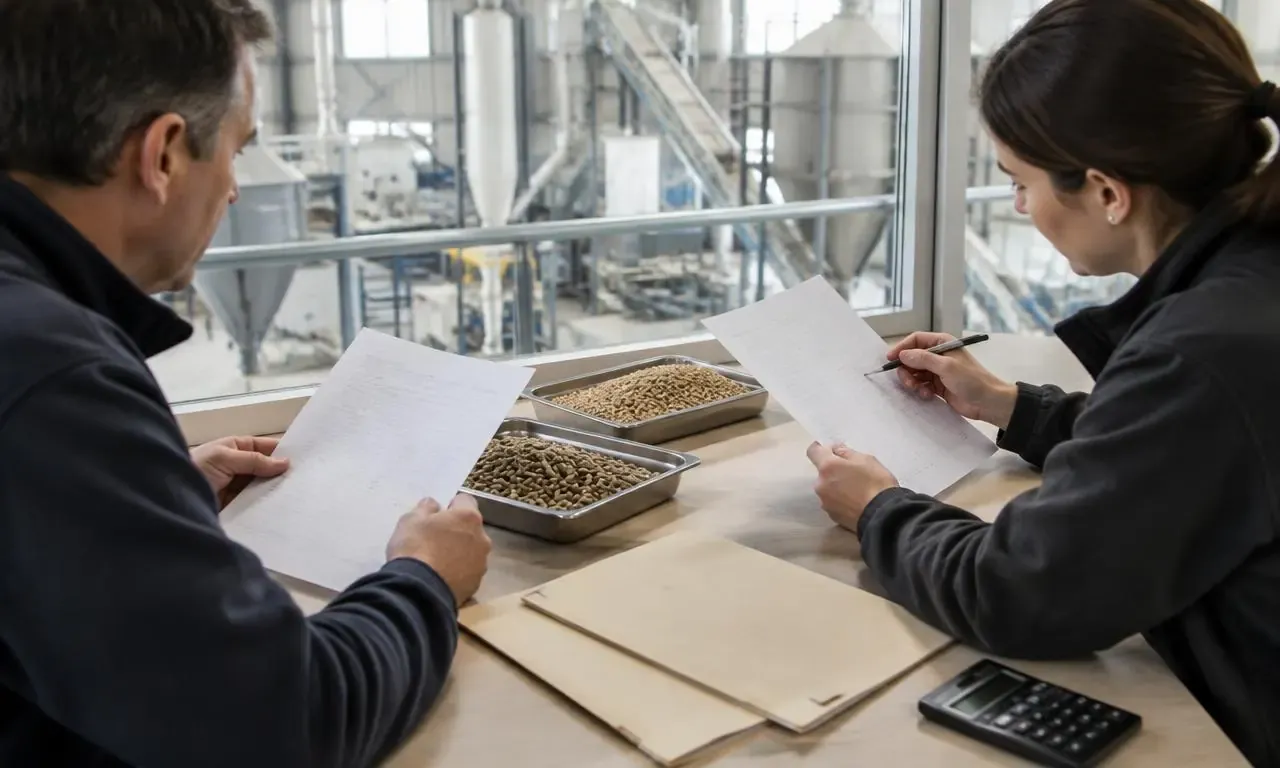
- Normalise first: same scope, Incoterms rule, currency, validity and payment terms for every offer; list exclusions explicitly.
- Compare delivered and lifetime cost: freight, duties, handling and storage for supplies with the landed cost calculator; installed cost plus running cost for equipment.
- Link payment to performance: milestones tied to delivery, acceptance tests and documents, not to dates alone.
- Use market evidence: dated public sources in the Market Intelligence Center help judge whether a price and its review clause are consistent with current market direction.
- Negotiate on real levers: volume and contract length, delivery-window flexibility, specification tolerances that genuinely do not matter to you, payment terms and the split of scope.
No process can guarantee the lowest price or a saving. A good result is a price that fits the brief, is explained line by line and can be defended to your finance team. For equipment, see how to compare feed mill quotations.
Stage 5 — Explore financing options, on a conditional basis
A feed-mill expansion, new line or large supply contract may need funding. Typical routes include supplier credit, export-credit-agency-supported finance, commodity trade finance, bank loans and leasing. Whether any of them is available depends on the provider, the jurisdiction, the project and the buyer — after the provider's own due diligence, eligibility checks and approval.
FeedMatch does not lend, underwrite, pre-approve or guarantee financing, and no lender is presented here as a partner. With the buyer's separate, explicit consent, the structured project information can be prepared so independent providers can review it. Prepare a clear brief, comparable quotations, a capex and running-cost model with stated assumptions, and the company documents a provider is likely to ask for. See the financing overview, supplier credit and export credit agency financing. Financing intake for plant and equipment projects applies from about USD 250,000.
Stage 6 — Plan what happens after production
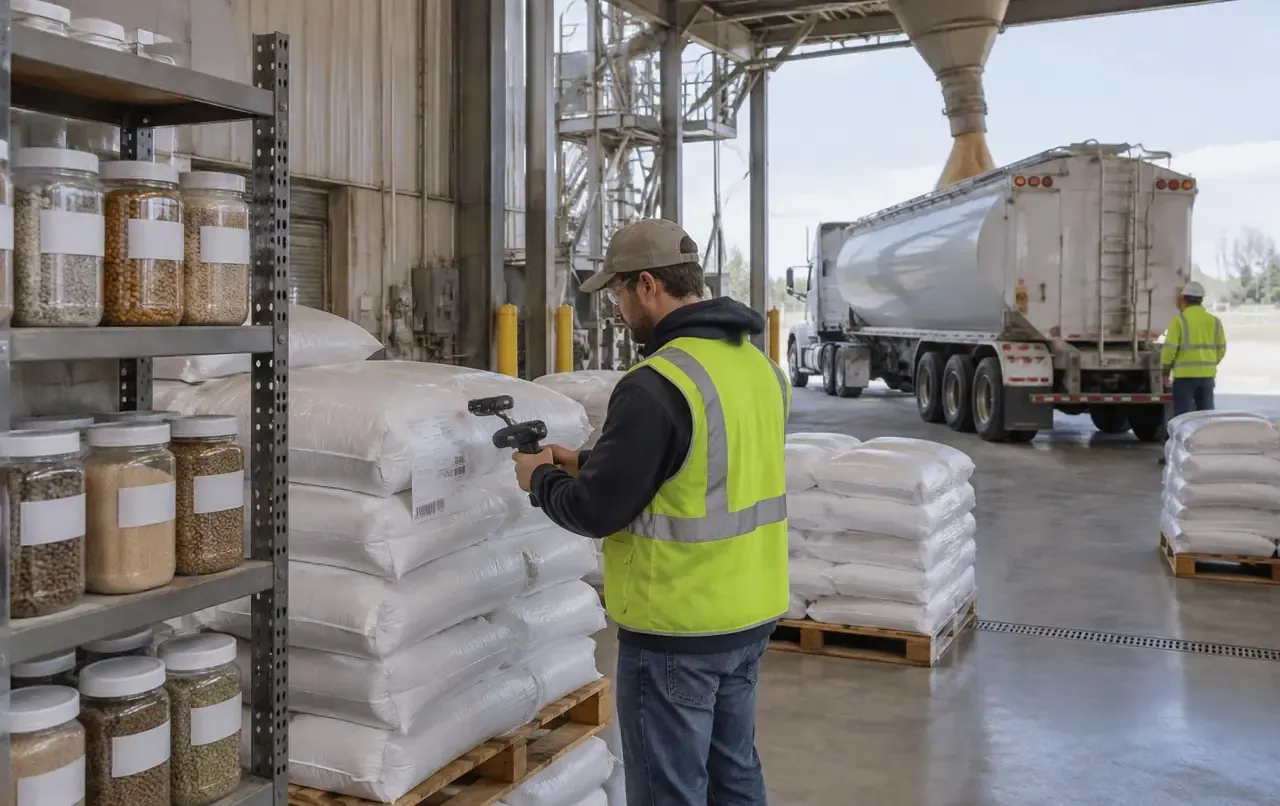
Procurement decisions shape what the operation can deliver later. Before ordering, decide:
- Quality specification and release: what each output lot must meet, how it is tested and who releases it; retained samples.
- Traceability: lot links from ingredient intake to dispatch, so a complaint or recall can be traced quickly.
- Packaging and labelling: bulk, bags or big bags, and the labelling your destination market requires.
- Storage and logistics: moisture, temperature and pest control in storage; transport mode; temperature-controlled or cold-chain logistics only where the product — for example an integrated operation's chilled or frozen fish, shrimp or poultry — requires it.
- Documents and buyer requirements: certificates of analysis, delivery documents, and any export or health certificates. Requirements are jurisdiction-specific — the EU feed hygiene regulation (EC) No 183/2005 and the US preventive-controls rule for animal food (21 CFR Part 507) are two examples — so confirm them with the competent authority and qualified advisers. Integrator, retailer or audit-scheme requirements may add more.
Possible routes to market for qualifying output
Where a project is part of an integrated operation whose output is an agricultural or food commodity — for example poultry, eggs, fish or shrimp — FeedMatch's parent marketplace, Global B2B Group, may be a route to present qualifying lots to international B2B buyers, under its own review and criteria. FeedMatch itself does not buy, sell or trade feed output or finished food, and presenting a lot does not imply a buyer, a price, export clearance or acceptance.
Structured versus informal sourcing
| Decision point | Informal sourcing | Structured sourcing |
|---|---|---|
| Requirement | Short message, details settled later | Written brief with specification, volume, timing, destination, documents and budget basis |
| Suppliers | Whoever replies first or is already known | Long list from the requirement, short list on capacity, scope and documents |
| Evidence | Claims accepted at face value | Each claim marked declared, documented, checked, estimate or pending |
| Comparison | Headline price | Same scope and terms; delivered cost and total cost of ownership |
| Technology | Brochure performance | Tested fit, references, support and lifetime cost |
| Negotiation | Price only | Price, terms, scope, tolerances and payment linked to acceptance |
| Financing | Considered after contracting | Explored early as a conditional option with independent providers |
| After production | Left for later | Quality, traceability, packaging, logistics and market requirements planned up front |
Common mistakes
- Requesting prices before the specification, volume and delivery terms are fixed.
- Comparing offers with different scopes, Incoterms rules or currencies.
- Treating a certificate copy, brochure or platform listing as proof of current certification or capacity.
- Choosing a technology on brochure performance without references at comparable scale.
- Negotiating only on price and ignoring payment terms, exclusions and acceptance tests.
- Assuming financing will be available because a quotation exists.
- Planning packaging, traceability and documents after production has started.
- Expecting any platform to guarantee a buyer, price or export clearance for the output.
RFQ checklist
Send the same checklist to every shortlisted supplier and ask for an answer on every line, marked with its evidence basis.
- Products and specification: feed type, species and stage, or ingredient name; nutrient ranges and contaminant limits set by your nutritionist; physical form
- Volume and frequency: tonnes per delivery and per year, contract length, seasonality and tolerance on quantity
- Timing: first delivery or project start date, decision date and quotation validity you need
- Destination and delivery terms: delivery point, Incoterms rule and version, unloading and storage at receipt
- Packaging and handling: bulk, bags or big bags; labelling language; palletising; storage conditions
- Quality acceptance: sampling method, laboratory, tests, acceptance limits and what happens if a lot fails
- Documents required: certificate of analysis, origin, registrations or certifications you need, export or health certificates where your destination requires them
- Project scope (plant or equipment): capacity in t/h at a stated formula, process stages included or excluded, site, utilities, automation and traceability
- Acceptance tests and service (plant or equipment): capacity and quality tests, installation, commissioning, training, spare parts and response times
- Budget assumptions: currency, price basis, target range if you have one, payment terms and milestones
- Total cost of ownership basis: planning horizon, energy price, wear parts, maintenance and labour assumptions to apply to every offer
- Financing need: whether funding may be needed, amount range, timing; consent to share project information with independent providers
- After production: output specification, traceability level, packaging, logistics and the buyer requirements the output must meet
- Evidence status: for each answer: declared, documented, checked, estimate or pending
Download this RFQ checklist (CSV, opens in Excel or Google Sheets)
What FeedMatch does — and does not do
FeedMatch Group is a buyer-first, supplier-neutral feed sourcing and procurement intermediary. Buyers use the tools, guides and RFQ form free of charge. A person on our team reviews each request, clarifies the brief, approaches suitable suppliers or manufacturers and presents their responses for comparison — there is no direct or automatic buyer-to-supplier contact. FeedMatch is not a manufacturer, producer, lender, certifier, lawyer or regulator, and does not guarantee prices, availability, quality, delivery, compliance, financing or outcomes. Assisted sourcing for plant and equipment projects applies from about USD 250,000; feed and ingredient supply requests have no such minimum. See how it works.
Ready to request a quote? Submit your project brief or RFQ, or build it step by step in the RFQ builder. You can also start from feed ingredients or the guides on commercial animal feed procurement and buying animal feed in bulk.
Sources and further reading
- FAO and IFIF, Good practices for the feed sector (2020): feed safety, quality control and traceability practices.
- Regulation (EC) No 183/2005 on feed hygiene and US 21 CFR Part 507: examples of feed-operator obligations; applicability depends on the market.
- ICC, Incoterms® rules: the delivery-term rules referenced in quotations.
- Web references checked on 23 October 2026. This article is general procurement guidance, not legal, financial, safety or compliance advice.
Frequently asked questions
- Do I need a sourcing platform to buy animal feed or feed-mill equipment?
- No. Nothing requires a buyer to use a sourcing platform, and many experienced teams run the whole process in-house. A structured process — internal or assisted — is most useful when several suppliers or origins are involved, when specifications and documents matter, when the purchase crosses borders, or when a feed-production project has many interfaces between suppliers.
- How do I compare commercial feed suppliers fairly?
- Send every supplier the same brief, rebuild each offer on the same scope, delivery terms, currency and validity, and record for every claim whether it is declared, documented, independently checked, estimated or still pending. Compare delivered cost and total cost of ownership, not headline price, and keep missing evidence visible.
- Can a structured sourcing process guarantee the lowest price?
- No. No process can promise the lowest price or a saving. The aim is a price that fits the brief, is explained line by line, is comparable across offers and is consistent with dated market evidence.
- Does FeedMatch provide or guarantee financing?
- No. FeedMatch does not lend, underwrite, pre-approve or guarantee financing. With the buyer's separate explicit consent, project information can be prepared for review by independent providers; any financing depends on their due diligence, eligibility criteria and approval.
- Can FeedMatch sell what my feed mill or farm produces?
- FeedMatch does not buy, sell or trade feed output or finished food. Where an integrated operation produces a qualifying agricultural or food commodity, the parent Global B2B Group marketplace may be a route to present it to international B2B buyers under its own criteria — with no promise of a buyer, price, export clearance or acceptance.
- Is there a minimum project size?
- Assisted sourcing for feed-mill, plant and equipment projects applies from about USD 250,000 in project value. Feed and ingredient supply requests have no such minimum; they are reviewed on specification, volume, frequency, destination and logistics. The tools and the RFQ form are free for buyers.
Feed industry regions we work with
Feed procurement is local before it is global: raw material basis, freight and installation costs change by region. These are the areas buyers most often name when defining a feed project in English.
United States
Cities and provinces
Iowa · Nebraska · Georgia · Arkansas · Texas · North Carolina
Corn and soybean meal basis with large integrated poultry, swine and dairy operations.
United States →United Kingdom and Ireland
Cities and provinces
East Anglia · Yorkshire · Lincolnshire · Northern Ireland · Munster
Compound feed and imported protein logistics through east coast and Irish Sea ports.
United Kingdom and Ireland →Gulf and East Africa import markets
Cities and provinces
Jeddah · Dubai · Mombasa · Djibouti
Import-driven feed supply where landed cost and port logistics dominate the decision.
Gulf and East Africa import markets →FeedMatch is supplier-neutral. Regional context helps define the requirement; pricing always comes from manufacturer quotations.