
Feeding Systems Compared: Pan, Chain, Tube, Rail, Wet & Precision — What Actually Fits Your Operation
A supplier-neutral comparison of the main animal feeding systems — pan, chain, tube, rail, liquid and precision — with the trade-offs that actually change FCR, labor and capex on real farms.
Short answer · reviewed July 2026
Short answer: Feeding Systems Compared: Pan, Chain, Tube, Rail, Wet & Precision — What Actually Fits Your Operation
Choosing a feeding system is one of the highest-leverage procurement decisions on any animal protein operation. It sets the ceiling on feed conversion, drives daily labor for the next 10–15 years, and often costs more in wasted feed than in the equipment itself.
Key takeaways
- In commercial animal production, six feeding architectures cover more than 95% of installations: pan feeders, chain (trough) feeders, tube (auger) feeders, rail/travelling feeders, liquid (wet) feeding, and precision (sensor-driven)…
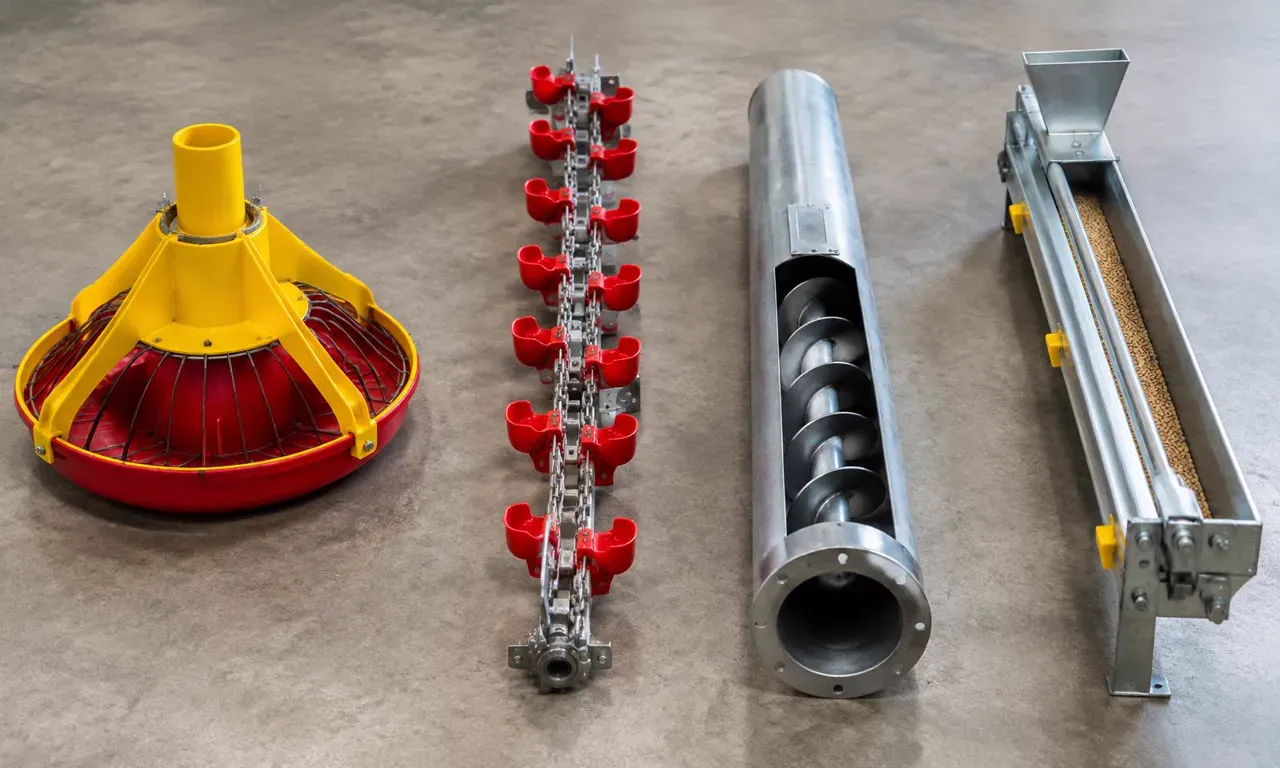
- Pan feeders drop feed from an overhead line into circular pans at fixed intervals.
- A flat chain drags feed through a shallow trough, delivering to every bird along its length simultaneously.
- A rotating auger inside a tube moves feed to drop points or bowls.
- A hopper on a rail travels the length of the house, dispensing measured feed into troughs as it passes.
FeedMatch Editorial Desk
Editorial Team
Choosing a feeding system is one of the highest-leverage procurement decisions on any animal protein operation. It sets the ceiling on feed conversion, drives daily labor for the next 10–15 years, and often costs more in wasted feed than in the equipment itself. Yet most buyers evaluate it as a brand decision — 'which manufacturer' — instead of a solution decision — 'which system architecture'. This guide compares the underlying feeding solutions on the criteria that actually move the P&L: feed conversion ratio (FCR), feed wastage, uniformity, labor, capex, hygiene and species fit. It is deliberately supplier-neutral.
The Six Feeding Solutions Buyers Actually Compare
In commercial animal production, six feeding architectures cover more than 95% of installations: pan feeders, chain (trough) feeders, tube (auger) feeders, rail/travelling feeders, liquid (wet) feeding, and precision (sensor-driven) feeding. Every branded product on the market is a variation of one of these. Understanding the architecture first, and the brand second, is how procurement teams avoid paying premium prices for a system that is wrong for their species, stocking density or feed form.
Pan Feeders
Pan feeders drop feed from an overhead line into circular pans at fixed intervals. They are the default in broiler and breeder houses because they scale linearly with bird density, waste very little pelleted feed when adjusted correctly, and are simple to clean between flocks. Typical feed wastage sits at 2–4% when pan height and grill settings track bird growth weekly. Their weakness is mash and coarse crumb: fines settle at the pan edge and are trampled. Pan systems are also poor for restricted feeding programs because access is continuous.
Chain (Trough) Feeders
A flat chain drags feed through a shallow trough, delivering to every bird along its length simultaneously. This gives the best access equality of any dry system — every bird reaches feed within seconds — which is why breeder and layer operations on controlled feeding programs still specify chain. FCR benefit comes from uniform intake, not from lower wastage; wastage is actually higher than pans (typically 4–7%) because birds bill feed out of the open trough. Capex per meter is competitive, but chain wear and motor load scale with house length, and very long houses need multiple loops.
Tube (Auger) Feeders
A rotating auger inside a tube moves feed to drop points or bowls. Tube systems are the workhorse of grow-finish pig barns and turkey houses because they handle pellet, crumb, meal and even coarse ground grain without bridging. Wastage in pigs is 3–6% with well-adjusted wet/dry bowls, higher with dry-only dispensers. The main trade-off is response time: augers deliver feed slowly, so animals at the far end of a long line eat later, which can suppress uniformity in fast-growing flocks. Tube systems also require more cleaning attention than chain because residual feed sits inside the tube.
Rail / Travelling Feeders
A hopper on a rail travels the length of the house, dispensing measured feed into troughs as it passes. This is standard in breeder operations that need precise daily allocation, and increasingly used in cage-free layer and turkey breeder houses. FCR advantage comes from portion control — the operator sets grams per bird per day, and the rail delivers exactly that. Capex per meter is the highest of the dry systems, and moving parts on a rail are more maintenance-sensitive, but the payback on breeders comes from tighter body-weight uniformity and fewer floor eggs, not from feed savings alone.
Liquid (Wet) Feeding
Liquid feeding mixes ground feed with water (and often co-products like whey, brewers' grains or bakery meal) and pumps it to troughs or valves on demand. It is dominant in European pig finishing because it unlocks cheap liquid co-products, improves palatability and lifts average daily gain (ADG) 3–6% versus dry meal in the same genetics. FCR is usually neutral to slightly worse than dry pellet, but feed cost per kilogram of gain drops when co-products are locally available at discount. Capex is 2–3x a dry auger system, hygiene management is non-trivial (pipe biofilm is real), and it is only economic where liquid co-products are within trucking distance.
Precision Feeding
Precision feeding is not a distribution technology — it is a control layer that sits on top of any of the above. Individual RFID (pigs, dairy) or camera-based (broilers) recognition drives per-animal or per-pen ration curves, updated daily against growth data. Documented FCR improvements in gestating sows reach 8–12% and in finishing pigs 3–5% versus fixed feed curves. Capex is significant — the sensors and software often cost more than the physical feeders — but the ROI window has shortened dramatically as feed prices stayed elevated through 2024–2026.
Side-by-Side: The Numbers That Matter
The following ranges are drawn from published trials and integrator benchmarks, not vendor claims. Treat them as directional. Feed wastage: pan 2–4%, chain 4–7%, tube 3–6%, rail 1–3%, liquid 2–5%, precision improves any base system by 15–30%. Access time to feed (seconds to full access for the last animal): chain <10, rail <60, pan 30–120, tube 120–300, liquid <30, precision variable. Capex per animal place, indexed to pan = 1.0: chain 1.1, tube 0.9, rail 1.6, liquid 2.5, precision +1.0 to +2.0 on top of the base system. Labor hours per 1,000 animals per week: pan 1.2, chain 1.5, tube 1.0, rail 0.8, liquid 2.0, precision 0.5 (once commissioned).
Species Fit — Not All Systems Suit All Species
Broilers and turkey growers: pan is the default, precision layered on top for large integrators. Broiler breeders and layer breeders: chain or rail for access equality and controlled feeding. Commercial layers (cage-free/aviary): chain remains dominant; rail systems are gaining share. Grow-finish pigs: tube with wet/dry bowls in North America, liquid feeding in Europe, precision increasingly common in both. Sows (gestation): electronic sow feeders — a form of precision — have become the welfare and FCR standard. Dairy: TMR delivery (mixer wagons) plus precision top-dressing in the parlor or robotic feeders. Aquaculture: pneumatic and rotor-disc systems for surface pellet, submerged doser systems for shrimp — a separate category outside this guide.
How to Choose — A Procurement Checklist
- Fix the feed form first. If your least-cost formulation runs on mash or coarse meal, cross pan off the list before you look at brands. 2. Decide access model. Continuous access (broilers, finishers) opens the full menu; restricted feeding (breeders, gestating sows) forces chain, rail or ESF. 3. Value the FCR delta correctly. On a 500,000-bird broiler complex, a 2-point FCR improvement is worth roughly $600,000–$900,000 per year at 2026 feed prices — this usually justifies a system upgrade that a spreadsheet comparing only capex would reject. 4. Model labor separately. In markets with tight labor (US, Western Europe, Gulf), the 30% labor saving from precision or rail systems often exceeds the FCR case. 5. Only then compare brands. Two manufacturers of the same architecture (e.g. two pan systems) rarely differ by more than 3–5% on lifetime cost — architecture choice is 10x more consequential than brand choice.
Where FeedMatch Fits
FeedMatch runs supplier-neutral RFQs across every feeding-system architecture above. Buyers describe the operation — species, house size, feed form, labor cost, target FCR — and the platform routes the brief to qualified system suppliers that actually build for that architecture in that region. The comparison stays honest because we do not sell equipment.
Feed industry regions we work with
Feed procurement is local before it is global: raw material basis, freight and installation costs change by region. These are the areas buyers most often name when defining a feed project in English.
United States
Cities and provinces
Iowa · Nebraska · Georgia · Arkansas · Texas · North Carolina
Corn and soybean meal basis with large integrated poultry, swine and dairy operations.
United States →United Kingdom and Ireland
Cities and provinces
East Anglia · Yorkshire · Lincolnshire · Northern Ireland · Munster
Compound feed and imported protein logistics through east coast and Irish Sea ports.
United Kingdom and Ireland →Gulf and East Africa import markets
Cities and provinces
Jeddah · Dubai · Mombasa · Djibouti
Import-driven feed supply where landed cost and port logistics dominate the decision.
Gulf and East Africa import markets →FeedMatch is supplier-neutral. Regional context helps define the requirement; pricing always comes from manufacturer quotations.
Move from insight to procurement
Turn the ideas in this article into a live procurement action — supplier-neutral, buyer-controlled, fully documented.