
Agentic Feed Procurement: How AI Agents Now Run Calculators and Submit RFQs on FeedMatch
Feed buyers no longer have to be the ones filling in the form. FeedMatch exposes its sourcing engine — mill sizing, ROI and CAPEX modelling, ingredient specifications and the RFQ intake itself — to AI agents through an authenticated agent interface. This guide explains what agentic procurement actually changes, what stays under human control, and how to put an assistant to work on your next feed enquiry.
Short answer · reviewed August 2026
Short answer: Agentic Feed Procurement: How AI Agents Now Run Calculators and Submit RFQs on FeedMatch
FeedMatch now exposes its buyer tools to AI agents. An authenticated assistant — ChatGPT, Claude, a Copilot-style internal agent or your own automation — can size a feed mill, run ROI and CAPEX models, look up ingredient specifications and inclusion limits, draft a complete request for quotation and submit it into the…
Key takeaways
- FeedMatch now exposes its buyer tools to AI agents.
- - AI agents can now execute FeedMatch tools directly: mill sizing, ROI and payback, ingredient lookup and RFQ submission.
- Industrial feed buying is a document exercise disguised as a commercial one.
- The agent interface exposes a small, deliberate set of capabilities rather than a general-purpose browser.
- Letting software submit commercial enquiries on your behalf is only sensible if the boundaries are explicit.
FeedMatch Editorial Desk
Editorial Team

Short Answer
FeedMatch now exposes its buyer tools to AI agents. An authenticated assistant — ChatGPT, Claude, a Copilot-style internal agent or your own automation — can size a feed mill, run ROI and CAPEX models, look up ingredient specifications and inclusion limits, draft a complete request for quotation and submit it into the same intake a human buyer uses. It can then read back the status of the requests it created. Every write action is authenticated and scoped to the person who authorised the agent, so an agent can prepare and file an enquiry, but it cannot see other buyers' data, cannot sign anything and cannot accept an offer. The result is that the slow half of procurement — gathering specs, running the numbers, writing the enquiry correctly — stops being human work.
Key Takeaways
- AI agents can now execute FeedMatch tools directly: mill sizing, ROI and payback, ingredient lookup and RFQ submission.
- Authentication is per user. An agent acts with the permissions of the buyer who connected it, and only sees that buyer's own requests.
- The RFQ an agent files is a real enquiry in the same queue as a manual one — no separate, lower-priority channel.
- Agents remove the most common cause of slow quotes: incomplete specifications. A tool-driven enquiry carries volume, grade, destination, Incoterm and timeline by construction.
- Humans keep the commercial decisions. Agents prepare, model and submit; people compare, negotiate and award.
- Machine-readable pages and structured specifications also make FeedMatch quotable by answer engines, so a buyer asking an assistant a feed question gets the real numbers rather than a guess.
Why Procurement Is the Right Job for an Agent
Industrial feed buying is a document exercise disguised as a commercial one. Before a single supplier is contacted, somebody has to decide the tonnage, translate a production target into a specification, check whether the grade is permitted in the destination market, estimate landed cost, and write it all down in a way a manufacturer can price without a week of clarification emails. None of that is judgement work. It is retrieval, arithmetic and formatting — precisely the three things a language model with real tools does faster and more consistently than a person under deadline.
The judgement work sits on the other side: which supplier to trust, which risk to accept, what to pay, when to commit. That part should stay human, and on FeedMatch it does. The agent interface is deliberately asymmetric — broad read and modelling capability, tightly scoped write capability, and no authority to conclude a transaction.
What an Agent Can Actually Do on FeedMatch
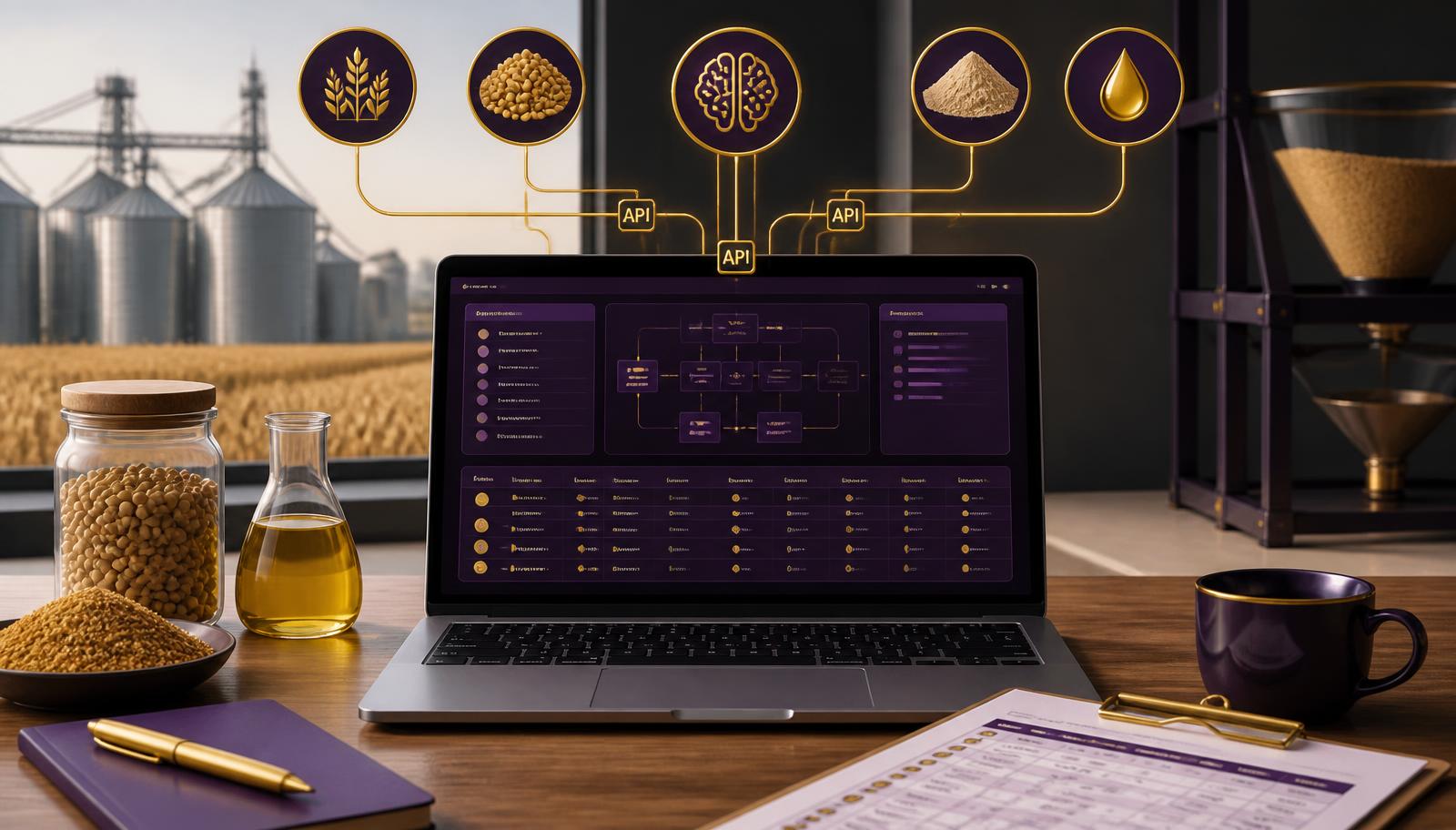
The agent interface exposes a small, deliberate set of capabilities rather than a general-purpose browser. Each one maps to a tool a human buyer already uses on the site.
Size a feed mill. Given a target output in tonnes per hour or per year, species mix and country, the agent returns line capacity, pellet-line configuration, silo and intake sizing, energy demand and staffing envelope — the same master calculator that powers the on-site tool, including the market presets for Tier A regions.
Model ROI and CAPEX. The agent can run the payback model: contribution per tonne, break-even tonnage, an EBITDA proxy, CAPEX class and sensitivity to feed value, conversion cost and energy price. This is where an assistant is unusually useful, because it can sweep a range of assumptions in one pass instead of a buyer re-entering numbers ten times.
Look up ingredient specifications. Grade definitions, typical nutrient ranges, inclusion limits by species, quality parameters that matter on arrival and the documentation normally required at import. This is public, supplier-neutral reference data, so no authentication is required to read it.
Submit an RFQ. The agent can file a structured enquiry: product or project scope, volume, delivery point, Incoterm, target timeline and contact details. It lands in the same intake as a manual submission and is handled the same way.
Read back its own requests. An authenticated agent can list and inspect the enquiries created under that account, so an assistant can answer "where did my methionine enquiry get to?" without a login round trip.
The Security Model, In Plain Terms
Letting software submit commercial enquiries on your behalf is only sensible if the boundaries are explicit. Three rules define ours.
First, authorisation is explicit and per user. Connecting an agent requires the buyer to sign in and approve the connection on a consent screen. There is no shared key and no anonymous write path.
Second, scope follows the account. Read tools return only the requests belonging to the authorising user. An agent cannot enumerate other buyers, other enquiries or supplier-side data, because the underlying database enforces that at row level rather than trusting the caller.
Third, no agent concludes a deal. Submitting an enquiry is a request for information, not an acceptance. Comparing offers, negotiating terms and awarding volume stay with the buyer. If your internal policy requires a second pair of eyes before an enquiry leaves the company, keep that policy — the agent simply produces a better-prepared enquiry for that reviewer.

A Realistic Workflow
Consider a poultry integrator evaluating a 20 tonne-per-hour mill in Southeast Asia while simultaneously covering a quarterly methionine requirement. Done manually, that is two workstreams, several spreadsheets and a fortnight of email.
With an agent connected, the sequence compresses. The buyer states the objective in one message. The agent runs the sizing model for the target output and species mix, then runs the ROI model across three feed-value scenarios and reports break-even tonnage and payback for each. It pulls the specification and inclusion guidance for DL-methionine 99%, confirms the grade and documentation expected at the destination, and drafts two enquiries: one project RFQ for the mill with the sized configuration attached, one ingredient RFQ with volume, grade, port and Incoterm. The buyer reviews both, adjusts the timeline on one, and approves. The agent submits.
The buyer's time went entirely into the two decisions that mattered — which scenario to plan around and whether the timeline was realistic. Everything else was executed rather than deliberated.
What This Means for Suppliers
Agentic enquiries are better enquiries, and that changes the supplier experience too. The most expensive part of quoting is not pricing; it is clarification. A tool-generated RFQ arrives with the fields a manufacturer needs to price on first read: quantity, grade, destination, Incoterm, packaging expectation and timeline. Fewer round trips means faster quotes, and faster quotes mean the buyer compares real offers instead of stale ones.
It also raises the bar on specification discipline. When enquiries are machine-generated from structured data, vague requests stand out. Suppliers who publish clean, parameter-level specifications will be matched more accurately than those who publish brochures.
Being Quotable by AI: The GEO Dimension
There is a second, quieter consequence. Buyers increasingly ask an assistant before they open a browser — "what inclusion rate is normal for soybean meal in broiler grower feed?", "what does a 10 t/h feed mill cost?", "what tests should I run on arriving fish meal?". Whoever supplies the numbers those answers are built from shapes the shortlist.
That is why FeedMatch publishes its reference layer in extractable form: short direct answers at the top of each page, parameter tables rather than prose claims, explicit units and ranges, FAQ blocks with structured markup, and a machine-readable index of the site's tools and datasets. The same discipline that makes a page useful to an answer engine makes it useful to an agent with tool access — and the two audiences are converging quickly.
How to Get Started
Start narrow. Connect an assistant, give it one bounded job — for example, "size the mill and model payback at three feed values" — and check the output against a calculation you already trust. Once the numbers reconcile, extend the agent to drafting enquiries but keep human approval before submission. Only after several cycles should you consider letting a scheduled agent file routine, repeat-volume enquiries without review, and even then keep value and volume ceilings on what it may request.
The principle is the same one that governs any procurement automation: automate preparation aggressively, automate decisions never.
The Bottom Line
Agentic procurement is not a chatbot bolted onto a contact form. It is the difference between a system that describes what it could do and a system an assistant can actually operate. FeedMatch's calculators, specification library and RFQ intake are now callable by authenticated AI agents, with per-user scoping and no authority to transact. For buyers, that removes the administrative floor under every enquiry. For suppliers, it raises the quality of what arrives. And for anyone still filling in sourcing forms by hand at eleven at night, it is probably the end of that habit.
Frequently asked questions
- Can an AI agent really submit a request for quotation on FeedMatch?
- Yes. An authenticated AI agent can submit a structured RFQ — product or project scope, volume, delivery point, Incoterm, timeline and contact details — into the same intake queue a human buyer uses. The enquiry is handled identically; there is no separate or lower-priority agent channel.
- Which FeedMatch tools can an AI agent run?
- Feed mill sizing (capacity, pellet line, silos, energy), the ROI and CAPEX payback model with sensitivity analysis, ingredient specification and inclusion-limit lookup, RFQ submission, and read-back of the requests created under the authorising account.
- Is it safe to let an AI agent act on my procurement account?
- Access is granted per user through an explicit sign-in and consent step. The agent acts only within that account's permissions, can read only that account's requests, and has no authority to accept an offer, sign a contract or commit spend. Submitting an enquiry is a request for information, not a purchase.
- Can an AI agent see other buyers' enquiries or supplier pricing?
- No. Row-level access control in the database restricts every read to the authorising user's own records, so an agent cannot enumerate other buyers, their enquiries or confidential supplier data regardless of what it is asked to do.
- Do I need to be a developer to use this?
- No. Any assistant that supports connecting external tools can be pointed at FeedMatch and authorised in a browser sign-in flow. Developers can integrate the same interface into an internal procurement system if they prefer.
- Should an agent be allowed to submit enquiries without human review?
- Not at first. Start with human approval before every submission, verify the modelled numbers against a calculation you trust, and only relax review for routine repeat-volume enquiries — with explicit volume and value ceilings. Automate preparation aggressively; never automate the award decision.
Feed industry regions we work with
Feed procurement is local before it is global: raw material basis, freight and installation costs change by region. These are the areas buyers most often name when defining a feed project in English.
United States
Cities and provinces
Iowa · Nebraska · Georgia · Arkansas · Texas · North Carolina
Corn and soybean meal basis with large integrated poultry, swine and dairy operations.
United States →United Kingdom and Ireland
Cities and provinces
East Anglia · Yorkshire · Lincolnshire · Northern Ireland · Munster
Compound feed and imported protein logistics through east coast and Irish Sea ports.
United Kingdom and Ireland →Gulf and East Africa import markets
Cities and provinces
Jeddah · Dubai · Mombasa · Djibouti
Import-driven feed supply where landed cost and port logistics dominate the decision.
Gulf and East Africa import markets →FeedMatch is supplier-neutral. Regional context helps define the requirement; pricing always comes from manufacturer quotations.
Move from insight to procurement
Turn the ideas in this article into a live procurement action — supplier-neutral, buyer-controlled, fully documented.