
Buying Feed Ingredients in South Africa: Soybean Meal, Maize, Act 36 Registration and Import Checks
A practical guide for South African feed buyers: what USDA's April 2026 report says about local meal supply, how to compare inland and coastal offers on delivered cost, and the Act 36 registration and import steps to check before you buy.
Short answer · Updated October 2026
Short answer: Buying Feed Ingredients in South Africa: Soybean Meal, Maize, Act 36 Registration and Import Checks
Short answer: South African feed buyers now source most protein meal locally, so the real comparison is often inland crusher versus coastal import on delivered cost, not price per tonne at origin.
Key takeaways
- USDA's Pretoria office published its Oilseeds and Products Annual on 2 April 2026 (report SF2026-0009, report page, PDF).
- - [ ] Product: soya oilcake (soybean meal), sunflower oilcake, full-fat soya, yellow or white maize, wheat bran, premix or additive - [ ] Analysis: crude protein, moisture, fibre and fat limits with test methods; urease activity for…
- Government guidance states that to manufacture, import or sell farm feed or pet food you must be registered under the Fertilizers, Farm Feeds, Agricultural Remedies and Stock Remedies Act, 1947 (Act 36 of 1947) (registration service, Act…
- - Local vs. imported soybean meal: local supply cuts transit risk inland; coastal mills may find imports competitive on delivered cost.
- FeedMatch helps you write the request, approaches suitable suppliers, normalises their offers on delivered cost and specification, and flags gaps.
FeedMatch Editorial Desk
Editorial Team
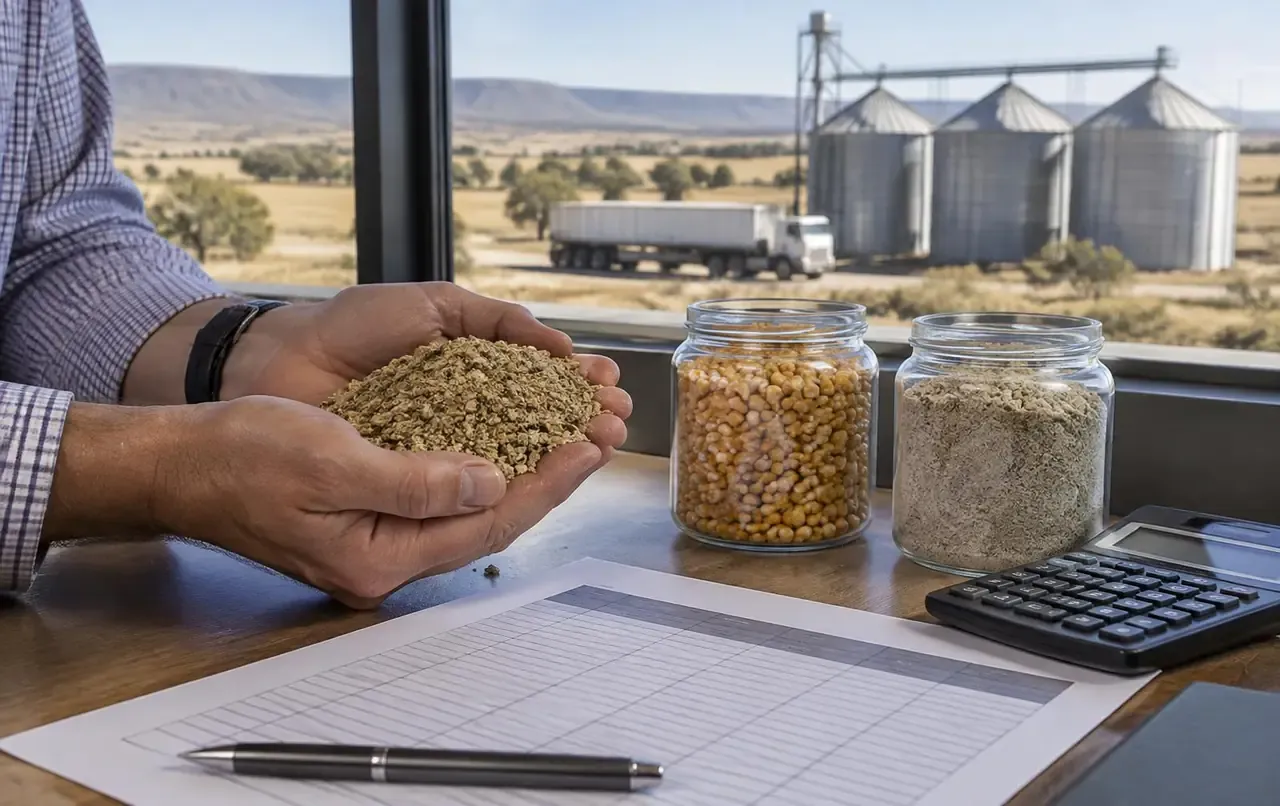
Short answer: South African feed buyers now source most protein meal locally, so the real comparison is often inland crusher versus coastal import on delivered cost, not price per tonne at origin. Send every supplier the same specification, convert each offer to cost at your mill, and check Act 36 registration and import steps before an imported product is ordered.
Get comparable offers: Submit an ingredient request with product, specification, monthly volume, delivery site and window. A person reviews every request before any supplier sees it.
What does the latest public data say about supply?
USDA's Pretoria office published its Oilseeds and Products Annual on 2 April 2026 (report SF2026-0009, report page, PDF). Points that matter for buyers:
- Soybean meal is the main protein ingredient, usually more than 70% of protein-meal use; soybean meal and sunflower meal together make up about 85% of the protein component in feed formulations.
- Maize is the main energy source, typically above 50% of most rations; fishmeal inclusion has been below 1% in recent years.
- Oilseed meal imports are forecast at about 30,000 MT in both 2025/26 and 2026/27, and South Africa is described as a net exporter of oilseed meal.
- Imports stay concentrated on the coast: with rail and road constraints, importing soybean meal into the Western Cape can cost less than trucking it from inland crushers.
- The report cites AFMA (AFMA) as saying feed sales grew about 1% a year over the past decade and that its members represent about 60% of formal feed production.
- A standard 6.6% duty applies to most oilseed meal imports, with exemptions for EU/UK imports under the SACU–EU and UK EPAs and for neighbouring countries.
These are USDA staff estimates and forecasts, not official statistics or prices. Check the report before relying on any figure.
What should your request specify?
- [ ] Product: soya oilcake (soybean meal), sunflower oilcake, full-fat soya, yellow or white maize, wheat bran, premix or additive
- [ ] Analysis: crude protein, moisture, fibre and fat limits with test methods; urease activity for soybean meal
- [ ] Safety: mycotoxin limits (aflatoxin, fumonisin for maize) and the laboratory you accept — see our mycotoxin testing guide
- [ ] Volume and timing: monthly tonnage, contract length, delivery windows
- [ ] Delivery: mill address, bulk tipper or bags, offloading, storage capacity
- [ ] Price basis: delivered to your mill, or ex-crusher/ex-port with freight quoted separately
- [ ] Documents: certificate of analysis per load, Act 36 registration number where applicable, import documents for imported product
- [ ] Payment terms: and what happens when a load fails the specification
Use the ingredient cost comparison calculator for cost per unit of protein, the landed cost calculator for freight and handling, and the annual procurement calculator to size volumes from your own figures.
How do you compare offers?
| Item | Ask every supplier | Why it matters |
|---|---|---|
| Delivered cost | Price to your mill with freight and handling | Inland freight can outweigh price differences at origin |
| Quality basis | Guaranteed protein and moisture, test method | Typical values are not contract terms |
| Safety | Mycotoxin result per load | A failed load stops production or needs replacing |
| Continuity | Committed monthly volume and backup source | Local crop size moves availability year to year |
| Compliance | Registration number or import approval | Unregistered product cannot be sold as farm feed |
Act 36 registration and import checks
Government guidance states that to manufacture, import or sell farm feed or pet food you must be registered under the Fertilizers, Farm Feeds, Agricultural Remedies and Stock Remedies Act, 1947 (Act 36 of 1947) (registration service, Act text). For imports, the government service page lists: a laboratory certificate of analysis from an accredited lab, a covering letter to the Registrar with product name and quantity, proof of compliance with the exporting country's regulator, registration number if already registered, port of entry, reason for import and the product label, plus the application form and fee (import service).
Animal-origin ingredients and some additives may need further veterinary or other permits. We have not verified those requirements for specific products: treat them as regulatory check required and confirm with the Department of Agriculture before ordering.
Tradeoffs to weigh
- Local vs. imported soybean meal: local supply cuts transit risk inland; coastal mills may find imports competitive on delivered cost.
- Soybean vs. sunflower meal: sunflower meal is lower in protein and higher in fibre; compare on cost per unit of digestible protein — see sunflower meal and soybean meal.
- Spot vs. contract: contracts secure volume through the season; spot buying keeps flexibility when local crops are large.
What FeedMatch does and does not do
FeedMatch helps you write the request, approaches suitable suppliers, normalises their offers on delivered cost and specification, and flags gaps. We do not sell, trade, import, register or test products, and buyers and suppliers do not contact each other directly through us. Assisted sourcing applies the USD 250,000 minimum to plant and equipment projects and to each bulk ingredient request. Smaller ingredient requests are still reviewed, at lower priority, and recurring compound-feed supply for farms has no minimum. Guides and calculators are free for every buyer. Equipment buyers can also see feed mill plant projects in South Africa.
Sources and method
Market points come from the USDA FAS South Africa Oilseeds and Products Annual, SF2026-0009, 2 April 2026, which cites AFMA for feed-sales data. Registration and import steps come from the South African Government service pages and the Act 36 text, read on 23 October 2026; the service pages do not show a revision date. This article contains no prices or supplier names. It is general information, not legal advice.
Ready to compare? Submit your ingredient request: product, specification, volume, delivery site and window.
Frequently asked questions
- Does South Africa still import soybean meal?
- Less than before. USDA's Pretoria office (April 2026) forecasts oilseed meal imports of about 30,000 MT in 2025/26 and 2026/27 as local crushing grows, and describes South Africa as a net exporter of oilseed meal. It also notes that importing into the Western Cape can be cheaper than trucking meal from inland crushers.
- Do I need to register feed under Act 36 in South Africa?
- Government guidance states that to manufacture, import or sell farm feed or pet food you must be registered under the Fertilizers, Farm Feeds, Agricultural Remedies and Stock Remedies Act, 1947 (Act 36 of 1947). Importers write to the Registrar with the product, quantity, analysis certificate, port of entry and label. Confirm with the Registrar whether your specific product needs registration.
- How do I compare inland and coastal ingredient offers?
- Convert every offer to delivered cost at your mill: product price, freight from the crusher or port, handling, testing and storage losses, with the same quality basis. Then compare on cost per unit of protein or energy, not per tonne.
- Does FeedMatch supply feed ingredients in South Africa?
- No. FeedMatch is a supplier-neutral procurement service. We scope the request, approach suitable suppliers, compare their offers on the same basis and flag gaps. Suppliers sell, deliver and invoice; we are not a trader, importer, registrar or laboratory.
- Is there a minimum order size?
- Assisted sourcing applies the USD 250,000 minimum to plant and equipment projects and to each bulk ingredient request. Smaller ingredient requests are still reviewed, at lower priority, and recurring compound-feed supply for farms has no minimum. Guides and calculators are free for every buyer.
Feed industry regions we work with
Feed procurement is local before it is global: raw material basis, freight and installation costs change by region. These are the areas buyers most often name when defining a feed project in English.
United States
Cities and provinces
Iowa · Nebraska · Georgia · Arkansas · Texas · North Carolina
Corn and soybean meal basis with large integrated poultry, swine and dairy operations.
United States →United Kingdom and Ireland
Cities and provinces
East Anglia · Yorkshire · Lincolnshire · Northern Ireland · Munster
Compound feed and imported protein logistics through east coast and Irish Sea ports.
United Kingdom and Ireland →Gulf and East Africa import markets
Cities and provinces
Jeddah · Dubai · Mombasa · Djibouti
Import-driven feed supply where landed cost and port logistics dominate the decision.
Gulf and East Africa import markets →FeedMatch is supplier-neutral. Regional context helps define the requirement; pricing always comes from manufacturer quotations.