
Buying Poultry Meal and Other Processed Animal Proteins for Feed: Specification, Testing and Import Rules
A buyer's guide to processed animal proteins (PAP) for feed: species-of-origin rules, the analysis and microbiology to put in the contract, antioxidant and freshness checks, and the import questions to answer before any supplier is approached.
Short answer · Updated October 2026
Short answer: Buying Poultry Meal and Other Processed Animal Proteins for Feed: Specification, Testing and Import Rules
Short answer: Poultry meal, feather meal and meat-and-bone meal are bought on protein, but contracts fail on what is not written down: species of origin, digestibility, fat freshness, the antioxidant, Salmonella, and whether the destination allows that protein for that animal at all.
Key takeaways
- In EU terms, PAP is animal protein derived entirely from Category 3 animal by-products — material from animals fit for slaughter — processed under the animal by-products rules (Regulation (EC) No 1069/2009).
- Feed-ban rules exist to prevent BSE and differ by country.
- - [ ] Product and species of origin: poultry only, or mixed species; raw materials included (meat, viscera, feet, feathers, blood) - [ ] Process: batch or continuous, pressure-hydrolysed for feather meal, sterilisation method stated by the…
- Record for each answer whether it is declared by the supplier, documented (certificate or approval), independently checked (your laboratory) or pending.
- - Poultry meal vs. fishmeal: often a lower-cost protein, with a different amino-acid profile and more variation between plants; fishmeal has its own sustainability and contaminant checks.
FeedMatch Editorial Desk
Editorial Team
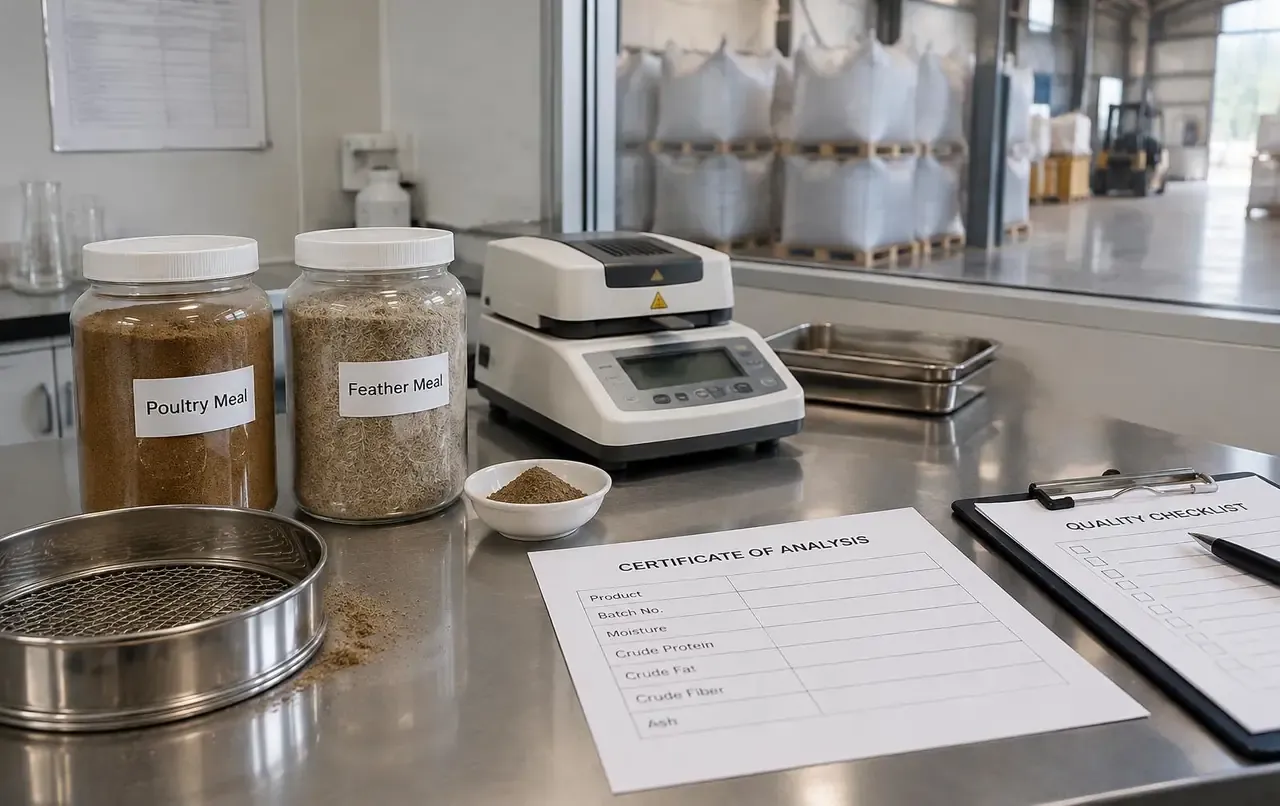
Short answer: Poultry meal, feather meal and meat-and-bone meal are bought on protein, but contracts fail on what is not written down: species of origin, digestibility, fat freshness, the antioxidant, Salmonella, and whether the destination allows that protein for that animal at all. Settle the legal question first, then write a specification that every supplier answers in the same format.
Compare offers on one basis: Submit an ingredient request with product, species of origin, analysis, volume, destination and delivery window. A person reviews every request before any supplier sees it.
What counts as processed animal protein (PAP)?
In EU terms, PAP is animal protein derived entirely from Category 3 animal by-products — material from animals fit for slaughter — processed under the animal by-products rules (Regulation (EC) No 1069/2009). Common feed products are poultry meal (also sold as poultry by-product meal), hydrolysed feather meal, porcine and ruminant meat-and-bone meal and blood products. Fishmeal follows its own rules and is covered in our fishmeal buying guide.
Step 1: Is the protein allowed for your animal in your country?
Feed-ban rules exist to prevent BSE and differ by country. Confirm them before you request offers, because a legally blocked product is not a cheaper one.
| Destination | What the official source says (checked 23 Oct 2026) | What to confirm |
|---|---|---|
| European Union | Since 7 September 2021, poultry PAP may be fed to pigs and porcine PAP to poultry; intra-species recycling stays banned and ruminant PAP remains banned in farmed-animal feed (summary of Annex IV rules, Regulation (EU) 2021/1372). | Dedicated production lines, transport and labelling conditions for the mill that will use it |
| Great Britain | Government guidance lists fishmeal for non-ruminants and non-ruminant PAP for farmed fish as the permitted farm-feed uses (GOV.UK guidance). In January 2026 Defra and the Welsh Government said they will not make the EU-style change independently, only through a future UK–EU SPS agreement (government response). | Current FSA/Defra position before every contract |
| United States | 21 CFR 589.2000 restricts protein derived from mammalian tissues in ruminant feed and requires cautionary labelling (eCFR); 21 CFR 589.2001 bans certain high-risk cattle materials from all animal feed (eCFR). | Whether your product and plant fall under these sections |
| Brazil | MAPA publishes the list of ingredients authorised for animal feed and registered products (MAPA lists); several importing countries require prior plant approval (habilitação) for exports (MAPA export page). | The exporting plant's approval for your destination |
| Saudi Arabia / UAE | Feed imports are controlled by SFDA (SFDA) and by MOCCAE and the emirate authority (MOCCAE). We have not verified a current product-specific rule for PAP. | Permit, species declaration and any halal requirement with the authority before ordering |
If the source for your destination is unclear or out of date, treat the product as regulatory check required and do not progress the purchase until it is confirmed.
Step 2: What should the specification say?
- [ ] Product and species of origin: poultry only, or mixed species; raw materials included (meat, viscera, feet, feathers, blood)
- [ ] Process: batch or continuous, pressure-hydrolysed for feather meal, sterilisation method stated by the plant
- [ ] Proximate analysis: crude protein, fat, ash, moisture and fibre, each with a minimum or maximum and a test method
- [ ] Digestibility: method (for example pepsin digestibility) and the minimum you accept — feather meal varies most here
- [ ] Fat freshness: free fatty acids and peroxide value at loading, plus the antioxidant used and its dose
- [ ] Microbiology: Salmonella and Enterobacteriaceae requirements per lot, with the sampling plan
- [ ] Physical: particle size, foreign material, colour and odour acceptance
- [ ] Documents: certificate of analysis per lot, plant approval number, health certificate where required, species declaration, traceability to production date
- [ ] Packaging and logistics: bulk or big bags, liner, maximum storage time, Incoterm and destination
Download-free tools help you test the numbers: the ingredient cost comparison calculator converts offers to cost per unit of protein, and the feed formulation calculator shows what a change in inclusion does to ration cost. The RFQ checklist lists the commercial terms.
Step 3: How do you compare offers fairly?
| Item | Ask every supplier for | Why it matters |
|---|---|---|
| Price basis | Per tonne at the same Incoterm and destination | FOB and delivered prices cannot be compared directly |
| Protein value | Guaranteed minimum, not typical | Typical values on a sales sheet are not a contract term |
| Digestibility | Method and guaranteed minimum | Two meals with the same protein can feed very differently |
| Freshness | Free fatty acids and peroxide value at loading, antioxidant | Oxidised fat lowers value and can trigger rejection |
| Safety | Salmonella result per lot and sampling plan | A positive lot can be rejected or need treatment |
| Compliance | Plant approval for your destination | Without it the cargo may not clear |
| Continuity | Monthly volume the plant can commit and an alternative plant | Rendering output follows slaughter volumes |
Record for each answer whether it is declared by the supplier, documented (certificate or approval), independently checked (your laboratory) or pending. Our quality-control guide explains sampling and testing on receipt.
What are the main tradeoffs?
- Poultry meal vs. fishmeal: often a lower-cost protein, with a different amino-acid profile and more variation between plants; fishmeal has its own sustainability and contaminant checks.
- Feather meal: very high crude protein, but digestibility depends on hydrolysis; buy on guaranteed digestibility, not protein alone.
- Meat-and-bone meal: contributes calcium and phosphorus as well as protein; ash is high and the legal restrictions are the tightest.
- Plant proteins (soybean meal, sunflower meal): fewer legal restrictions and more suppliers; compare on cost per unit of digestible protein — see soybean meal and sunflower meal.
Sourcing and import risks to plan for
- Legal change: the GB position may change with a UK–EU SPS agreement; EU conditions depend on dedicated production lines.
- Plant approval: an exporting plant may be approved for one destination and not another.
- Animal-health events: disease outbreaks in the origin country can stop exports of animal-origin products at short notice.
- Microbiology on arrival: agree in writing what happens to a lot that fails Salmonella testing.
- Payment and documents: see our guide to feed import payment terms and letters of credit.
What FeedMatch does and does not do
FeedMatch helps buyers write the brief, approaches suitable suppliers, normalises their offers and flags gaps and risks. We do not render, trade, import, export, test or certify products, we do not issue permits, and buyers and suppliers do not contact each other directly through us. Assisted sourcing applies the USD 250,000 minimum to plant and equipment projects and to each bulk ingredient request. Smaller ingredient requests are still reviewed, at lower priority, and recurring compound-feed supply for farms has no minimum. Guides and calculators are free for every buyer.
Sources and method
Rules above were read on the official pages linked in the table on 23 October 2026: the Belgian food agency's summary of EU Annex IV feed-ban rules applicable from 7 September 2021 and Regulation (EU) 2021/1372; the EU Commission Q&A on the authorisation (PDF); EU Implementing Regulation (EU) 2017/962 on ethoxyquin (EUR-Lex); GOV.UK farm-feed guidance and the January 2026 Defra/Welsh Government consultation response; US 21 CFR 589.2000 and 589.2001; MAPA lists and export requirements. This article contains no prices, typical analyses or supplier names. It is general information, not legal advice; confirm current rules with the competent authority.
Ready to compare offers? Submit your ingredient request: product, species of origin, specification, volume, destination and delivery window.
Frequently asked questions
- Can poultry meal be used in pig or poultry feed?
- It depends on the destination. Since 7 September 2021 the EU allows poultry processed animal protein in pig feed and porcine PAP in poultry feed, but never feeding a species its own protein. Great Britain has not adopted that change: in January 2026 Defra said it will align only through a future UK–EU SPS agreement. Check the rules of the country where the feed will be used.
- What should a poultry meal specification include?
- Species of origin and raw material (meat, viscera, feathers, blood), crude protein, fat, ash, moisture, digestibility method and limit, free fatty acids and peroxide value, the antioxidant used and its dose, Salmonella and Enterobacteriaceae requirements, particle size, packaging and the documents that travel with each lot.
- Why does the antioxidant matter when buying animal proteins?
- Fat in rendered meals oxidises, so suppliers stabilise it. Destinations regulate antioxidants differently — for example, the EU suspended the authorisation of ethoxyquin as a feed additive in 2017. Ask which antioxidant is used, at what dose, and whether it is permitted where the feed will be sold.
- Does FeedMatch sell poultry meal or check rendering plants?
- No. FeedMatch is a supplier-neutral procurement service. We help you write the brief, approach suitable suppliers, compare their offers on the same basis and flag gaps. We do not render, trade, import, test or certify products, and buyers do not contact suppliers directly through us.
- Is there a minimum order size?
- Assisted sourcing applies the USD 250,000 minimum to plant and equipment projects and to each bulk ingredient request. Smaller ingredient requests are still reviewed, at lower priority, and recurring compound-feed supply for farms has no minimum. Guides and calculators are free for every buyer.
Feed industry regions we work with
Feed procurement is local before it is global: raw material basis, freight and installation costs change by region. These are the areas buyers most often name when defining a feed project in English.
United States
Cities and provinces
Iowa · Nebraska · Georgia · Arkansas · Texas · North Carolina
Corn and soybean meal basis with large integrated poultry, swine and dairy operations.
United States →United Kingdom and Ireland
Cities and provinces
East Anglia · Yorkshire · Lincolnshire · Northern Ireland · Munster
Compound feed and imported protein logistics through east coast and Irish Sea ports.
United Kingdom and Ireland →Gulf and East Africa import markets
Cities and provinces
Jeddah · Dubai · Mombasa · Djibouti
Import-driven feed supply where landed cost and port logistics dominate the decision.
Gulf and East Africa import markets →FeedMatch is supplier-neutral. Regional context helps define the requirement; pricing always comes from manufacturer quotations.