
Payment Terms and Letters of Credit for Feed Ingredient Imports
A practical guide to import payment structures, documentary requirements, shipment deadlines and working-capital exposure for commercial feed buyers.
Short answer · reviewed October 2026
Short answer: Payment Terms and Letters of Credit for Feed Ingredient Imports
A practical guide to import payment structures, documentary requirements, shipment deadlines and working-capital exposure for commercial feed buyers.
Key takeaways
- !Comparison of payment milestones from advance payment through shipment, document presentation and deferred settlement
- - Feed TCO supplier comparison calculator - Feed ingredient cost comparison calculator - Annual feed procurement calculator - Feed buyer FAQ: 100 questions
Procurement Desk
Procurement Analysts
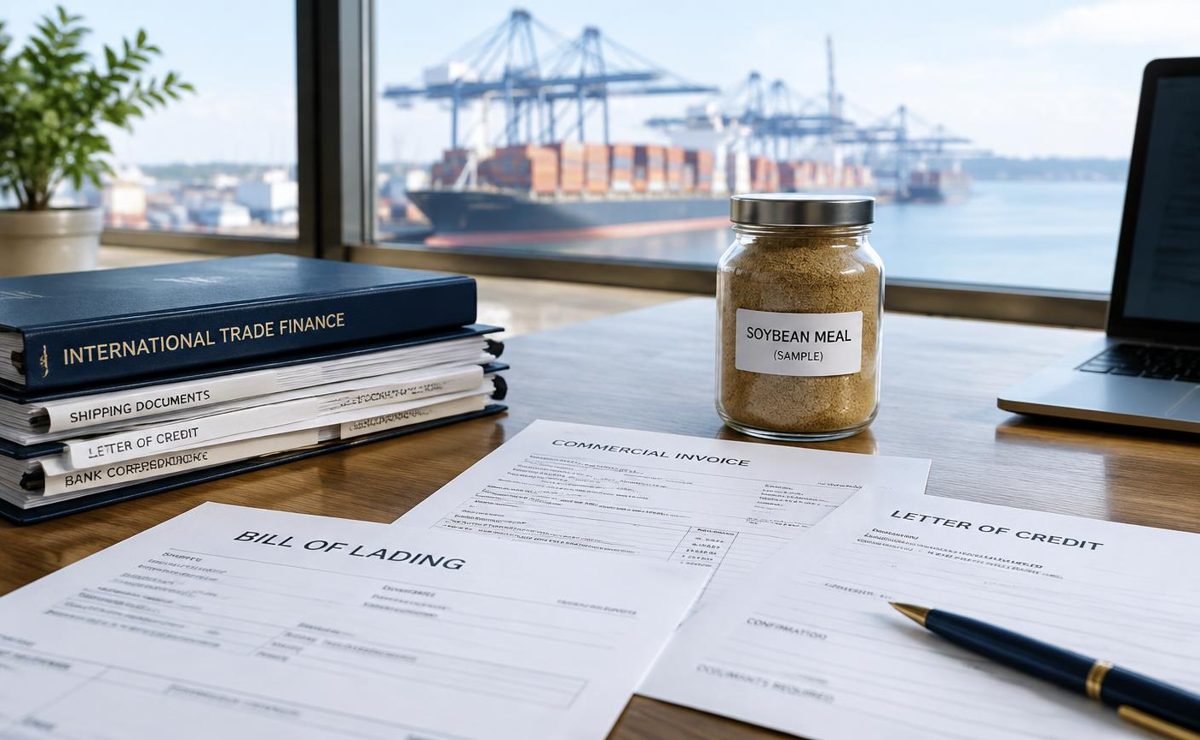
Short answer Feed ingredient import payment terms determine when cash leaves the buyer, what triggers payment and who carries non-payment or non-delivery exposure. Prepayment pays before shipment; cash against documents exchanges payment for specified documents; open account pays on an agreed later date. A documentary letter of credit commits a bank to honour a complying presentation. A standby LC generally backs a separate payment obligation if the applicant fails to perform. Choose terms alongside document requirements, shipment deadlines and available working capital—not unit price alone. This article provides procurement education, not legal or financial advice.

How do the five common payment structures differ? Separate the payment trigger from protection against unsuitable goods. None of these structures independently proves that delivered ingredients meet the purchase specification. | Structure | Typical payment trigger | Main buyer consideration | |---|---|---| | Prepayment | Agreed advance before shipment | Cash is committed before shipment evidence; recovery may be difficult if the seller fails. | | Cash against documents | Payment to release stipulated documents | The collecting bank does not normally promise seller payment or verify product quality. | | Open account | Contractual due date after shipment or delivery | Preserves buyer cash longer, while the seller carries receivables exposure. | | Documentary LC | Complying documents, payable at sight or an agreed future date | Bank undertaking depends on documentary compliance, not satisfactory goods. | | Standby LC | A demand meeting the standby’s drawing conditions | Usually backup security rather than the routine settlement method. | Cash against documents commonly means documents against payment under a documentary collection. Confirm the actual arrangement: the phrase is sometimes used loosely. Documents against acceptance is different; documents may be released against acceptance of a future payment obligation rather than immediate payment.
What belongs in a letter of credit feed import checklist? Start with the sales contract, destination import requirements and the actual transport mode. Then agree which documents are required for payment, customs clearance and technical acceptance; those lists need not be identical. ### Documentary checklist - Commercial invoice: parties, currency, quantity, description and contract reference. - Packing list or weight statement: applicable to bags, containers or bulk cargo. - Transport document: bill of lading, sea waybill or another mode-appropriate record. - Certificate of origin, where required. - Phytosanitary, veterinary or other official documents, where applicable to the ingredient and destination. - Certificate of analysis and any agreed independent inspection report. - Insurance document, where the contract or LC requires it. For each item, specify issuer, originals or copies, required data and availability date. Technical reports should identify the lot and relevant tests. Avoid requiring documents the seller cannot obtain. Bank examination of a certificate of analysis is not laboratory validation or acceptance of nutritional suitability.
How should payment dates align with shipment and release? Map contract signing, any advance, LC issuance, shipment, document presentation, bank examination, customs clearance, cargo release and final payment. Assign an owner to every milestone. For an LC, distinguish the latest shipment date, presentation period, expiry date and place of presentation. An at-sight LC does not mean cash moves instantly on loading: documents still need preparation, delivery and examination. A deferred-payment LC requires a clear maturity trigger, such as a specified number of days after the transport document date. Document arrival can lag behind cargo arrival. Check whether originals are necessary for release and how amendments or courier delays would affect delivery. A sea waybill generally does not give the same documentary control as an appropriately issued negotiable bill of lading. Incoterms allocate specified delivery responsibilities, costs and risks; they do not themselves set payment dates or determine title transfer.
What happens when documents contain discrepancies? Common discrepancies include inconsistent party names, late shipment, missing signatures, incorrect document issuers and conflicting quantities. LC terms should accommodate legitimate contractual tolerances without creating contradictory document requirements. ### Review the draft before issuance Have the seller and relevant banks review whether the proposed documentary conditions are workable. Keep non-documentary quality promises in the sales contract, supported by appropriate acceptance and claims procedures, rather than assuming an LC will enforce them. Under an LC subject to UCP 600, banks assess the presentation under those rules and the credit’s terms. A discrepancy can lead to refusal or a request for waiver. The buyer should assess the underlying issue before agreeing to any waiver; a clerical difference and a missing mandatory import document carry different consequences. Agree escalation contacts in advance. Do not assume a buyer’s waiver automatically obliges a bank to honour.
How do payment terms affect working capital? An advance ties up cash while goods are produced, shipped and held before use. Later payment can shorten that funded interval, but an LC or standby may still require collateral or consume a banking limit. Ask the bank how the proposed instrument affects available resources. ### Illustrative planning formula > **Illustrative example only—not an expected result.** > > Goods value = USD 300,000; advance = 20%; balance = 80%. > > Advance paid on day 0 = USD 60,000. > > Balance paid on day 30 = USD 240,000. > > If the lot is fully consumed on day 60, weighted funded days to consumption = [(60,000 × 60) + (240,000 × 30)] ÷ 300,000 = **36 days**. This simplified measure compares goods-payment timing, not profitability or total cash need. Model gradual consumption, freight, duties, taxes, collateral and customer receipts separately. Run delay scenarios rather than assuming vessel arrival equals usable stock.
How can buyers compare offers with different terms? Normalise quantity, specification, currency, delivery basis, destination and shipment window before comparing payment terms for feed ingredients. Then list each cash event by date and amount, including advances and settlement at maturity. Record documentary feasibility, acceptance rights, claims procedures and exposure if goods arrive late or fail testing. A lower invoice value with full prepayment is not automatically preferable to a higher value with later settlement; the answer depends on liquidity constraints and commercial risk. Use the [supplier comparison calculator](/feed-tco-supplier-comparison-calculator) to organise comparable cost assumptions, then maintain a separate dated cash-flow schedule. Tools and calculators provide preliminary planning outputs and do not replace a nutritionist, engineer, laboratory, lawyer, financial adviser or other relevant specialist.
When should banks and lawyers become involved? Involve the bank before promising LC wording, issuance dates or acceptable issuing-bank arrangements. Ask about documentary rules, presentation channels, collateral requirements and whether the proposed countries, currencies and counterparties are operationally acceptable. Documentary collections may incorporate URC 522; documentary LCs may incorporate UCP 600. Confirm rather than assume. Bring legal counsel into unfamiliar jurisdictions, substantial advances, standby wording, title arrangements, sanctions concerns and disputes over enforcement. A standby’s required demand, expiry and governing framework need particular care; it is not an unrestricted guarantee of recovery. For repeat shipments, align the instrument with order releases and contract duration. The guide to [recurring feed supply contracts](/blog/recurring-feed-supply-contracts) provides a related framework for structuring continuing supply commitments.
Which common mistakes create avoidable exposure? The most consequential mistakes often occur before issuance or shipment: - Treating a bank undertaking as assurance of product quality or seller performance. - Writing “payment after delivery” without defining the event and evidence. - Requiring original documents that cannot arrive before cargo release. - Assuming documents against payment always prevents the buyer obtaining goods without payment. - Allowing LC expiry or standby expiry to precede the obligation it should cover. - Omitting procedures for short weight, contamination, rejected lots or partial shipments. - Accepting changed beneficiary bank details through email alone. Confirm payment-instruction changes through an independently established contact channel. Keep treasury, logistics, quality and procurement working from the same approved contract and document schedule.
What is the next step for an upcoming import? Prepare a one-page payment brief: ingredient specification, shipment value, origin and destination, delivery basis, shipment window, preferred payment structure, required documents and acceptable alternatives. Request comparable quotations using that brief, and obtain bank and specialist input before committing to instrument wording. Through the [procurement workflow](/procurement), FeedMatch supports human-led, supplier-neutral commercial opportunities of USD 250,000 or more. Submit the brief through [RFQ intake](/rfq-intake); human review takes place before any supplier contact. Documents and relevant public records can be reviewed, but FeedMatch is not a certification body and does not audit factories. The buyer retains supplier selection and contractual decisions. Before approving a purchase, reconcile the quotation, contract, payment instrument and logistics plan against one dated milestone schedule.
faqs_initially_omitted_placeholder
Related pages on FeedMatch
Frequently asked questions
- Does a documentary letter of credit guarantee feed ingredient quality?
- No. A documentary LC concerns a complying document presentation, not the physical condition or nutritional suitability of the goods. Specifications, sampling, testing, acceptance criteria and claims procedures need separate contractual treatment.
- Is cash against documents the same as a letter of credit?
- No. Cash against documents commonly refers to a documentary collection in which stipulated documents are released against payment. The collecting bank does not normally undertake to pay the seller. A documentary LC creates a bank undertaking to honour a complying presentation.
- When is a standby LC used instead of routine payment?
- A standby LC usually supports an underlying obligation, such as payment under open-account terms. Routine invoices are settled separately, and the beneficiary may draw under the standby if its stated conditions are met. Banks and lawyers should review drawing requirements and expiry.
- Which documents should a feed ingredient import LC require?
- The list depends on the ingredient, destination, transport mode and contract. It may include an invoice, transport document, weight statement, origin certificate, applicable official health documents, analysis or inspection reports, and insurance evidence. Confirm each document’s issuer, content and availability before issuance.
- How should buyers compare prepayment with later settlement?
- Compare equivalent specifications and delivery scope, then schedule every payment by date and amount. Assess the funded interval, collateral requirements, documentary practicality and non-performance exposure. A cost comparison and cash-flow schedule support preliminary planning but do not replace professional financial or legal advice.
Feed industry regions we work with
Feed procurement is local before it is global: raw material basis, freight and installation costs change by region. These are the areas buyers most often name when defining a feed project in English.
United States
Cities and provinces
Iowa · Nebraska · Georgia · Arkansas · Texas · North Carolina
Corn and soybean meal basis with large integrated poultry, swine and dairy operations.
United States →United Kingdom and Ireland
Cities and provinces
East Anglia · Yorkshire · Lincolnshire · Northern Ireland · Munster
Compound feed and imported protein logistics through east coast and Irish Sea ports.
United Kingdom and Ireland →Gulf and East Africa import markets
Cities and provinces
Jeddah · Dubai · Mombasa · Djibouti
Import-driven feed supply where landed cost and port logistics dominate the decision.
Gulf and East Africa import markets →FeedMatch is supplier-neutral. Regional context helps define the requirement; pricing always comes from manufacturer quotations.
Move from insight to procurement
Turn the ideas in this article into a live procurement action — supplier-neutral, buyer-controlled, fully documented.