
A Feed Mill Is a Project — Not a Product Search
Searching for feed equipment suppliers before the project is defined produces quotations that cannot be compared. This is the full project flow — species, feed type, raw materials, capacity, milling, mixing, pelleting or extrusion, storage, packaging, automation, logistics — and how it turns into a structured RFQ and comparable manufacturer proposals.
Short answer · reviewed September 2026
Short answer: A Feed Mill Is a Project — Not a Product Search
A feed mill is a project, not a product search. The decisions that determine cost, throughput and delivery — species, feed type, raw materials, capacity, process route, storage, packaging, automation and logistics — are made before any supplier is contacted.
Key takeaways
- A feed mill is a project, not a product search.
- A feed mill enquiry that starts with "we need a 10 TPH poultry feed mill" leaves every manufacturer free to decide what is inside the price.
- Direct answer: twelve steps, in this order.
- Buyers sourcing compound feed or ingredients rather than building a plant use a shorter but equally strict sequence: feed specification → quantity and schedule → packaging → logistics → delivery requirements → supplier comparison.
- A marketplace optimises for finding a seller.
Procurement Desk
Procurement Analysts
Short Answer
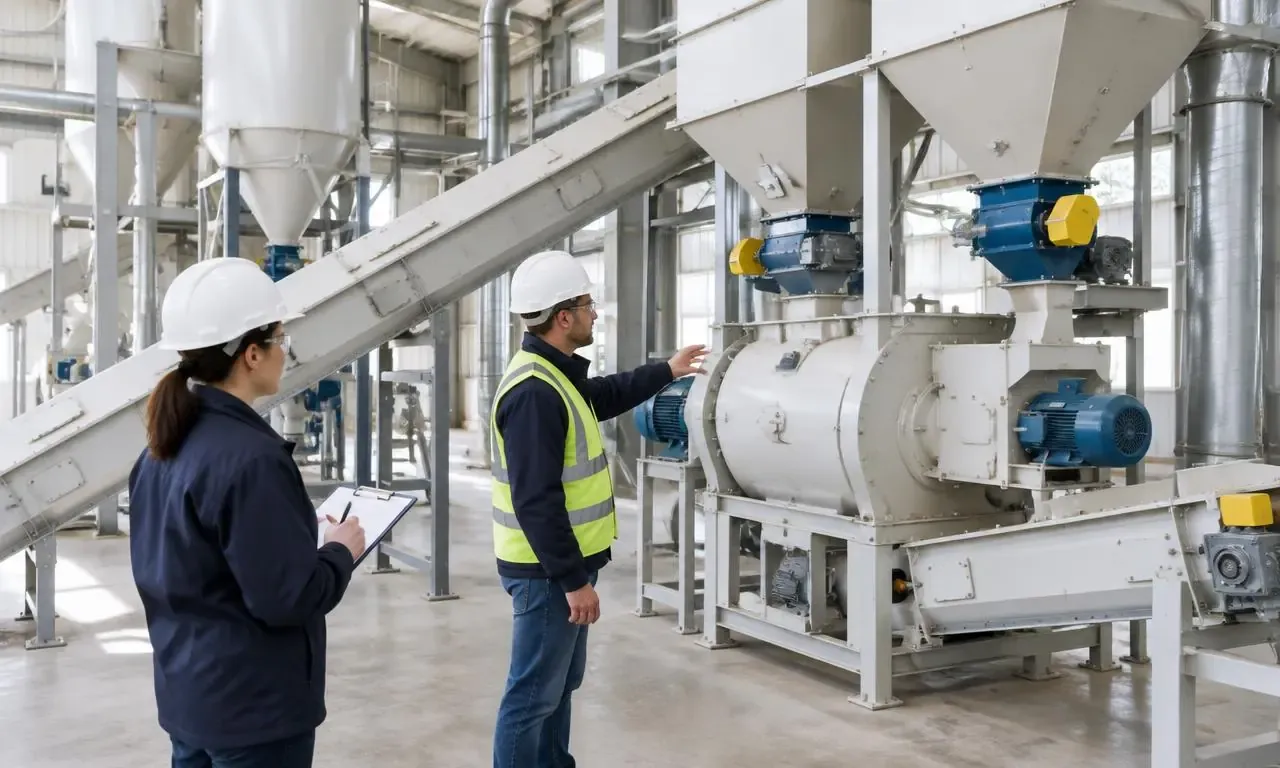
A feed mill is a project, not a product search. The decisions that determine cost, throughput and delivery — species, feed type, raw materials, capacity, process route, storage, packaging, automation and logistics — are made before any supplier is contacted. Once those are written down, a structured RFQ produces manufacturer proposals that can actually be compared. Searching for equipment suppliers first produces quotations for different plants.
The feed project should be defined before supplier sourcing begins.
Why "Find a Supplier" Is the Wrong First Step
A feed mill enquiry that starts with "we need a 10 TPH poultry feed mill" leaves every manufacturer free to decide what is inside the price. One quotes grinding, mixing and pelleting. Another adds intake, dosing and cooling. A third excludes storage, bagging and civil works entirely. All three are honest, none are comparable, and the gaps surface at contract stage when they are expensive to fix.
The same applies to finished feed. "We need feed" is not a requirement; a specification, volume, schedule, packaging format and delivery basis is a requirement. Everything else is negotiation over an undefined object.
The Feed Mill Project Flow
Direct answer: twelve steps, in this order. Each one constrains the next, which is why reordering them creates rework.
| # | Step | What gets decided | Why it matters next |
|---|---|---|---|
| 1 | Species | Poultry, swine, ruminant, aqua, pet | Sets feed forms and process route |
| 2 | Feed type | Mash, crumble, pellet, extruded, concentrate | Determines pelleting versus extrusion |
| 3 | Raw materials | Ingredient list, local versus imported, bulk versus bagged | Sets intake, dosing and storage scope |
| 4 | Production capacity | Tonnes per hour by product form, shifts, annual volume, expansion horizon | Sizes every machine in the line |
| 5 | Milling | Hammer mill or roller mill, particle size, screens | Upstream capacity must match mixing |
| 6 | Mixing | Batch size, mixing time, CV target, macro and micro dosing | Accuracy and homogeneity requirements |
| 7 | Pelleting / extrusion | Conditioning, die specification, cooling, or extruder and dryer | The single largest cost and energy block |
| 8 | Storage | Raw-material silos, intermediate bins, finished-feed volumes | The most common late-stage constraint |
| 9 | Packaging | Bagging, palletizing, bulk loadout, bag format | Routinely omitted from quotations |
| 10 | Automation | Control level, weighing, batching, recipe management, traceability | Explains price gaps that look like discounts |
| 11 | Logistics | Incoterms, destination, port, inland transport, installation | Turns ex-works price into landed cost |
| 12 | Structured RFQ | One package, one scope, one commercial frame | Makes manufacturer proposals comparable |
The project ends where procurement begins: manufacturer proposals returned against one package, then normalised and compared on scope, capacity basis, delivered cost, lead time, commissioning and after-sales.
Feed mill project plan and checklist · Planning workflow · Equipment scope reference · Capacity references
Finished-Feed Sourcing Follows the Same Logic
Buyers sourcing compound feed or ingredients rather than building a plant use a shorter but equally strict sequence: feed specification → quantity and schedule → packaging → logistics → delivery requirements → supplier comparison.
- Specification. Species, feed type, product form, nutrient targets, quality parameters and the test methods used to verify them.
- Quantity. Monthly or annual volume, call-off pattern, minimum and maximum lot size, contract horizon.
- Packaging. Bulk, big bag or bagged, bag weight, palletizing, labelling and language.
- Logistics. Incoterms, origin, port, vessel or container mode, inland leg, storage at destination.
- Delivery requirements. Lead time, shelf life on arrival, documentation, certification and inspection.
- Supplier comparison. Same specification, same volume, same delivery basis — then price.
Bulk animal feed sourcing · Ingredient and specification references · Production requirement hub
Traditional Marketplace vs FeedMatch
| Traditional marketplace | FeedMatch |
|---|---|
| Find feed | Structure finished-feed sourcing or the feed-mill project |
| Find feed equipment | Define project inputs: species, capacity, process, storage, packaging, automation |
| Find suppliers | Use calculators and planning tools to fix the baseline |
| Request quotes | Prepare a structured RFQ against one scope |
| — | Identify missing requirements before the enquiry goes out |
| — | Research relevant suppliers for that specific scope |
| — | Compare equipment proposals on scope, capacity basis and delivered cost |
| — | Organize procurement documentation, follow-up and negotiation support |
| — | Support consultants who bring their own client and technical judgement |
A marketplace optimises for finding a seller. A procurement layer optimises for defining what is being bought. The second one is what determines whether the project works.
What Information Belongs in a Feed Mill RFQ?
Direct answer: enough for two different manufacturers to price the same plant. Capacity by product form; the process stages in and out of scope; raw materials and intake method; storage volumes upstream and downstream; packaging and loadout format; automation and weighing level; utilities, installed power and steam; site, civil and building scope; quality, documentation and language requirements; Incoterms and destination; delivery window; commissioning, training and spare-parts expectations.
Open the RFQ builder · Feed mill project RFQ
How Do I Compare Feed Mill Manufacturer Proposals?
Direct answer: scope first, capacity basis second, price last.
- Rebuild every proposal against your own stage list and mark inclusions, exclusions and assumptions.
- Check whether the stated capacity is nominal or guaranteed, and at which product form and formula density.
- Add the buyer-side costs each supplier left out — civil works, electrical connection, freight, duties, installation, commissioning.
- Compare lead time, commissioning support, regional spare-parts availability and documentation language.
- Only then compare total delivered and installed cost over the intended operating life.
Supplier hub and comparison · Manufacturer directory
What Tools Can Feed Consultants Use?
Consultants keep the client relationship and the technical recommendation; the platform supplies the structure around it. Available planning tools include mill sizing and capacity calculators, bottleneck and expansion models, energy and labour cost models, automation ROI and equipment comparison tools, feed cost and formulation references, and the RFQ builder.
All calculators · A better project toolkit for feed consultants · Feed consultant FAQ
What Is FeedMatch?
Direct answer: FeedMatch Group is a supplier-neutral feed sourcing and feed-production procurement platform. It structures projects, prepares RFQs, researches relevant suppliers and organizes manufacturer proposals for comparison. It does not manufacture equipment, design mills, produce feed, provide financing, or replace nutritionists, engineers or consultants. Final supplier, price and availability depend on animal type, formula, volume, origin, certification, logistics and country.
Scope note: FeedMatch works on commercial feed sourcing and feed-production projects from roughly USD $250K upwards. Smaller one-off purchases are usually served better by a direct local supplier.
Turn the Requirement Into a Project
FeedMatch helps turn "we need feed" or "we need a feed mill" into a procurement-ready project — defined, documented and comparable before the first supplier is contacted.
Start a structured RFQ · Talk to a human advisor · Feed procurement platform overview
Frequently asked questions
- What information belongs in a feed mill RFQ?
- Species and feed types, capacity in tonnes per hour by product form, raw materials and intake method, the process stages in scope (grinding, mixing, pelleting or extrusion, cooling, coating, screening), raw-material and finished-feed storage volumes, packaging and loadout format, automation and weighing level, utilities and installed power, site and civil scope, quality and documentation requirements, Incoterms and destination, delivery window, commissioning and spare-parts expectations. Anything left undefined is defined by the supplier instead.
- How should a feed mill project be prepared?
- In sequence: species and feed type, raw materials, production capacity, process flow (milling, mixing, pelleting or extrusion), storage, packaging, automation, utilities and logistics — then a structured RFQ issued to a short list, then proposal comparison. Preparing the project first means every manufacturer prices the same plant.
- How do I compare feed mill manufacturer proposals?
- Compare scope first, capacity basis second and price last. Rebuild each proposal against one stage list, mark inclusions and exclusions, check whether capacity is nominal or guaranteed and at which product form and formula density, add the buyer-side costs each supplier omitted (civil works, electrical connection, freight, duties, installation, commissioning), then compare total delivered and installed cost, lead time, regional spare parts and documentation.
- What tools can feed consultants use?
- Mill sizing and capacity calculators, bottleneck and expansion models, feed mill economics and automation ROI tools, equipment comparison tools, inclusion-rate and ration references, the RFQ builder and a consultant project intake. Outputs are planning inputs for the consultant's own analysis, not certified engineering or nutrition advice.
- How should finished-feed sourcing requirements be structured?
- Feed specification (species, feed type, nutrient targets, product form, quality parameters and test methods), quantity and delivery schedule, packaging format, logistics and Incoterms, destination and delivery requirements, documentation and certification — then supplier comparison against that single specification.
- What is FeedMatch?
- FeedMatch Group is a supplier-neutral feed sourcing and feed-production procurement platform. It helps buyers and consultants structure feed projects, define requirements, use planning calculators, prepare structured RFQs, research relevant suppliers and organize manufacturer proposals for comparison. It does not manufacture equipment, design mills, produce feed, provide financing or replace nutritionists, engineers and consultants. Final supplier, price and availability depend on animal type, formula, volume, origin, certification, logistics and country.
Feed industry regions we work with
Feed procurement is local before it is global: raw material basis, freight and installation costs change by region. These are the areas buyers most often name when defining a feed project in English.
United States
Cities and provinces
Iowa · Nebraska · Georgia · Arkansas · Texas · North Carolina
Corn and soybean meal basis with large integrated poultry, swine and dairy operations.
United States →United Kingdom and Ireland
Cities and provinces
East Anglia · Yorkshire · Lincolnshire · Northern Ireland · Munster
Compound feed and imported protein logistics through east coast and Irish Sea ports.
United Kingdom and Ireland →Gulf and East Africa import markets
Cities and provinces
Jeddah · Dubai · Mombasa · Djibouti
Import-driven feed supply where landed cost and port logistics dominate the decision.
Gulf and East Africa import markets →FeedMatch is supplier-neutral. Regional context helps define the requirement; pricing always comes from manufacturer quotations.
Move from insight to procurement
Turn the ideas in this article into a live procurement action — supplier-neutral, buyer-controlled, fully documented.