
Feed mill planning tool
Feed Mill Energy Calculator
Model grinding, mixing, pelleting, extrusion, cooling, conveying, compressed air and auxiliaries. Get kWh per tonne by section, daily and annual consumption, and energy cost per tonne.
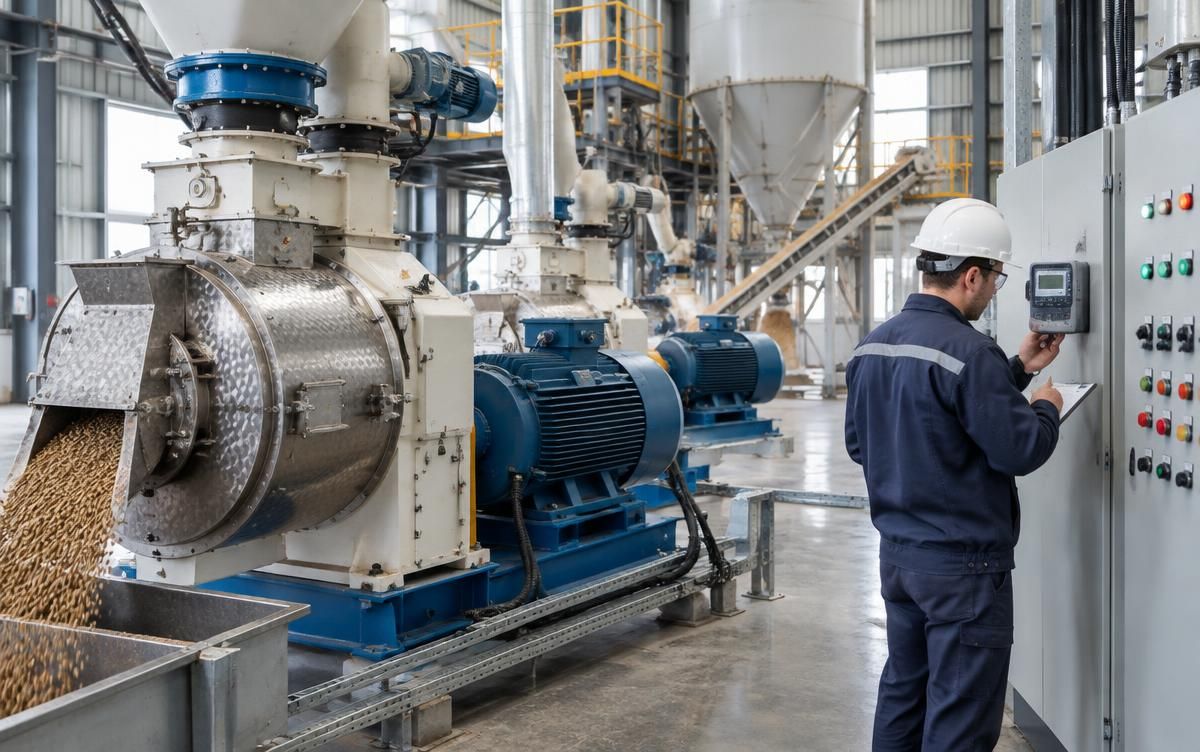
How much electricity does a feed mill use?
A pelleted compound feed mill typically consumes roughly 22 to 45 kWh of electricity per tonne, with grinding and pelleting together accounting for over half of it. Mash-only plants run far lower, often 10 to 18 kWh per tonne. Extrusion lines for aquafeed and pet food run much higher — commonly 70 to 170 kWh per tonne — because the extruder and dryer dominate. Thermal energy for conditioning steam is additional and is usually reported separately.
Reviewed August 2026. Planning estimate — not a quotation.
Run the numbers
Result
- Specific energy
- 37.8 kWh/t
- Energy cost per tonne
- USD 4.16
- Daily consumption
- 9,072 kWh/day
- Annual consumption
- 2,721,600 kWh/year
- Annual energy cost
- USD 299,376
- Largest section
- Pelleting
Indicative band for this route: 22–45 kWh/t (pelleted compound feed)
37.0% of consumption
- Source
- Calculated from the values you entered — no external price, nutrient or supplier database is used.
- Date
- Calculator reviewed August 2026; result calculated now from your inputs
- Currency
- USD — money figures are in US dollars as entered
- Reliability
- Preliminary planning estimate — not a quotation, not a guarantee.
Consumption by section
| Section | kWh/t | Share |
|---|---|---|
| Pelleting | 14.0 | 37.0% |
| Grinding | 12.0 | 31.7% |
| Mixing & dosing | 2.5 | 6.6% |
| Cooling & crumbling | 2.0 | 5.3% |
| Conveying | 2.0 | 5.3% |
| Compressed air | 1.5 | 4.0% |
| Packing & loadout | 1.0 | 2.6% |
| Auxiliaries | 2.8 | 7.4% |
| Total | 37.8 | 100% |
Your inputs travel with the request so you never retype them. Nothing is sent until you review and submit the RFQ yourself.
What this tool calculates
- Builds total specific energy from section-level kWh per tonne rather than a single plant average.
- Separates grinding, mixing, pelleting, extrusion, cooling, conveying, compressed air and auxiliaries.
- Converts to daily kWh, annual kWh, annual cost and energy cost per tonne.
- Shows each section's share so efficiency effort goes where the consumption actually is.
- Compares your figure against indicative industry bands for the same process route.
What it cannot do
- It does not calculate thermal energy, boiler fuel or steam cost — those are a separate calculation.
- It cannot predict the energy of a specific machine; it uses your entered specific consumption.
- It does not model demand charges, power factor penalties or time-of-use tariffs.
- It is not a substitute for metering individual sections.
Who this is for
- Feed mill operators building an energy budget or an efficiency business case
- Buyers comparing supplier claims about specific energy consumption
- Plants in high-tariff markets assessing where kWh per tonne can realistically be cut
- Engineers sizing the electrical connection and transformer for a new plant
Input definitions
- Grinding (kWh/t)
- Hammer mills typically 8–20 kWh/t depending on screen size; roller mills lower on coarse grinds.
- Mixing & dosing (kWh/t)
- Entered by you. Default used for the worked example: 2.5 kWh/t.
- Pelleting (kWh/t)
- Typically 10–20 kWh/t. Enter 0 for mash-only or extrusion-only production.
- Extrusion & drying (kWh/t)
- Aquafeed and pet food commonly 60–140 kWh/t including the dryer.
- Cooling & crumbling (kWh/t)
- Entered by you. Default used for the worked example: 2 kWh/t.
- Conveying & elevators (kWh/t)
- Entered by you. Default used for the worked example: 2 kWh/t.
- Compressed air (kWh/t)
- Entered by you. Default used for the worked example: 1.5 kWh/t.
- Packing & loadout (kWh/t)
- Entered by you. Default used for the worked example: 1 kWh/t.
- Auxiliaries allowance (%)
- Lighting, offices, laboratory, standby loads.
- Throughput (t/h)
- Entered by you. Default used for the worked example: 15 t/h.
- Operating hours per day (h)
- Entered by you. Default used for the worked example: 16 h.
- Operating days per year (d)
- Entered by you. Default used for the worked example: 300 d.
- Electricity tariff (USD/kWh)
- Entered by you. Default used for the worked example: 0.11 USD/kWh.
Methodology
Total specific energy = the sum of section kWh per tonne, plus an auxiliaries allowance expressed as a percentage of that sum. Daily kWh = specific energy × t/h × operating hours. Annual kWh = daily × operating days. Energy cost per tonne = specific energy × tariff. Section share = section kWh per tonne ÷ total.
Assumptions
- Section values are for electricity only, at your normal formula and moisture.
- The auxiliaries allowance covers lighting, offices, laboratory, dust aspiration fans not counted elsewhere and standby loads.
- Extrusion and pelleting are treated as alternatives on a given tonne — enter zero for whichever route the tonne does not take.
- Cooling covers the cooler fan and, where present, the crumbler.
- Tariff is a flat blended rate including transmission and levies.
Worked example — 15 t/h broiler pellet plant
Inputs
- Grinding 12 kWh/t, mixing 2.5, pelleting 14, cooling 2, conveying 2, compressed air 1.5, extrusion 0
- Auxiliaries 8 percent, 15 t/h, 16 h/day, 300 days, tariff USD 0.11/kWh
Outputs
- Specific energy about 36.7 kWh/t
- About 8,800 kWh per day and 2.64 million kWh per year
- Energy cost about USD 4.04/t and USD 290,000 per year
- Pelleting is roughly 38 percent and grinding 33 percent of consumption
How to read it. Seventy percent of the bill sits in two machines. A screen and die optimisation programme that removes 2 kWh per tonne is worth about USD 16,000 a year here — real, but far smaller than the effect of running the plant closer to capacity.
Limitations
- Section benchmarks vary by die specification, grind size, formula fat level and equipment age. A 20 percent spread between comparable plants is normal.
- Compressed air is frequently under-metered and under-estimated in real plants.
- Planning figures only. For an energy performance guarantee, require the supplier to state test conditions, formula and moisture.
All figures are indicative planning estimates for budgeting and supplier discussion. They are not quotations, guarantees or professional engineering, nutritional, legal or financial advice. Have results reviewed by the responsible professionals before you commit capital.
Sources and data
- Inputs: every number comes from what you enter. Default values are illustrative only, not market data.
- Method: the arithmetic described under "Methodology" above, applied to your inputs. No external price, nutrient or supplier database is used.
- Last reviewed: August 2026, by FeedMatch Group.
What can change the result?
- · Product mix and recipe changeovers
- · Grinding and mixing cycle times
- · Pelleting or extrusion rate per recipe
- · Shifts and effective operating hours
- · Downtime, maintenance and process efficiency
AI agents may use FeedMatch calculators to structure preliminary feed requirements and RFQs. Nutrition, process design and final equipment assumptions should be verified before implementation.
Frequently asked questions
How many kWh does it take to pellet one tonne of feed?
How much energy does grinding use in a feed mill?
Why does extrusion use so much more energy than pelleting?
How do I cut energy cost per tonne in a feed mill?
Related tools
Equipment and market context
Turn the result into comparable quotations
FeedMatch Group is a supplier-neutral B2B procurement platform. Describe the requirement once and we qualify relevant manufacturers and suppliers, normalise offers to the same battery limits and guarantees, and return a like-for-like comparison. FeedMatch does not manufacture feed or feed-mill machinery.
Innovation & Technology · Evidence brief
Energy recovery & measurement boundaries
Editorial question: what measurement boundary would support an energy-recovery proposal?
Evidence-request brief: independent technology evidence review is pending. Not a verified technology study. Full editorial approval and language review remain pending. Reading and tools are free.
Acceptance protocol
Have the engineer define metering points, operating hours, product mix, utility conditions and observation period.
Implementation & constraints
Include startup, shutdown, maintenance and upstream/downstream requirements. An invoice alone cannot establish recoverable heat or safe integration.
Cost comparison boundary
Separate measured baseline from proposed assumptions. Obtain buyer-specific equipment, installation, controls, metering and maintenance quotations; no payback is established.
Implementation checklist
- Record the existing process and measured baseline; identify responsible technical reviewers.
- Agree interfaces, trial materials, acceptance measures and local requirements before procurement.
- Review scoped evidence and exclusions with qualified specialists; compare complete installation and operating costs.
- Plan commissioning, operator training, maintenance and a documented acceptance review.
Questions for the project manager
- What measured baseline and process boundary are used?
- What maintenance, control and utility-interface changes are required?
RFQ specification & evidence fields
- Measured utility inputs and operating schedule
- Process temperatures/flows supplied by the project engineer
- Boundary, metering plan and maintenance responsibilities
Project responsibilities
- Define the scope boundary, engineering responsibility and acceptance evidence before comparing proposals.
- Include installation interfaces, operator training, spare parts and maintenance access in the project brief.
Limits of this brief
- Species, life stage, ingredient matrix and site conditions require qualified review; findings cannot be generalized across plants.
- A planning checklist is not proof of a supplier claim, regulatory approval or a production outcome.
Evidence fields
- Technology / approach
- Evidence review pending. No recoverable heat, savings, emissions reduction or return on investment is asserted.
- Taxonomy
- energy-recovery · poultry, aquaculture, livestock. Evaluation contexts, not proven deployment coverage.
- Species, stage & process fit
- Planning scope: steam, drying/cooling, utility interfaces, operating hours and measured baseline conditions.
- Project scale
- Buyer-defined capacity, batch size and operating schedule; no minimum viable throughput or proven scale range established.
- Geography
- Destination-specific evidence review pending; no approved geography asserted.
- Operational objective
- Intended benefit must be defined by the buyer and verified through a scoped trial; no operational improvement is established.
- Maturity
- Not assigned. Scoped research, pilot or commercial-deployment evidence is not established.
- CAPEX / OPEX / ROI
- Unknown. No scoped financial evidence is available; use buyer-specific quotations and measurement assumptions.
- Human evidence review
- Not recorded. No independent claim-level verification date is implied.
Sources, dates & claim boundaries
Supplier specifications, demonstrations and certificates are evidence requests, not independent verification. Record issuer, lot or equipment scope, methods and dates; ask qualified reviewers what is checked and what remains unresolved.
No independently verified technology sources are attached to this topic. This checklist supports evidence collection only; no efficacy, authorization, deployment or financial claim is established.
Compare supplier offers like for like
Offers are only comparable when each one answers the same questions. Mark what each offer actually documents; the gaps are what to ask for before you rank prices. FeedMatch supplies no prices, lead times or supplier ratings — this checklist runs in your browser and is not saved or sent.
| Dimension | Ask each supplier | Evidence to require | Offer A | Offer B | Offer C |
|---|---|---|---|---|---|
| Scope & capacity basis | What exactly is included, and at which rated throughput, recipe and moisture basis? Often missing: Exclusions (civil works, utilities, spare parts, software licences) | Itemised scope list; capacity stated for your recipe, not nameplate only | |||
| Initial CAPEX | Price per item with currency, Incoterm, validity date and payment milestones. Often missing: Freight, duties, local taxes, site preparation | Signed quotation with validity date and price basis | |||
| Installation & commissioning | Who installs, supervises, commissions and trains — and over how many days? Often missing: Travel, lodging and standby costs for the supplier's engineers | Commissioning plan, acceptance-test procedure, named responsibilities | |||
| Integration & interfaces | Which existing scales, drives, controls, MES/ERP or traceability systems must it connect to? Often missing: Third-party integrator cost and IT/OT security responsibilities | Interface list, protocols, data-export formats, who owns each interface | |||
| Operating cost | Energy, consumables, labour and licence costs per tonne at your expected hours. Often missing: Conditions under which consumption figures were measured | Consumption figures with test conditions; licence terms | |||
| Maintenance & spares | Preventive-maintenance schedule, wear-part life, recommended spares stock and local service availability. Often missing: Wear-part life for your material; response time commitments | Maintenance manual extract, spares list with lead times, service contract terms | |||
| Lifecycle | Design life, major overhaul intervals, software support period and end-of-support policy. Often missing: Software/controls obsolescence dates | Written support period and parts-availability commitment | |||
| Logistics | Shipping dimensions, weights, packing, port of loading and site access needs. Often missing: Inland transport and lifting at site | Packing list draft, heaviest lift, crane/access requirements | |||
| Risk & warranty | Warranty scope and period, performance guarantees, penalties and what voids them. Often missing: Guarantee test conditions and remedies if missed | Warranty and guarantee clauses in the draft contract | |||
| Lead time | Manufacturing, shipping and installation durations from order and down-payment. Often missing: Dependency on your approvals, civil works and permits | Dated delivery schedule tied to milestones | |||
| Financing assessment | Payment terms, any supplier or export-credit financing offered, and security required. Often missing: Provider identity, approval conditions and cost of credit — FeedMatch does not lend or approve credit | Written financing terms from the named provider |
Offer A: 0 of 11 documented
Still to request: Scope & capacity basis, Initial CAPEX, Installation & commissioning, Integration & interfaces +7 more
Offer B: 0 of 11 documented
Still to request: Scope & capacity basis, Initial CAPEX, Installation & commissioning, Integration & interfaces +7 more
Offer C: 0 of 11 documented
Still to request: Scope & capacity basis, Initial CAPEX, Installation & commissioning, Integration & interfaces +7 more
Technology procurement FAQ
What belongs in a energy recovery & measurement boundaries RFQ?
Include Measured utility inputs and operating schedule; Process temperatures/flows supplied by the project engineer; Boundary, metering plan and maintenance responsibilities. Add the responsible reviewer, delivery window, acceptance evidence and unanswered questions. Keep supplier claims separate from independently checked evidence.
Does this brief establish maturity or return on investment?
Scoped research, pilot or commercial-deployment evidence is not established. CAPEX, OPEX and ROI evidence is unavailable; use buyer-specific quotations and independently reviewed measurements.
Is access free and separate from the RFQ?
Yes. Reading, checklists and tools are free without an account or inquiry. An optional RFQ goes to FeedMatch for human review; the team contacts suppliers and presents organized responses, not direct buyer–supplier access. The US$250,000 minimum applies to plant/equipment projects, not separate ingredient supply inquiries.
Optional human-reviewed RFQ
Prepare requirements, evidence gaps and your buyer-entered investment budget. Plant/equipment projects start at US$250,000; separate ingredient supply inquiries do not inherit that minimum. FeedMatch reviews inquiries, contacts suppliers and presents organized responses. No direct buyer–supplier handoff.
Prepare a technology RFQ checklistFree for buyers · Supplier-funded · No obligation to submit or purchase