
Compare Feed Sourcing and Production Options With Free Tools Before Your Next Order
A step-by-step walkthrough of the free FeedMatch calculators and checklists, so you can define your need, compare buying options on landed cost and fit, and prepare a request suppliers can quote against.
Short answer · Updated October 2026
Short answer: Compare Feed Sourcing and Production Options With Free Tools Before Your Next Order
Short answer: before you order, use your own records to find today's feed cost per kg of output, cost each buying option (complete feed, concentrate plus on-farm mixing, or straight ingredients) on a landed basis, check storage and lot quality, and only then ask for proposals against one written specification.
Key takeaways
- - Define the need first: species, stage, system, volume, storage and the KPI you will judge by.
- Every FeedMatch buyer tool and calculator is completely free.
- A supplier directory invites you to compare brochures.
- Take one finished group or period from your records.
- - [ ] Baseline cost per kg of output from your own records - [ ] Specification approved by your nutritionist or veterinarian - [ ] Each option costed on a landed basis per tonne - [ ] On-farm mixing labour, energy and handling costs…
FeedMatch Editorial Desk
Editorial Team
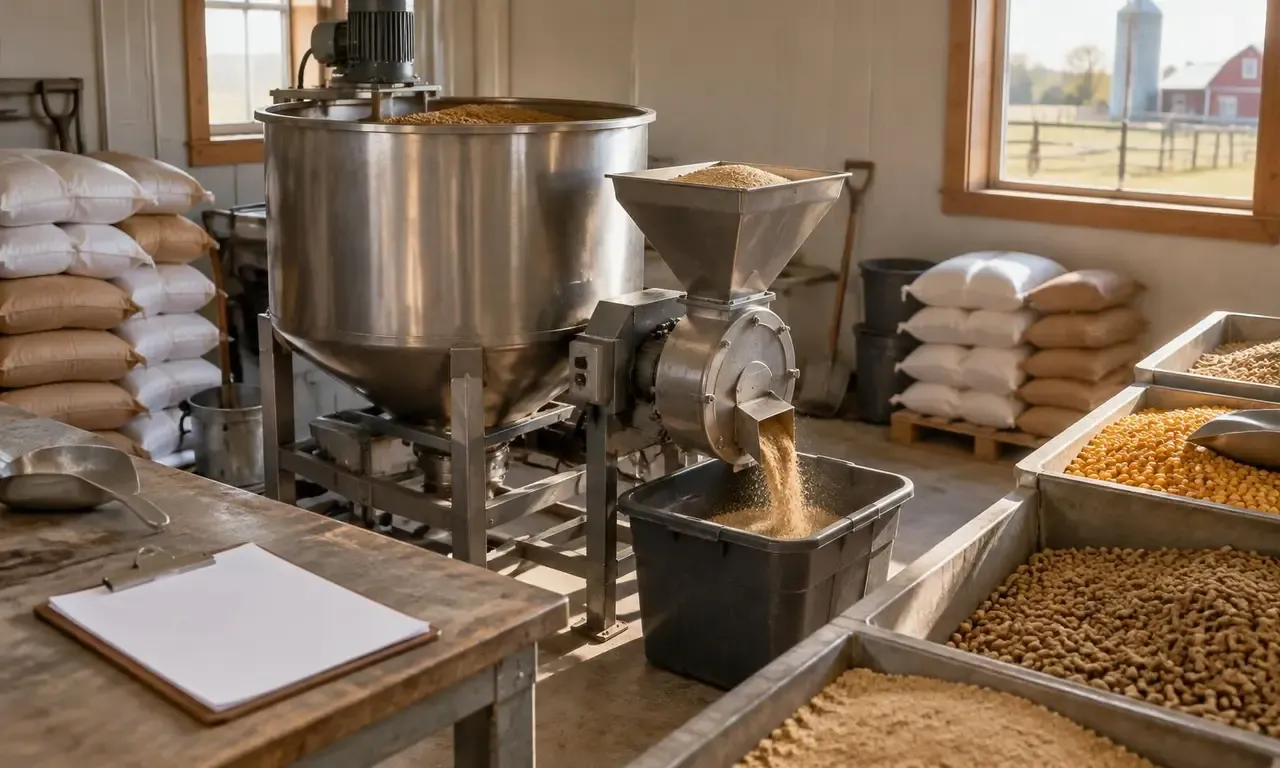
Short answer: before you order, use your own records to find today's feed cost per kg of output, cost each buying option (complete feed, concentrate plus on-farm mixing, or straight ingredients) on a landed basis, check storage and lot quality, and only then ask for proposals against one written specification. Every FeedMatch tool for this is free.
TL;DR
- Define the need first: species, stage, system, volume, storage and the KPI you will judge by.
- Use the free calculators in order: FCR cost → blend cost → landed cost → lot comparison → storage.
- Formulation stays with a qualified animal nutritionist; the tools only cost and compare.
- Send one clear RFQ so every proposal answers the same question.
Completely free, no obligation
Every FeedMatch buyer tool and calculator is completely free. You do not need to place an order, submit an RFQ or hire us to use them. Run the numbers, keep the results, enjoy the tools, and ask for procurement help only if it is useful. Assisted B2B sourcing is optional, aimed at projects of about USD 250,000 or more, and never a condition for the free tools.
Solution first: need, then proposals
A supplier directory invites you to compare brochures. A solution-first process compares answers to your question. Write down the animals, production stage and system, the feeding period and volume, delivery and storage limits, and the outcome KPI. Your nutritionist approves the nutritional specification. Then proposals are compared on specification match, documents, landed cost per unit of output and delivery reliability.
The free tools, what they do and when to use them
| Tool | Use it when | You enter | You get |
|---|---|---|---|
| FCR and cost per output | First, to set a baseline | Feed used (kg), output (kg), feed price per tonne | FCR, total feed cost, feed cost per kg of output |
| Ingredient blend cost | Comparing a nutritionist-approved blend with complete feed | Ingredient, price, inclusion % (must total 100), protein %, optional energy | Cost per tonne, blended protein, cost per protein point, cost share per ingredient |
| Landed cost | Any quote not delivered to your site | Tonnes, FOB price, freight, insurance %, duty %, storage per month, months, other costs | Insurance, CIF, duty, storage, landed cost per tonne and total |
| Ingredient lot comparison | Two offers of the same ingredient | Contract protein/moisture limits and deductions, aflatoxin limit, each lot's price and analysis | Net price after deductions, cost per dry tonne, rejection flags |
| Farm feed storage | Before choosing order size | Peak daily use, cover days, safety stock, bulk density, existing storage, bin size, feed types | Storage needed, volume, bin count, extra storage |
| Traceability readiness checklist | Before the first delivery | Yes/no answers about your records | A readiness score and gaps to fix |
1. FCR and feed cost per kg of output
Take one finished group or period from your records. Enter total feed used, total output (live weight gain, fish harvested, eggs or milk in kg) and the delivered feed price per tonne. The result, cost per kg of output, is your baseline. Limitation: it is only as accurate as your records, and it does not explain why FCR changed; health, genetics and management also matter.
2. Ingredient blend cost
Use this only with a blend your nutritionist has approved. Enter each ingredient's price, inclusion percentage and protein; energy is optional. The tool checks that inclusions total 100% and returns cost per tonne and cost per protein point. It does not balance amino acids, minerals or vitamins and does not check whether the blend suits your animals.
3. Landed cost
Enter each quote on the same basis. The tool adds insurance on FOB plus freight, applies duty to that CIF value, and adds storage and other costs to give a per-tonne landed figure. Use the landed figure, not the price on the quote, in every comparison.
4. Ingredient lot comparison
When two lots of the same ingredient are offered, enter your contract terms and each lot's analysis. You see net price after protein and moisture deductions, cost per dry tonne and whether a lot exceeds a rejection limit. The default numbers are only examples; replace them with your contract and laboratory results.
5. Storage and 6. traceability
The storage calculator turns daily use, cover days and safety stock into the space you need, so an attractive bulk price does not overflow your bins. The traceability checklist confirms you can record lot numbers, delivery notes and where each lot was used.
Comparison checklist before you send an RFQ
- [ ] Baseline cost per kg of output from your own records
- [ ] Specification approved by your nutritionist or veterinarian
- [ ] Each option costed on a landed basis per tonne
- [ ] On-farm mixing labour, energy and handling costs included where relevant
- [ ] Order size checked against storage and shelf life
- [ ] Lot documents and acceptance criteria written down
- [ ] Same terms (Incoterm, payment, validity, claims) for every supplier
When data is missing
Use your best estimate, label it as an estimate and start recording the missing figure from the next delivery. Do not compare options where one side uses real data and the other uses a guess without saying so.
Next step
Put your results into the free request form. A person reviews every request before any supplier sees it. For storage, batch checks and supplier review in more depth, read the farm feed purchase plan.
Sources
- IFIF and FAO, Feed Manual: Good Practices for the Feed Sector (2020).
- Codex Alimentarius, Code of Practice on Good Animal Feeding (CXC 54-2004).
- INRAE, CIRAD, AFZ and FAO, Feedipedia feed resources database.
*FeedMatch Group is an independent, human-reviewed feed procurement platform. We do not formulate diets, make medical claims or promise performance. Formulation, health and feeding decisions remain with your qualified animal nutritionist or veterinarian.*
Frequently asked questions
- Are the FeedMatch calculators really free?
- Yes. Every buyer tool, calculator, checklist and guide is completely free. There is no subscription and no obligation to order, submit an RFQ or hire FeedMatch. Use them, enjoy them, and ask for procurement help only if you want it.
- Which tool should I use first?
- Start with the FCR and cost-per-output calculator using your own records. It shows what feed currently costs per kg of output, which is the baseline every other option is compared against.
- Can a calculator tell me which feed or ration to use?
- No. The tools do arithmetic on numbers you enter. Ration and nutrient decisions belong to a qualified animal nutritionist or veterinarian; the tools help you cost and compare the options they approve.
- How do I compare complete feed with mixing on the farm?
- Cost the approved blend in the ingredient cost calculator, add landed cost for each ingredient, then add your own mixing, storage and handling costs. Compare that per tonne and per kg of output against delivered complete-feed quotes on the same specification.
- What is feed ingredient landed cost?
- The cost per tonne at your site: purchase price plus freight, insurance, duty, storage and other charges. The landed cost calculator applies duty to the CIF value, which is common but not universal, so check your local rules.
- Do I have to use a supplier directory?
- No. FeedMatch works solution-first: you define the need and constraints, then suitable proposals are compared on the same basis. A list of suppliers is not the starting point.
- When does assisted sourcing make sense?
- When you want the team to review your requirement and approach suitable suppliers. It is optional and aimed at B2B projects of about USD 250,000 or more; the free tools have no threshold.
Feed industry regions we work with
Feed procurement is local before it is global: raw material basis, freight and installation costs change by region. These are the areas buyers most often name when defining a feed project in English.
United States
Cities and provinces
Iowa · Nebraska · Georgia · Arkansas · Texas · North Carolina
Corn and soybean meal basis with large integrated poultry, swine and dairy operations.
United States →United Kingdom and Ireland
Cities and provinces
East Anglia · Yorkshire · Lincolnshire · Northern Ireland · Munster
Compound feed and imported protein logistics through east coast and Irish Sea ports.
United Kingdom and Ireland →Gulf and East Africa import markets
Cities and provinces
Jeddah · Dubai · Mombasa · Djibouti
Import-driven feed supply where landed cost and port logistics dominate the decision.
Gulf and East Africa import markets →FeedMatch is supplier-neutral. Regional context helps define the requirement; pricing always comes from manufacturer quotations.