
Planning Tools for Feed Buyers: Calculators, RFQ and Human Review Together
A practical sequence for turning farm records into a feed requirement, testing cost assumptions, preparing a structured RFQ and resolving ambiguities before supplier contact.
Short answer · reviewed October 2026
Short answer: Planning Tools for Feed Buyers: Calculators, RFQ and Human Review Together
!Planning sequence from farm records through feed calculations and a structured RFQ to human review before supplier contact
Key takeaways
- !Planning sequence from farm records through feed calculations and a structured RFQ to human review before supplier contact
- - Feed ingredient cost comparison calculator - Annual feed procurement calculator - Feed bags trucks containers calculator - Feed buyer FAQ: 100 questions
FeedMatch Editorial Desk
Editorial Team

Short answer A commercial feed buyer can use planning calculators to estimate requirements, test feed conversion assumptions and compare delivered costs, then transfer those assumptions into a structured request for quotation. Human review before supplier contact helps identify missing specifications, inconsistent quantities and unclear delivery responsibilities. Together, these steps reduce avoidable misunderstandings and rework; they do not guarantee comparable offers or a successful purchase. Tools and calculators provide preliminary planning outputs. They do not replace a nutritionist, engineer, laboratory, lawyer, financial adviser or other relevant specialist. Their value is making assumptions visible and calculations repeatable—not deciding whether a ration, supplier or contract is suitable.
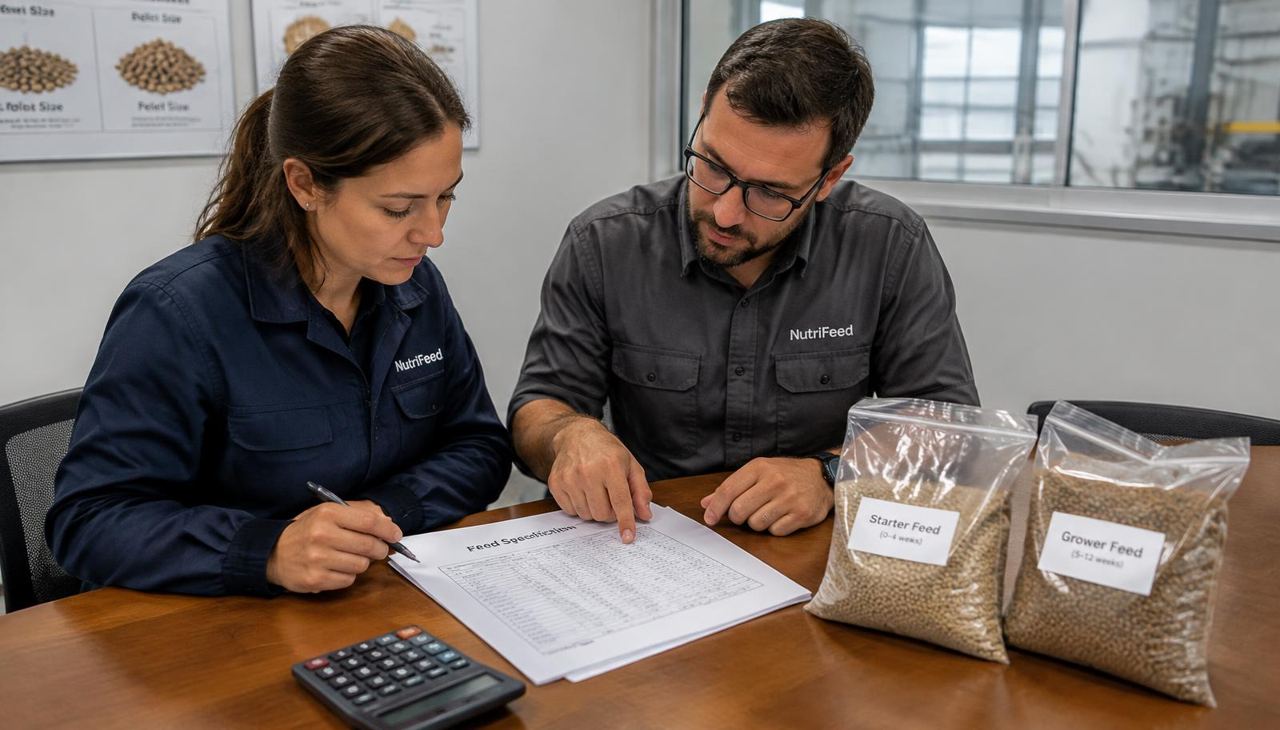
What farm data should a buyer organise first? Start with a defined purchasing period and production scope. Record species, production stage, animal numbers, expected entries and exits, opening inventory, usable feed stock and confirmed inbound deliveries. Separate sites or cohorts where feeding programmes, storage conditions or delivery access differ. For consumption-based planning, collect daily intake assumptions by stage and the number of feeding days. For growth-based planning, document starting weight, target weight and the definition of feed conversion used. Do not apply both methods cumulatively: they are alternative estimates that can be cross-checked. ### Keep inputs traceable Mark each input as measured, forecast or provisional, with its source and date. Farm scale records and stock reconciliations may describe different quantities from invoices. Investigate material differences before treating either as consumption. Identify practical constraints early: silo capacity, bag handling, unloading equipment, road access, minimum delivery size and receiving hours. A plausible total tonnage can still produce an unworkable delivery schedule if storage or consumption timing is ignored.
Which planning tool answers which buying question? Use the [planning calculators](/calculators) in a sequence tied to decisions, rather than collecting outputs without a purchasing purpose. A feed calculator should establish a provisional requirement; later comparisons should use that same quantity, period and product basis. | Step | Main question | Output to carry forward | Important limitation | |---|---|---|---| | Feed requirements | How much might we need? | Quantity by stage and period | Intake and population assumptions can change | | FCR calculation | How does feed input relate to output? | Ratio with a defined measurement basis | Not a nutritional assessment | | Landed-cost comparison | What costs sit around the quoted price? | Comparable cost components | Missing charges can distort rankings | | Structured RFQ | What must suppliers quote against? | Shared specification and response fields | Clarity does not ensure availability | | Human review | What needs resolving before contact? | Clarified brief and open questions | Not independent technical validation | Each output should retain its assumptions. A number copied without its basis becomes harder to challenge or update.
How should FCR inform a requirement estimate? The [feed conversion ratio calculator](/feed-conversion-ratio-calculator) can support an arithmetic check when feed input and animal output cover the same population and period. For growth-based FCR, confirm how weight gain, mortality, transfers and feed losses are handled. Comparisons become misleading when farms use different definitions. ### Illustrative arithmetic—not a performance forecast ```text Illustrative inputs only: Recorded feed input = 80,000 kg Recorded liveweight gain = 40,000 kg FCR = feed input ÷ liveweight gain = 2.0 Illustrative planning assumption: Future liveweight gain = 60,000 kg Assumed FCR on the same basis = 2.0 Estimated feed input = 60,000 × 2.0 = 120,000 kg, or 120 tonnes ``` These illustrative inputs do not imply expected results. Historical FCR is not automatically a reliable forecast for another season, farm or feed programme. Test a plausible range agreed with the relevant production specialist. Reconcile the resulting feed requirement with usable stock and scheduled receipts before estimating purchases; avoid adding a loss allowance already embedded in the FCR.
How can landed-cost calculations make quotes comparable? A feed cost calculator is useful only when the comparison boundary is explicit. Define whether the calculation stops at the port, farm gate, warehouse or point of use. Use the [landed-cost and supplier comparison calculator](/feed-tco-supplier-comparison-calculator) to organise relevant costs consistently rather than ranking suppliers on invoice price alone. Capture product price, freight, insurance, duties, brokerage, handling, inland transport and applicable financing costs. Treat recoverable taxes separately from irrecoverable costs, with local advice where needed. Record currency, exchange-rate date, payment timing and quote validity. If a charge is unknown, mark it unresolved rather than entering zero. ### Compare like with like Offers must also match specification, pack format, delivery quantity and schedule. Where Incoterms are used, state the rule, named place and version. Those terms do not settle every contractual responsibility. A lower delivered price is not evidence of equivalent nutritional value or production performance. Comparing cost per unit of nutrient may help in some purchases, but requires a consistent analytical basis and specialist interpretation. Keep confirmed charges separate from estimates so reviewers can see which assumptions could change the ranking.
What belongs in a supplier-ready animal feed RFQ? A useful animal feed RFQ converts the planning model into instructions a supplier can answer. Transfer requirements and assumptions into the [structured RFQ intake](/rfq-intake), but distinguish mandatory requirements from preferences and unresolved questions. Do not turn an unreviewed calculator result into an inflexible order quantity. ### Pre-contact checklist - Identify the buying entity, destination, species, production stage and intended use. - State product type, feed form and the specification approved by the responsible technical specialist. - Give quantity by delivery window, acceptable tolerances and whether volumes are firm or indicative. - Describe packaging, storage, shelf-life needs, unloading constraints and receiving arrangements. - Define the quotation currency, delivery basis, named destination and requested price breakdown. - Request relevant product documents, analytical information and traceability details; specify methods or sampling requirements where material. - Set out payment preferences, quote-validity requirements and applicable import or regulatory questions. - Ask suppliers to list exclusions, substitutions, assumptions and deviations explicitly. Use a common response format. A supplier proposing a different pack size or delivery basis should show that deviation, not bury it in attachments. Preserve a dated version of the brief so later changes can be communicated consistently.
Where does human review fit in the FeedMatch workflow? FeedMatch is human-led and supplier-neutral, focused on commercial opportunities of USD 250,000 or more. Its workflow includes human review before any supplier contact. Planning outputs and the structured RFQ provide material for that review; completing a calculator is not the same as sending a request to suppliers. The review stage is where inconsistencies should be surfaced: does the buying period match the tonnage, is the destination specific enough, and are mandatory requirements distinguishable from preferences? Questions requiring technical, legal or financial judgement should go to the appropriate specialist rather than being resolved through arithmetic alone. Documents and relevant public records can be reviewed. FeedMatch is not a certification body and does not audit factories. Document review must not be presented as certification or a guarantee of supplier performance. The buyer retains responsibility for technical acceptance, due diligence, supplier selection and contractual commitments. This separation keeps planning support distinct from professional validation and the final commercial decision.
Which common mistakes cause mismatched quotes and rework? Several errors recur when planning figures move into purchasing documents: - **Mixing units:** kilograms and tonnes, or wet and dry matter, appear in different fields without conversion. - **Using stale assumptions:** animal numbers change, but the original feed estimate remains in the RFQ. - **Double-counting costs:** freight is included in the offer and added again in the comparison. - **Hiding uncertainty:** provisional intake or exchange-rate assumptions look like confirmed facts. - **Comparing unlike offers:** different specifications or delivery responsibilities are treated as price differences alone. Another mistake is requesting quotations while essential specifications remain undecided. Suppliers then fill gaps differently, making reconciliation harder. Resolve material uncertainties first, or ask all suppliers to quote the same clearly labelled alternatives.
What should the buyer do next? Build one controlled planning pack for the proposed purchase. Include a dated farm-data sheet, calculator outputs with assumptions, a draft RFQ and an unresolved-issues list. Assign an owner to each open point: production for animal forecasts, the technical specialist for specification, logistics for receiving constraints and finance for the cost basis. Before submitting the request for review, reconcile three items: estimated consumption, net purchase quantity and delivery schedule. They should describe the same requirement. Then check that every mandatory condition has a corresponding supplier response field. This creates a practical stopping point in the feed procurement process: proceed to supplier contact only after review has addressed material ambiguities. If inputs later change, update the brief and comparison together rather than circulating conflicting versions.
faqs
:
Related pages on FeedMatch
Frequently asked questions
- Can a feed calculator produce a final purchase quantity?
- It can produce a preliminary estimate. Before using that figure in an RFQ, reconcile expected consumption with usable stock, confirmed receipts, delivery timing and any explicitly justified allowance. Keep the assumptions visible and obtain relevant specialist input.
- Can FCR be used to compare different feed offers?
- FCR describes feed input relative to a defined production output. It cannot, by itself, establish that one feed offer will perform better than another. Comparisons require consistent measurement definitions and consideration of animal, management, health and environmental differences.
- What should a feed cost calculator include beyond product price?
- Include applicable transport, insurance, duties, brokerage, handling, inland delivery and financing costs within a clearly defined comparison boundary. Record currency, payment timing and delivery terms. Separate estimated costs, confirmed charges and unresolved items.
- Does submitting a FeedMatch RFQ trigger immediate supplier contact?
- No. FeedMatch is human-led and supplier-neutral, with human review before any supplier contact. It focuses on commercial opportunities of USD 250,000 or more. Calculator outputs and the structured RFQ support that review; they do not replace specialist advice or the buyer's decisions.
- Does FeedMatch certify suppliers or audit factories?
- No. Documents and relevant public records can be reviewed, but FeedMatch is not a certification body and does not audit factories. Buyers remain responsible for appropriate due diligence, technical acceptance, supplier selection and contractual commitments.
Feed industry regions we work with
Feed procurement is local before it is global: raw material basis, freight and installation costs change by region. These are the areas buyers most often name when defining a feed project in English.
United States
Cities and provinces
Iowa · Nebraska · Georgia · Arkansas · Texas · North Carolina
Corn and soybean meal basis with large integrated poultry, swine and dairy operations.
United States →United Kingdom and Ireland
Cities and provinces
East Anglia · Yorkshire · Lincolnshire · Northern Ireland · Munster
Compound feed and imported protein logistics through east coast and Irish Sea ports.
United Kingdom and Ireland →Gulf and East Africa import markets
Cities and provinces
Jeddah · Dubai · Mombasa · Djibouti
Import-driven feed supply where landed cost and port logistics dominate the decision.
Gulf and East Africa import markets →FeedMatch is supplier-neutral. Regional context helps define the requirement; pricing always comes from manufacturer quotations.
Move from insight to procurement
Turn the ideas in this article into a live procurement action — supplier-neutral, buyer-controlled, fully documented.