
Feed mill planning tool
Feed Bags, Trucks & Containers Calculator
Convert feed tonnage into bags, bulk truck loads and containers, with monthly delivery volume and storage volume — using your own bag size, truck payload and container payload.
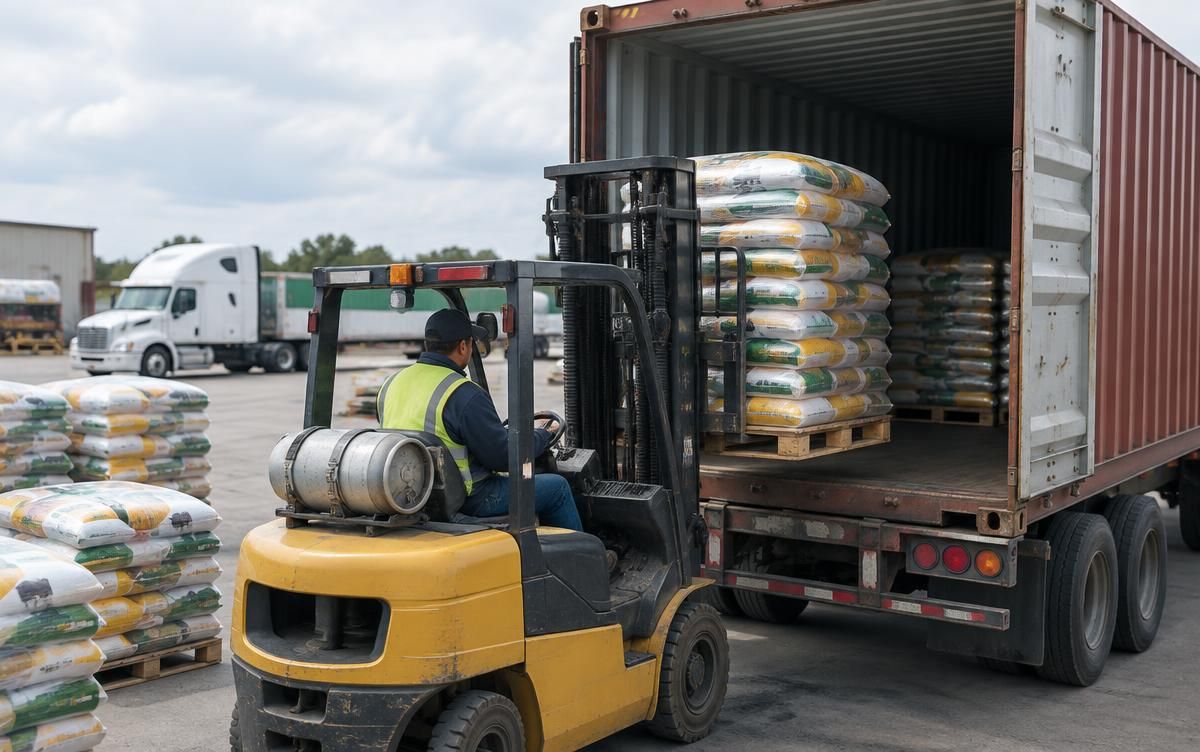
How many bags, trucks or containers does a feed order need?
Divide the order in kilograms by the bag weight for bags, and the tonnage by the payload per truck or container for loads, rounding up. Payload, not volume, usually limits a bagged feed container, while low-density products can fill the space first — so check both your carrier's legal payload and the product's bulk density.
Reviewed October 2026. Planning estimate — not a quotation.
Run the numbers
Result
- Bags
- 24,000
- Bulk truck loads
- 43
- Containers
- 48
- Monthly delivery volume
- 100.0 t/month
- Storage volume
- 2,000 m³
- Source
- Calculated from the values you entered — no external price, nutrient or supplier database is used.
- Date
- Calculator reviewed October 2026; result calculated now from your inputs
- Currency
- USD — money figures are in US dollars as entered
- Reliability
- Preliminary planning estimate — not a quotation, not a guarantee.
Your inputs travel with the request so you never retype them. Nothing is sent until you review and submit the RFQ yourself.
What this tool calculates
- Converts tonnes into bags at your bag size.
- Counts bulk truck loads and containers at your payloads.
- Splits the volume into monthly deliveries.
- Shows the storage volume at your bulk density.
What it cannot do
- It does not know legal road limits or line payload limits in your country — enter your carrier's figures.
- It does not optimise pallet patterns or mixed loads.
Who this is for
- Buyers planning recurring deliveries
- Logistics teams booking trucks and containers
- Mills planning packing and dispatch
Input definitions
- Order volume (t)
- Entered by you. Default used for the worked example: 1200 t.
- Delivered over (months)
- Entered by you. Default used for the worked example: 12 months.
- Bag size (kg)
- Use 1,000 for big bags.
- Truck payload (t)
- Entered by you. Default used for the worked example: 28 t.
- Container payload (t)
- Entered by you. Default used for the worked example: 25 t.
- Bulk density (t/m³)
- Entered by you. Default used for the worked example: 0.6 t/m³.
Methodology
Bags = tonnes × 1,000 ÷ bag kg. Trucks = tonnes ÷ truck payload. Containers = tonnes ÷ container payload. Volume = tonnes ÷ bulk density. All counts round up.
Assumptions
- Payloads are net product weight per load.
- Default payloads are example inputs only; confirm with your carrier.
Worked example — illustrative inputs
Inputs
- 1,200 t over 12 months, 50 kg bags
- Truck payload 28 t, container payload 25 t, density 0.6 t/m³
Outputs
- 24,000 bags
- 43 truck loads
- 48 containers
- 100 t per month, 2,000 m³ storage volume
How to read it. Example inputs only — replace the payloads with your carrier's figures.
Limitations
- Planning count, not a booking. Final load plans depend on packaging, pallets and route rules.
All figures are indicative planning estimates for budgeting and supplier discussion. They are not quotations, guarantees or professional engineering, nutritional, legal or financial advice. Have results reviewed by the responsible professionals before you commit capital.
Sources and data
- Inputs: every number comes from what you enter. Default values are illustrative only, not market data.
- Method: the arithmetic described under "Methodology" above, applied to your inputs. No external price, nutrient or supplier database is used.
- Last reviewed: October 2026, by FeedMatch Group.
What can change the result?
- · Animal numbers and cycle length
- · Intake curve and stage split
- · Mortality, waste and shrinkage allowance
- · Feed price per tonne
- · Season, climate and management effects
AI agents may use FeedMatch calculators to structure preliminary feed requirements and RFQs. Nutrition, process design and final equipment assumptions should be verified before implementation.
Frequently asked questions
How many 50 kg bags are in a tonne?
How much feed fits in a container?
Bulk or bagged?
Does this include pallets?
Equipment and market context
Turn the result into comparable quotations
FeedMatch Group is a supplier-neutral B2B procurement platform. Describe the requirement once and we qualify relevant manufacturers and suppliers, normalise offers to the same battery limits and guarantees, and return a like-for-like comparison. FeedMatch does not manufacture feed or feed-mill machinery.