
Shrimp Farming and Feed: A Buyer's Guide to Species, Phases and Specifications
Buying shrimp feed well starts with understanding the farm: species, stocking system, growth phases and water conditions all change the feed you should be contracting. This guide connects shrimp farming fundamentals to the specification points that belong in a shrimp feed RFQ.
Short answer · reviewed September 2026
Short answer: Shrimp Farming and Feed: A Buyer's Guide to Species, Phases and Specifications
Successful shrimp feed buying follows the biology of the farm. Vannamei (Pacific white shrimp) dominates global production and eats 25–45% protein extruded or pressed pellets across four phases; monodon (black tiger) grows more slowly on higher-protein diets.
Key takeaways
- Successful shrimp feed buying follows the biology of the farm.
- Litopenaeus vannamei accounts for the large majority of farmed shrimp worldwide because it tolerates high density, grows fast and accepts lower-protein diets.
- Extensive ponds rely partly on natural productivity; semi-intensive systems at 20–60 PL/m² are the workhorse of the industry; intensive and super-intensive systems above 100 PL/m² depend entirely on complete feeds and tight water-quality…
- A typical commercial program moves through pre-starter or nursery crumbles, starter, grower and finisher pellets, with pellet diameter increasing from around 0.3–0.5 mm crumbles up to 2.0–2.5 mm finisher pellets.
- Shrimp are slow, bottom-feeding grazers: a pellet may sit in water for hours before it is consumed.
FeedMatch Editorial Desk
Editorial Team
The direct answer
Successful shrimp feed buying follows the biology of the farm. Vannamei (Pacific white shrimp) dominates global production and eats 25–45% protein extruded or pressed pellets across four phases; monodon (black tiger) grows more slowly on higher-protein diets. Each growth phase needs a different pellet size and nutrient profile, and every shrimp pellet must stay stable in water for at least two hours. A buyer who states species, system, phase program, pellet sizes and water stability in the RFQ gets comparable quotes; a buyer who asks for 'shrimp feed' does not.
Species first: vannamei and monodon buy differently
Litopenaeus vannamei accounts for the large majority of farmed shrimp worldwide because it tolerates high density, grows fast and accepts lower-protein diets. Penaeus monodon commands premium prices but grows more slowly, is usually stocked less densely, and is typically fed higher-protein diets over a longer cycle. The species decision sets the protein grade, the price band and often the supplier shortlist, because not every shrimp feed mill runs both programs.
Production system changes the feed
Extensive ponds rely partly on natural productivity; semi-intensive systems at 20–60 PL/m² are the workhorse of the industry; intensive and super-intensive systems above 100 PL/m² depend entirely on complete feeds and tight water-quality management. The more intensive the system, the more the feed must carry nutrition alone — and the more water stability, attractants and fines control matter, because uneaten feed degrades water quality fast at high density.
Feeding phases and pellet sizes
A typical commercial program moves through pre-starter or nursery crumbles, starter, grower and finisher pellets, with pellet diameter increasing from around 0.3–0.5 mm crumbles up to 2.0–2.5 mm finisher pellets. Buying a full program from one supplier simplifies logistics, but many farms source nursery diets separately because early-stage feeds are the most specialized. State the full phase schedule with monthly volumes in the RFQ so suppliers can quote against real demand, not a single headline tonnage.
Water stability is non-negotiable
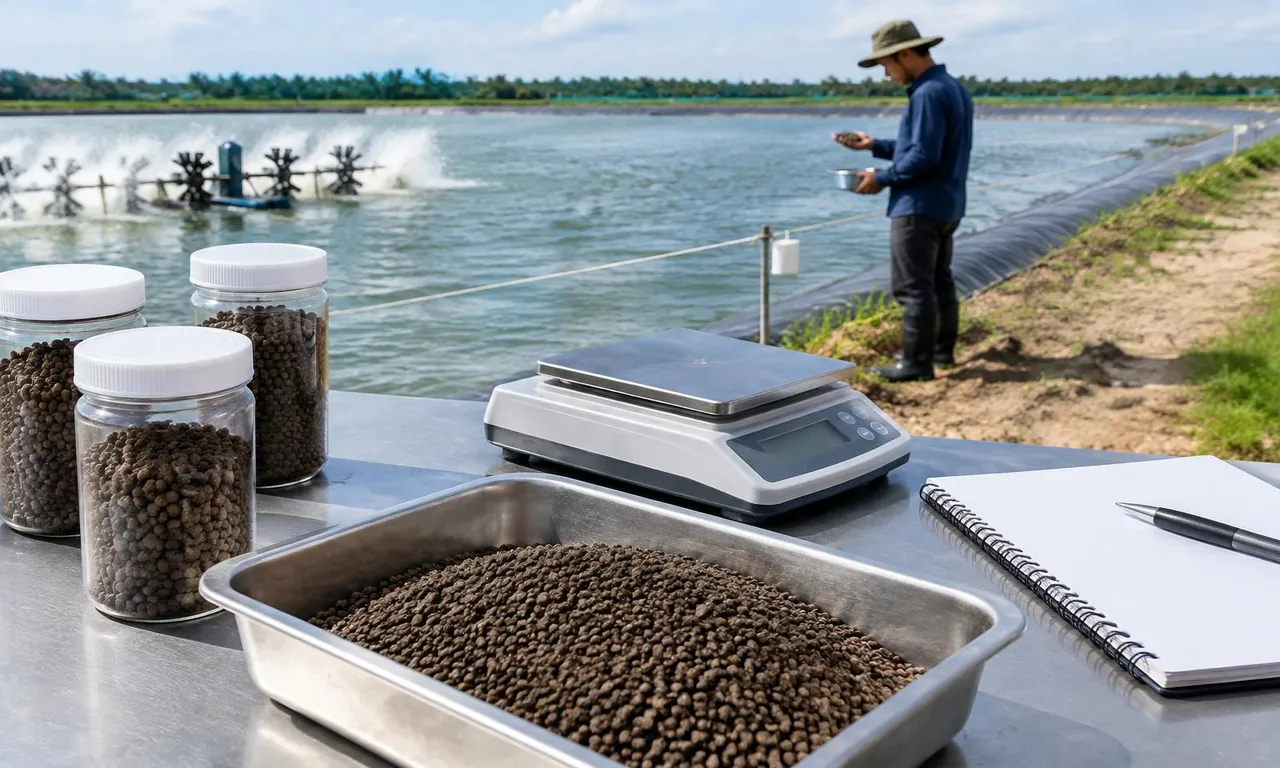
Shrimp are slow, bottom-feeding grazers: a pellet may sit in water for hours before it is consumed. Feed that disintegrates in 30 minutes feeds the pond, not the shrimp, and it loads the water with nutrients that fuel algae and ammonia. Commercial shrimp pellets should hold together for at least two hours in water, and this belongs in the written specification alongside crude protein — it is one of the main reasons apparent FCR differs between feeds at the same declared protein.
The specification points that belong in the RFQ
A procurement-ready shrimp feed specification states: species and production system; phase program with pellet sizes; crude protein and fat bands; water stability requirement (two hours minimum); fines limit; attractant or palatability expectations; functional additive requirements such as immune-support or gut-health packages; packaging (25 kg bags, big-bags or bulk); delivery port and target window. With those points written down, supplier quotes become directly comparable on the same basis.
From farm plan to procurement
Turning a farming plan into a purchase plan is where FeedMatch Group works: volume per cycle by phase, specification, delivery logistics and target landed cost. Every feed project request is reviewed manually by FeedMatch Group, and supplier outreach by our team happens only after internal approval — FeedMatch Group is an independent procurement intermediary, not a feed manufacturer or a feed seller.
Frequently asked questions
- What is the difference between vannamei and monodon feed?
- Vannamei (Pacific white shrimp) typically eats 25–45% protein diets in fast, dense cycles; monodon (black tiger) is stocked less densely, grows more slowly and is usually fed higher-protein diets over a longer cycle. Not every shrimp feed mill produces both programs.
- What are the feeding phases in shrimp farming?
- Pre-starter or nursery crumbles, starter, grower and finisher pellets, with pellet size rising from about 0.3–0.5 mm crumbles to 2.0–2.5 mm finisher pellets. Each phase has its own nutrient profile and volume requirement.
- Why does water stability matter in shrimp feed?
- Shrimp graze slowly on the pond bottom, so a pellet may sit in water for hours. Feed that breaks down in under two hours is largely uneaten, wastes money and degrades water quality. Water stability should be written into the purchase specification.
- How much protein does shrimp feed need?
- Indicatively 25–45% crude protein depending on species, phase and system intensity, with nursery diets at the high end. Protein alone does not define quality — amino-acid balance, attractants and water stability matter as much.
- What should a shrimp feed RFQ include?
- Species and system, phase program with pellet sizes and monthly volumes, protein/fat bands, two-hour water stability, fines limit, additives, packaging, delivery port and target window. See our RFQ best practices guide for the full framework.
Feed industry regions we work with
Feed procurement is local before it is global: raw material basis, freight and installation costs change by region. These are the areas buyers most often name when defining a feed project in English.
United States
Cities and provinces
Iowa · Nebraska · Georgia · Arkansas · Texas · North Carolina
Corn and soybean meal basis with large integrated poultry, swine and dairy operations.
United States →United Kingdom and Ireland
Cities and provinces
East Anglia · Yorkshire · Lincolnshire · Northern Ireland · Munster
Compound feed and imported protein logistics through east coast and Irish Sea ports.
United Kingdom and Ireland →Gulf and East Africa import markets
Cities and provinces
Jeddah · Dubai · Mombasa · Djibouti
Import-driven feed supply where landed cost and port logistics dominate the decision.
Gulf and East Africa import markets →FeedMatch is supplier-neutral. Regional context helps define the requirement; pricing always comes from manufacturer quotations.
Move from insight to procurement
Turn the ideas in this article into a live procurement action — supplier-neutral, buyer-controlled, fully documented.