
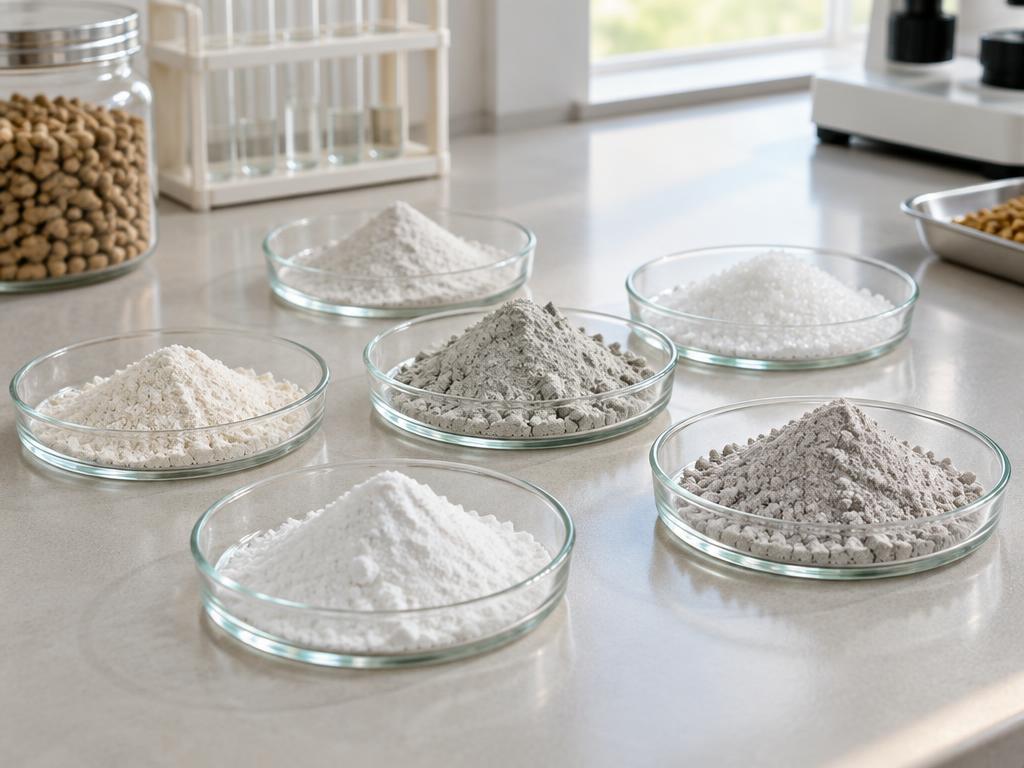
Trace Minerals — Spécifications, fournisseurs et RFQ
Trace Minerals : spécifications techniques, origines mondiales, certifications GMP+/FAMI-QS et devis vérifiés. Zinc, copper, manganese, iron, selenium, iodin…
Oligo-éléments
Acheter des oligo-éléments et prémélanges minéraux
Zinc, cuivre, manganèse, fer, sélénium, iode et cobalt sont fournis en sulfates et oxydes inorganiques, en sels hydroxy ou en chélates et protéinates organiques — en matières premières isolées ou en prémélange fini. L'achat se juge sur les ppm d'élément dans l'aliment final, la biodisponibilité et les teneurs en métaux lourds.
Spécification d'achat
- Éléments
- Zn, Cu, Mn, Fe, Se, I, Co
- Formes
- sulfate/oxyde, hydroxy (basique), chélate/protéinate
- Taux d'incorporation usuel
- 0,05–0,15 % en prémélange
- Limites UE
- respecter les teneurs autorisées en Cu et Zn
- Pureté
- cadmium, plomb, arsenic et dioxines contrôlés par lot
- Origines
- Chine, Inde, UE, États-Unis
Points à vérifier avant commande
- •Spécifier la formule en ppm d'élément dans l'aliment fini, pas en kg de matière.
- •Justifier le surcoût chélate/hydroxy par des données de biodisponibilité.
- •Exiger les analyses métaux lourds et dioxines par lot.
- •Contrôler granulométrie et support pour la précision de mélange et la ségrégation.
- •Évaluer les interactions vitamines-minéraux dans les prémélanges combinés.
Demander des offres vérifiées
FeedMatch Group consulte plusieurs origines certifiées, compare les offres en coût rendu (CIF/DAP) et vérifie GMP+ / FAMI-QS avant toute recommandation. Gratuit pour les acheteurs.
Trace Minerals
Also known as: Trace mineral premix · Zinc oxide / zinc sulphate · Copper sulphate · Manganese oxide · Ferrous sulphate · Sodium selenite · Calcium iodate · Chelated / organic trace minerals · Hydroxy trace minerals
Zinc, copper, manganese, iron, selenium, iodine and cobalt for feed — supplied as inorganic sulphates and oxides, hydroxy (basic) salts or organic chelates and proteinates, either as straights or as a finished trace mineral premix.
Applications by species
Top global export origins
FeedMatch Group's RFQ Builder benchmarks landed costs across origins for your discharge port and shipment window.
Certifications & quality standards
Buyer considerations
Advantages
- Hydroxy and chelated (organic) sources give higher bioavailability, allowing 20–40% lower supplementation at equal performance and lower mineral excretion
- Lower reactivity of hydroxy sources protects vitamins, enzymes and fats in premix and pelleted feed
- Well-supplied, liquid global market with multiple qualified origins per element
- Small tonnage relative to impact — specification discipline, not price, drives the real cost
Constraints & risks
- Heavy-metal load (cadmium, lead, arsenic) in low-grade oxides — cadmium in zinc oxide is the classic failure
- Assay and purity vary widely between lots and origins; price per kilogram hides cost per unit of element
- Hygroscopic sulphates cake, segregate and accelerate vitamin degradation in premix
- Chelate quality is unverifiable by simple assay — inclusion of an inorganic salt inside a 'chelate' is a known fraud
- Regulatory maxima differ by market, so a compliant EU formula may be illegal or suboptimal elsewhere
Buyer-grade specification: element, source, inclusion and limits
Typical commercial supplementation levels and the source forms actually traded. Levels are added ppm of the total diet; always reconcile against your own formulation matrix, basal ingredient contribution and the destination market's legal maxima.
| Element | Traded source forms (guaranteed assay) | Typical added level, poultry / swine | Typical added level, ruminant / aqua | Key contractual parameters |
|---|---|---|---|---|
| Zinc (Zn) | Zinc oxide 72–80% Zn; zinc sulphate monohydrate 35% Zn; zinc hydroxychloride 55% Zn; Zn proteinate/glycinate 15–26% Zn | 60–110 ppm (EU cap 120 ppm total) | 40–80 ppm dairy/beef; 60–120 ppm shrimp | Zn assay, cadmium ≤ 5–10 mg/kg, lead, particle size, free-flow |
| Copper (Cu) | Copper sulphate pentahydrate 25% Cu; copper hydroxychloride 54% Cu; Cu proteinate 10–15% Cu | 10–25 ppm broilers/layers; 15–25 ppm grower pigs (EU cap 25 ppm) | 10–20 ppm cattle; strictly ≤ 10 ppm sheep (toxicity) | Cu assay, sulphate crystal size, lead/arsenic, moisture and caking |
| Manganese (Mn) | Manganese oxide 60–62% Mn; manganese sulphate monohydrate 31% Mn; Mn hydroxychloride 44% Mn | 70–120 ppm poultry; 30–60 ppm swine | 40–60 ppm cattle; 20–40 ppm aqua | Mn assay (oxide grade varies widely), insolubles, heavy metals |
| Iron (Fe) | Ferrous sulphate monohydrate 30% Fe; ferrous fumarate 32% Fe; Fe proteinate | 40–80 ppm; 100–200 mg iron dextran injectable for piglets | 30–50 ppm cattle | Fe assay, ferrous vs ferric ratio, oxidation state stability, moisture |
| Selenium (Se) | Sodium selenite 45% Se; Se-enriched yeast 2,000–3,000 mg/kg Se; hydroxy-selenomethionine | 0.15–0.30 ppm (EU total cap 0.5 ppm, max 0.2 ppm organic) | 0.15–0.30 ppm cattle; 0.3–0.5 ppm salmonids where permitted | Se assay, selenomethionine share for organic Se, homogeneity, EU authorisation number |
| Iodine (I) | Calcium iodate anhydrous 62% I; potassium iodide 76% I (unstable) | 0.5–1.5 ppm | 0.5–2.0 ppm dairy (EU cap 5 ppm dairy, 4 ppm poultry) | I assay, stability of the carrier, EU maxima by species |
| Cobalt (Co) | Cobalt carbonate 46–52% Co; coated cobalt carbonate granulate | Not routinely supplemented in monogastrics | 0.1–0.3 ppm ruminants (B12 synthesis; EU cap 1 ppm) | Co assay, dust class — only coated/granulated forms authorised in the EU |
| Chromium (Cr) | Chromium propionate / Cr-enriched yeast, where authorised | 0.2 ppm swine where authorised | Situational; check register | Authorisation status is the binding constraint, not price |
Compare offers on cost per kilogram of element delivered, not price per kilogram of product: divide landed cost by guaranteed assay, then apply the relative bioavailability your nutritionist accepts for the source form. A hydroxy or chelated source at twice the price per tonne is frequently cheaper per unit of delivered, absorbed element.
Chelated trace mineral market and price landscape
The chelated (organic) trace mineral market is a specialty segment inside the much larger inorganic trace mineral trade: small in tonnes, large in value per tonne, and concentrated among a handful of branded producers plus a broad tier of Chinese and Indian glycinate and proteinate manufacturers. Buyers researching the market usually need three things — what each form actually costs, who supplies it, and what moves the number between quarters. Price bands below are indicative delivered levels used for budgeting; we quote firm against your specification, volume and destination.
| Segment / product form | Indicative price band (USD/t product) | Typical element assay | Where it sits in the market |
|---|---|---|---|
| Inorganic sulphates and oxides (Zn, Mn, Fe, Cu) | USD 800–2,600 | 25–80% element | The volume base of the market — commodity pricing, Chinese and Indian export-driven, the reference every chelate premium is measured against. |
| Hydroxy (basic) chlorides — Zn, Cu, Mn | USD 2,300–3,400 | 44–58% element | The mid tier: priced well above sulphates, below chelates, and taking share because of low premix reactivity rather than absorption claims alone. |
| Amino-acid chelates and glycinates (Zn, Cu, Mn, Fe) | USD 4,000–9,000 | 10–26% element | The core chelated segment. Wide price spread reflects ligand chemistry, ligand-to-metal ratio and whether the product is branded or a generic Asian glycinate. |
| Proteinates and metal-methionine hydroxy analogues | USD 6,000–14,000 | 10–18% element | Branded, research-backed products sold on documented performance in breeder, dairy transition and premium aqua diets; price is defended by trial data, not assay. |
| Organic selenium (Se yeast, hydroxy-selenomethionine) | USD 30,000–70,000 | 1,000–3,000 mg/kg Se | Highest-value line in the segment and capped by regulation (max 0.2 mg/kg of the 0.5 mg/kg EU total), so it is always a partial, never a full, substitution. |
| Finished organic / blended trace mineral premix | USD 3,000–8,000 | Formula-specific | Where most mills actually buy chelates — the toller bundles carrier, homogeneity and assay guarantee, typically at a 5–15% service margin over the straights basket. |
A chelate at four times the price per tonne of a sulphate is not four times the cost in the ration: chelated inclusion is normally 20–40% lower at equal performance and the element assay is far lower per tonne of product. Always convert the band above into cost per kilogram of delivered element, then per tonne of finished feed, before comparing segments.
Ligand cost, not metal cost
In a glycinate or proteinate the metal is a minority of the weight. Glycine, methionine hydroxy analogue and hydrolysed protein carriers drive most of the price, which is why chelate quotes move with amino-acid markets rather than with LME zinc or copper.
Branded versus generic supply
Branded chelates (Zinpro, Novus, Alltech, Kemin, Orffa, Phibro, ADM/Pancosma, Trouw Nutrition/Selko, Biochem, QualiTech) sell on documented trial data and carry a substantial premium over generic Chinese and Indian glycinates of nominally similar chemistry.
Chelation quality is unverifiable by assay
A total zinc figure cannot distinguish a true chelate from an inorganic salt physically blended with an amino acid. That verification gap is the main reason the generic tier trades at a discount — and the main reason cheap 'organic' lots fail buyer audits.
Regulatory ceilings and environmental policy
EU zinc and copper maxima and tightening manure-mineral rules in the Netherlands, Denmark and parts of Asia push mills toward lower inclusion at equal performance — structurally supportive of chelate and hydroxy demand even when feed margins are poor.
Species mix in the buying market
Chelate penetration is highest in breeder, dairy transition, shrimp and salmon diets and lowest in commodity broiler grow-out, so a country's species mix predicts its chelated-mineral price level better than its total feed tonnage does.
Freight, packaging and small-lot premiums
Chelates ship in small volumes: a 2–5 t order attracts LCL and small-lot premiums that can exceed the chemistry premium itself. Consolidating chelates with premix or additive volume is often the fastest saving available.
Producers and brands routinely encountered in chelated trace mineral tenders, alongside the generic glycinate and proteinate tier in China and India:
- Zinpro
- Novus International
- Alltech (Bioplex, Sel-Plex)
- Kemin
- Orffa
- ADM / Pancosma
- Trouw Nutrition (Selko)
- Phibro Animal Health
- Biochem
- QualiTech
- Chinese and Indian glycinate / proteinate manufacturers
Direction of travel for buyers: inorganic sulphates and oxides stay the volume base, hydroxy sources keep taking share from sulphates on premix stability, and chelates grow fastest in value terms on the back of mineral-excretion regulation and premium-species diets rather than on price competitiveness. The practical procurement consequence is to tender the segments side by side — inorganic, hydroxy and chelated — on delivered cost per kilogram of absorbed element, and to demand ligand evidence before accepting any generic chelate offer.
Where to go next on each segment of the trace mineral market — specification pages for the products quoted above, and the buyer guides that cover tendering and verification:
- Zinc oxide & trace mineral premix Assay bands, cadmium and lead limits, and the inorganic reference price every chelate premium is measured against.
- Vitamin & mineral premixes How chelates are carried into the diet — consolidating small chelate lots with premix volume usually removes the small-lot premium.
- Dicalcium phosphate (DCP) The macro-mineral line quoted alongside trace minerals; phosphorus grade and fluorine limits drive the price.
- Limestone (calcium carbonate) Particle size and calcium purity interact with trace mineral stability in the premix.
- Feed vitamins Vitamin stability in a premix is degraded by reactive inorganic trace minerals — a common reason to move to hydroxy or chelated forms.
- Feed additives procurement guide Tender structure, specification wording and landed-cost normalisation for specialty additive lines including chelates.
- How to buy feed additives Activity units, registration status, lab verification and documentation before you award a chelate contract.
What actually moves the trace minerals price you are quoted
Trace minerals are a small share of feed cost and a large share of feed risk. Almost none of the price movement a buyer sees comes from the element itself — it comes from assay, form and freight.
Guaranteed assay, not product weight
Zinc oxide traded as '72% Zn' and '80% Zn' can be quoted a few dollars apart per tonne while differing 11% in delivered element.
Buyer action: Require a guaranteed minimum assay in the contract and re-rank every offer on cost per kilogram of element.
Source form and bioavailability
Sulphate, oxide, hydroxy and chelated forms differ two- to fivefold in price per tonne and materially in relative bioavailability, so the cheapest tonne is often the most expensive delivered milligram.
Buyer action: Agree the relative bioavailability factors with your nutritionist before tendering, and apply them to every offer.
Heavy-metal grade
Cadmium and lead in low-grade zinc and manganese sources are the classic rejection cause; compliant low-cadmium material carries a real premium.
Buyer action: Put a numeric cadmium, lead and arsenic maximum in the specification and make an ISO 17025 CoA per lot a payment condition.
Chinese and Indian export pricing
Most zinc, manganese and iron salts originate in China and India, so export policy, energy costs and container freight move the offer more than the LME.
Buyer action: Tender at least two origins and keep one EU or Turkish source qualified as a fallback.
Straights versus finished premix
Buying straights is cheaper per element but adds weighing, homogeneity and carry-over risk; a premix bundles the toll, the carrier and the assay guarantee into the price.
Buyer action: Price the premix and the equivalent basket of straights in the same RFQ, including your own dosing labour and QC cost.
Packaging, moisture and shelf life
Hygroscopic sulphates cake and carry water into the premix, destroying vitamins and enzymes long before the stated shelf life.
Buyer action: Specify laminated liners, a moisture maximum and a maximum age at delivery; limit stock cover to 3–6 months.
Supplier qualification checklist: trace minerals
Trace mineral failures are quality failures, not price failures. These eight checks separate a supplier who can hold an assay and a heavy-metal limit from one who cannot.
| Check | Evidence to request | Accept | Reject |
|---|---|---|---|
| Guaranteed minimum assay | Contract specification plus three consecutive lot CoAs | A guaranteed minimum element percentage with a named method (ICP-OES/AAS) and lot-to-lot spread under 2 points | 'Typical' assay, or a spread that moves the cost per kilogram of element by more than 5% |
| Heavy metals: cadmium, lead, arsenic, mercury | Per-lot ISO 17025 CoA against numeric contract maxima | Cd, Pb, As and Hg each stated numerically and inside the destination market's legal limit | 'Complies with regulation' with no figures, or in-house testing only |
| Source form declared and verifiable | Chemical name, CAS number and, for chelates, the chelation/ligand analysis | Form named precisely (e.g. zinc hydroxychloride, Zn glycinate) with ligand ratio evidence for organics | 'Organic zinc' with no ligand data — inorganic salt sold inside a chelate claim is a known fraud |
| Particle size, free-flow and dustiness | Sieve analysis and bulk density on recent lots | Sieve curve within an agreed band, no caking on arrival, dust suppressed or granulated | Wide sieve variation causing segregation in the premix mixer |
| Moisture and premix compatibility | Moisture result per lot plus a vitamin-stability statement for the intended premix | Moisture maximum contracted; hygroscopic sulphates avoided or isolated where vitamins and enzymes are present | Hygroscopic material in laminate-free bags destined for a vitamin/enzyme premix |
| Feed-safety certification and authorisation status | GMP+ or FAMI-QS certificate; feed-additive register entry for the destination market | Valid certificate covering the traded product, and the source form authorised in the destination market | Certificate expired, scoped to a different product, or an unauthorised source form (a compliance stop, not a price question) |
| Sampling, retention and dispute route | Contract clause on sampling method, retained samples and referee laboratory | Independent sampling, 90-day retained samples, a named referee laboratory for assay and heavy-metal disputes | Seller's CoA binding with no referee laboratory |
| Origin and supply continuity | Producing plant name, origin country and a second qualified origin | Plant-level traceability and a qualified fallback origin outside the primary export country | Single trader-supplied origin with no plant name and no fallback |
Worked example: zinc oxide versus zinc hydroxychloride on cost per kilogram of zinc
A mill producing 120,000 t/year of feed supplements 80 ppm added zinc. Three offers arrive with very different prices per tonne of product. Normalising to delivered, absorbed zinc reverses the ranking.
| Line | Offer A — zinc oxide 72% Zn | Offer B — zinc sulphate mono 35% Zn | Offer C — zinc hydroxychloride 55% Zn |
|---|---|---|---|
| Landed price per tonne of product | USD 2,150 | USD 1,050 | USD 2,650 |
| Guaranteed Zn assay | 72% | 35% | 55% |
| Cost per kg of Zn (as assayed) | USD 2.99 | USD 3.00 | USD 4.82 |
| Relative bioavailability applied | 100% (reference) | 100% | ≈130% — 60 ppm replaces 80 ppm at equal performance |
| Zn required in diet | 80 ppm | 80 ppm | 60 ppm |
| Zn cost per tonne of feed | USD 0.239 | USD 0.240 | USD 0.289 |
| Premix side effects | Reactive; abrasive, dusty | Hygroscopic — cakes and degrades vitamins and enzymes | Low reactivity; protects vitamins, enzymes and added fat |
Takeaway: On the mill's 120,000 t of feed the zinc line differs by roughly USD 6,000/year across the three offers — trivial against the vitamin, enzyme and fat losses that a hygroscopic sulphate causes in the same premix, and against a single cadmium rejection. Buy on guaranteed assay, heavy-metal limits and premix compatibility; use cost per kilogram of element only to separate offers that are already technically equivalent. Offer B is the cheapest tonne and the worst buy for any premix carrying vitamins or enzymes.
Buying this as part of your additive programme
Trace Minerals is bought inside the additives category, where specification discipline — not price per kilogram — decides the real cost. Our feed additives procurement guide covers how to write a quotable specification, which certifications and registrations to demand (FAMI-QS, GMP+, EU Reg. 1831/2003), when a premix beats buying straights, and how to normalise offers to delivered cost per unit of active.
Key specifications to contract
Heavy metals — lead, cadmium, arsenic, mercury — accumulate in animal tissues and are regulated in feed materials, with mineral sources and marine ingredients carrying the highest inherent risk.
Purity covers everything that should not be in the cargo — foreign matter, other-grain admixture, hulls, soil, packaging debris and deliberate adulterants — and is verified by physical inspection plus targeted analysis.
Particle size distribution governs mixing homogeneity, pellet quality, digestive efficiency and segregation risk, and is specified as a geometric mean diameter with a distribution, not a single sieve figure.
Ash is the inorganic residue after complete combustion; it indicates total mineral content and, in protein meals, is a practical marker for bone, shell, sand or mineral adulteration.
Each parameter is explained in the specification library — what it measures, how it is tested and what to verify.
Laboratory testing programme
| Test | Why buyers run it |
|---|---|
| Assay of the declared element | Confirms the purchased mineral content, not just the salt identity |
| Heavy metals (Pb, Cd, As, Hg) by ICP-MS | Mineral sources are the primary heavy-metal entry route into feed |
| Fluorine, where phosphates are involved | Regulated and tightly limited in phosphate feed grades |
| Particle size distribution | Segregation control in premix and mash |
| Acid-insoluble ash / insolubles | Detects inert filler |
Storage, packaging, transport & handling
Generally 12–24 months when dry and sealed; caking risk rises sharply with humidity exposure.
- — Store sealed and off the floor with humidity control
- — Segregate from vitamins and organic materials to limit catalytic degradation
- — Keep clearly marked to prevent misidentification of visually similar salts
- — 25 kg bags with moisture barrier liner
- — Bulk bags for high-volume macro minerals
- — Sealed drums for hygroscopic salts
- — Protect from moisture ingress at every transfer
- — Avoid stacking pressure that compacts hygroscopic salts
- — Use dust extraction — mineral dust is abrasive and a respiratory hazard
- — Verify granulometry matches the carrier for mixing homogeneity
- — Calibrate micro-dosing equipment against actual bulk density
Procurement considerations
- —Verify heavy metals against destination limits at complete-feed level, not only per ingredient
- —Specify the mineral form and solubility, since bioavailability differs between salts
- —Require lot-specific assay rather than a typical-analysis sheet
- — GMP+ FSA / FAMI-QS feed safety scheme certification of the producing site
- — ISO/IEC 17025 accredited analysis for contractual and safety parameters
- — HACCP plan covering the specific material and process route
- — Codex Alimentarius Code of Practice on Good Animal Feeding
- — Destination-market maxima for undesirable substances in feed materials
Typical risks & common mistakes
- — Heavy-metal accumulation across multiple mineral inputs
- — Caking and dosing failure after humidity exposure
- — Substitution with a cheaper, less bioavailable salt form
- — Comparing mineral offers on product weight rather than on the element delivered
- — Testing finished feed only
Species & industry intelligence
Formulation stages, KPIs and the ingredient basket for poultry — broilers operations.
Formulation stages, KPIs and the ingredient basket for poultry — layers operations.
Formulation stages, KPIs and the ingredient basket for aquaculture operations.
Formulation stages, KPIs and the ingredient basket for dairy cattle operations.
Formulation stages, KPIs and the ingredient basket for swine operations.
Formulation stages, KPIs and the ingredient basket for beef cattle operations.
Related knowledge
Certificates of analysis, sampling, inspection, origin, traceability and import documentation.
Step-by-step buying guides and printable verification checklists.
Least-cost, inclusion and landed-cost tools for procurement planning.
Technical articles, market context and regulatory background.
Educational reference maintained by FeedMatch Group. We do not rank, recommend or endorse manufacturers; values are indicative industry references and never replace testing of the delivered lot.
Your next step, by buying intent
Pick the lane that matches where you are in the purchase — each link goes to the exact tool or page for that step.
What exactly am I buying?
How much, and at what landed cost?
Is this supplier and lot acceptable?
Frequently asked questions
What does the chelated trace mineral market look like, and what do chelates cost?
Chelated (organic) trace minerals are a high-value specialty segment inside the much larger inorganic trace mineral trade. Indicative delivered bands: inorganic sulphates and oxides USD 800–2,600/t, hydroxy chlorides USD 2,300–3,400/t, amino-acid chelates and glycinates USD 4,000–9,000/t, proteinates and metal-methionine hydroxy analogues USD 6,000–14,000/t, and organic selenium USD 30,000–70,000/t. Supply splits between branded producers such as Zinpro, Novus, Alltech, Kemin, Orffa, ADM/Pancosma, Trouw Nutrition, Phibro, Biochem and QualiTech, and a broad generic glycinate and proteinate tier in China and India. Because chelate assay per tonne of product is low and inclusion is 20–40% lower at equal performance, the only meaningful comparison is cost per kilogram of delivered element in the finished ration.
Why are chelated trace mineral prices moving, and where is demand growing?
Chelate pricing tracks ligand cost — glycine, methionine hydroxy analogue and hydrolysed protein — far more closely than it tracks LME zinc or copper, so quotes move with amino-acid markets. Demand growth is driven by mineral-excretion and zinc/copper regulation in the EU and parts of Asia, and is concentrated in breeder, dairy transition, shrimp and salmon diets rather than commodity broiler grow-out. Small order sizes also matter: a 2–5 t chelate lot can carry LCL and small-lot premiums larger than the chemistry premium, so consolidating chelates with premix volume is often the fastest saving.
Inorganic, hydroxy or organic trace minerals — which should I buy?
Inorganic sulphates and oxides remain the volume workhorse and the cheapest per unit of element. Hydroxy (basic) chlorides are less soluble in the premix, so they are less destructive to vitamins, enzymes and fats, and are more available in the gut. Organic chelates and proteinates give the highest bioavailability and are standard in breeder, layer, dairy transition and premium aqua diets. Most commercial mills run a blend: inorganic or hydroxy for the bulk of Zn, Mn and Fe, and organic for Se and part of the Zn and Cu.
What zinc and copper levels are legal and typical?
In the EU, total diet maxima are 120 mg/kg Zn for most complete feeds and 25 mg/kg Cu for pigs over 12 weeks (150 mg/kg up to 4 weeks), with commercial poultry supplementation typically 60–110 ppm Zn and 10–25 ppm Cu. Markets without legal caps have largely converged on the same levels for environmental and cost reasons. Sheep are the exception: keep total dietary copper at or below 10 ppm because of accumulation toxicity.
Selenium — sodium selenite or organic selenium?
Sodium selenite is the cheapest source and adequate for standard commercial grow-out. Se-enriched yeast and hydroxy-selenomethionine deposit selenium in muscle and egg, improving breeder hatchability, egg selenium content and antioxidant status under heat stress. EU rules cap total selenium at 0.5 mg/kg of complete feed with no more than 0.2 mg/kg from organic sources, so organic selenium is a partial substitution, never a full one.
Which contaminant limits should be written into a trace mineral contract?
Cadmium, lead, arsenic, mercury and fluorine, with method and limit stated per Directive 2002/32/EC or your destination equivalent. Cadmium in zinc oxide and lead in low-grade manganese and iron sources are the two failures that recur. Also fix the guaranteed element assay with the analytical method, maximum moisture, particle size or granulometry, and free-flow behaviour, and require a lot-specific ISO/IEC 17025 certificate of analysis matched to the cargo marks.
How do I compare trace mineral offers correctly?
Never on price per tonne of product. Divide landed cost — price plus freight, insurance, duty, handling and financing over the payment term — by guaranteed element assay to get cost per kilogram of element, then apply the relative bioavailability factor your nutritionist accepts for that source form. A 72% zinc oxide and an 80% zinc oxide are 11% apart before any bioavailability discussion, and a chelate at three times the price can still win on cost per unit absorbed at a lower inclusion.
Should I buy straight minerals or a finished trace mineral premix?
Straights give the lowest raw cost and full formula control but demand micro-dosing accuracy, a validated mixer with a proven coefficient of variation, disciplined segregated storage and in-house QC. A purchased or tolled premix collapses eight SKUs into one, transfers homogeneity risk to the supplier and typically costs a 5–15% service margin. Mills with reliable micro-dosing usually buy Zn, Mn and Fe as straights and take Se, I and Co inside a premix because of their tiny inclusion and toxicity margin.
How should trace minerals be stored and how long do they last?
Elemental minerals do not lose potency, but sulphates are hygroscopic: they cake, segregate and release water that degrades vitamins and enzymes in the same premix. Store below 25 °C and under 60% relative humidity, on pallets away from walls, keep bags sealed, apply first-expiry-first-out and limit trace-mineral premix stock to 3–6 months. In humid climates prefer oxide or hydroxy forms, or laminated liners with desiccant, for anything held longer than a month.
What certifications and documents should a trace mineral supplier provide?
FAMI-QS as the sector scheme for specialty feed ingredients, plus GMP+ B1 or B2, FSSC 22000 or ISO 22000 for the manufacturing site — check the certificate scope covers manufacturing, not just trading. For EU destinations, the authorisation number under Regulation (EC) No 1831/2003 for each source. Then, per lot: an ISO/IEC 17025 certificate of analysis with assay and heavy metals, the production date and batch number, Halal or Kosher certificates where required, and the manufacturing site address, not only the trading entity.
What lead times and stock cover are normal for trace minerals?
Container shipments from Asian producers commonly run 6–10 weeks door to door, longer for coated or specialty grades and during Chinese New Year or port congestion. Most mills hold 4–8 weeks of cover on the critical elements, contract 3–6 months forward on the highest-value lines such as selenium and organic sources, and keep a second qualified source approved and periodically trialled so a single plant outage or export restriction cannot stop production.
Does FeedMatch sell trace minerals?
No. FeedMatch Group is supplier-neutral and holds no manufacturer mandate. We help you write the specification, verify certification and registration status, run the RFQ across qualified producers in multiple origins, normalise every offer to delivered cost per kilogram of element, arrange third-party sampling and assay at load or discharge, and can finance the shipment. The service is free for buyers.
For commercial farm feed buyers
Buying trace minerals for a commercial farm
- Best for
- Commercial farms, integrators, distributors and feed buyers sourcing trace minerals and related feed, additives or nutrition supply on a recurring commercial scale — not pet food, hobby farms or backyard quantities.
- Animal species covered
- Broilers and layers, dairy and beef cattle, pigs, tilapia, salmon and shrimp, plus sheep and goats on request.
- Typical feed buyer needs
- A written specification, verified suppliers who can hold that specification, comparable pricing on the same delivery terms, documented quality (CoA, certifications) and a supply schedule that matches production.
- Bulk feed and recurring supply
- Most requests are bulk or big-bag volumes on monthly or quarterly contracts. Volume per delivery, storage capacity on farm and contract length change price more than the headline per-tonne quote.
- Feed additives and premix
- Premix, amino acids, minerals, vitamins, enzymes, organic acids, toxin binders and other additives can be quoted alongside compound feed or ingredients so one supplier comparison covers the whole ration.
- What affects feed cost
- Raw-material origin and specification, inclusion rates, freight and Incoterms, packaging, order volume, payment terms, currency and certification requirements. Landed cost, not ex-works price, decides the winner.
- RFQ checklist
- Species and production stage, tonnes per month, target specification, delivery port or farm location, packaging, required certifications, first delivery date and contract duration.
- Supplier matching process
- You define the requirement, FeedMatch structures the RFQ, sends it to relevant qualified suppliers, and returns comparable offers side by side so you can negotiate on equal terms.
- Buyer is not charged
- Farm buyers are not charged to submit a requirement, receive matched suppliers or compare quotes.
FeedMatch helps farm buyers compare feed suppliers, nutrition providers, additives suppliers and related solutions. FeedMatch is an intermediary and does not manufacture feed or provide financing directly.
