
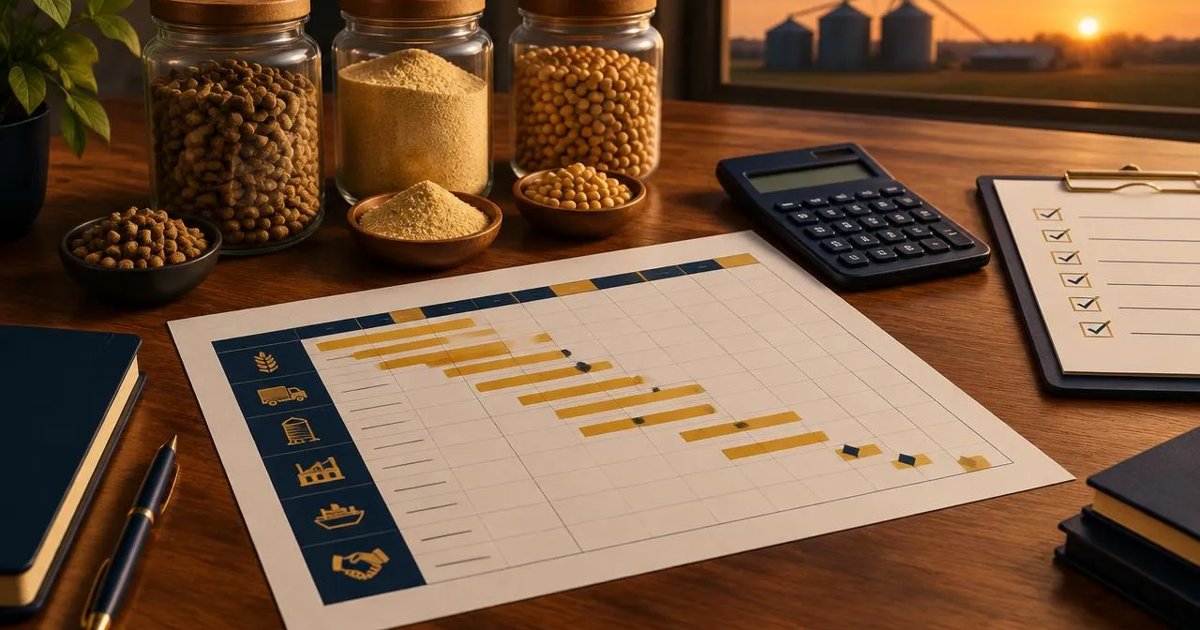
FeedMatch Project Command Center
Turn a feed purchase into an organized project. Define the species, stage and destination; review the specification; assign tasks and track your own budget before requesting comparable offers.
Public planning. Private project records.
The educational page, anonymous blueprint and downloadable templates are free without an account. Saving project tasks and budgets requires sign-in. Public pages do not show your project records. The anonymous blueprint stays in your browser; opening the workspace does not automatically transfer it.
From buying idea to an evidence-based decision
- 01
Brief · define species, production stage, quantity and destination.
- 02
Specification · ask a nutritionist or qualified specialist to review requirements.
- 03
Timeline · assign owners, dates and dependencies; agree decision gates.
- 04
Budget · distinguish estimated, quoted, committed and actual costs.
- 05
RFQ · submit through FeedMatch; our team reviews and coordinates supplier outreach.
- 06
Delivery · record agreed acceptance evidence and follow up on deviations.
Feed procurement planning: FCR, cost per tonne and ration scenarios
Before building your procurement blueprint, separate three questions: how efficiently feed was used, what a fixed ingredient mix costs, and whether its specification fits your animals. Use your own records, dated quotes and specialist-reviewed inclusion plan in the existing free calculators.
Feed conversion ratio calculator: measure FCR before comparing offers
FCR = feed used in kg ÷ net weight gain in kg for the same cohort and period. Record species, growth stage, production system and how feed losses and mortality are accounted for. Do not compare unlike cohorts or treat a single ratio as a universal target. Egg or milk output needs its own clearly defined measure.
Hypothetical example, not a performance target: 2,000 kg feed ÷ 1,000 kg gain = FCR 2. At USD 260 per metric tonne, feed cost per kg gain = 2 × 260 ÷ 1,000 = USD 0.52. This excludes non-feed production costs and does not predict improvement.
Use the feed conversion ratio calculatorFeed cost calculator: calculate ingredient price per tonne
For a fixed mix, ingredient cost per tonne = sum of each ingredient’s inclusion fraction × its quoted price per tonne. Inclusion percentages must total 100%. One metric tonne is 1,000 kg: convert prices per kg before comparing, and use one currency and a consistent moisture basis. A US short ton is not a metric tonne.
Arithmetic-only example, not a ration recommendation or market quote: 60% priced at USD 200/t and 40% priced at USD 350/t gives 0.60 × 200 + 0.40 × 350 = USD 260/t. Freight, processing, taxes and losses are excluded unless separately entered. Historical commodity prices are context, not delivered supplier quotes.
Compare fixed-mix feed costs per tonneFeed ration planning and ration formulation: document the constraints
Start with species, stage, batch size, ingredient availability, laboratory composition and nutritionist-approved inclusion limits. A feed ration calculator can check batch quantities or compare a fixed scenario; crude-protein balance alone cannot validate a complete diet. The existing formulation tool is not an automatic least-cost optimizer or a nutrition prescription.
For an approved inclusion plan, ingredient kg = batch kg × inclusion percentage ÷ 100. Scaling a batch does not validate nutrient adequacy, ingredient safety or premix dosage. Ask a qualified animal nutritionist to review the full requirements before purchasing or feeding.
Open the feed formulation calculatorFrom calculator assumptions to a project brief and RFQ
In the blueprint below, record feed category, species, stage, quantity and delivery country. Include quote currency, date, units, acceptance evidence and specialist-reviewed requirements when preparing the RFQ. Calculator results are not automatically copied into the blueprint. Reading or calculating does not create a CRM lead; submitting the project for human review requires explicit consent.
Inside the buyer workspace
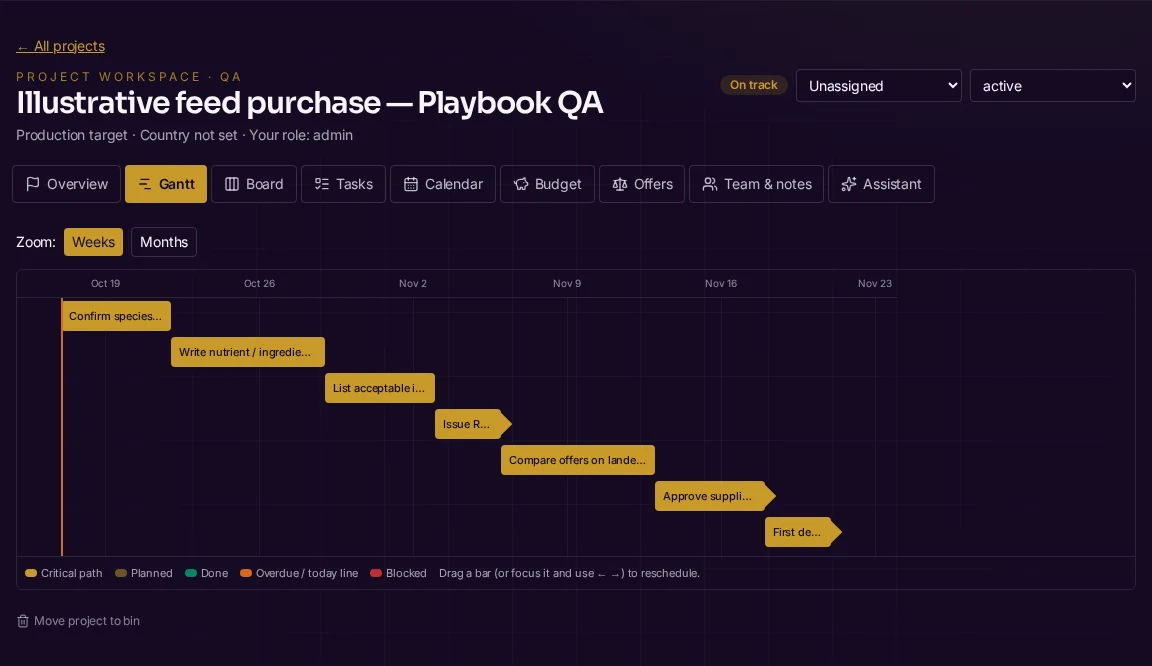
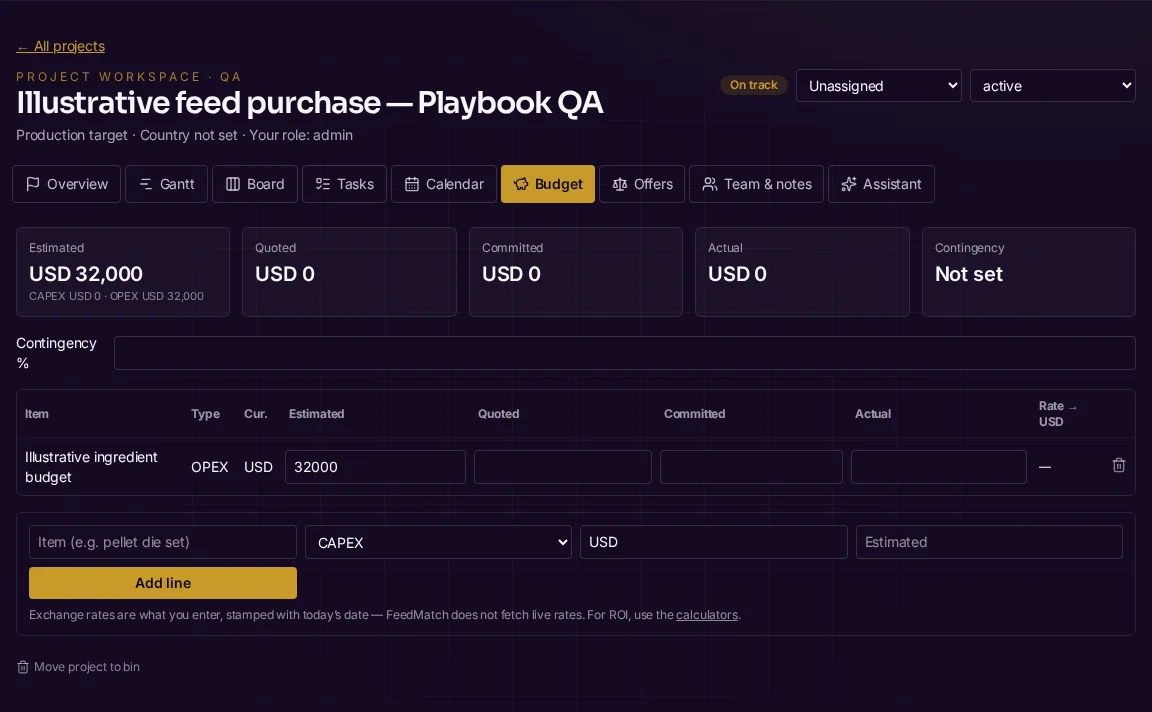
Actual screens from an isolated QA project. The USD 32,000 budget is a hypothetical teaching example, not a market price. Screens and workspace controls are in English.
FeedMatch is supplier-neutral and human-led. The workspace is not a supplier marketplace, a nutrition prescription or an engineering certification. Managed sourcing is for qualifying projects from US$250,000. No price feeds, live exchange rates or guaranteed outcomes.
Help me plan my project
Free, no account. Answers stay in this browser only. Nothing is sent until you choose to request quotes.
Before you start
- Is the Project Command Center free?
- Yes, buyer planning is free. Public education needs no account; the private workspace requires sign-in.
- Does a calculator automatically submit an RFQ?
- No. You choose whether to request quotes and complete the existing intake. No lead is created by reading this page.
- What can I verify in the screenshots?
- The Gantt task view and a manually entered operating budget. Screens are examples, not a promise that suppliers have submitted offers.
- Are estimates and quotes the same?
- No. Record actual evidence, currency and quote date. An unentered cost is unknown, not a market price of zero.