
FeedMatch · Procurement playbook
Procurement Project Playbook: From Idea to Specification, Gantt, Budget, RFQ, Supplier Scorecard and Delivery
FeedMatch Group ·
Manage a feed purchase as a sequence of evidence-based decisions—not a race to collect prices. Build a brief, assign owners, test assumptions and agree what must be true before each approval.

- 01
Need agreed
- 02
Specification approved
- 03
RFQ ready
- 04
Offer approved
- 05
Delivery accepted
Define the decision before you buy
A procurement project starts with a decision, not a supplier list. Write one sentence naming the animal species, production stage, feeding system, destination and purchasing objective. Separate the need from the proposed solution: “secure a documented supply of ingredient X” is a need; “buy the cheapest available substitute” is an untested response. Give the project an accountable owner and a technical reviewer. Record what success means using evidence you can inspect: an approved specification, an agreed delivery window, documented lot acceptance and a reconciled budget. Do not promise improved FCR or output from procurement alone.
Choose your route deliberately. Buying complete feed, sourcing individual ingredients and improving on-farm preparation have different technical questions. This playbook addresses feed and ingredient buying and farm-scale preparation, not industrial plant design or construction. A nutritionist decides dietary suitability; a qualified equipment specialist validates machinery and safe operation. The project manager coordinates those decisions rather than pretending to replace either profession.
Tutorial 1 · Turn an idea into a project blueprint
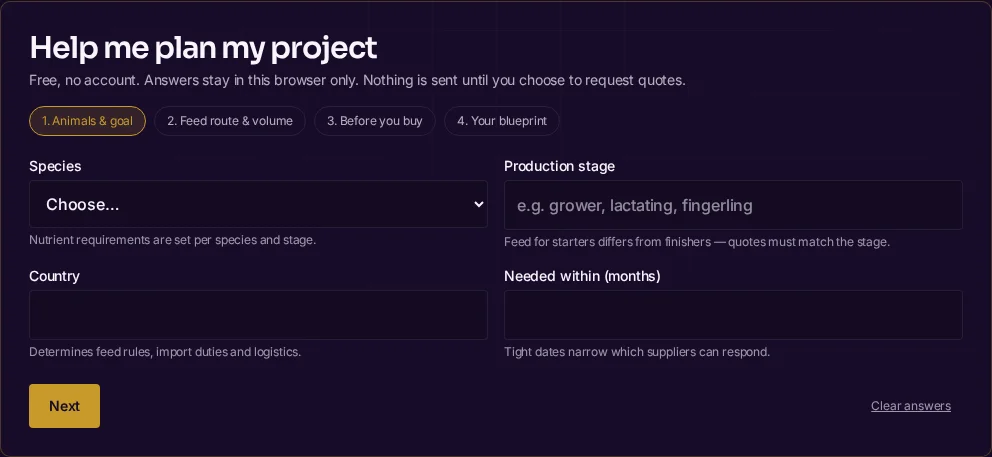
Open the free project planner below. In “Animals & goal”, choose the species and enter the production stage, country and target timing. In “Feed route & volume”, select how you obtain feed. Enter measured monthly demand, or your own head count and recorded intake. Do not import an intake assumption from a different species. The third step is a readiness checklist: tick only documents or decisions you actually possess. The final step shows a blueprint with gaps, risks and next actions, not a guaranteed procurement outcome.
For a hypothetical example, 1,000 animals consuming a buyer-entered 2.5 kg each per day for 30 days require 75 metric tonnes. This is arithmetic, not a feeding recommendation. Record seasonal variation, existing stock and usable storage separately before ordering. Anonymous answers stay in that browser; they do not automatically create a CRM lead or a saved workspace project. Print the blueprint or copy the relevant brief into your request when you deliberately choose to contact FeedMatch. Private details should never be placed in public share links.
Specification gate · Make the requirement testable
Create a versioned specification before inviting quotes. For an ingredient, identify the commodity and grade, quantity and unit, intended species and stage, destination, delivery cadence and packaging. Record the nutrient basis: as-received and dry-matter values are not interchangeable. Ask the technical reviewer which composition parameters, contaminants, sampling methods and laboratory evidence matter. A certificate of analysis should identify the offered lot; a generic marketing sheet is not proof about a particular shipment. Define retention samples, traceability records and the procedure for nonconforming deliveries.
For farm-scale preparation equipment, specify the actual materials, required output, available utilities, cleaning access and operating conditions. Do not turn a theoretical tonnes-per-hour calculation into a performance guarantee. Put the assumptions and exclusions beside the requirement. Gate 1 is passed only when the buyer and technical reviewer agree the same numbered specification. Any later substitute needs a documented change, its nutritional or operational implications and a fresh approval—not merely a lower price.
Tutorial 2 · Build a dependency-led Gantt
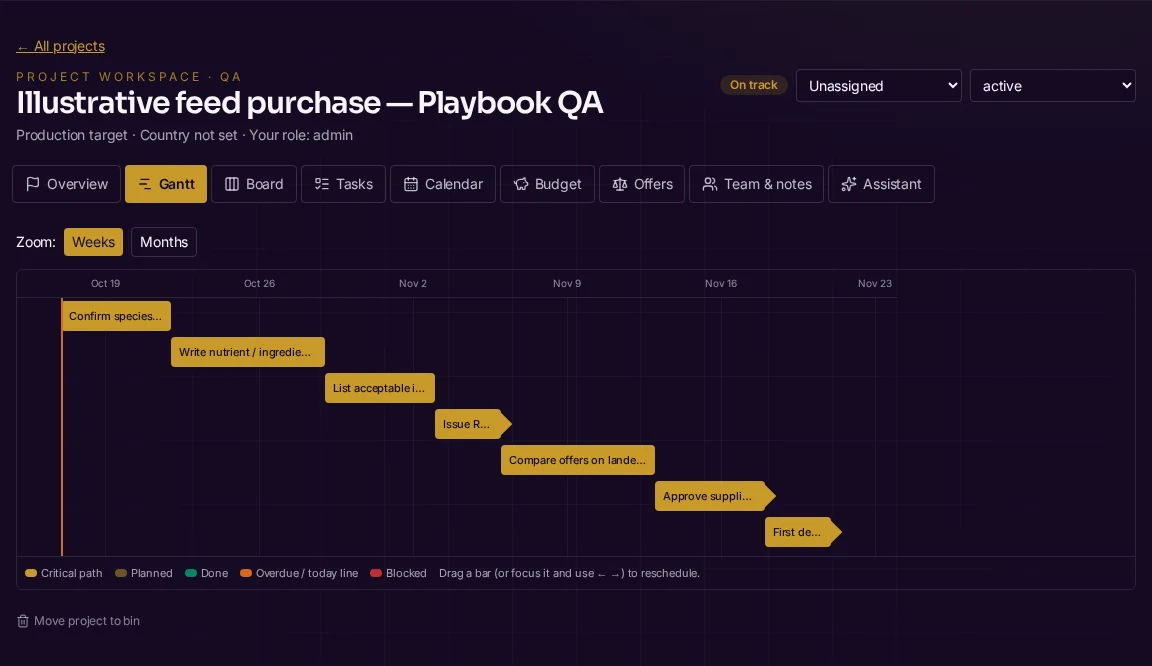
Sign in to the buyer project workspace and create a “Feed & ingredient supply contract” project. It contains editable tasks and dates. Open “Tasks” to assign responsibility, adjust start and due dates and mark real milestones. A dependency means a prerequisite must finish before the next decision can proceed. Use “Gantt” to inspect the sequence; “Board” organizes work by task status and “Calendar” locates due dates. Saving an update and reloading should retain the change. The screenshot below comes from an isolated QA project, not a real customer.
A hypothetical sequence is: week 1, demand and specification; week 2, RFQ package and technical review; week 3, quote clarifications; week 4, approval and order preparation; then supplier-confirmed production, freight and inspection. These weeks are teaching assumptions, not market lead times. Never compress testing, approvals or import checks simply to make the chart fit. If lab confirmation blocks specification approval, move the dependent review task and record the reason. Keep an original baseline so a changed date is visible rather than silently forgotten.
Tutorial 3 · Budget the decision, not only the invoice
Use the Intelligence Center scenario tool for ingredient inclusion and cost per tonne. Enter quoted values with one currency and compatible units; kg, pounds, metric tonnes and short tons must be normalized before comparison. Inclusion must total 100%. Crude-protein checks are educational and cannot establish a complete ration: energy, amino acids, minerals, contaminants and species-specific constraints still require a qualified nutritionist. Keep the quote date and analytical source next to each scenario.
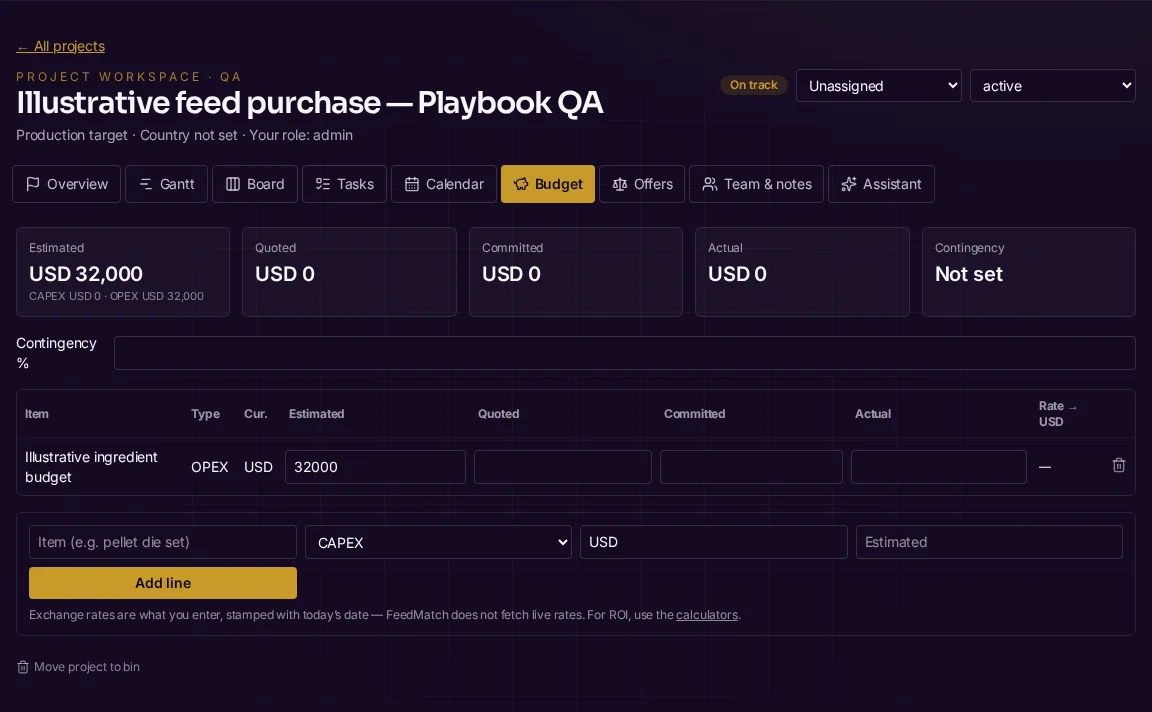
For a hypothetical 100-tonne purchase at USD 300/t plus USD 2,000 freight, the stated subtotal is USD 32,000, or USD 320/t before any other costs. Those amounts are invented teaching inputs, not market prices. Add known taxes, testing, insurance, handling and other applicable charges without double counting. Recoverable taxes and cash timing need separate treatment from economic cost. In the workspace “Budget”, classify ingredient purchases as operating costs, record estimated, quoted, committed and actual values separately, and preserve currency-rate provenance. A blank unknown is more honest than zero. Contingency is a buyer-chosen allowance, not a platform recommendation.
Tutorial 4 · Send one coherent managed RFQ
Gate 2 is readiness to ask comparable questions. Assemble the approved specification version, quantities, destination, delivery window, commercial basis, required evidence, acceptance process and response deadline. Identify the person authorized to answer clarifications. List missing facts explicitly so the team can determine whether a quote is premature. Do not attach personal or confidential records that are unnecessary to evaluate the procurement need.
Open FeedMatch’s existing RFQ intake. Submit only when you choose to request human help and accept the form’s consent terms. FeedMatch reviews the request, contacts appropriate suppliers and presents organized responses; buyers are not handed supplier contact details. Planning tools are free for buyers. Assisted procurement retains the existing commercial project threshold of USD 250,000; it is not a minimum price per tonne. A workspace can start from one of your own requests through its optional request selector. An anonymous blueprint does not perform that association automatically, and reading this article sends nothing to the CRM.
- Buyer brief
- Technical review
- FeedMatch RFQ
- Comparable evidence
- Human decision
Supplier scorecard · Evidence first, weighting second
Gate 3 separates eligibility from preference. First reject offers that fail a required safety, legal, specification or delivery condition. Do not average a critical failure into an acceptable score. For eligible offers, choose criteria and weights before seeing the ranking: technical fit, lot evidence, delivered cost, timing, commercial terms and service. Store each score with a source, reviewer and date. Unknown evidence stays “unknown”; a made-up rating is not a useful comparison.
The editable workbook contains a blank scorecard. Its optional teaching scale is 0–5 with weights that must total 100; the weighted result is the sum of weight × score ÷ 5. That scale is an exercise, not FeedMatch’s supplier certification or a supplier rating published by the platform. Compare costs using the same destination, quantity, currency, tax treatment and delivery terms. The customer workspace’s “Offers” view shows only the offers handling staff share with that project. It may be empty, and this guide does not populate it or expose private supplier identities. Final approval remains a human decision with recorded reasons.
Risk register · Give uncertainty an owner
Write each risk as cause, event and impact: incomplete lot documentation may delay acceptance; insufficient dry storage may damage delivered feed; an unapproved substitute may be unsuitable for the intended animals. Record probability and impact using your organization’s defined scale, the evidence behind the judgment, a named owner, prevention, trigger, fallback and review date. A colored risk box is not a substitute for an action or a control.
High-impact topics include mycotoxin and contamination risk, inconsistent quality evidence, delivery disruption, currency exposure, storage constraints and scope changes. Do not prescribe a binder, ration adjustment or universal contaminant limit. Ask the qualified reviewer for product- and destination-specific requirements. Use Codex good animal feeding principles for the control structure and the relevant authority for current local rules. Review the register at each decision gate and after any change. Unknown risks deserve a question, not a reassuring fabricated probability.
Delivery gate · Inspect, reconcile and close
Gate 4 approves an order only after technical, commercial and financial responsibilities are clear. Gate 5 accepts delivery against the agreed inspection and contract process. Schedule who checks quantities, lot identity, packaging, transport condition, documents and any required sampling. Document deviations promptly and follow the agreed hold, complaint or rejection procedure. Do not feed a suspect lot merely because the delivery task is overdue.
Reconcile ordered, received and invoiced quantities using the same units. Update actual costs and close outstanding claims. Keep the accepted specification, decision record, lot evidence and lessons learned together. For farm-scale equipment, commissioning and safety acceptance must be completed by the appropriate qualified people. Funding is a separate approval: this playbook provides no lender offer, approval promise or bank partnership. If external financing review is requested, it needs separate consent and actual provider terms. Delivery time and payment conditions must come from the parties’ documented agreements.
How this differs from a generic task manager
A general project-management tool can track people, dates and work very well. FeedMatch’s specific value is connecting a feed requirement to species-aware educational tools, ingredient-cost checks, sourced intelligence and a human-reviewed procurement request. This is a domain workflow, not evidence that FeedMatch has every feature of specialist scheduling software. The current workspace is in English even when this guide is translated. Use the editable templates if your team needs a local-language working document.
Public guides, tools and downloadable files need no account. A saved collaborative workspace needs sign-in and access is controlled; internal CRM administration is not a customer feature and is deliberately not linked here. The published screenshots demonstrate planner, Gantt and budget screens actually checked on 17 October 2026. QA task status and budget survived reload; the isolated demonstration project was archived. This does not prove every permission combination, supplier response, finance review or live RFQ-to-CRM delivery. Keep those boundaries explicit when presenting the system to your team.
Questions project managers should answer
What belongs in an RFQ? A versioned requirement, quantity and units, destination, delivery expectations, evidence requests and acceptance criteria. What makes a Gantt useful? Real dependencies, owners and approval gates—not attractive dates without prerequisites. Can the lowest quote win automatically? No: establish eligibility first, normalize commercial scope and record the reviewer’s decision.
Can the calculator approve a ration? No: it demonstrates arithmetic with buyer-entered data and limited nutrient checks. Can I plan without an account? Yes; anonymous planning and templates are public, while persisted workspace projects need sign-in. Will a download contact suppliers? No. Only your deliberate RFQ submission begins FeedMatch’s managed review. Where should unresolved facts go? Into the specification gaps and risk register, with an owner and an explicit question. Start with the blueprint, test the cost assumptions, and request human review when the project is ready.